
At a Glance
Momentum is p = m × v, a vector measured in kg·m/s. Kinetic energy is KE = ½ m × v², a scalar measured in joules. Momentum is conserved in every collision with no outside force, but kinetic energy is conserved only in elastic collisions, and the two are linked by KE = p² / (2m).
- Momentum
- p = mv, vector, kg·m/s
- Kinetic energy
- KE = ½mv², scalar, joule (J)
- Speed doubles
- Momentum ×2 · Kinetic energy ×4
- Conserved in collisions
- Momentum always · KE only if elastic
- Link between them
- KE = p² / (2m)
On this page
- What Is the Difference Between Momentum and Kinetic Energy?
- How Are Momentum and Kinetic Energy Defined?
- What Are the Formulas for Momentum and Kinetic Energy?
- Why Does Kinetic Energy Grow Faster Than Momentum?
- Which Is Conserved in a Collision, Momentum or Kinetic Energy?
- How Are Momentum and Kinetic Energy Related?
- What Are Everyday Examples of Momentum and Kinetic Energy?
- How Can You Practice Momentum and Energy Problems?
- Common Misconceptions
- Key Facts
- Quiz
- FAQ
What Is the Difference Between Momentum and Kinetic Energy?
Both quantities belong only to moving objects, and both depend on mass and speed, so it is easy to treat them as twins. They answer different questions, though. Momentum asks how much motion an object carries and in which direction. Kinetic energy asks how much work that motion could do if it were brought to a stop.
The formulas show the split right away. Momentum is
Direction is the other big difference. Momentum is a vector, so two objects moving in opposite directions can have momenta that cancel. Kinetic energy is a scalar that is never negative, so energies always add. The table below lines the two up point by point.
| Feature | Momentum | Kinetic energy |
|---|---|---|
| Formula | p = mv | KE = ½mv² |
| Type of quantity | Vector (has direction) | Scalar (no direction) |
| SI unit | kg·m/s (same as N·s) | joule, J (same as N·m) |
| Can it be negative? | Yes, the sign shows direction | No, never below zero |
| Effect of doubling speed | Doubles | Quadruples |
| Effect of doubling mass | Doubles | Doubles |
| Changed by | Impulse: force × time | Work: force × distance |
| Conserved in elastic collisions? | Yes | Yes |
| Conserved in inelastic collisions? | Yes | No, some becomes heat and sound |
| Two objects moving in opposite directions | Momenta can cancel to zero | Energies always add |
| Related by | p = √(2m·KE) | KE = p² / (2m) |
| Example, 6 kg ball at 8 m/s | 48 kg·m/s | 192 J |
| Source: Definitions from SI mechanics; example values computed with p = mv and KE = ½mv² · Retrieved October 2026 | ||
How Are Momentum and Kinetic Energy Defined?
Momentum is the product of an object's mass and its velocity. Its SI unit is the kilogram meter per second (kg·m/s), which is the same as a newton second (N·s). That second name is a hint: momentum is what a force changes when it acts for some time. A force of 1 N acting for 1 s changes momentum by 1 kg·m/s.
Kinetic energy is the energy an object has because it moves. Its SI unit is the joule (J), the same unit used for work, heat and every other form of energy. That is also a hint: kinetic energy is what a force changes when it acts over some distance. A force of 1 N pushing along 1 m adds 1 J.
So the cleanest way to remember the pair is this. A force acting over time changes momentum, which is impulse. A force acting over distance changes kinetic energy, which is work.
What Are the Formulas for Momentum and Kinetic Energy?
Momentum is
Both formulas use the same two inputs, so you can work out both for any moving object in a few seconds. The examples below do exactly that for one bowling ball. For quick answers with unit conversions, try our momentum calculator and kinetic energy calculator.
Here is the momentum formula with each variable and its SI unit, plus the forms solved for mass and for velocity.
| Symbol | Quantity | SI unit |
|---|---|---|
| momentum | kilogram meter per second (kg·m/s) | |
| mass | kilogram (kg) | |
| velocity | meter per second (m/s) |
Rearranged to find another variable:
Valid for: vector (same direction as v); non-relativistic.
Example 1 Momentum of a rolling bowling ball
A 6 kg bowling ball rolls down the lane at 8 m/s. What is its momentum?
- Given:
- mass:
- velocity:
- mass:
- Formula:
- Substitute:
- Answer:
The momentum points down the lane, in the same direction as the ball's velocity.
Example 2 Kinetic energy of the same ball
The same 6 kg bowling ball moves at 8 m/s. How much kinetic energy does it carry?
- Given:
- mass:
- speed:
- mass:
- Formula:
- Substitute:
- Answer:
Same ball, same moment, two different numbers in two different units: one describes motion, the other describes stored ability to do work.
Why Does Kinetic Energy Grow Faster Than Momentum?
Speed appears once in the momentum formula and twice in the kinetic energy formula. Raise the speed by a factor of 3 and momentum grows 3 times, while kinetic energy grows 9 times. The graph below shows the curve for a 6 kg ball: each doubling of speed multiplies the energy by four.
Here is a pair that makes the point sharply. A 2,000 kg truck creeping at 5 m/s and a 500 kg small car moving at 20 m/s have exactly the same momentum, 10,000 kg·m/s (computed). The car, however, carries 100,000 J of kinetic energy while the truck carries only 25,000 J (computed). Equal momentum, four times the energy.
That is why highway speed matters so much for crash damage. The energy that has to be absorbed by crumple zones, brakes and barriers climbs with the square of speed, so a modest increase in speed adds a large amount of energy to get rid of.

Which Is Conserved in a Collision, Momentum or Kinetic Energy?
Momentum is conserved in every collision, as long as no outside force such as friction acts during the brief impact. This is the law of conservation of momentum, and it holds whether the objects bounce, dent or stick together.
Kinetic energy is a different story. In an elastic collision the total kinetic energy after the bump equals the total before. In an inelastic collision some of it turns into heat, sound and the work of bending material, so the total drops. Total energy is still conserved, but less of it remains as motion.
Picture a 1 kg cart at 4 m/s hitting an identical cart at rest and latching onto it. Momentum before is 4 kg·m/s, and afterward the pair moves at 2 m/s, still 4 kg·m/s. Kinetic energy, however, drops from 8 J to 4 J (computed): half of it went into the latch, the bumpers and a little noise. Our elastic vs inelastic collision comparison covers this in depth.
How Are Momentum and Kinetic Energy Related?
Substitute
The equation also explains recoil. When a rifle fires, the bullet and the rifle receive equal and opposite momentum. The light bullet gets almost all of the kinetic energy, while the heavy rifle gets very little, so the shooter feels a shove rather than a dangerous blow.
Physicists use the same link in particle and photon momentum problems, where momentum and energy are often easier to measure than speed.
Example 3 Kinetic energy straight from momentum
A 1,500 kg car has a momentum of 30,000 kg·m/s. Without finding its speed first, what is its kinetic energy?
- Given:
- momentum:
- mass:
- momentum:
- Formula:
- Substitute:
- Answer:
You can check it the long way: the speed is 30,000 ÷ 1,500 = 20 m/s, and ½ × 1,500 × 20² gives the same energy.
What Are Everyday Examples of Momentum and Kinetic Energy?
Situations where momentum is the useful idea:
- A loaded freight train takes a long time to stop because its momentum is huge, even at low speed.
- Ice skaters who push off each other glide apart with equal and opposite momentum.
- Airbags lengthen the time a passenger takes to stop, which lowers the force needed to remove their momentum.
Situations where kinetic energy is the useful idea:
- A hammer drives a nail because its kinetic energy does work pushing the nail into wood.
- A car's stopping distance roughly quadruples when its speed doubles, because the brakes must remove four times the energy.
- A wind turbine captures part of the kinetic energy of moving air.
For more cases, see our lists of momentum examples and kinetic energy examples.
How Can You Practice Momentum and Energy Problems?
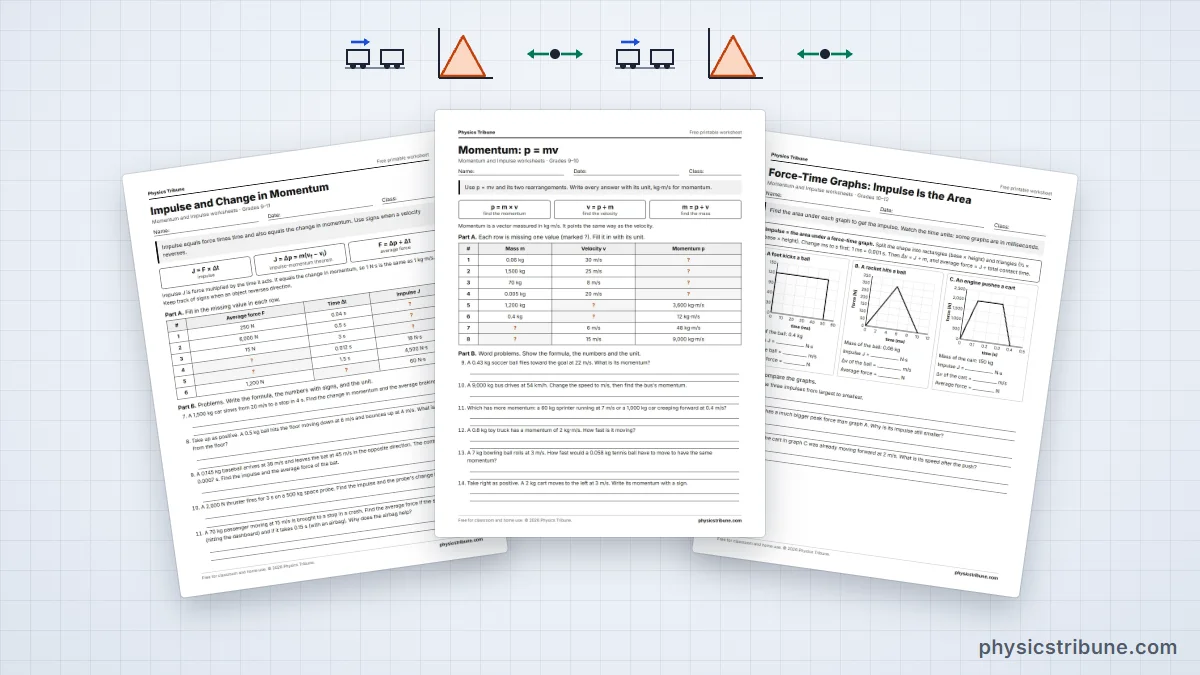
The best practice is to find both quantities for the same object and then follow them through a collision. Our momentum and impulse worksheets and kinetic and potential energy worksheets include printable answer keys, and the quiz below checks the key ideas. Both quantities trace back to the laws of motion set out by Isaac Newton.
Common Misconceptions
Myth: Momentum and kinetic energy are the same thing written two ways.
Physics: They have different formulas, different units and different behavior. Momentum is a vector in kg·m/s, while kinetic energy is a scalar in joules that grows with the square of speed.
Myth: If two objects have the same momentum, they must have the same kinetic energy.
Physics: Not unless their masses are equal. Since KE = p² / (2m), the lighter object with the same momentum always carries more kinetic energy.
Myth: In a crash where the cars stick together, momentum is lost.
Physics: Momentum is still conserved. What is lost from motion is kinetic energy, which turns into heat, sound and the work of crushing metal.
Myth: An object can have kinetic energy but no momentum.
Physics: A single moving object always has both. A system can have zero total momentum while having kinetic energy, for example two equal carts rolling apart in opposite directions.
Key Facts
- Momentum is mass times velocity, p = mv, and is measured in kg·m/s.
- Kinetic energy is one half mass times speed squared, KE = ½mv², and is measured in joules.
- Momentum is a vector with direction; kinetic energy is a scalar that is never negative.
- Doubling an object's speed doubles its momentum but quadruples its kinetic energy.
- Momentum is conserved in every isolated collision, but kinetic energy is conserved only in elastic ones.
- The two are linked by KE = p² / (2m), so for equal momentum the lighter object has more kinetic energy.
- A force acting over time changes momentum; a force acting over distance changes kinetic energy.
Quick Quiz: How Well Do You Know Momentum vs Kinetic Energy?
6 questions. Tap an answer to check it.
Which quantity is a vector?
Momentum has the same direction as velocity, so it is a vector.
A ball's speed doubles. What happens to its kinetic energy?
Kinetic energy depends on speed squared, so doubling speed multiplies it by four.
In a collision where two carts stick together, which quantity is conserved?
Momentum is conserved in every isolated collision, but sticking collisions lose kinetic energy.
What is the SI unit of momentum?
Momentum is mass times velocity, so its unit is kilogram meter per second.
Two objects have the same momentum. Which one has more kinetic energy?
Since KE = p² / (2m), a smaller mass gives a larger kinetic energy for the same momentum.
A force acting over a distance changes which quantity directly?
Force times distance is work, and net work changes kinetic energy.
Frequently Asked Questions
What is the difference between momentum and kinetic energy?
Momentum is mass times velocity, a vector measured in kg·m/s that tells how much motion an object carries and in which direction. Kinetic energy is one half mass times speed squared, a scalar measured in joules that tells how much work the motion can do. Momentum grows in step with speed, while kinetic energy grows with its square.
Can an object have momentum without kinetic energy?
No. A single object that has momentum must be moving, and anything moving has kinetic energy. The reverse is subtler for a group of objects: two carts rolling apart at equal speeds in opposite directions have zero total momentum, because the vectors cancel, yet the pair still has plenty of kinetic energy, because energies never cancel.
Why is momentum conserved but kinetic energy is not?
During a collision the objects push on each other with equal and opposite forces for the same time, so the momentum one gains the other loses. No such rule protects kinetic energy. When materials bend, heat up or make noise, part of the kinetic energy changes form. Total energy is conserved, but not necessarily as motion.
What happens to momentum and kinetic energy when speed doubles?
Momentum doubles, because speed appears once in p = mv. Kinetic energy becomes four times larger, because speed is squared in KE = ½mv². Triple the speed and kinetic energy rises nine times. This is why a modest increase in driving speed makes crashes much more destructive.
What is the formula that connects momentum and kinetic energy?
The connecting formula is KE = p² / (2m). You get it by writing v as p divided by m and substituting into KE = ½mv². Rearranged, momentum is the square root of 2m times KE. These forms are handy when you know momentum and mass but not speed, as often happens in collision and particle problems.
Do momentum and kinetic energy have the same units?
No. Momentum uses kilogram meters per second, which equals a newton second. Kinetic energy uses joules, which equal a newton meter or a kilogram meter squared per second squared. The different units are a quick sign that they measure different things: one is a force acting over time, the other a force acting over distance.
Which matters more in a car crash, momentum or kinetic energy?
Both matter for different parts of the story. Momentum sets how the cars move just after impact and how large the average force is for a given stopping time. Kinetic energy sets how much damage must be absorbed by crushing metal, so it explains why crashes at higher speed are so much worse.
Is kinetic energy a vector like momentum?
No, kinetic energy is a scalar. Squaring the speed removes any direction, so a ball moving east at 5 m/s and an identical ball moving west at 5 m/s have the same kinetic energy. Their momenta are equal in size but opposite in direction, so they would cancel if you added them.
Keep Exploring








Sources
Constants come from NIST CODATA 2022 (public domain) and unit definitions from the BIPM SI Brochure (CC BY 4.0). Text, diagrams and illustrations are original work by Physics Tribune.