
At a Glance
Kinetic energy is the energy of anything that moves, found with KE = 1/2 m v^2. Common examples are a thrown ball, a moving car, a person walking, flowing water, blowing wind, a spinning wheel and the jiggling molecules of a warm drink.
- What counts
- Anything with mass that is moving
- Formula
- KE = ½mv²
- SI unit
- joule (J)
- Main types
- Translational, rotational, vibrational, thermal
- Quick test
- Is it moving right now? Then it has kinetic energy
On this page
- What Makes Something an Example of Kinetic Energy?
- What Are Examples of Kinetic Energy at Home?
- Which Sports Show Kinetic Energy Best?
- What Are Examples of Kinetic Energy in Nature?
- How Do Vehicles and Machines Use Kinetic Energy?
- What Kind of Motion Is Each Example?
- How Can You Tell Kinetic From Potential Energy in an Example?
- Kinetic Energy Examples Explained for Kids
- Common Misconceptions
- Key Facts
- Quiz
- FAQ
What Makes Something an Example of Kinetic Energy?
Something is an example of kinetic energy when it has mass and it is moving at this moment. That is the whole test. A book resting on a shelf does not qualify, but the same book sliding off the shelf does, because now it has speed.
The amount depends on two things. Mass counts once, so a heavier object carries more. Speed counts twice, because it is squared in
Motion comes in several shapes. An object can travel from place to place, spin in one spot, or shake back and forth. All three are kinetic energy, and you will see each kind in the lists below.
| Example | What is moving | Type of motion |
|---|---|---|
| Ceiling fan | Blades and the air they push | Rotational |
| Washing machine spin | Drum and wet clothes | Rotational |
| Faucet stream | Falling water | Translational |
| Slamming door | The door panel | Rotational (about the hinges) |
| Hot tea | Water molecules | Thermal |
| Pitched baseball | The ball | Translational and rotational |
| Sprinter | The runner's body | Translational |
| Bowling ball | The rolling ball | Translational and rotational |
| Kicked soccer ball | Leg, then ball | Translational |
| Downhill skier | Skier and skis | Translational |
| Wind | Air molecules in bulk | Translational |
| River | Flowing water | Translational |
| Ocean wave | Water moving in loops | Vibrational |
| Raindrop | Falling drop | Translational |
| Running cheetah | The animal | Translational |
| Earth in orbit | The whole planet | Translational |
| Car on a highway | Car and passengers | Translational |
| Freight train | Locomotive and cars | Translational |
| Hammer and nail | Hammer head | Rotational swing, then impact |
| Flywheel | Heavy spinning wheel | Rotational |
| Source: Classification by our editors · Retrieved October 2026 | ||
What Are Examples of Kinetic Energy at Home?
Your home is full of moving parts once you start looking for them.
- A ceiling fan. The blades spin, so they carry rotational kinetic energy, and they push air that then moves across the room.
- A washing machine drum. During the spin cycle the drum and wet clothes whirl fast enough to fling water out through the holes.
- Water from a faucet. The falling stream is moving mass. Turn the tap up and the water arrives faster, with more energy per second.
- A door swinging shut. A slammed door moves quickly and makes a loud bang because its energy turns into sound and a small jolt to the frame.
- A hot cup of tea. The water molecules jiggle and collide much faster than those in cold water. That hidden motion is thermal kinetic energy.
Even sound is an example. When a speaker plays music, its cone vibrates and makes air molecules shake back and forth, carrying kinetic energy to your ears.

Which Sports Show Kinetic Energy Best?
Sports are basically contests of who can give kinetic energy to an object, or to their own body, most effectively.
- A pitched baseball. A fast pitch carries over a hundred joules, which is why catchers wear padded gloves.
- A sprinter. The runner's whole body is the moving mass, and top sprinters reach roughly 10 to 12 m/s.
- A bowling ball. It rolls, so it has energy from moving forward and from spinning, and it shares that energy with the pins.
- A kicked soccer ball. The leg swings, transfers energy to the ball during contact, and the ball flies off faster than the foot was moving.
- A downhill skier. Gravity speeds the skier up, building kinetic energy that must be scrubbed off by carving turns.
Notice the pattern in ball sports. Equipment that hits or catches a fast object is designed to spread the stopping over a longer time, so the energy is absorbed gently.

What Are Examples of Kinetic Energy in Nature?
- Wind. Moving air has mass, so it carries energy. Wind turbines turn that energy into electricity.
- A river. Flowing water rolls pebbles, carves valleys and turns the wheels of old mills.
- Ocean waves. The water in a wave moves in loops, and breaking waves can toss rocks onto a beach.
- Falling raindrops. Each drop carries only a tiny amount, but billions of them during a storm can loosen bare soil.
- A running cheetah. Fast animals hold a large share of kinetic energy for their size, which also makes stopping and turning hard work.
- The Earth orbiting the Sun. Our planet moves at about 30 km/s, so even though it feels still, it carries an enormous amount of kinetic energy.
How Do Vehicles and Machines Use Kinetic Energy?
- A car on the highway. At about 60 mph a family car carries roughly half a megajoule. The brakes must turn all of it into heat to stop the car.
- A freight train. Its huge mass means it needs a very long distance to stop, even at modest speed.
- A hammer striking a nail. The swing builds kinetic energy that is delivered to the nail in a split second.
- A flywheel. Some machines store energy in a heavy spinning wheel and draw it back out later, an idea related to rotational kinetic energy.
The table below puts rough numbers on several of these examples. To work out your own values, try our kinetic energy calculator.
| Example | Typical mass | Typical speed | Kinetic energy |
|---|---|---|---|
| Large raindrop | 0.034 g | 9 m/s | about 0.0014 J |
| Pitched baseball | 0.145 kg | 40 m/s | 116 J |
| Kicked soccer ball | 0.43 kg | 25 m/s | about 134 J |
| Bowling ball (forward motion only) | 7 kg | 8 m/s | 224 J |
| Jogger | 70 kg | 3 m/s | 315 J |
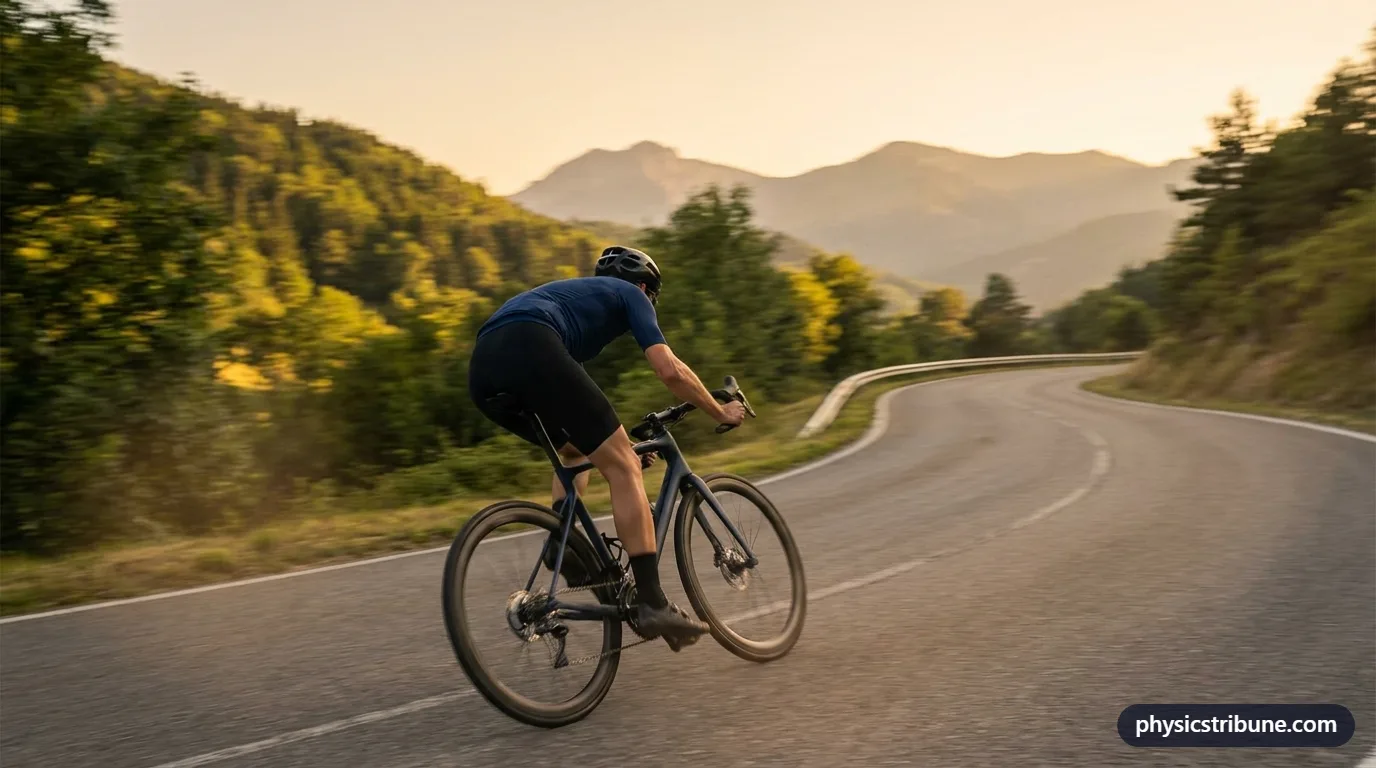
| Cyclist with bike | 85 kg | 8 m/s | 2,720 J |
| Family car at about 60 mph | 1,500 kg | 27 m/s | about 547,000 J |
| Loaded truck | 36,000 kg | 25 m/s | about 11 million J |
| Long freight train | 10,000,000 kg | 20 m/s | about 2 billion J |
| Source: Computed with KE = ½mv²; masses and speeds are typical values · Retrieved October 2026 | |||
What Kind of Motion Is Each Example?
Sorting the 20 examples by the shape of the motion helps you recognize new ones quickly.
- Translational: the whole object travels from one place to another. A thrown ball, a car, a sprinter, wind and a river all fit here.
- Rotational: the object spins around an axis. Fan blades, a washing machine drum, a flywheel and a spinning top belong here.
- Vibrational: parts move back and forth around a fixed spot. A guitar string, a speaker cone and the air in a sound wave are examples.
- Thermal: the random motion of atoms and molecules. Hot tea, a warm stove and the air in a room all have it, as described by the kinetic theory of gases.
Many real objects mix types. A rolling bowling ball moves forward and spins at the same time, so its energy is split between translational and rotational motion.
How Can You Tell Kinetic From Potential Energy in an Example?
Ask whether the energy depends on motion or on position. A ball held high above the ground has potential energy because of where it is. Let it go, and that stored energy turns into kinetic energy as it speeds up.
Many everyday examples swap back and forth between the two. A child on a swing has the most kinetic energy at the bottom of the arc and the most potential energy at the turning points. For the other side of the picture, see our examples of potential energy and the full kinetic vs potential energy comparison. Chains of these swaps appear in our energy transformation examples.
Kinetic Energy Examples Explained for Kids
Kinetic energy is "moving energy." If something is going, rolling, spinning or shaking, it has some. If it is sitting perfectly still, it has none.
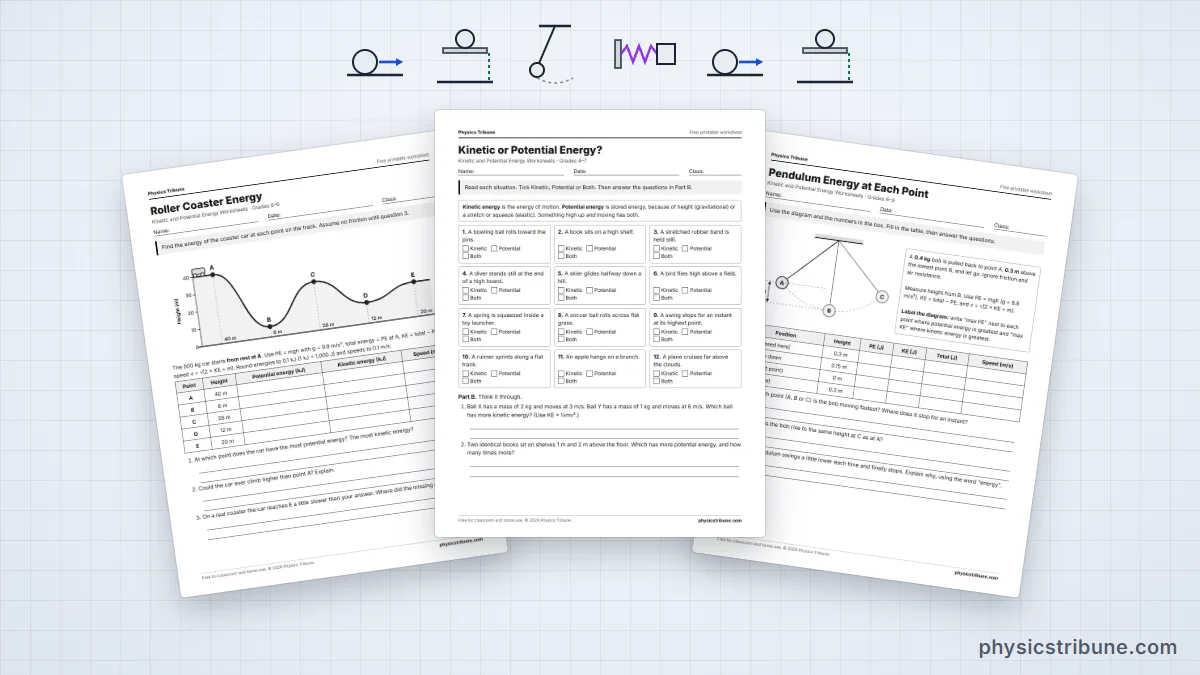
Try this quick game: look around the room and point at five things with kinetic energy. A clock hand, a fan, a pet walking past and your own blinking eyes all count. Younger learners can find more activities on our kinetic and potential energy for kids page, and teachers can print practice sheets from the kinetic and potential energy worksheets.
Common Misconceptions
Myth: Only fast objects have kinetic energy.
Physics: Any moving object has some, even a snail. Slow objects simply have less, because the energy grows with the square of speed.
Myth: A spinning wheel that stays in one place has no kinetic energy.
Physics: Its parts are moving in circles, so it has rotational kinetic energy even though its center does not travel.
Myth: Heat and kinetic energy are completely different things.
Physics: The thermal energy of a substance is mostly the kinetic energy of its jiggling atoms and molecules.
Key Facts
- Anything with mass that is moving has kinetic energy; anything at rest has none.
- Kinetic energy is found with KE = ½mv², so it is measured in joules.
- Doubling an object's speed makes its kinetic energy four times larger.
- Spinning, shaking and the random motion of molecules are all forms of kinetic energy.
- A family car at highway speed carries roughly half a million joules.
- Brakes, padded gloves and airbags all work by absorbing kinetic energy safely.
Quick Quiz: How Well Do You Know Examples of Kinetic Energy?
6 questions. Tap an answer to check it.
Which of these has kinetic energy?
Only the leaf is moving; the others store energy but are at rest.
A ceiling fan spinning in place has which type of kinetic energy?
The blades move in circles around an axis, which is rotational motion.
The hot water in a kettle is an example of which kind of kinetic energy?
Its molecules move randomly and fast, and that motion is thermal energy.
Two identical cars drive at 20 m/s and 40 m/s. How does the faster car's kinetic energy compare?
Doubling speed multiplies kinetic energy by 2 × 2 = 4.
Which example is mainly potential energy, not kinetic energy?
Still water behind a dam stores energy because of its height, not its motion.
A rolling bowling ball has kinetic energy from:
A rolling object both travels and rotates, so it has both kinds.
Frequently Asked Questions
What are 10 examples of kinetic energy?
Ten common examples are a rolling ball, a moving car, a person walking, a flying bird, wind, a flowing river, a spinning fan, a falling raindrop, a swinging hammer and the vibrating string of a guitar. Each one has mass and is moving, which is the only requirement for kinetic energy.
What are examples of kinetic energy at home?
At home you can find kinetic energy in a spinning ceiling fan, a washing machine drum during the spin cycle, water pouring from a faucet, a door swinging shut, a blender blade, a ticking clock hand and the fast-moving molecules in a pot of boiling water.
What are examples of kinetic energy in everyday life?
Everyday examples include walking to school, riding a bike, a bus moving through traffic, a ball thrown in the park, leaves blowing in the wind and a dog running after a stick. Anything you see in motion during the day is carrying kinetic energy at that moment.
Is a person walking an example of kinetic energy?
Yes. A walking person has mass and is moving, so they have kinetic energy. A 70 kg adult walking at about 1.4 m/s has roughly 70 joules. Running at three times that speed multiplies the energy by nine, because speed is squared in the formula.
Is sound an example of kinetic energy?
Sound is carried by kinetic energy. A vibrating object pushes nearby air molecules back and forth, and those moving molecules pass the vibration along to the next layer of air. The energy travels outward as a wave of small, rapid back-and-forth motions.
What are examples of kinetic and potential energy together?
A swing, a roller coaster, a bouncing ball and a pendulum all show both. At the highest points the energy is mostly potential, and at the lowest points it is mostly kinetic. The total stays nearly the same as long as friction and air resistance are small.
What is a good example of kinetic energy for kids?
A sled sliding down a snowy hill is a great example. The sled starts still at the top, picks up speed on the way down and moves fastest near the bottom. The faster it goes, the more kinetic energy it has, and the harder it is to stop.
Keep Exploring
 energyKinetic Energy
 calculatorsKinetic Energy Calculator
 examplesExamples of Potential Energy
 examplesExamples of Energy Transformation
 compareKinetic vs Potential Energy
 rotationRotational Kinetic Energy
 worksheetsKinetic and Potential Energy Worksheets
 kidsKinetic and Potential Energy for Kids
 examplesPhysics Examples in Everyday Life