
At a Glance
Magnetism is a force produced by moving electric charges and by the spins of electrons, and it acts through a magnetic field measured in teslas (T). Electromagnetism describes how electric and magnetic fields create each other: a current makes a magnetic field, B = μ0 I / (2πr) around a long wire, and a changing magnetic flux induces a voltage, ε = −N ΔΦ/Δt.
- What it covers
- Magnets, fields, magnetic force, induction, machines, AC circuits, Maxwell's equations
- Unit of magnetic field
- tesla (T) = 1 kg/(s²·A) = 1 Wb/m²
- Unit of magnetic flux
- weber (Wb) = 1 T·m²
- Key constant
- μ0 = 1.256 637 061 27 × 10⁻⁶ N/A² (CODATA 2022)
- Core laws
- Ampère's law, Faraday's law, Lenz's law, Gauss's law for magnetism
- Sub-guides
- 7 topic groups, 50+ pages
On this page
- What Is Magnetism in Physics?
- Magnetism Explained Simply
- How Do Magnets and Magnetic Fields Work?
- What Force Does a Magnetic Field Exert?
- How Does Electricity Create a Magnetic Field?
- What Is Electromagnetic Induction?
- How Do Motors, Generators and Transformers Use Magnetism?
- How Do Maxwell's Equations Tie Electricity, Magnetism and Light Together?
- In What Order Should You Learn Magnetism?
- All pages in this guide
- Key Facts
- FAQ
What Is Magnetism in Physics?
Magnetism is one side of the electromagnetic force, one of the four fundamental forces of nature. Every magnetic effect traces back to electric charges in motion: a current flowing in a wire, an electron orbiting inside an atom, or the built-in spin that every electron carries. In most materials those tiny magnetic effects point every which way and cancel out. In iron, nickel and cobalt they can line up and add together, which is what makes a permanent magnet.
Physicists describe magnetism with a magnetic field, written B and measured in teslas. The field is a vector: at every point it has a strength and a direction, which is the way a small compass needle would point. Field strengths range enormously, from the faint field of Earth to the powerful coils of a hospital scanner, as the table below shows.
| Source | Typical field | In teslas |
|---|---|---|
| Earth's field at the surface | about 25 to 65 microtesla | 2.5 × 10⁻⁵ to 6.5 × 10⁻⁵ T |
| Near a fridge magnet | about 5 millitesla | 5 × 10⁻³ T |
| Near a small neodymium magnet | about 0.1 to 1 tesla | 0.1 to 1 T |
| Hospital MRI scanner | about 1.5 to 3 tesla | 1.5 to 3 T |
| Strongest steady lab magnets | about 45 tesla | 45 T |
| Source: Typical values; 1 T = 1 kg s⁻² A⁻¹ = 1 Wb/m² (BIPM SI Brochure, data/si-units.json) · Retrieved October 2026 | ||
Magnetism Explained Simply
Think of a magnet as being surrounded by an invisible pattern of pull and push that reaches out into the space around it. Bring another magnet or a piece of iron into that pattern and it feels a force, even without touching. Every magnet has two ends, a north pole and a south pole. Opposite poles attract and like poles repel, and you can never get one pole on its own: cut a magnet in half and you get two smaller magnets.
The surprise of the 1800s was that electricity and magnetism are partners. Run a current through a wire and it acts like a magnet. Move a magnet near a coil of wire and a current starts to flow. Almost every electric motor, generator and speaker in the world uses one of those two tricks.
How Do Magnets and Magnetic Fields Work?
The magnets and magnetic fields group starts with how magnets work and how to picture a field with magnetic field lines, which always form closed loops from north to south outside the magnet. It explains why some materials stick to magnets and others do not in ferromagnetism, paramagnetism and diamagnetism, and the difference between permanent and temporary magnets.
Our planet is a magnet too. Earth's magnetic field steers a compass and shields us from charged particles from the Sun, some of which are funneled toward the poles to light up the aurora.
What Force Does a Magnetic Field Exert?
A magnetic field pushes on a charge only while the charge moves, and always at right angles to both the motion and the field. That sideways push is described in magnetic force on a moving charge, and its direction is found with the right-hand rule. Because the force is sideways, it bends charged particles into circles, the idea behind the mass spectrometer.
A wire carrying current in a field feels the same force on all its moving charges at once, giving the force on a current-carrying wire. On a loop of wire, those forces make a twist, the torque on a current loop that spins every electric motor. The whole set lives in the magnetic force guide.
How Does Electricity Create a Magnetic Field?
In 1820 Hans Christian Ørsted showed that a current in a wire deflects a nearby compass needle, the first proof that electricity makes magnetism. You can repeat it in our Ørsted's compass experiment. The field circles the wire, and its strength is given in magnetic field of a straight wire.
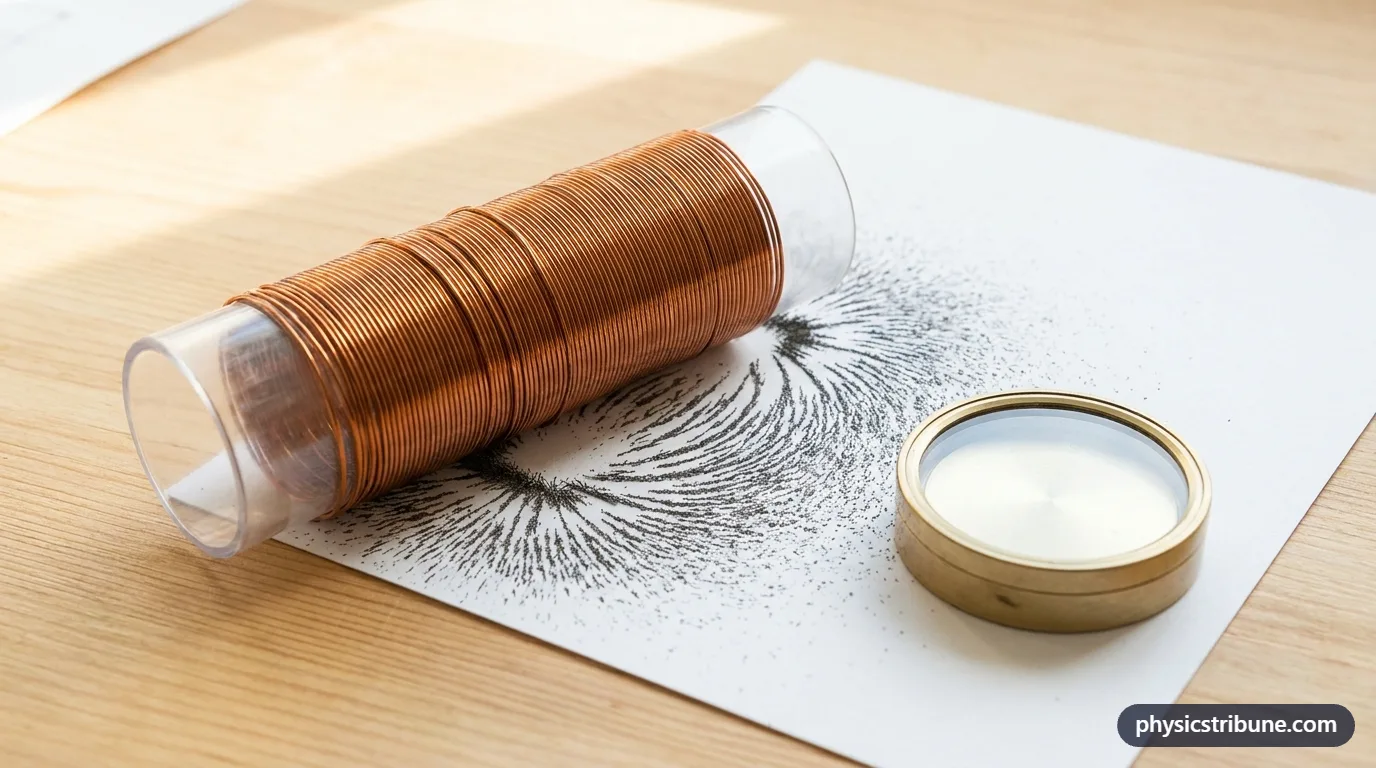
Wind the wire into a loop or a long coil and the fields add up. A solenoid produces a strong, nearly uniform field inside, and wrapping it around iron gives an electromagnet that can be switched on and off. The general rules behind these results are Ampère's law and the Biot-Savart law, both in the sources of magnetic fields group.
What Is Electromagnetic Induction?
Induction is the reverse partnership: a changing magnetic field creates a voltage. Michael Faraday demonstrated it on 29 August 1831 with two coils wound on an iron ring, an experiment you can follow in Faraday's induction ring experiment.
Faraday's law says the induced voltage equals the rate of change of magnetic flux through a coil, and Lenz's law says the induced current always opposes the change that caused it. These two laws lead on to inductance, eddy currents and motional emf, all collected in the electromagnetic induction guide.
| Quantity | Formula | SI unit |
|---|---|---|
| Force on a moving charge | F = |q| v B sin θ | newton (N) |
| Force on a current-carrying wire | F = I L B sin θ | newton (N) |
| Radius of a charge's circular path | r = m v / (|q| B) | meter (m) |
| Field of a long straight wire | B = μ0 I / (2π r) | tesla (T) |
| Field at the center of a loop | B = μ0 N I / (2R) | tesla (T) |
| Field inside a solenoid | B = μ0 n I | tesla (T) |
| Magnetic flux | Φ = B A cos θ | weber (Wb) |
| Faraday's law | ε = −N ΔΦ / Δt | volt (V) |
| Motional emf | ε = B ℓ v | volt (V) |
| Transformer equation | Vs / Vp = Ns / Np | no unit (ratio) |
| Energy stored in an inductor | U = ½ L I² | joule (J) |
| Inductive reactance | XL = 2π f L | ohm (Ω) |
| Source: Formulas from our formula data set (data/formulas.json); μ0 from NIST CODATA 2022 · Retrieved October 2026 | ||
How Do Motors, Generators and Transformers Use Magnetism?
An electric motor turns electrical energy into motion using the force on a current in a magnetic field. An electric generator runs the same machine backward, spinning a coil in a field to induce a voltage. A transformer uses induction between two coils to raise or lower an AC voltage, which is what makes long-distance power lines practical.
Smaller devices work the same way: a loudspeaker, a microphone and an induction cooktop. Hospitals use strong coil fields in MRI scanners. The full list is in motors, generators and transformers.
How Do Maxwell's Equations Tie Electricity, Magnetism and Light Together?
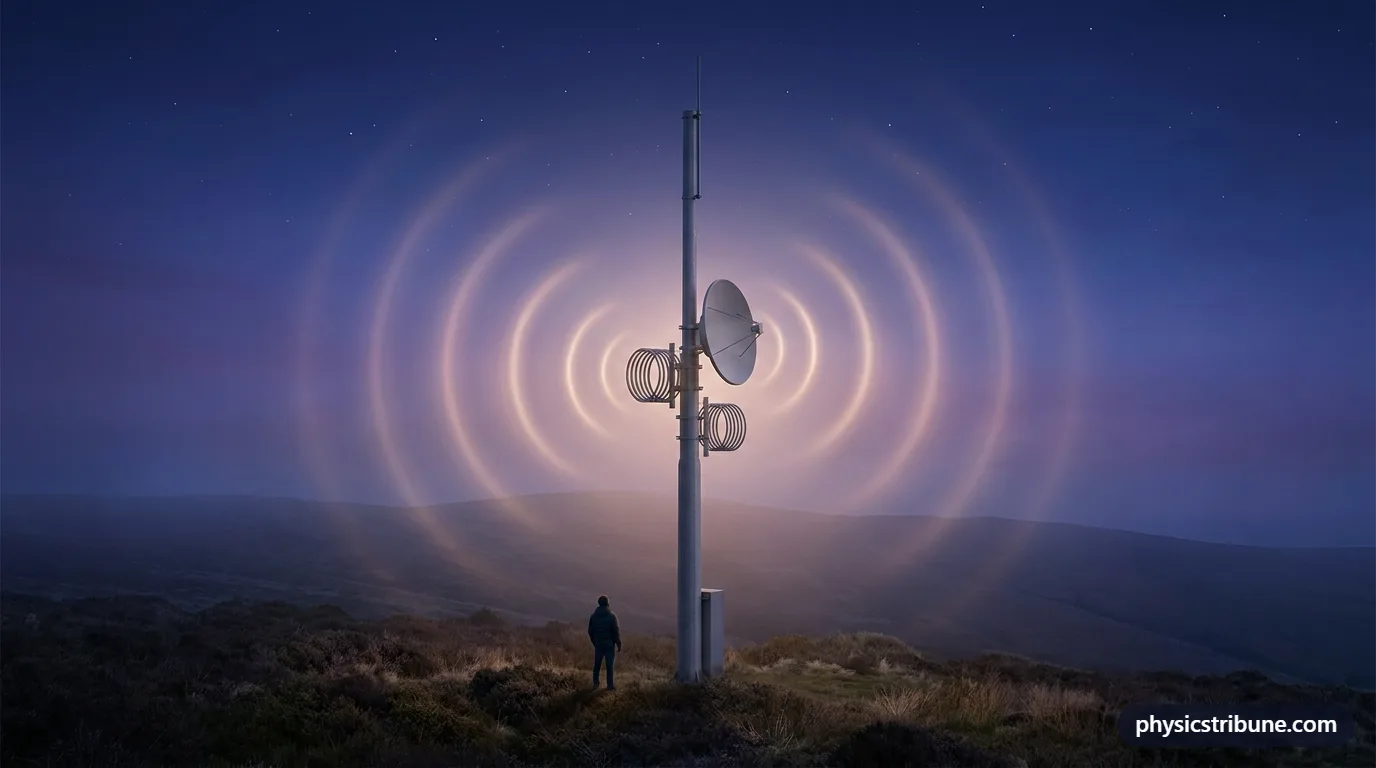
James Clerk Maxwell published his full theory of the electromagnetic field in 1865. His equations sum up everything above in four statements and add one key piece, the displacement current, which says a changing electric field also makes a magnetic field. Put together, changing electric and magnetic fields can sustain each other and travel through empty space as a wave, and the predicted speed matched the measured speed of light. Light is an electromagnetic wave. Read the story in the Maxwell's equations guide and on our James Clerk Maxwell page.
The power in homes alternates direction many times a second, so its behavior depends on inductors and capacitors as much as on resistors. The AC circuits group covers RMS voltage, reactance, impedance and resonance.
In What Order Should You Learn Magnetism?
Each step builds on the last. We suggest this path:
- Magnets and magnetic fields: poles, field lines and Earth's field.
- Magnetic force on moving charges and wires, with the right-hand rule.
- Sources of magnetic fields: wires, coils, solenoids and electromagnets.
- Electromagnetic induction: flux, Faraday's law and Lenz's law.
- Motors, generators and transformers, which put the first four steps to work.
- AC circuits and finally Maxwell's equations.
It helps to know the basics of electricity first, since magnetism always involves currents. Practice with the magnetic field calculator and our magnetism worksheets, and keep the magnetism formulas sheet nearby. Younger learners can start with magnets for kids.
All Magnetism & Electromagnetism (7)

Key Facts
- All magnetism comes from moving electric charges and the spin of electrons.
- Magnetic field strength is measured in teslas, and Earth's field is only tens of microteslas.
- Magnetic poles always come in north-south pairs; an isolated pole has never been found.
- Ørsted showed in 1820 that an electric current produces a magnetic field.
- Faraday discovered electromagnetic induction in 1831, the principle behind generators and transformers.
- Maxwell's 1865 theory unified electricity and magnetism and showed that light is an electromagnetic wave.
Frequently Asked Questions
What is the difference between magnetism and electromagnetism?
Magnetism usually refers to the forces and fields of magnets and magnetic materials. Electromagnetism is the complete theory that treats electricity and magnetism as two sides of one force. It explains how currents make magnetic fields, how changing magnetic fields make currents, and how the two together form light. Every magnetic effect is ultimately part of electromagnetism.
What causes magnetism?
Magnetism is caused by moving electric charges. In a wire, it comes from the current. In a permanent magnet, it comes mostly from the spin of electrons, which makes each electron behave like a tiny magnet. In iron and a few other metals, neighboring electron spins line up in regions called domains, and when the domains align the whole object becomes magnetic.
What is the SI unit of magnetic field?
The SI unit of magnetic field is the tesla, symbol T, equal to one kilogram per second squared per ampere. One tesla is a strong field, so smaller units are common: Earth's field is roughly 25 to 65 microtesla. An older unit, the gauss, is still used in some fields, and one tesla equals 10,000 gauss.
Who discovered electromagnetism?
Several scientists built it step by step. Hans Christian Ørsted showed in 1820 that a current deflects a compass needle. André-Marie Ampère worked out the forces between currents soon after. Michael Faraday discovered electromagnetic induction in 1831, and James Clerk Maxwell joined everything into one theory in 1865, predicting that light is an electromagnetic wave.
Can a magnet have only one pole?
No magnet with a single pole has ever been found. If you cut a bar magnet in half, each piece becomes a complete magnet with its own north and south pole. This is written into Gauss's law for magnetism, which says magnetic field lines always form closed loops. Some theories predict isolated magnetic monopoles, but experiments have not detected one.
Where is electromagnetism used in everyday life?
It is almost everywhere. Electric motors in fans, cars and washing machines, generators in power stations, transformers on power poles, speakers and headphones, induction cooktops, wireless phone chargers, credit card readers and hospital MRI scanners all depend on it. Radio, Wi-Fi and the light from a lamp are electromagnetic waves, so even seeing relies on electromagnetism.
Keep Exploring
 magnetismMagnets & Magnetic Fields
 magnetismMagnetic Force
 magnetismElectromagnets & Sources of Magnetic Fields
 magnetismElectromagnetic Induction
 magnetismMotors, Generators & Transformers
 magnetismMaxwell's Equations
 formulasMagnetism and Electromagnetism Formulas
 calculatorsMagnetic Field Calculator (wire, solenoid)
 worksheetsMagnetism Worksheets