
At a Glance
Modern physics covers relativity and quantum mechanics, the theories that replaced classical physics for very fast, very massive and very small systems. Key results include E = mc², the Lorentz factor γ = 1 / √(1 − v²/c²) and the photon energy E = hf. Classical physics still works well for everyday speeds and sizes.
- What it covers
- Relativity, quantum physics, atoms, frontiers
- Began
- Around 1900 (Planck 1900, Einstein 1905)
- Speed of light
- c = 299 792 458 m/s (exact)
- Planck constant
- h = 6.626 070 15 × 10^-34 J·s (exact)
- Key formulas
- E = mc², E = hf, λ = h/p
- Sub-guides
- Special and general relativity, quantum, atomic, frontiers
On this page
What Is Modern Physics?
Modern physics is the set of theories that physicists built in the twentieth century once Newton's mechanics and Maxwell's electromagnetism started giving wrong answers. Those older theories, now called classical physics, still predict the flight of a baseball or the current in a toaster perfectly well. They break down only in extreme conditions, and modern physics is the map of those extremes.
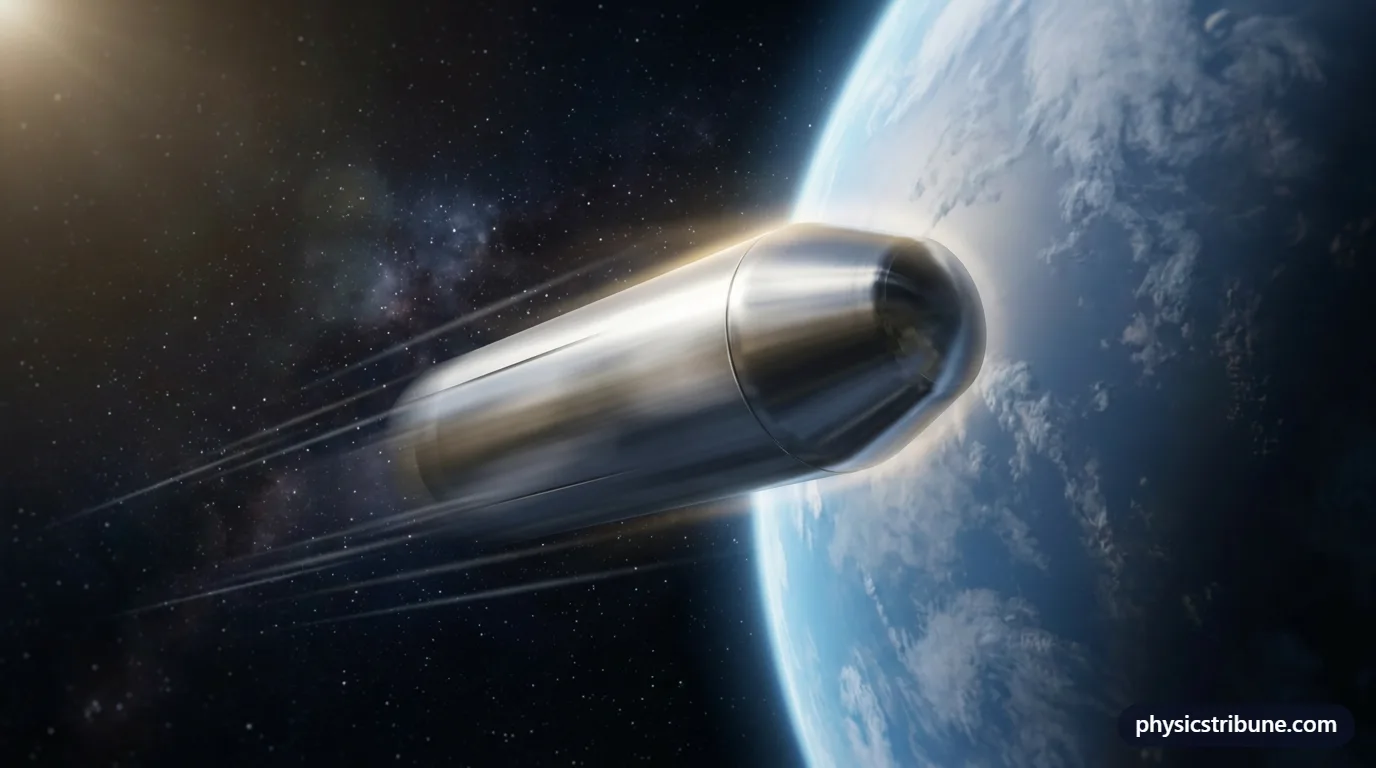
There are three places where the classical picture fails. Objects moving at a large fraction of the speed of light age more slowly and gain momentum faster than Newton allows. Very massive objects bend the paths of light and slow nearby clocks. And on the scale of atoms, energy comes in fixed packets and particles behave like waves.
Two theories handle these cases. Relativity, built mainly by Albert Einstein, deals with speed and gravity. Quantum mechanics, started by Max Planck and finished by a whole generation of physicists, deals with the very small. Our comparison of classical vs quantum physics shows exactly where the line falls.
Modern Physics Explained Simply
Picture classical physics as a road map that is perfect for driving around your town. It gets you everywhere you normally go. But if you try to use it for a trip to the Moon or for walking inside a single cell, it has nothing useful to say.
Relativity is the map for the very fast and the very heavy. It says that space and time stretch and squeeze depending on how you move and how strong gravity is around you. Quantum physics is the map for the very small. It says that light comes in tiny lumps, that electrons can only sit at certain energies, and that you cannot know everything about a particle at once.
What Does Relativity Say About Space and Time?
Special relativity rests on two ideas, set out in Einstein's postulates: the laws of physics are the same for every observer moving at constant velocity, and every such observer measures the same speed of light. Accepting both forces some strange results. Moving clocks run slow, which is time dilation, and moving objects are shorter along their motion, which is length contraction.
The size of these effects is set by the Lorentz factor,
General relativity extends the theory to gravity. Instead of a force pulling across empty space, mass and energy curve spacetime, and objects follow the straightest possible paths through that curved geometry. The special vs general relativity page lays the two theories side by side.
| Speed (fraction of c) | Lorentz factor γ | What a moving 1-hour clock shows while 1 hour passes for you |
|---|---|---|
| 0.1 c | 1.005 | about 59.7 minutes |
| 0.5 c | 1.155 | about 52.0 minutes |
| 0.9 c | 2.294 | about 26.2 minutes |
| 0.99 c | 7.089 | about 8.5 minutes |
| 0.995 c | 10.01 | about 6.0 minutes |
| Source: Computed with γ = 1 / √(1 − v²/c²) and 60 min / γ · Retrieved October 2026 | ||
What Is Quantum Physics About?
Quantum physics describes matter and light at the scale of atoms and below. Its starting point is quantization of energy: light is emitted and absorbed in packets called photons, each carrying energy
Matter has a wave side too. An electron moving at a million meters per second has a de Broglie wavelength of about 0.73 nanometers (computed), comparable to the spacing of atoms in a crystal. That is why electrons diffract, and why wave-particle duality is a central idea. The uncertainty principle and the Schrödinger equation complete the core toolkit.
| Quantity | Formula | SI unit |
|---|---|---|
| Lorentz factor | γ = 1 / √(1 − v²/c²) | no unit |
| Time dilation | Δt = γ Δt0 | second (s) |
| Length contraction | L = L0 / γ | meter (m) |
| Mass-energy equivalence | E = m c² | joule (J) |
| Relativistic kinetic energy | KE = (γ − 1) m c² | joule (J) |
| Photon energy | E = h f = h c / λ | joule (J) |
| Photoelectric equation | KE_max = h f − φ | joule (J) |
| de Broglie wavelength | λ = h / p = h / (m v) | meter (m) |
| Uncertainty principle | Δx Δp ≥ ħ / 2 | J·s |
| Bohr energy levels (hydrogen-like) | E_n = −(Z²/n²) × 13.6 eV | electronvolt (eV) |
| Source: Formulas from our formula data set (data/formulas.json) · Retrieved October 2026 | ||
How Did Modern Physics Explain the Atom?
Around 1900 nobody could explain why a glowing gas gives off light at only a few sharp colors. Atomic physics answered that question. Experiments by Ernest Rutherford showed a tiny, dense nucleus, and Niels Bohr proposed that electrons occupy fixed energy levels around it.
When an electron drops from a higher level to a lower one, the atom releases a photon whose energy matches the gap exactly. Those photons form the line pattern of emission and absorption spectra, a fingerprint that lets astronomers read the makeup of stars. The Bohr model was later replaced by full quantum mechanics, but it still gives the right energies for hydrogen.
Where Do You Use Modern Physics Every Day?
Modern physics is not only for laboratories. A few examples from ordinary life:
- GPS navigation works only because satellite clocks are corrected for both special and general relativity; without the fix, position errors would build up by kilometers each day.
- Lasers in barcode scanners and fiber links rely on electrons dropping between quantized energy levels, as explained in how lasers work.
- Solar panels and camera sensors turn photons into electric current, a direct use of quantum ideas.
- Computer chips are designed using the quantum theory of electrons in solids, and quantum computing pushes that further.
- Medical imaging uses X-rays, whose production is covered in how X-rays are produced.
In What Order Should You Learn Modern Physics?
Each topic leans on the one before it, so we suggest this path:
- Special relativity: postulates, time dilation, length contraction and
- Quantum physics: photons, the photoelectric effect, matter waves and uncertainty.
- Atomic physics: atomic models, energy levels, spectra and quantum numbers.
- General relativity: the equivalence principle, curved spacetime, black holes and gravitational waves.
- Frontiers of physics: dark matter, quantum gravity and the questions still open.
Practice with the time dilation calculator and the photon energy calculator, and keep the modern physics formulas sheet nearby. Nuclear decay, fission and particles have their own branch under nuclear and particle physics.
All Modern Physics: Relativity & Quantum (5)

Key Facts
- Modern physics is the physics of the very fast, the very massive and the very small, developed mostly after 1900.
- Special relativity shows that time and length depend on the observer's motion, governed by the Lorentz factor.
- General relativity describes gravity as the curvature of spacetime by mass and energy.
- Quantum physics shows that light and energy come in discrete packets, with each photon carrying E = hf.
- Particles such as electrons also behave as waves with wavelength λ = h/p.
- Atoms emit and absorb light at sharp wavelengths because their electrons occupy quantized energy levels.
- Classical physics remains an excellent approximation for everyday speeds, masses and sizes.
Frequently Asked Questions
What is modern physics?
Modern physics is the branch of physics built since about 1900 to explain what classical physics cannot. It rests on two theories: relativity, which handles very high speeds and strong gravity, and quantum mechanics, which handles atoms, light and subatomic particles. Atomic, nuclear, particle and solid-state physics all grew out of these two foundations.
What is the difference between classical and modern physics?
Classical physics, meaning Newtonian mechanics, thermodynamics and Maxwell's electromagnetism, treats time as absolute and energy as continuous. Modern physics shows that time and space depend on motion and gravity, and that energy at atomic scales comes in discrete amounts. For everyday objects the two give the same answers, so classical physics is still used whenever speeds are low and sizes are large.
What are the main topics in modern physics?
The main topics are special relativity, general relativity, quantum mechanics, atomic physics, nuclear physics and particle physics. High school and introductory college courses usually cover time dilation, mass-energy equivalence, photons, the photoelectric effect, matter waves, the Bohr model, spectra and radioactive decay, then add a short look at open questions such as dark matter and quantum gravity.
Who is the father of modern physics?
No single person built modern physics, but two names are usually given. Max Planck launched quantum theory in 1900 by proposing that energy is emitted in packets, and Albert Einstein published special relativity and the light-quantum idea in 1905. Bohr, Rutherford, Heisenberg, Schrödinger, Dirac and many others then turned these ideas into complete theories.
Is modern physics hard to learn?
The math of advanced modern physics is demanding, but the core ideas are accessible with algebra. Time dilation, E = mc², photon energy and the Bohr model all use formulas no harder than those in a first physics course. The real challenge is that the results feel strange, so working through numbers and examples is the best way to build intuition.
Why do we still learn classical physics if modern physics is more accurate?
Classical physics is the limit of modern physics for slow, large objects, and in that range it is simpler and just as accurate. At highway speed the Lorentz factor differs from one by less than a trillionth, so nobody uses relativity to design a car. Engineers and scientists choose the simplest theory that gives the needed accuracy.
Keep Exploring
 modern physicsSpecial Relativity
 modern physicsQuantum Physics
 modern physicsAtomic Physics
 modern physicsGeneral Relativity
 modern physicsMass-Energy Equivalence (E = mc²)
 compareClassical vs Quantum Physics
 calculatorsTime Dilation & Lorentz Factor Calculator
 formulasModern Physics Formulas
 physicistsAlbert Einstein