
At a Glance
Thermodynamics is the physics of heat, temperature and energy transfer. Its central rule is the first law, ΔU = Q - W: the change in a system's internal energy equals the heat added minus the work the system does. The second law adds that heat flows on its own only from hot to cold, so no engine can turn all of its heat into work.
- What it covers
- Temperature, heat, heat transfer, gases, the four laws, engines, entropy
- Unit of heat and energy
- joule (J)
- Unit of temperature
- kelvin (K); degree Celsius in daily use
- Core laws
- Energy is conserved (first law); entropy of an isolated system never decreases (second law)
- Key formulas
- Q = mcΔT, PV = nRT, ΔU = Q - W, e = 1 - Tc/Th
- Sub-guides
- 5 topic groups, 55+ pages
On this page
- What Is Thermodynamics?
- Thermodynamics Explained Simply
- What Is the Difference Between Heat and Temperature?
- How Does Heat Move From Place to Place?
- How Do Gases Respond to Heat and Pressure?
- What Are the Laws of Thermodynamics?
- How Do Engines and Refrigerators Use Thermodynamics?
- In What Order Should You Learn Thermodynamics?
- All pages in this guide
- Key Facts
- FAQ
What Is Thermodynamics?
Thermodynamics is the study of energy in its thermal form and of the rules that govern how that energy moves. It grew out of a practical question in the age of steam: how much useful work can you get from burning coal? The answers turned out to apply everywhere, from a cooling cup of coffee to the inside of a star.
The subject works with a few big quantities. Temperature tells you how hot something is. Heat is energy that moves because of a temperature difference. Internal energy is the total energy stored in the jiggling and arrangement of a body's particles, and entropy measures how spread out that energy is.
A useful habit in thermodynamics is to draw a boundary around the thing you care about, called the system, and to track what crosses it. Our page on open, closed and isolated systems explains how that boundary choice shapes every calculation.
Thermodynamics Explained Simply
Picture every object as a crowd of tiny particles that never sit still. In a hot object they move and shake fast; in a cold one they move slowly. Temperature is a measure of how hard the crowd is jostling, and heat is the energy handed over when a lively crowd bumps into a calmer one.
Two everyday facts carry most of the subject. You can never get more energy out of a machine than you put in. And warmth spreads out by itself, from the hot pan to the cool kitchen, but it never gathers back into the pan on its own. Engines, fridges and even weather all follow from those two facts.
What Is the Difference Between Heat and Temperature?
Temperature is a property of an object, while heat is energy in transit. A bathtub of warm water and a cup of boiling water show the difference: the cup is hotter, but the tub holds far more thermal energy and could melt much more ice. Our heat vs temperature comparison works through more cases like this.
How much a temperature rises when heat flows in depends on the material, which is captured by specific heat capacity. When a substance melts or boils, heat goes in with no temperature change at all; that hidden energy is latent heat. Measuring these energies in the lab is called calorimetry, and temperatures are read on the Celsius, Fahrenheit and Kelvin scales, all the way down to absolute zero.
How Does Heat Move From Place to Place?
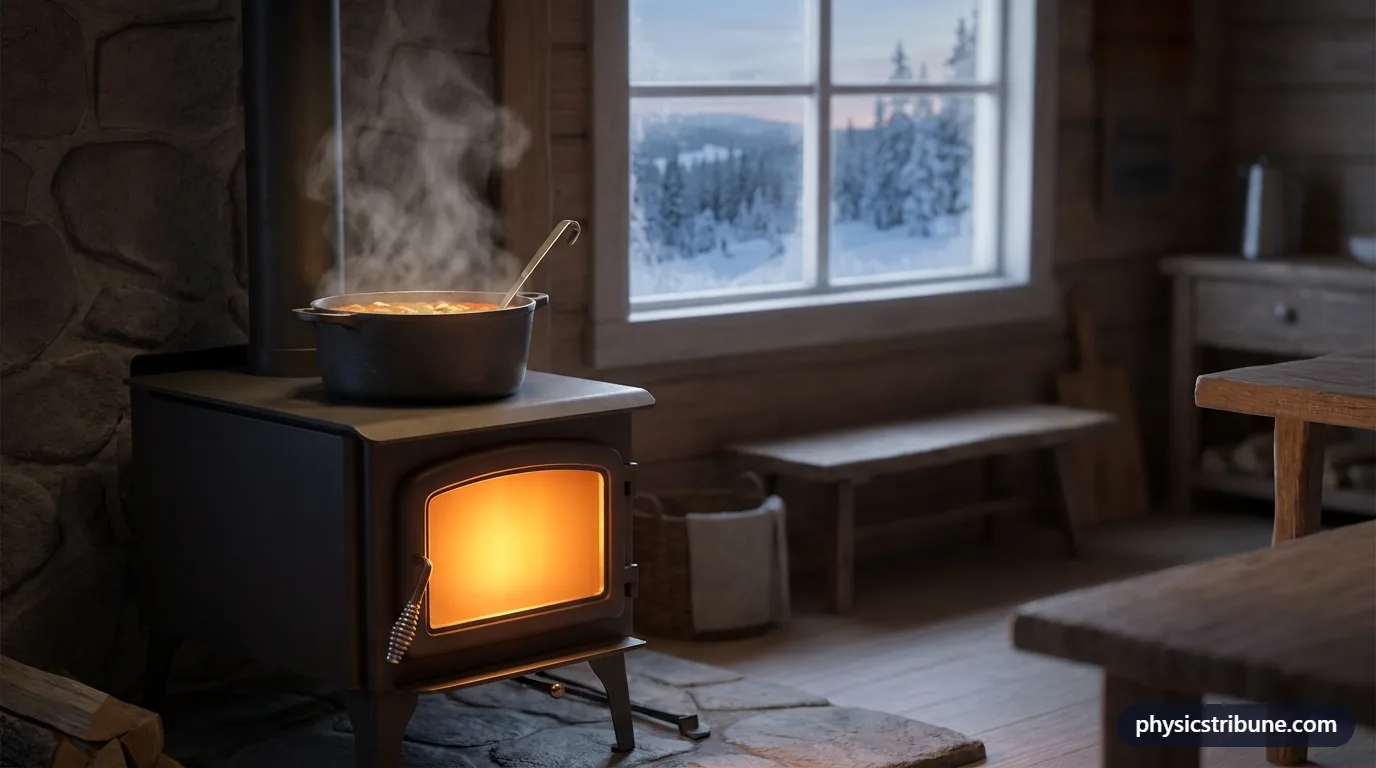
Heat travels in three ways. Conduction passes energy from particle to particle through a solid, which is why a metal spoon in hot soup warms up along its handle. Convection carries energy with a moving fluid, as when warm air rises from a radiator. Thermal radiation crosses empty space as infrared light, which is how sunlight warms your face.
Most real situations mix all three. Our heat transfer guide covers the rate formulas, insulation and how to slow heat down, and the conduction vs convection vs radiation page sets the three side by side.

How Do Gases Respond to Heat and Pressure?
Gases are the easiest matter to describe with numbers, because their particles are far apart and mostly ignore each other. Squeeze a gas and its pressure rises, as Boyle's law says. Warm it and it expands, as Charles's law says. The ideal gas law,
The kinetic theory of gases explains why the laws work: pressure is the drumming of molecules on the walls, and temperature tracks their average kinetic energy. The full set lives in our gas laws and kinetic theory guide.
| Constant | Symbol | Value | Where it appears |
|---|---|---|---|
| Boltzmann constant | k_B | 1.380 649 × 10⁻²³ J/K (exact) | Kinetic theory, entropy |
| Molar gas constant | R | 8.314 462 618... J/(mol·K) (exact) | Ideal gas law |
| Avogadro constant | N_A | 6.022 140 76 × 10²³ mol⁻¹ (exact) | Moles to molecules |
| Stefan-Boltzmann constant | σ | 5.670 374 419... × 10⁻⁸ W/(m²·K⁴) (exact) | Thermal radiation |
| Standard atmosphere | atm | 101 325 Pa (exact) | Gas problems at sea level |
| Source: NIST CODATA 2022 (physics.nist.gov) · public domain · Retrieved October 2026 | |||
What Are the Laws of Thermodynamics?
Four laws hold the subject together. The zeroth law says two objects each in thermal equilibrium with a third are in equilibrium with each other, which is what makes thermometers meaningful. The first law is conservation of energy written for heat and work,
The second law says the entropy of an isolated system never decreases, so heat flows on its own only from hot to cold. The third law says absolute zero can be approached but never reached. Our laws of thermodynamics guide treats each one in depth.
| Quantity | Formula | SI unit |
|---|---|---|
| Heat for a temperature change | Q = m c ΔT | joule (J) |
| Heat for a change of phase | Q = m L | joule (J) |
| Celsius to kelvin | T_K = T_C + 273.15 | kelvin (K) |
| Linear thermal expansion | ΔL = α L ΔT | meter (m) |
| Ideal gas law | P V = n R T | P in pascals, V in m³ |
| Average kinetic energy of a gas molecule | KE_avg = 3/2 k_B T | joule (J) |
| First law of thermodynamics | ΔU = Q - W | joule (J) |
| Work done by a gas at constant pressure | W = P ΔV | joule (J) |
| Rate of conduction | Q/t = k A ΔT / d | watt (W) |
| Radiated power (Stefan-Boltzmann) | P = e σ A T⁴ | watt (W) |
| Entropy change at constant temperature | ΔS = Q / T | joule per kelvin (J/K) |
| Carnot efficiency | e = 1 - Tc / Th | no unit (fraction or %) |
| Source: Formulas from our formula data set (data/formulas.json) · Retrieved October 2026 | ||
How Do Engines and Refrigerators Use Thermodynamics?
A heat engine takes in heat from a hot source, turns part of it into work and dumps the rest into a cold sink. A refrigerator or heat pump runs the same cycle backward, spending work to push heat uphill from cold to hot. The Carnot cycle sets the best efficiency any engine can reach between two temperatures.
Engines are built from simple steps such as isothermal and adiabatic processes, which are easiest to follow on a PV diagram. The heat engines, refrigerators and heat pumps guide gathers these pages together.
In What Order Should You Learn Thermodynamics?
Each step builds on the one before. We suggest this path:
- Temperature and heat, including specific heat and latent heat.
- Heat transfer by conduction, convection and radiation.
- Gas laws and kinetic theory, ending with
- The laws of thermodynamics, with internal energy and entropy.
- Thermodynamic processes and PV diagrams.
- Heat engines, refrigerators and heat pumps, where everything comes together.
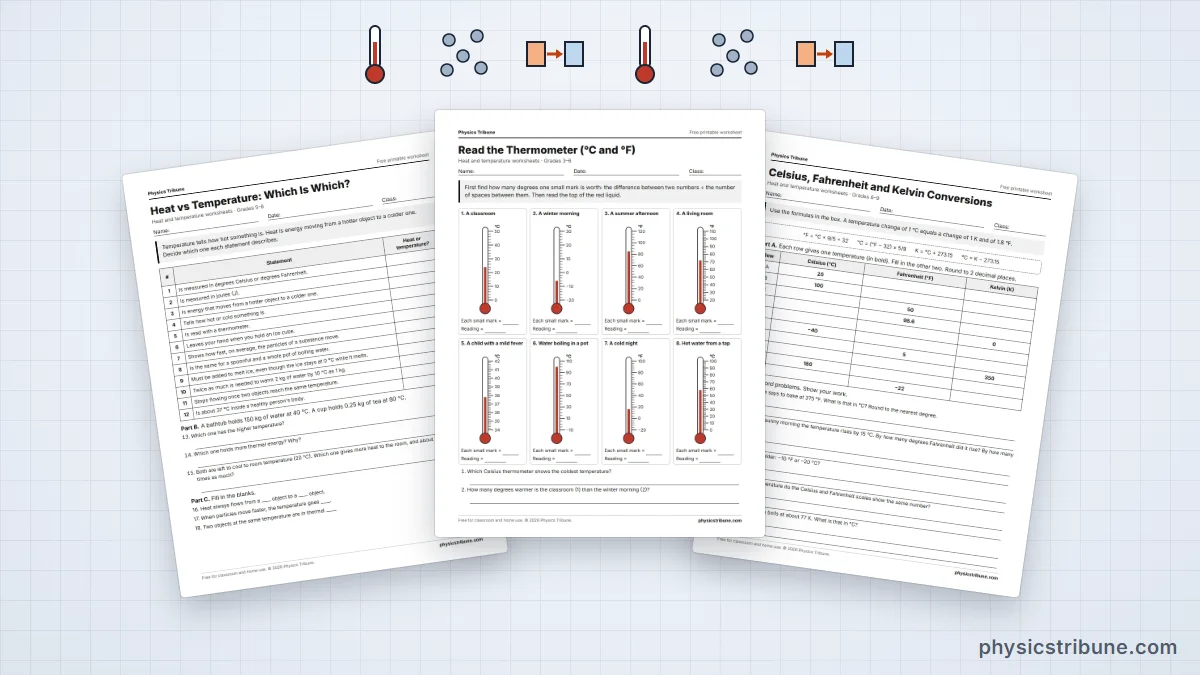
Practice along the way with the specific heat calculator, the gas law calculator and our heat and temperature worksheets. Every equation sits on one page in the thermodynamics formulas sheet, and the people behind them, such as Sadi Carnot and Rudolf Clausius, each have their own page.
All Heat & Thermodynamics (6)

Key Facts
- Thermodynamics studies heat, temperature and the conversion of energy between heat and work.
- Heat is energy moving because of a temperature difference, and it is measured in joules.
- The SI unit of temperature is the kelvin, and 0 K is absolute zero.
- Heat moves by conduction, convection and radiation.
- The first law says energy is conserved: ΔU = Q - W.
- The second law says heat flows on its own only from hot to cold, so no heat engine is 100 percent efficient.
- The ideal gas law PV = nRT links pressure, volume, amount and temperature of a gas.
Frequently Asked Questions
What is thermodynamics in simple terms?
Thermodynamics is the part of physics that deals with heat, temperature and energy. It explains how heat moves from hot things to cold things, how that flow can be used to do work in engines, and why some changes, like ice melting in a warm room, happen by themselves while their reverse never does. Its laws apply to everything from kitchens to stars.
What are the 4 laws of thermodynamics?
The zeroth law says that two bodies in thermal equilibrium with a third are in equilibrium with each other, which defines temperature. The first law says energy is conserved, so ΔU = Q - W. The second law says the entropy of an isolated system never decreases, which makes heat flow from hot to cold. The third law says absolute zero cannot be reached in a finite number of steps.
Is heat the same as temperature?
No. Temperature describes how hot an object is and is linked to the average kinetic energy of its particles. Heat is energy that flows from one object to another because their temperatures differ. A large lake at 15 °C has a lower temperature than a candle flame, yet it can give away vastly more heat because it contains so much more matter.
What is the unit of heat?
Heat is a form of energy transfer, so its SI unit is the joule (J). Older units are still common: the calorie is defined as exactly 4.184 J, and the food Calorie printed on nutrition labels is 1,000 calories, or 4,184 J. Engineers in the United States also meet the British thermal unit on furnace and air conditioner ratings.
Why is thermodynamics important?
Thermodynamics sets the limits on every power plant, car engine, refrigerator and air conditioner, so it shapes how we produce and use energy. It also explains weather, ocean currents, cooking, the cooling of electronics and the way living cells manage energy. Chemists use it to predict which reactions can happen, and astronomers use it to understand how stars shine.
Who is the father of thermodynamics?
Sadi Carnot is often called the father of thermodynamics, because his analysis of ideal heat engines in the 1820s showed that efficiency depends on the temperatures of the hot and cold reservoirs. Later scientists, including Rudolf Clausius, Lord Kelvin, James Prescott Joule and Ludwig Boltzmann, turned his ideas into the laws and the particle picture we use today.
Keep Exploring
 thermodynamicsTemperature & Heat
 thermodynamicsHeat Transfer
 thermodynamicsGas Laws & Kinetic Theory
 thermodynamicsLaws of Thermodynamics
 thermodynamicsHeat Engines, Refrigerators & Heat Pumps
 compareHeat vs Temperature
 calculatorsSpecific Heat Calculator (Q = mcΔT)
 formulasHeat and Thermodynamics Formulas
 worksheetsHeat and Temperature Worksheets