
At a Glance
An electromagnet is a current-carrying coil whose magnetic field can be switched on, off or reversed. Its strength inside a long coil follows B = μ0 N I / ℓ, so more turns, more current and an iron core make it stronger. Everyday examples are doorbells, speakers, motors, relays, door locks, MRI scanners and maglev trains.
- What it is
- A coil of wire that is magnetic only while current flows
- Field formula
- B = μ0 N I / ℓ (long coil, no core)
- Made stronger by
- More turns, more current, an iron core
- Key advantage
- Can be switched on, off and reversed
- Discovered
- Ørsted linked current and magnetism in 1820
On this page
- What Makes Something an Electromagnet?
- What Are Examples of Electromagnets in Everyday Life at Home?
- How Are Electromagnets Used in Industry and Transport?
- Which Electromagnets Are Used in Medicine and Science?
- How Do Electromagnets Keep Things Safe and Locked?
- Why Are Some Electromagnets So Much Stronger Than Others?
- Electromagnet Examples for Kids
- Common Misconceptions
- Key Facts
- Quiz
- FAQ
What Makes Something an Electromagnet?
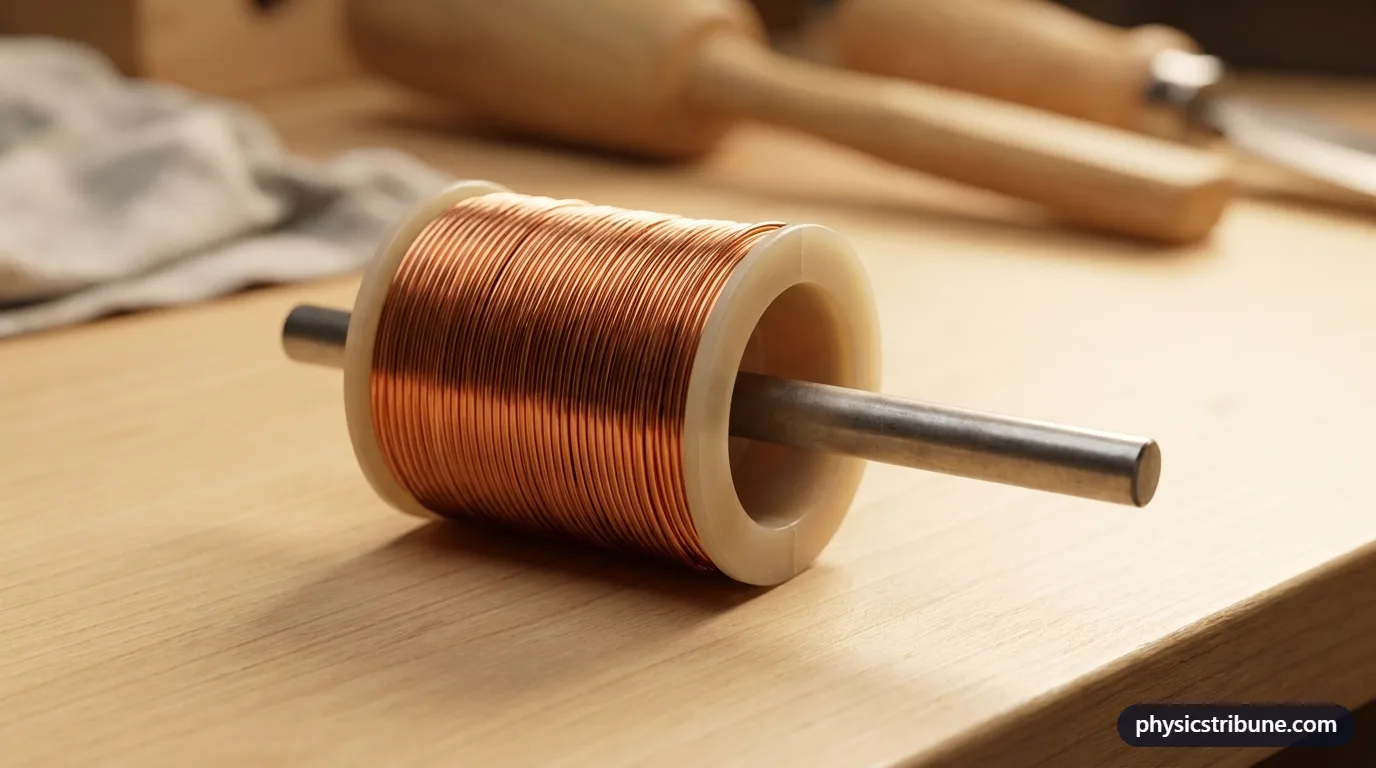
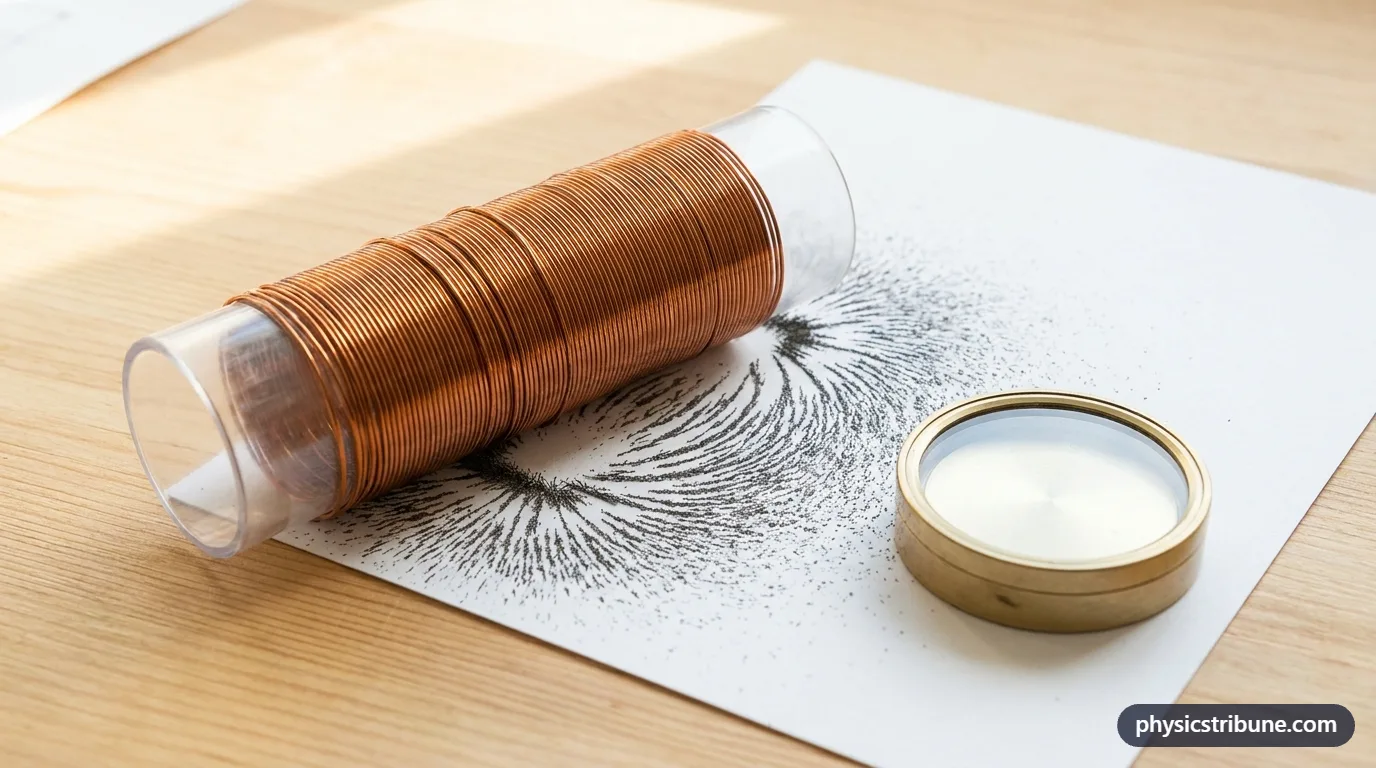
Any wire carrying current is surrounded by a magnetic field. Wind that wire into a tight coil, called a solenoid, and the small fields of every loop add up into one strong field that looks like the field of a bar magnet. Put a soft iron core inside the coil and the iron itself becomes magnetized, multiplying the effect many times.
The defining feature of an electromagnet is control. Cut the current and the field almost disappears. Reverse the current and the north and south poles swap. Change the current and the strength changes with it. Every example below uses at least one of those three tricks.
The table lists all 16 examples with what the magnet does and the physics idea it relies on. The sections that follow explain each one in a few sentences.
For a long coil with no iron inside, the field at its center depends only on the turns per meter and the current.
| Symbol | Quantity | SI unit |
|---|---|---|
| magnetic field inside | tesla (T) | |
| permeability of free space (4π × 10⁻⁷ T·m/A (approximately; 1.2566 × 10⁻⁶ T·m/A)) | tesla meter per ampere (T·m/A) | |
| turns per unit length (N/ℓ) | per meter (1/m) | |
| current | ampere (A) | |
| total number of turns | dimensionless (1) | |
| length of the solenoid | meter (m) |
Valid for: long ideal solenoid, far from the ends; air core.
| Example | What the electromagnet does | Physics idea |
|---|---|---|
| Doorbell | Pulls a striker onto a chime | Switching on and off |
| Loudspeaker | Moves a cone in and out | Changing current, force on a coil |
| Headphones | Moves a thin membrane | Changing current, force on a coil |
| Electric motor | Keeps a rotor turning | Reversing the poles |
| Induction cooktop | Heats an iron pan | Alternating field induces currents |
| Solenoid valve | Lifts a plunger to let water in | Switching on and off |
| Scrapyard crane | Lifts and drops steel scrap | Switching on and off, iron core |
| Maglev train | Lifts and pulls the train | Repulsion and attraction, variable strength |
| Recycling separator | Pulls steel out of mixed waste | Attraction of iron and steel |
| Car starter solenoid | Closes heavy contacts | Small current controls a large one |
| Transformer | Changes voltage | Alternating field, induction |
| MRI scanner | Makes a strong steady field | Superconducting coil |
| Particle accelerator | Bends particle beams | Magnetic force on moving charges |
| Hard disk drive | Swings the read arm | Variable current, fast response |
| Relay and circuit breaker | Opens or closes a switch | Small current controls a large one |
| Magnetic door lock | Holds a door until power is cut | Switching off releases the load |
| Source: Classification by our editors · Retrieved October 2026 | ||
What Are Examples of Electromagnets in Everyday Life at Home?
- Doorbell. Pressing the button closes a circuit, the coil pulls an iron plunger or striker, and it hits a metal chime. A spring returns it when you let go.
- Loudspeaker. A light coil glued to the speaker cone sits next to a permanent magnet. The music signal makes the current in the coil change thousands of times a second, so the coil and cone push in and out and move the air.
- Headphones and earbuds. They work exactly like a loudspeaker, only smaller. A tiny coil moves a thin membrane right next to your ear.
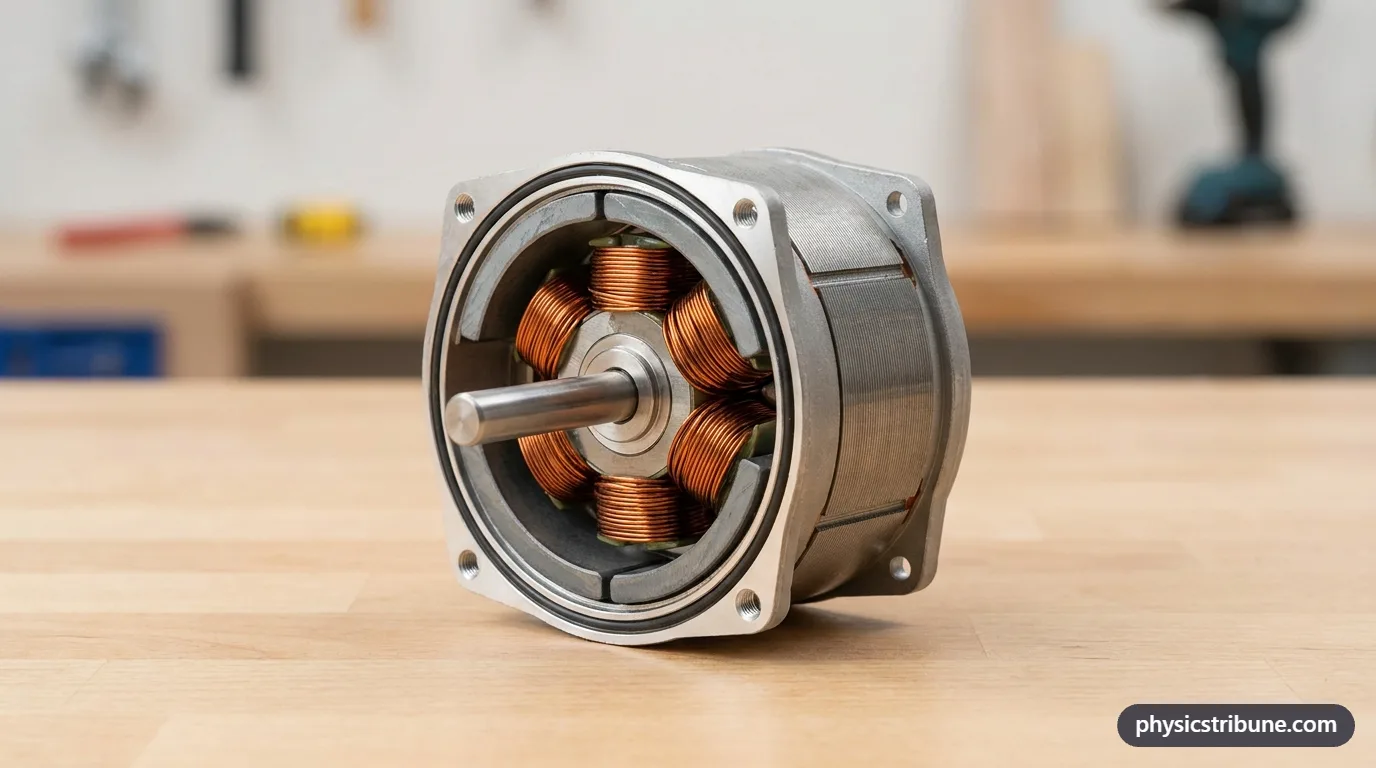
- Electric motors. Fans, blenders, washing machine drums and cordless drills all spin because coils inside the electric motor are switched so that their poles keep chasing the poles of another magnet.
- Induction cooktop. A flat coil under the glass carries rapidly alternating current. Its changing field drives currents inside the iron pan, and those currents heat the pan directly.
- Solenoid valves. Dishwashers, washing machines and refrigerators with ice makers open and close their water inlets with a small coil that lifts a plunger off a seal.
These are easy to overlook because the coil is hidden. A good rule: if a household device clicks, hums, buzzes or spins, an electromagnet is probably inside.
Example 1 A homemade coil for a door chime
A hobbyist winds 300 turns of wire along a cardboard tube 0.10 m long and passes a current of 2.0 A through it. What is the magnetic field at the center of the coil, with no iron core?
- Given:
- permeability of free space:
- total number of turns:
- current:
- length of the solenoid:
- permeability of free space:
- Formula:
- Substitute:
- Answer:
A few thousandths of a tesla is weak on its own; sliding a soft iron rod into the tube makes the chime plunger feel a far larger pull.
How Are Electromagnets Used in Industry and Transport?
- Scrapyard lifting magnet. A crane lowers a large round electromagnet onto a pile of steel scrap, switches it on, lifts the load and swings it over a truck. Switching the current off drops the scrap exactly where the operator wants it.
- Maglev trains. Powerful electromagnets in the track and the train lift the cars a short distance off the guideway and pull them forward, so there is no wheel friction at all. See our page on magnetic levitation for the details.
- Recycling separators. Overhead electromagnets above a conveyor belt pull steel cans away from aluminum, plastic and glass, so the metals can be recycled separately.
- Car starter solenoid. Turning the key or pressing the start button sends a small current to a coil. Its plunger closes heavy contacts that let a very large current flow to the starter motor.
- Transformers. In a transformer, alternating current in one coil turns the iron core into an electromagnet whose field flips back and forth. That changing field induces a voltage in a second coil, which is how power grids step voltages up and down.
Which Electromagnets Are Used in Medicine and Science?
- MRI scanners. A hospital MRI machine is built around a huge superconducting coil that produces a steady field, typically 1.5 or 3 tesla. That is tens of thousands of times stronger than the Earth's field at the surface.
- Particle accelerators. Rings of electromagnets bend beams of fast charged particles into a circle and squeeze them into a narrow beam. The magnets must be adjusted as the particles gain energy.
- Hard disk drives. The arm that carries the read and write head is swung across the spinning disk by a small coil between two permanent magnets. Changing the current moves the arm to the right track in a few thousandths of a second.
The MRI and accelerator examples show why electromagnets matter in research: no permanent magnet of a practical size can reach those field strengths, and no permanent magnet can be tuned while the experiment runs.
How Do Electromagnets Keep Things Safe and Locked?
- Relays and circuit breakers. A relay uses a small current in a coil to pull a metal switch arm, so a low-power control circuit can turn a high-power circuit on or off. Many circuit breakers contain a coil that snaps the contacts open when a sudden surge of current makes its field strong enough.
- Magnetic door locks and fire door holders. An electromagnet on the door frame holds a steel plate on the door. When the power is cut, by a card reader or a fire alarm, the magnet lets go and the door opens or swings shut.
Both examples take advantage of the off switch. A fire door that is held open by a magnet closes on its own the moment the alarm system cuts the current, which is a safe way to fail.
Why Are Some Electromagnets So Much Stronger Than Others?
Three things set the strength. More turns of wire per meter of coil add more loops of field. More current makes each loop stronger. A core of soft iron lines up its own tiny magnetic regions with the coil's field and can boost it hundreds of times. That is why a doorbell coil can be small while a scrapyard magnet is a heavy disk packed with wire and iron.
Superconducting coils, like those in MRI scanners, go further. Cooled with liquid helium, their wire has zero resistance, so a very large current can circulate without wasting energy as heat. You can estimate the field of a simple coil with our magnetic field calculator, and see how electromagnets compare with fridge magnets on our electromagnet vs permanent magnet page.

Electromagnet Examples for Kids
An electromagnet is a magnet with an on and off switch. Wrap insulated wire around a steel nail, connect the ends to a battery, and the nail picks up paper clips. Disconnect the battery and the clips fall. Our build an electromagnet experiment shows how to do this safely with an adult.
The first person to notice that electric current moves a compass needle was Hans Christian Ørsted in 1820, and Michael Faraday soon built on his work. For more magnet fun, visit magnets for kids, and for practice try the magnetism worksheets.

Common Misconceptions
Myth: Electromagnets only attract iron while permanent magnets can repel.
Physics: An electromagnet has a north and a south pole like any magnet, so it can repel another magnet just as well. Speakers and motors depend on both pushes and pulls.
Myth: The battery's voltage alone decides how strong an electromagnet is.
Physics: What matters is the current and the number of turns, plus the core. A thick coil with many turns can be stronger on a small battery than a thin coil on a big one.
Myth: An electromagnet stays magnetic after you switch it off.
Physics: A soft iron core loses almost all its magnetism when the current stops. Hard steel can keep a little, which is why cores are made of soft iron.
Key Facts
- An electromagnet is a coil of wire that is magnetic only while current flows through it.
- More turns, more current and a soft iron core all make an electromagnet stronger.
- Reversing the current swaps the north and south poles of an electromagnet.
- Doorbells, speakers, motors, relays and solenoid valves all contain electromagnets.
- MRI scanners use superconducting coils with fields of typically 1.5 or 3 tesla.
- Scrapyard cranes and recycling plants use electromagnets to pick up iron and steel.
- Hans Christian Ørsted showed in 1820 that an electric current produces a magnetic effect.
Quick Quiz: How Well Do You Know Examples of Electromagnets?
6 questions. Tap an answer to check it.
Which of these is NOT an example of an electromagnet in use?
A compass needle is a permanent magnet; the others use current-carrying coils.
Why do scrapyards use electromagnets instead of permanent magnets?
Turning off the current releases the scrap exactly where it is needed.
What happens when you reverse the current in an electromagnet?
The field direction follows the current, so north and south trade places.
What does the iron core in an electromagnet do?
The iron becomes magnetized and adds its own field to the coil's field.
Which device uses an electromagnet to let a small current control a large one?
The coil in a relay pulls a switch arm that closes a separate high-power circuit.
Classify it: an induction cooktop heats a pan because its coil makes a field that is
A changing field induces currents in the pan, and those currents produce heat.
Frequently Asked Questions
What are 5 examples of electromagnets?
Five common examples are a doorbell, which pulls a striker onto a chime; a loudspeaker, which moves a cone to make sound; an electric motor, which spins a fan or a drill; a scrapyard crane magnet, which lifts steel; and an MRI scanner, which uses a very strong coil to image the inside of the body.
What are examples of electromagnets in everyday life?
At home you will find electromagnets in doorbells, speakers, headphones, washing machine valves, dishwasher valves, refrigerator ice makers, blenders, fans and induction cooktops. Outside the home they are in car starters, elevator brakes, magnetic door locks, traffic and rail signals, recycling plants and hospital scanners.
How is an electromagnet different from a permanent magnet?
A permanent magnet keeps its field all the time and its strength is fixed. An electromagnet needs a current, so it can be switched on and off, made stronger or weaker by changing the current, and reversed by changing the current's direction. That control is why most machines use electromagnets.
Is a speaker an electromagnet?
A speaker contains both kinds of magnet. A permanent magnet provides a fixed field, and a lightweight coil attached to the cone acts as an electromagnet. As the audio current changes, the coil is pushed and pulled in the fixed field, so the cone vibrates and produces sound waves in the air.
Are electromagnets used in phones?
Yes. The tiny speaker and earpiece in a phone each use a small coil, and the vibration motor that buzzes for notifications is an electric motor or a coil that shakes a small mass. Wireless charging pads also use coils whose changing magnetic field passes energy to a matching coil in the phone.
What is the strongest electromagnet in everyday use?
For most people the strongest one they will meet is a hospital MRI scanner, typically 1.5 or 3 tesla. Research magnets in laboratories go much higher. For comparison, a fridge magnet is roughly a few thousandths of a tesla near its surface, and the Earth's field is about 50 millionths of a tesla.
How can I make an electromagnet stronger?
Add more turns of wire, increase the current with a suitable power source, and use a soft iron core such as a large iron nail. Keep the turns tightly wound and close together. Be careful, because more current also heats the wire, so short tests with an adult present are the safe way to experiment.
Keep Exploring
 magnetismElectromagnets
 magnetismSolenoids
 compareDifference Between Electromagnet and Permanent Magnet
 experimentsBuild an electromagnet
 calculatorsMagnetic Field Calculator (wire, solenoid)
 magnetismHow Electric Motors Work
 physicistsHans Christian Ørsted
 kidsMagnets for Kids
 examplesPhysics Examples in Everyday Life