At a Glance
Michael Faraday (born September 22, 1791, died August 25, 1867) was an English experimental scientist best known for discovering electromagnetic induction in 1831. His law of induction, written today as ε = -N ΔΦ_B / Δt, says a changing magnetic flux through a coil produces a voltage, the principle behind every generator and transformer.
- Born
- September 22, 1791, Newington Butts, near London, England
- Died
- August 25, 1867, Hampton Court, England, age 75
- Nationality
- Kingdom of Great Britain; United Kingdom of Great Britain and Ireland
- Known for
- Electromagnetic induction, the electric motor and field lines
- Key work
- Experimental Researches in Electricity (series begun 1831)
- Key equation
- ε = -N ΔΦ_B / Δt (Faraday's law of induction)
On this page
- Who Was Michael Faraday?
- How Did a Bookbinder's Apprentice Become a Scientist?
- How Did Faraday Build the First Electric Motor?
- What Did Faraday Discover in 1831?
- What Are Faraday's Lines of Force?
- What Did Faraday Contribute to Chemistry?
- What Are the Faraday Cage and the Faraday Effect?
- Faraday's Key Equation
- Faraday the Lecturer and His Later Years
- Why Is Faraday Important Today?
- Key Facts
- Quiz
- FAQ
Who Was Michael Faraday?
Michael Faraday was the experimenter who showed that magnetism can make electricity. Before 1831 scientists knew that an electric current creates a magnetic field, but no one had managed the reverse. Faraday found that a changing magnetic field drives a current through a nearby wire, a discovery now called electromagnetic induction.
That single result is why we have power stations, transformers, electric guitars and wireless phone chargers. He also built the first device that turned electric current into continuous motion, coined many words chemists still use, and explained how electricity splits compounds apart. All of this came from a man with almost no formal schooling and very little mathematics.
Faraday worked at the Royal Institution in London for more than fifty years. He was famous in his own time as a lecturer who could make an audience of children and adults gasp at a demonstration, and he remained modest, deeply religious and uninterested in wealth.
How Did a Bookbinder's Apprentice Become a Scientist?
Faraday was born in 1791 in Newington Butts, then a village just south of London, into a poor family. His father was a blacksmith in weak health, and Michael left school after learning basic reading, writing and arithmetic. At 14 he was apprenticed to a bookbinder and bookseller, which turned out to be the luckiest job he could have had.
He read the books he bound. An encyclopedia article on electricity and a popular chemistry book for beginners set him on fire, and he began repeating the experiments at home with whatever he could afford. In 1812 a customer gave him tickets to lectures by Humphry Davy, the leading chemist in Britain. Faraday wrote up careful notes, bound them, and sent them to Davy with a request for any kind of job in science.
In 1813 a laboratory assistant post opened at the Royal Institution and Davy hired him. Within months Faraday was traveling across Europe with Davy and his wife, part assistant and part servant, meeting the great scientists of France and Italy. He came home with an education no school could have given him.
| Year | Event |
|---|---|
| 1791 | Born on September 22 in Newington Butts, near London |
| 1805 | Begins a seven-year apprenticeship as a bookbinder |
| 1812 | Attends Humphry Davy's lectures at the Royal Institution |
| 1813 | Hired as a laboratory assistant at the Royal Institution; tours Europe with Davy |
| 1821 | Demonstrates electromagnetic rotation, the first electric motor; marries Sarah Barnard |
| 1823 | Liquefies chlorine gas |
| 1825 | Isolates benzene; becomes director of the Royal Institution laboratory |
| 1831 | Discovers electromagnetic induction with an iron ring; builds a disk generator |
| 1833 | Becomes Fullerian Professor of Chemistry; works out the laws of electrolysis |
| 1836 | Demonstrates electrostatic shielding in a foil-lined room |
| 1845 | Discovers the Faraday effect and diamagnetism |
| 1858 | Moves into a house at Hampton Court granted by Queen Victoria |
| 1867 | Dies at Hampton Court on August 25, aged 75 |
| Source: Birth and death dates from our physicists data file (Wikidata, CC0); other years are standard biographical dates · Retrieved October 2026 | |
How Did Faraday Build the First Electric Motor?
In 1820 the Danish physicist Hans Christian Orsted showed that a current-carrying wire deflects a compass needle, the effect you can reproduce in the Orsted compass experiment. Scientists across Europe raced to understand it. In 1821 Faraday found a way to turn the push between a current and a magnet into steady rotation.
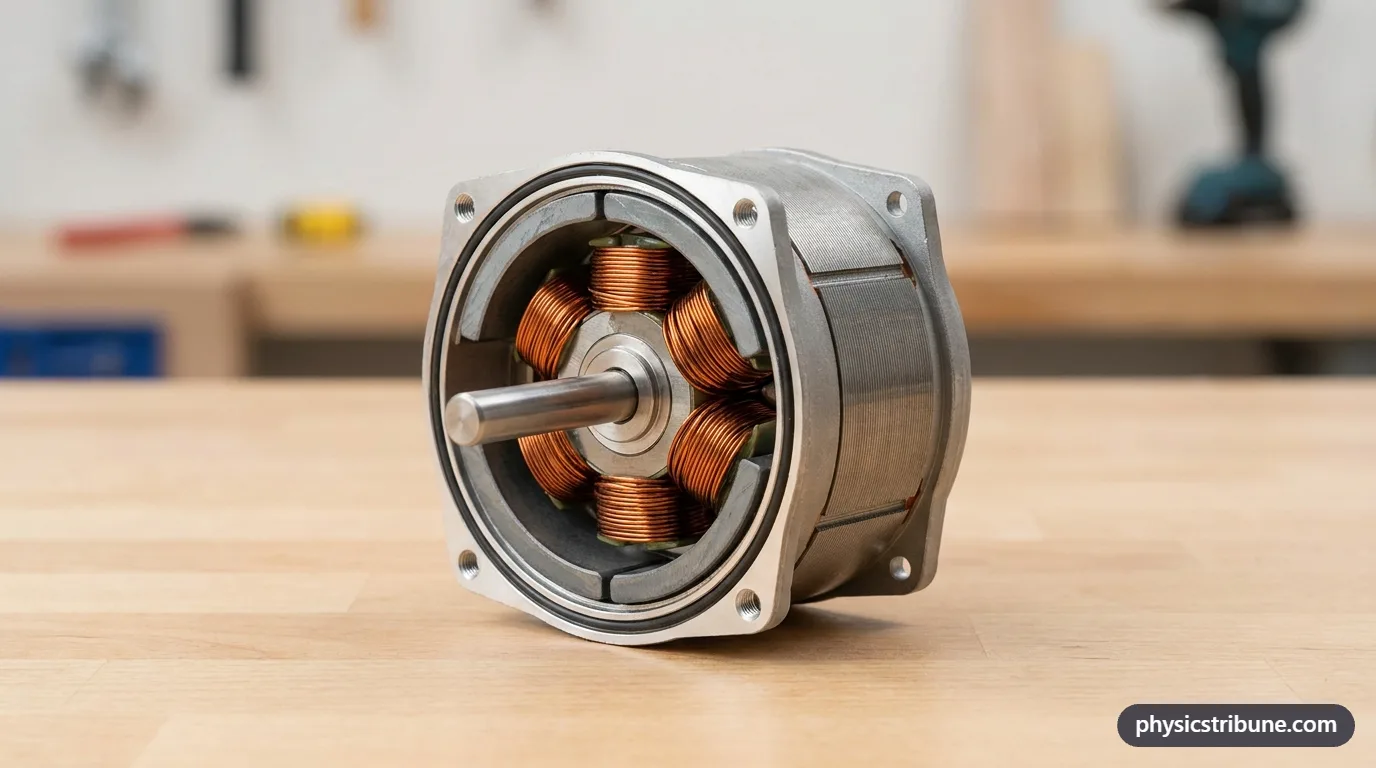
He stood a bar magnet upright in a dish of mercury and hung a wire so its lower end dipped into the liquid. When a battery drove current through the wire, the free end circled the magnet again and again. This "electromagnetic rotation" was the first electric motor, a direct ancestor of the motors in fans, drills and electric cars. You can build a simple modern version in our homopolar motor project.
What Did Faraday Discover in 1831?
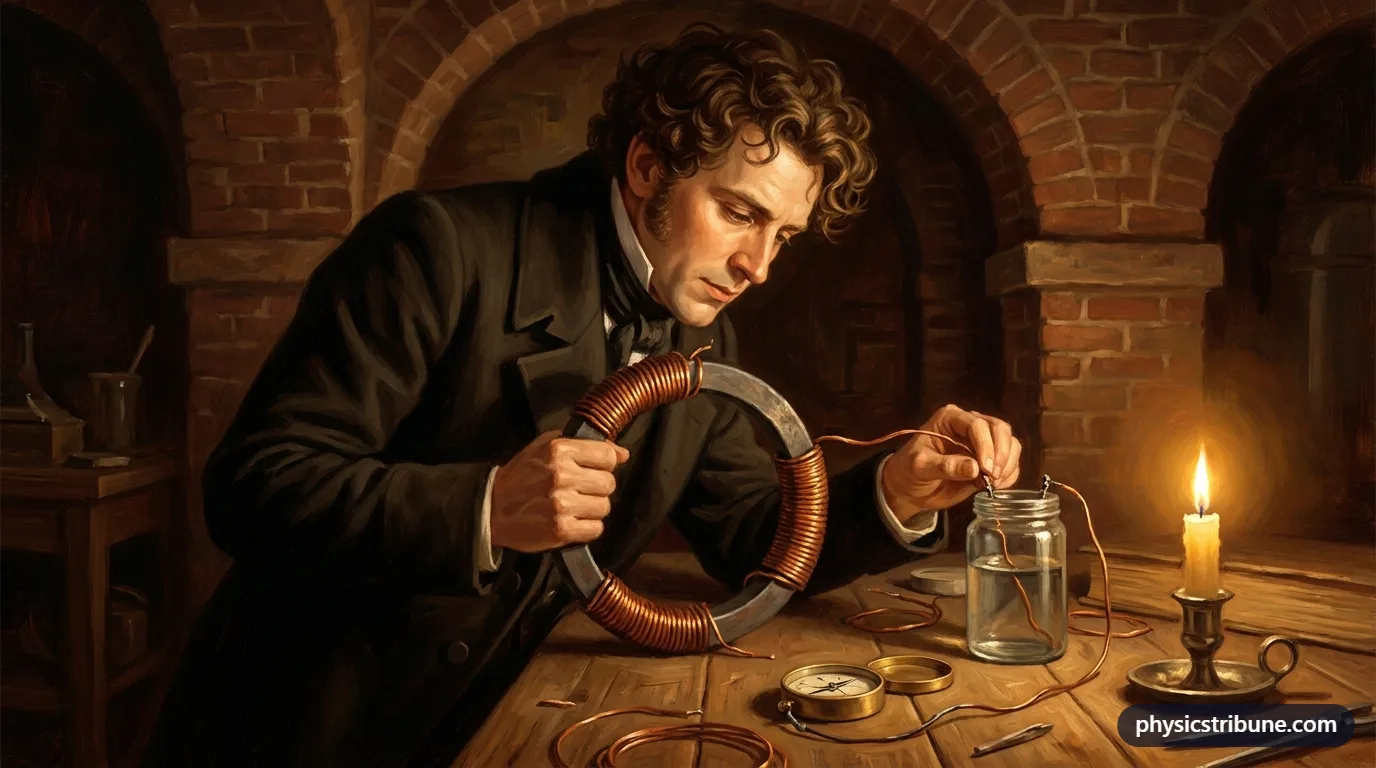
For ten years Faraday tried to get electricity out of magnetism without success. In August 1831 he wound two separate coils of insulated wire on opposite sides of a soft iron ring. He connected one coil to a battery and the other to a sensitive current detector. Nothing happened while the current flowed steadily, but the needle kicked at the instant he connected the battery and kicked the other way when he disconnected it.
He had found the key: only a change in magnetism induces a current. Within weeks he showed the same thing by pushing a magnet in and out of a coil, and then by spinning a copper disk between the poles of a magnet to get a steady current. That disk was the first electric generator, and the iron ring was the first transformer. Our page on the Faraday induction ring experiment walks through the setup.
The American scientist Joseph Henry found induction independently at about the same time, but Faraday published first and explored it far more thoroughly.
What Are Faraday's Lines of Force?
Faraday did not think of magnets and charges as reaching across empty space by magic. He pictured the space around them filled with curved lines of force, the patterns iron filings trace when you sprinkle them near a magnet. The lines bunch together where the force is strong and spread out where it is weak, and a current is induced when a wire cuts across them.
Most scientists of the time saw this as a handy sketch for someone who could not do the mathematics. It turned out to be one of the deepest ideas in physics. James Clerk Maxwell translated the lines into equations, and the result was the modern concept of a magnetic field and an electric field as real things that store energy. Our guide to magnetic field lines shows how to read these patterns.

What Did Faraday Contribute to Chemistry?
Faraday was a first-class chemist as well as a physicist. In 1823 he turned chlorine into a liquid by squeezing and cooling it, and in 1825 he isolated benzene from the oily residue of gas lighting. He also made new kinds of optical glass and studied steel alloys.
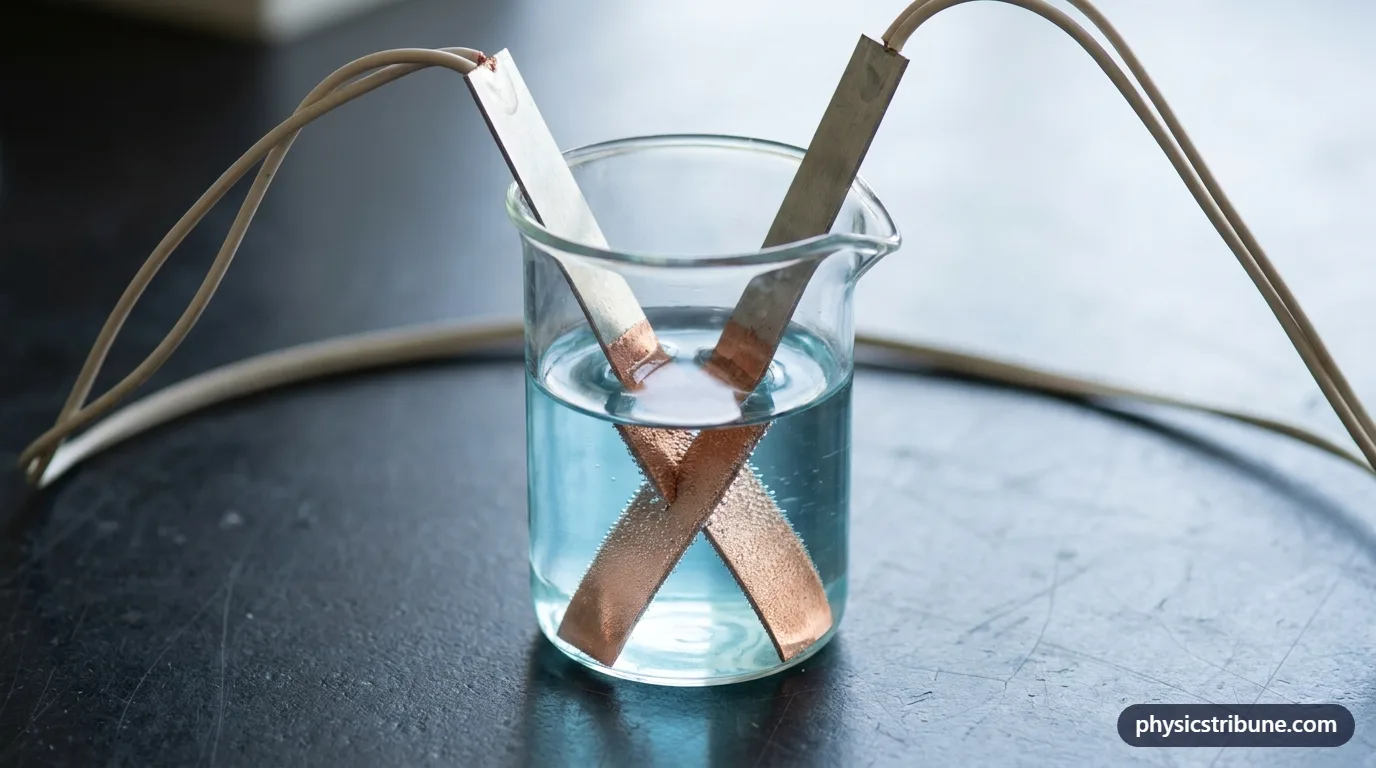
In the early 1830s he worked out the laws of electrolysis: the amount of a substance released at an electrode is proportional to the total charge passed through the solution. The constant that links charge to moles of electrons is named the Faraday constant in his honor. With help from the scholar William Whewell he introduced the words electrode, anode, cathode, ion and electrolyte, which every chemistry student now learns.
What Are the Faraday Cage and the Faraday Effect?
In 1836 Faraday built a room lined with metal foil and showed that strong electric charges on the outside left the inside untouched. The charges on a conductor rearrange themselves so the field inside cancels. This is the principle of the Faraday cage, which protects people in cars and airplanes from lightning and keeps microwave ovens from leaking.
In 1845 he found that a strong magnetic field rotates the plane of polarized light passing through heavy glass. This Faraday effect was the first hint that light and magnetism are related, a link Maxwell later made exact. In the same year Faraday showed that every material responds to a magnet in some way, and named the weak repulsion shown by substances like water and bismuth diamagnetism.
Faraday's Key Equation
Faraday described induction in words and pictures, not symbols. Later physicists turned his rule into the equation below: the voltage induced in a coil equals the number of turns times how fast the magnetic flux through each turn is changing. The faster the change, the bigger the voltage, which is why generators spin quickly. Our full article on Faraday's law covers the details, and Lenz's law explains the minus sign.
Here is Faraday's law in the form students use today, with each symbol and its SI unit, plus the rearranged versions.
| Symbol | Quantity | SI unit |
|---|---|---|
| induced emf | volt (V) | |
| number of turns | dimensionless (1) | |
| change in magnetic flux through one turn | weber (Wb) | |
| time interval | second (s) |
Rearranged to find another variable:
Valid for: minus sign expresses Lenz's law (induced emf opposes the change in flux); average emf over Δt.
Example 1 A magnet pushed into a coil
A student plunges a bar magnet into a 150-turn coil. The magnetic flux through each turn rises by 0.004 Wb in 0.02 s. What is the size of the voltage induced in the coil?
- Given:
- number of turns:
- change in magnetic flux through one turn:
- time interval:
- number of turns:
- Formula:
- Substitute:
- Answer:
We report the magnitude; the minus sign in the law only tells you the direction of the induced current, which opposes the change (Lenz's law).
Example 2 A metal rod sliding through a field
A 0.5 m copper rod slides at 3 m/s across a uniform magnetic field of 0.2 T, cutting the field lines at right angles. What voltage appears between its ends?
- Given:
- magnetic field:
- length of the moving rod:
- speed of the rod:
- magnetic field:
- Formula:
- Substitute:
- Answer:
This motional emf is the same effect Faraday used in his spinning copper disk, the first generator to give a steady current.
Faraday the Lecturer and His Later Years
Faraday believed science should be shared with everyone. He started the Friday Evening Discourses at the Royal Institution and gave the Christmas Lectures for young people many times. His 1860 series, published as The Chemical History of a Candle, explained combustion, air and water using nothing more than a burning candle, and it is still in print.
He turned down a knighthood and twice declined to become president of the Royal Society, preferring to stay "plain Michael Faraday." He was a lifelong member of a small Christian group called the Sandemanians, and he and his wife Sarah, whom he married in 1821, had no children. In 1858 Queen Victoria gave him the use of a house at Hampton Court, where he died in 1867 as his memory faded.
Why Is Faraday Important Today?
Nearly all the electricity in the world is generated by Faraday's principle: a coil and a magnetic field moving relative to each other in a power station. Transformers built on his iron ring carry that power across continents, as described on our how is electricity generated page. His field concept became the foundation of electromagnetism, relativity and modern particle physics.
The SI unit of capacitance, the farad, is named after him, and Einstein kept his picture on the wall beside Newton and Maxwell. For a quick answer on priority, see who discovered electromagnetic induction.
Key Facts
- Michael Faraday was born on September 22, 1791, and died on August 25, 1867.
- He left school young and learned science by reading the books he bound as an apprentice.
- In 1821 he built the first device to turn electric current into continuous rotation.
- In 1831 he discovered electromagnetic induction, the principle behind generators and transformers.
- He introduced lines of force, the idea that grew into the modern electric and magnetic field.
- He worked out the laws of electrolysis and coined the words electrode, anode, cathode and ion.
- The farad, the SI unit of capacitance, and the Faraday constant are named after him.
Quick Quiz: How Well Do You Know Michael Faraday?
6 questions. Tap an answer to check it.
What did Faraday discover in 1831?
He found that a changing magnetic field induces a current in a nearby coil.
In his iron ring experiment, when did the detector show a current?
Induction needs a changing magnetic field, which happens only at switch-on and switch-off.
What was Faraday's first job?
He learned science by reading the books he bound as a teenage apprentice.
Which SI unit is named after Faraday?
The farad is the SI unit of capacitance.
Who turned Faraday's lines of force into mathematical equations?
Maxwell built his field equations directly on Faraday's picture of lines of force.
According to Faraday's law, what happens to the induced voltage if the flux changes twice as fast?
The induced emf is proportional to the rate of change of flux, so doubling the rate doubles it.
Frequently Asked Questions
What is Michael Faraday best known for?
Faraday is best known for discovering electromagnetic induction in 1831, the finding that a changing magnetic field creates an electric current in a wire. He also built the first electric motor in 1821, the first generator and transformer, introduced the idea of field lines, discovered benzene and worked out the laws of electrolysis.
What did Michael Faraday invent?
Faraday invented the first electric motor, a wire that spun around a magnet in a dish of mercury, and the first electric generator, a copper disk turning between magnet poles. His iron ring with two coils was the first transformer. He also demonstrated the shielding effect behind the Faraday cage, though he did not patent any of his inventions.
Did Michael Faraday go to school?
Only briefly. Faraday attended a local day school where he learned reading, writing and simple arithmetic, then left at about 13. Everything else he taught himself, mostly by reading the books that came through the bookbinder's shop where he was an apprentice, and later by working beside Humphry Davy at the Royal Institution.
How did Faraday discover electromagnetic induction?
In August 1831 he wound two coils on an iron ring, one connected to a battery and the other to a current detector. The detector twitched only when the battery was switched on or off, showing that a changing magnetic field induces current. He then confirmed it by moving a magnet in and out of a coil.
What is Faraday's law in simple terms?
Faraday's law says that a voltage appears in a loop of wire whenever the amount of magnetic field passing through the loop changes. The faster the change and the more turns of wire, the larger the voltage. Moving a magnet, moving the coil, or switching a nearby current on and off all produce this effect.
Why did Faraday refuse a knighthood?
Faraday turned down a knighthood because he wanted to remain an ordinary man and felt titles did not fit his religious beliefs as a Sandemanian. He also declined the presidency of the Royal Society twice. He did accept a modest house at Hampton Court from Queen Victoria late in his life.
How did Faraday influence Maxwell?
Maxwell read Faraday's Experimental Researches in Electricity and set out to express its lines of force in mathematics. The result was his set of field equations, which predicted electromagnetic waves and showed that light is one of them. Maxwell openly credited Faraday's physical picture as the starting point of his theory.
What units and constants are named after Faraday?
The farad, symbol F, is the SI unit of capacitance and is named after him. The Faraday constant, about 96,485 coulombs per mole, gives the charge carried by one mole of electrons and appears in the laws of electrolysis he discovered. The Faraday effect and the Faraday cage also carry his name.