At a Glance
A generator produces electricity by electromagnetic induction: spinning a coil of N turns and area A at angular speed ω in a magnetic field B induces an emf = N A B ω sin(ωt). The output is alternating current with a peak voltage of N A B ω, and the energy comes from whatever turns the shaft, such as steam, wind or falling water.
- Converts
- Mechanical (kinetic) energy into electrical energy
- Principle
- Electromagnetic induction (Faraday's law)
- Formula
- emf = N A B ω sin(ωt); peak = N A B ω
- Main parts
- Rotor, stator, magnetic field, coil windings, slip rings or commutator
- Output
- AC (slip rings) or DC (commutator or rectifier)
- Opposite device
- Electric motor (electrical to mechanical)
On this page
- What Is an Electric Generator?
- How Does a Generator Work Step by Step?
- What Are the Main Parts of a Generator?
- How Does a Generator Produce Electricity?
- Why Does a Generator Make Alternating Current?
- What Is the Difference Between AC and DC Generators?
- Where Are Electric Generators Used?
- Why Is a Generator Harder to Turn When It Supplies Power?
- Who Invented the Electric Generator?
- Common Misconceptions
- Key Facts
- Quiz
- FAQ
What Is an Electric Generator?
An electric generator is a device that turns motion into electricity. Something has to keep its shaft spinning, whether that is steam in a power station, wind on a turbine, water rushing through a dam, a diesel engine or your legs on a bicycle. The generator converts that mechanical energy into electrical energy that can travel down a wire.
A generator does not create electric charge. The electrons are already in the copper of its coils and in the circuit connected to it. What the generator supplies is the push, the electromotive force, that makes those electrons move and carry energy to a lamp or a motor.
A generator is essentially an electric motor run backward. Feed current into a motor and its shaft turns; turn the shaft of a motor and it produces current. Our generator vs motor page compares the two side by side.
How Does a Generator Work Step by Step?
Picture the simplest generator: a rectangular loop of wire that can spin between the north and south poles of a magnet.
- Something turns the shaft. A turbine, engine or hand crank rotates the coil at a steady rate.
- The flux through the coil changes. When the coil faces the poles, the most field lines pass through it. A quarter turn later it is edge-on and none do. The magnetic flux rises and falls continuously.
- A voltage is induced. By Faraday's law, a changing flux induces an emf around the loop. The faster the flux changes, the bigger the emf.
- The voltage reverses every half turn. As each side of the coil switches from moving up to moving down through the field, the direction of the induced emf flips.
- Current flows out. Sliding contacts carry the voltage to the outside circuit, where it drives a current that lights a bulb or charges a battery.
Large power-station machines usually do the reverse arrangement, spinning an electromagnet inside fixed coils, but the physics is identical: what matters is relative motion between field and wire.
What Are the Main Parts of a Generator?
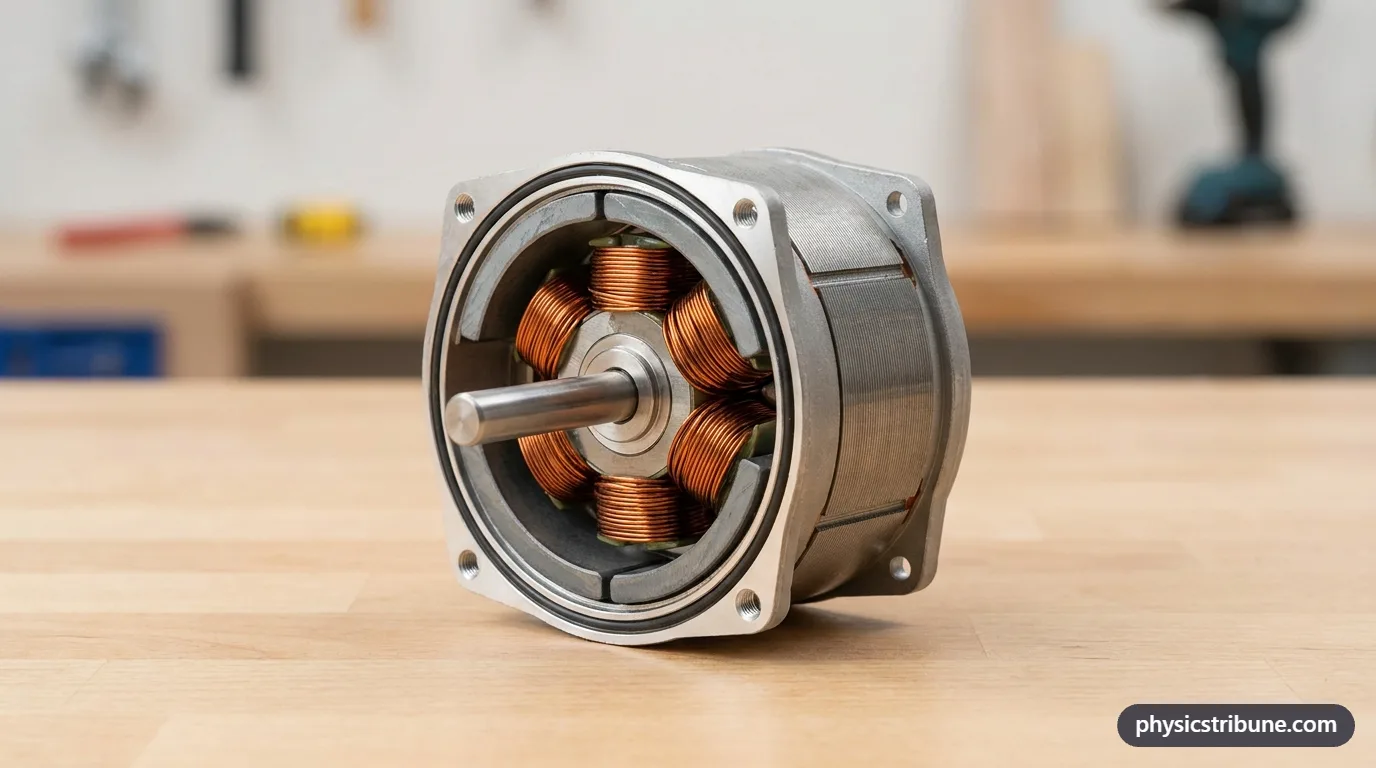
- Rotor: the part that spins. In small machines it carries the coil; in large ones it carries the magnet or electromagnet.
- Stator: the fixed outer part. It holds either the permanent magnets or the output coils.
- Field source: permanent magnets in small generators, or electromagnets fed with a small DC current in large ones, because their strength can be adjusted.
- Armature windings: the coils of insulated copper wire in which the voltage is induced. More turns give more voltage.
- Slip rings or commutator: slip rings pass alternating current out unchanged; a split-ring commutator flips the connections every half turn to give direct current.
- Brushes: carbon blocks that press on the rings and carry current between the spinning and stationary parts.
- Iron core: laminated iron that guides the magnetic flux through the coils and boosts the field.
How Does a Generator Produce Electricity?
The key is electromagnetic induction. For a single loop of area A in a field B, the flux is
Faraday's law says the emf equals the rate of change of flux times the number of turns N. The rate of change of a cosine is a sine, which gives
The examples below put real numbers into the formula. Notice that doubling the spin rate doubles both the peak voltage and the frequency of the output.
The voltage of a coil spinning at a steady rate in a uniform magnetic field follows a sine curve, given by this formula.
| Symbol | Quantity | SI unit |
|---|---|---|
| instantaneous emf | volt (V) | |
| number of turns | dimensionless (1) | |
| coil area | square meter (m²) | |
| magnetic field | tesla (T) | |
| angular velocity of the coil | radian per second (rad/s) | |
| time | second (s) |
Valid for: coil rotating at constant ω in a uniform field; peak emf ε₀ = NABω.
Example 1 Peak voltage of a small generator
A rectangular coil of 250 turns, each enclosing 0.015 m², spins 50 times per second in a uniform 0.3 T magnetic field. What is the peak emf it produces? Use ω = 2πf.
- Given:
- number of turns:
- coil area:
- magnetic field:
- f:
- number of turns:
- Formula:
- Substitute:
- Answer:
This is the peak value; the voltage swings between plus and minus this amount 50 times every second.
Example 3 How many turns does the coil need?
You want a generator to reach a peak emf of 170 V. Its coil turns at 60 revolutions per second, each loop encloses 0.01 m², and the magnetic field is 0.5 T. How many turns must the coil have?
- Given:
- instantaneous emf:
- coil area:
- magnetic field:
- f:
- instantaneous emf:
- Formula:
- Substitute:
- Answer:
Turns come in whole numbers, so a designer would round up to the next whole turn to be sure of reaching 170 V.
| Turns N | Area A (m²) | Field B (T) | Spin rate (rev/s) | Peak emf NABω (V) |
|---|---|---|---|---|
| 100 | 0.01 | 0.2 | 50 | 62.8 |
| 200 | 0.01 | 0.2 | 50 | 125.7 |
| 200 | 0.02 | 0.2 | 50 | 251.3 |
| 200 | 0.02 | 0.4 | 50 | 502.7 |
| 200 | 0.02 | 0.4 | 25 | 251.3 |
| Source: Computed with peak emf = N A B ω and ω = 2π × spin rate · Retrieved October 2026 | ||||

Why Does a Generator Make Alternating Current?
Each side of a spinning coil moves up through the field for half a turn and down for the other half. The induced emf therefore points one way, then the other, tracing out the smooth sine wave in the graph below. A generator connected through slip rings delivers this alternating current directly.
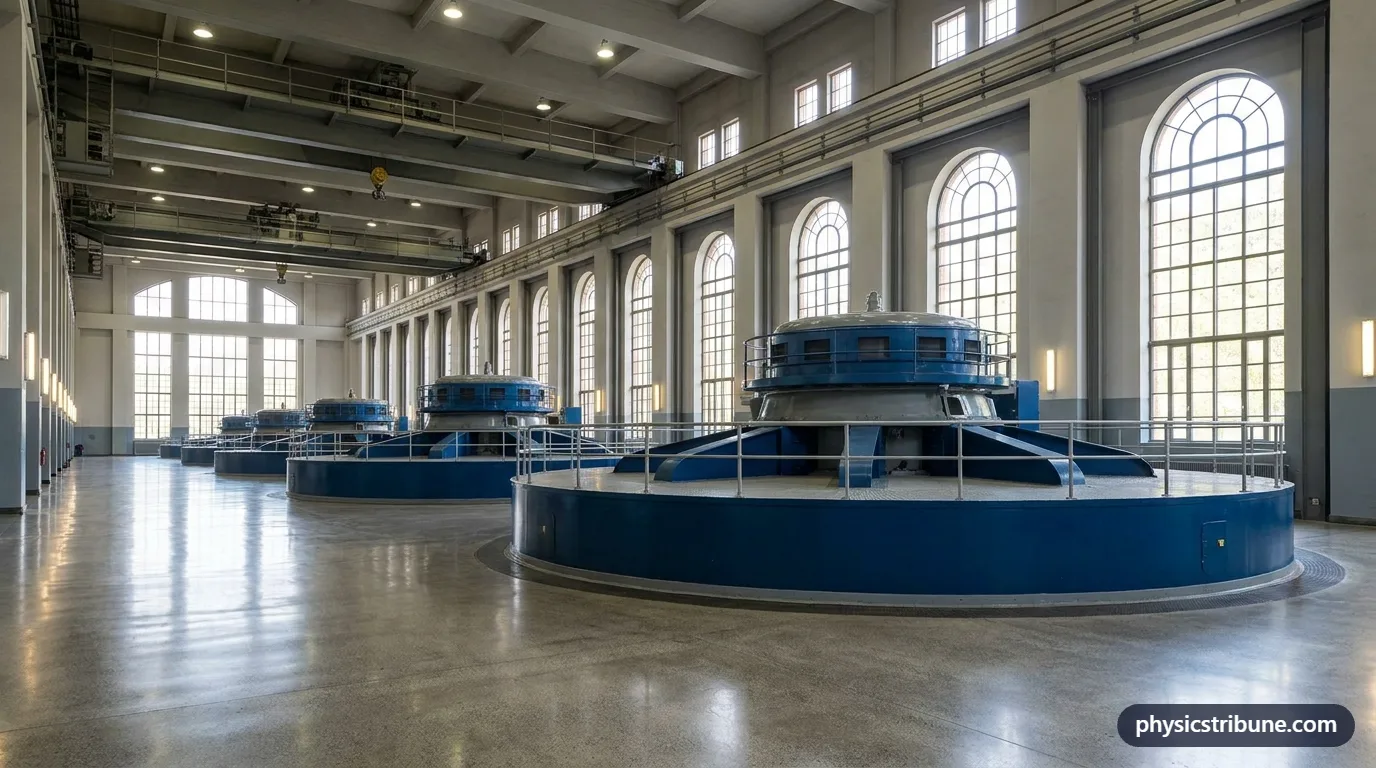
The frequency of the output equals the number of turns per second for a simple two-pole machine. That is why power-station generators are locked to a precise speed: a two-pole machine must spin at 3,600 revolutions per minute to supply 60 Hz, or 3,000 to supply 50 Hz. Machines with more poles can turn more slowly; the slow, many-poled generators in hydroelectric dams are a good example.
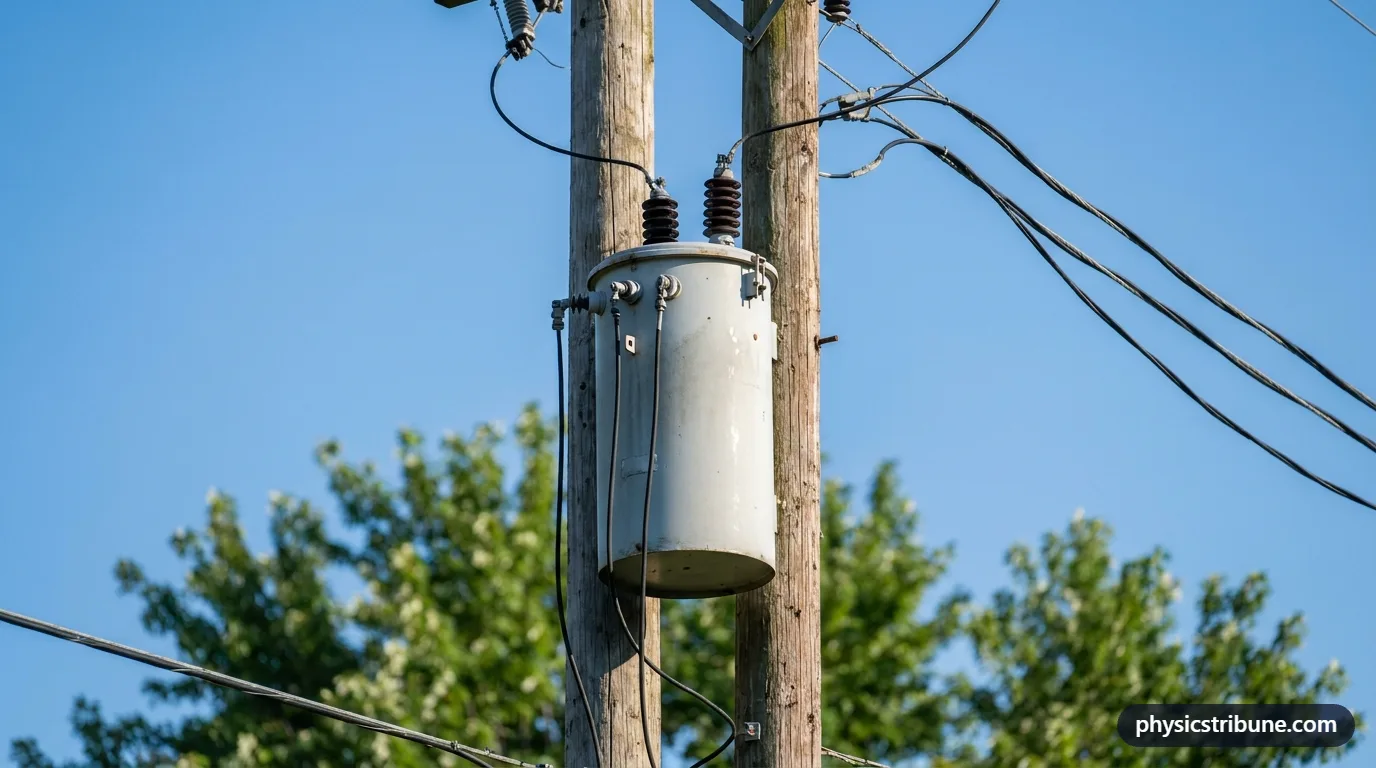
AC has a big practical advantage. Its voltage can be raised or lowered easily with a transformer, which makes long-distance transmission efficient. Read AC vs DC for the full comparison.
Example 2 Voltage partway through a turn
A generator coil has 120 turns of area 0.02 m² and turns at 60 revolutions per second in a 0.25 T field. Starting from the moment its emf is zero, what emf does it produce 0.003 s later?
- Given:
- number of turns:
- coil area:
- magnetic field:
- f:
- time:
- number of turns:
- Formula:
- Substitute:
- Answer:
At this instant the coil has not yet reached a quarter of its cycle, so the emf is still rising toward its peak.

What Is the Difference Between AC and DC Generators?
An AC generator, or alternator, connects each end of its coil to its own continuous slip ring, so the reversing emf reaches the circuit unchanged. A DC generator, or dynamo, uses a split-ring commutator instead. Just as the emf is about to reverse, the commutator swaps which end of the coil touches which brush, so the outside circuit always receives current in the same direction.
The DC output of a simple dynamo is bumpy, rising and falling to zero twice per turn. Real dynamos use many coils at different angles to smooth it out. Today most machines that need DC, such as car alternators, generate AC and then convert it with diodes, because slip rings wear far less than commutators.
| Feature | AC generator | DC generator |
|---|---|---|
| Connection to the coil | Two continuous slip rings | One split-ring commutator |
| Output | Sine-wave alternating current | Current in one direction, pulsing |
| Wear | Low, smooth rings | Higher, brushes spark across gaps |
| Voltage change | Easy with a transformer | Needs electronic converters |
| Typical uses | Power stations, wind turbines, car alternators | Older vehicles, some small and educational machines |
| Source: Qualitative comparison of standard generator designs · Retrieved October 2026 | ||
Where Are Electric Generators Used?
- Power stations: coal, gas and nuclear plants boil water into high-pressure steam that spins turbines connected to huge alternators.
- Hydroelectric dams: falling water turns slow, wide generators; see hydroelectric power.
- Wind turbines: the blades turn a generator in the nacelle at the top of the tower; see wind energy.
- Vehicles: a car's alternator, driven by the engine belt, recharges the battery and runs the electrics.
- Backup and portable power: engine-driven generators keep hospitals running during outages and power campsites and construction sites.
- Small devices: bicycle hub dynamos, wind-up flashlights and hand-crank radios.
For the bigger picture of how these machines feed homes, read how electricity is generated and our page on the national grid.

Why Is a Generator Harder to Turn When It Supplies Power?
A generator cannot make energy from nothing. When current flows in its coils, those coils sit in a magnetic field, so they feel a force. By Lenz's law that force always opposes the rotation. The more current the circuit draws, the harder the shaft is to turn, and the more mechanical work must be supplied.
You can feel this with a hand-crank flashlight: it spins freely with the lamp off and stiffens when you switch it on. Large generators turn mechanical energy into electrical energy with efficiencies typically around 98 percent, and the small remainder becomes heat in the windings and iron. This is conservation of energy at work.
Who Invented the Electric Generator?
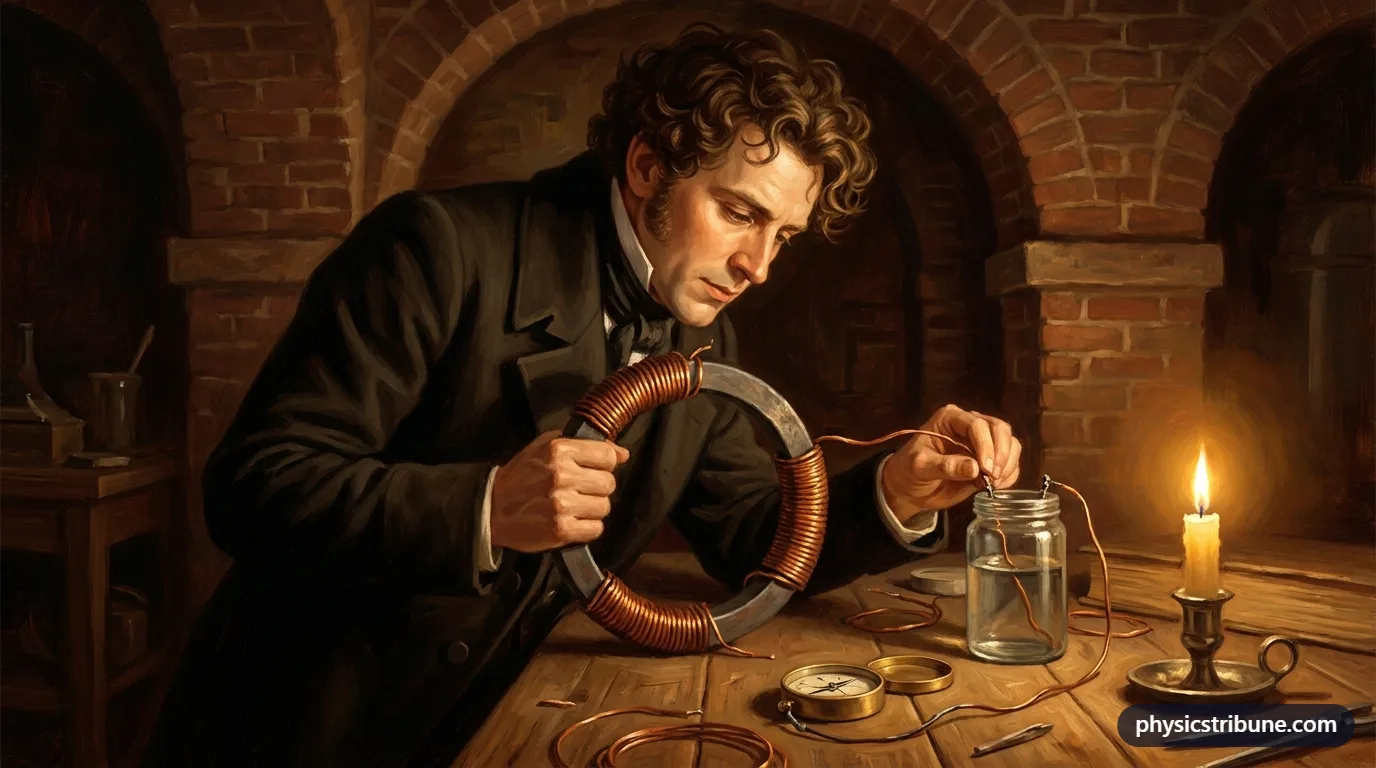
In 1831 Michael Faraday discovered electromagnetic induction and built the first generator, a copper disk spun between the poles of a magnet that produced a small steady current. The story of that discovery is told in who discovered electromagnetic induction. Within a year, instrument makers had built hand-cranked machines with spinning magnets and coils.
Practical dynamos for lighting arrived in the 1860s and 1870s, once inventors replaced permanent magnets with self-excited electromagnets. In the 1880s and 1890s Nikola Tesla and others developed polyphase AC generators and motors, which became the basis of modern power grids.
Common Misconceptions
Myth: A generator creates electricity or electric charge.
Physics: The charges are already in the wires. A generator only supplies the emf that pushes them around the circuit, converting mechanical energy into electrical energy.
Myth: Generators produce free energy once they are spinning.
Physics: Drawing current makes the coil resist turning, so every joule of electrical energy must be paid for with at least a joule of mechanical work.
Myth: A magnet sitting still next to a coil produces current.
Physics: Only a changing magnetic flux induces an emf. With no motion or change, the voltage is zero no matter how strong the magnet is.
Key Facts
- An electric generator converts mechanical energy into electrical energy using electromagnetic induction.
- A coil spinning in a magnetic field produces an emf of N A B ω sin(ωt), with a peak of N A B ω.
- More turns, a larger coil, a stronger field or faster rotation all raise the generator's voltage.
- Slip rings give alternating current, while a split-ring commutator gives direct current.
- A two-pole generator must spin at 3,600 rpm for 60 Hz or 3,000 rpm for 50 Hz output.
- Lenz's law makes a loaded generator harder to turn, so energy is conserved.
- Michael Faraday built the first generator, a spinning copper disk, in 1831.
Quick Quiz: How Well Do You Know How Electric Generators Work?
6 questions. Tap an answer to check it.
Which physical principle does an electric generator use?
A changing magnetic flux through the coil induces an emf, as described by Faraday's law.
What happens to the peak emf if a generator's coil spins twice as fast?
The peak emf is N A B ω, which is proportional to the angular speed ω.
Which part makes a simple generator give direct current?
The commutator reverses the coil connections every half turn so the output current keeps one direction.
Why does a generator become harder to turn when a lamp is switched on?
By Lenz's law the current in the coil produces a force that resists the motion causing it.
A two-pole generator spins at 3,000 revolutions per minute. What is the frequency of its output?
3,000 revolutions per minute is 50 revolutions per second, giving one cycle per turn, 50 Hz.
In what position is the emf of a spinning coil largest?
The emf depends on how fast the flux changes, which is greatest when the coil is edge-on to the field.
Frequently Asked Questions
How does a generator produce electricity?
It moves a coil of wire relative to a magnetic field, so the magnetic flux through the coil keeps changing. By Faraday's law of induction, a changing flux induces a voltage in the coil. When the coil is part of a closed circuit, that voltage drives a current, carrying energy supplied by whatever is turning the generator's shaft.
How does a generator work in simple words?
A generator spins magnets and coils of wire past each other. Each time a magnet sweeps past a coil, it gives the electrons in the wire a push. That repeated push is electricity. The energy to keep things spinning comes from an engine, steam, wind or flowing water, and the generator turns that motion into electrical energy.
Why does a generator produce electricity?
Because a changing magnetic field always produces an electric field, a rule written into Faraday's law, one of Maxwell's equations. Inside a wire, that electric field pushes the free electrons along. A generator is simply a practical way to keep the magnetic flux through a coil changing all the time, so the push never stops.
What is the difference between a generator and a motor?
They are built from the same parts but run in opposite directions. A motor takes electrical energy in and gives mechanical rotation out, using the force on a current in a magnetic field. A generator takes rotation in and gives electrical energy out, using electromagnetic induction. Many machines can work as either, which is how regenerative braking works.
Do generators produce AC or DC?
A spinning coil naturally produces alternating current, because each side of the coil moves up and then down through the field every turn. With slip rings, the AC goes out unchanged. A commutator or electronic rectifier can convert it to direct current. Power stations and wind turbines produce AC; car alternators produce AC and convert it to DC internally.
How can you increase the voltage of a generator?
The peak voltage equals N A B ω, so you can add more turns of wire, make each loop larger, use stronger magnets or an iron core to boost the field, or spin the coil faster. Spinning faster also raises the frequency, which is why grid generators use more turns and stronger fields instead of extra speed.
Is a generator 100 percent efficient?
No, but large ones come close. Big power-station generators typically convert around 98 percent of the shaft's mechanical energy into electrical energy. The rest is lost as heat from the resistance of the copper windings, from small induced currents in the iron core and from friction in the bearings. Small portable generators lose a larger share.
What energy sources turn generators?
Almost any source of motion. Steam from burning coal, gas or biomass, or from nuclear fission, drives turbines. Wind turns turbine blades directly, and falling water spins hydroelectric turbines. Diesel and gasoline engines drive backup and portable generators. Solar panels are the main exception: they make electricity directly from light, with no generator involved.