At a Glance
Alternating current is electric current that reverses direction in a repeating cycle, usually following a sine wave. Its effective value is the root-mean-square (RMS) value, V_rms = V0 / sqrt(2), where V0 is the peak voltage, so a 120 V US outlet actually swings to a peak of about 170 V. AC is used for power grids because transformers can easily raise or lower its voltage.
- Abbreviation
- AC
- SI units
- ampere (A) for current, volt (V) for voltage, hertz (Hz) for frequency
- Key formula
- V_rms = V0 / √2 (sine wave)
- Typical mains
- 120 V at 60 Hz (North America); 230 V at 50 Hz (Europe and most of the world)
- Waveform
- Sine wave, positive and negative halves
- Opposite of
- Direct current (DC), which flows one way
On this page
- What Is Alternating Current?
- Alternating Current Explained Simply
- How Is Alternating Current Produced?
- How Does an AC Waveform Change Over Time?
- What Is RMS Voltage and Why Is It Used?
- What Is the Difference Between AC and DC?
- Why Do Homes and Power Grids Use AC?
- How Much Power Does an AC Device Use?
- Who Invented Alternating Current?
- Going Deeper: How Do Capacitors and Inductors React to AC?
- Practice Alternating Current Problems
- Common Misconceptions
- Key Facts
- Quiz
- FAQ
What Is Alternating Current?
Alternating current is a flow of electric charge that keeps switching direction. For a short moment the electrons in a wire are pushed one way, then the push weakens, stops and reverses, and they are pushed the other way. The pattern repeats over and over, many times every second.
The electrons in an AC wire do not travel from the power plant to your home. They mostly rock back and forth in place by a tiny distance. What travels along the wire is the energy, carried by the electric field that pushes on them, much as a wave crosses a pond while the water itself only bobs up and down.
The number of complete back-and-forth cycles per second is the frequency, measured in hertz. The largest value the voltage or current reaches in each cycle is the peak or amplitude. Most AC supplies follow a smooth sine-wave shape, so the size of the current is always changing even while the frequency stays fixed.
Alternating Current Explained Simply
Picture a long jump rope tied to a wall. If you walk forward with it, you pull the whole rope along in one direction; that is like direct current. If you stand still and shake your hand up and down, the rope just wiggles, yet energy still travels along it and makes the far end move. That wiggle is like alternating current.
A lamp does not care which way the charges move. It glows because charges bump through the thin filament and heat it, and that happens whether they go left or right. So AC can light a bulb, heat a kettle or spin a fan just as well as a battery can.
How Is Alternating Current Produced?
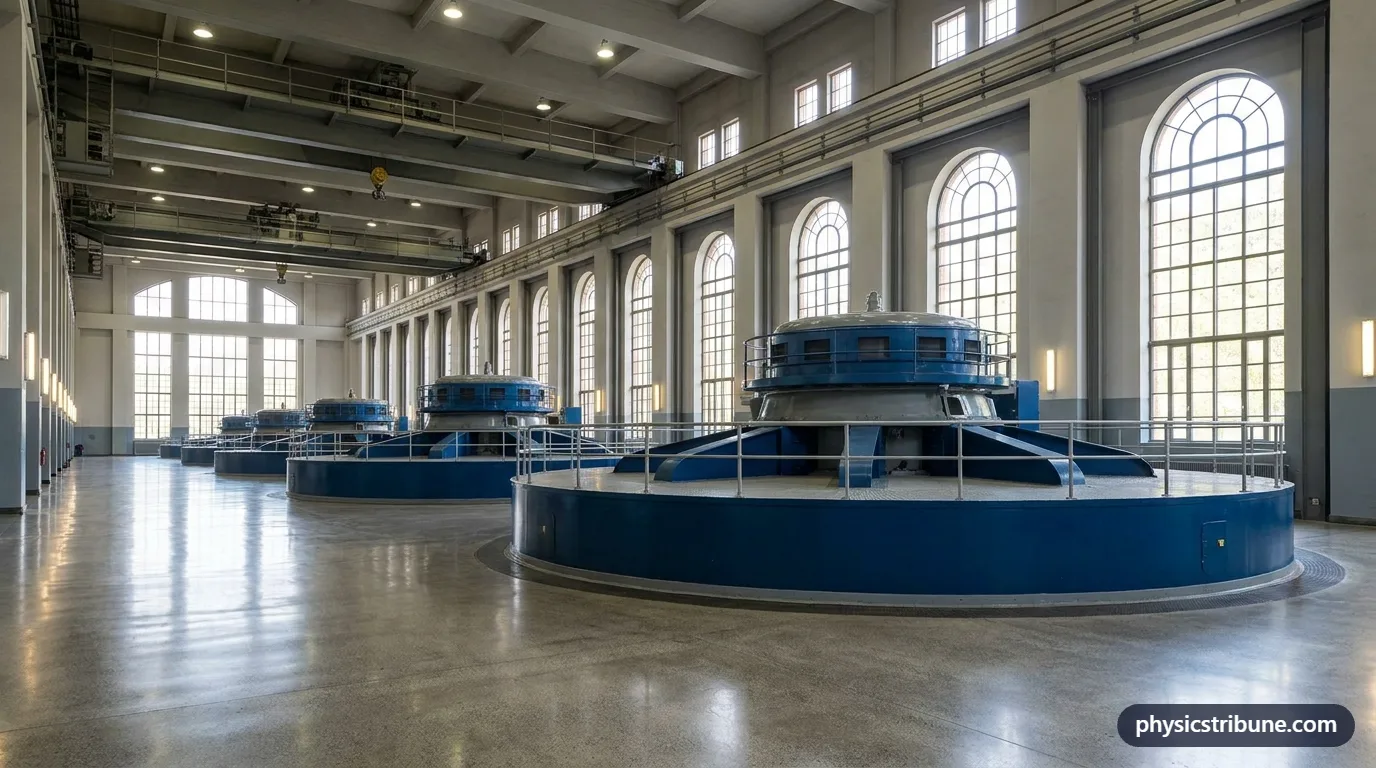
Almost all AC comes from a generator. Inside, a coil of wire spins in a magnetic field, or a magnet spins inside a coil. As the coil turns, the magnetic field through it grows, shrinks and reverses, and by Faraday's law of induction that changing field produces a voltage in the wire.
During half of each turn one side of the coil moves up through the field and the voltage points one way. During the other half it moves down and the voltage reverses. A steady rotation therefore produces a voltage that follows a sine wave, and one full turn of a simple two-pole generator makes one full cycle.
To produce 60 Hz, a simple two-pole generator would have to turn 60 times a second, or 3,600 revolutions per minute. Large power-plant generators often have more magnetic poles so they can spin more slowly while still delivering the same frequency. Steam, falling water, wind or gas turbines provide the turning, as described in how electricity is generated.
How Does an AC Waveform Change Over Time?
If you plot an AC voltage against time you get a sine wave. It starts at zero, climbs to the positive peak, falls back through zero, dips to the negative peak and returns to zero, completing one cycle. The time for one cycle is the period, and the period is simply one divided by the frequency.
At 60 Hz each cycle lasts about 16.7 milliseconds, and at 50 Hz it lasts 20 milliseconds. Because the current passes through zero twice per cycle, a 60 Hz supply actually reverses direction 120 times every second. The light from some older fluorescent tubes flickered at twice the mains frequency for exactly this reason.
The two graphs below compare the two common mains supplies. The first shows 120 V, 60 Hz mains, peaking near 170 V, with a flat line for the steady DC voltage that would give the same heating. The second shows 230 V, 50 Hz mains, peaking near 325 V with a 20 ms period. Each time the current reverses, the magnetic field around the wire reverses too, and transformers and motors depend on that constantly changing field.
| Region (typical) | RMS voltage | Frequency | Peak voltage | Period |
|---|---|---|---|---|
| United States, Canada, Mexico | 120 V | 60 Hz | 169.7 V | 16.7 ms |
| Japan | 100 V | 50 Hz (east) / 60 Hz (west) | 141.4 V | 20 ms / 16.7 ms |
| Europe, most of Asia and Africa | 230 V | 50 Hz | 325.3 V | 20 ms |
| United Kingdom, Australia (older rating) | 240 V | 50 Hz | 339.4 V | 20 ms |
| Source: Nominal supply values (typical); peak computed as V0 = √2 × V_rms and period as T = 1/f · Retrieved October 2026 | ||||


What Is RMS Voltage and Why Is It Used?
Since an AC voltage keeps changing, it needs a single number that tells you how much useful work it can do. That number is the root-mean-square or RMS value. An RMS voltage of 120 V delivers the same average heating power to a resistor as a steady DC voltage of 120 V.
For a sine wave the RMS value equals the peak divided by the square root of two,
Household meters, appliance labels and grid specifications all quote RMS values unless they say otherwise. Our RMS voltage and current page derives the factor of the square root of two and covers waveforms that are not sine waves.
Here is the RMS formula for a sine-wave supply, for both voltage and current, with each variable and its SI unit.
| Symbol | Quantity | SI unit |
|---|---|---|
| root-mean-square voltage | volt (V) | |
| peak voltage | volt (V) | |
| root-mean-square current | ampere (A) | |
| peak current | ampere (A) |
Rearranged to find another variable:
Valid for: sinusoidal AC only; average power P_ave = I_rms V_rms for a resistive load.
Example 1 Reading an oscilloscope trace
A technician connects an oscilloscope to a sine-wave supply and sees the voltage peak at 340 V on each side of zero. What RMS voltage would a standard meter display for this supply?
- Given:
- peak voltage:
- peak voltage:
- Formula:
- Substitute:
- Answer:
This is close to the 240 V supply still found in the UK and Australia, a reminder that meters show RMS, not peak, values.
Example 2 How high does a 120 V outlet really go?
A US wall outlet is rated at 120 V RMS. An engineer choosing a capacitor for a device plugged into it needs to know the highest instantaneous voltage the part will see. What is the peak voltage of the supply?
- Given:
- root-mean-square voltage:
- root-mean-square voltage:
- Formula:
- Substitute:
- Answer:
Parts connected to the mains must be rated well above this peak value, not just above the 120 V on the label.
What Is the Difference Between AC and DC?
Direct current flows steadily in one direction, the way current leaves a battery, travels around a circuit and returns to the battery. Alternating current reverses direction in a regular cycle. Both are made of the same moving charges and both obey Ohm's law in a simple resistor.
Electronics such as phones, laptops and LED bulbs run on DC inside, so their chargers and power supplies convert AC to DC. They do this with diodes arranged as a rectifier, which let current pass only one way, followed by smoothing parts that fill in the gaps. The reverse job, turning DC into AC, is done by an inverter, as in a solar panel system.
For a full side-by-side table of the two, including safety and transmission, see AC vs DC.
Why Do Homes and Power Grids Use AC?
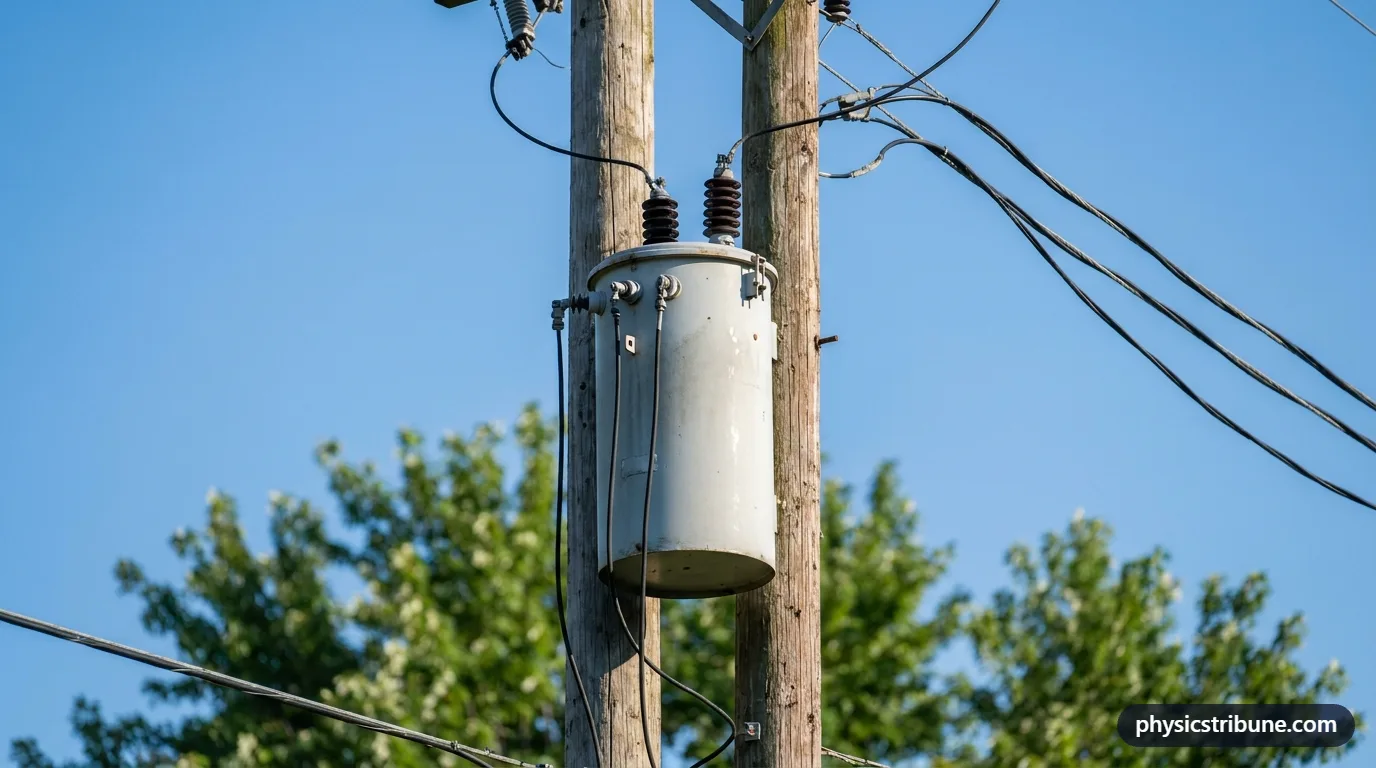
The main reason is the transformer. A transformer is two coils wrapped around an iron core, and it only works with a changing current. It can step AC voltage up or down with very little energy lost, using nothing but coils of wire and no moving parts.
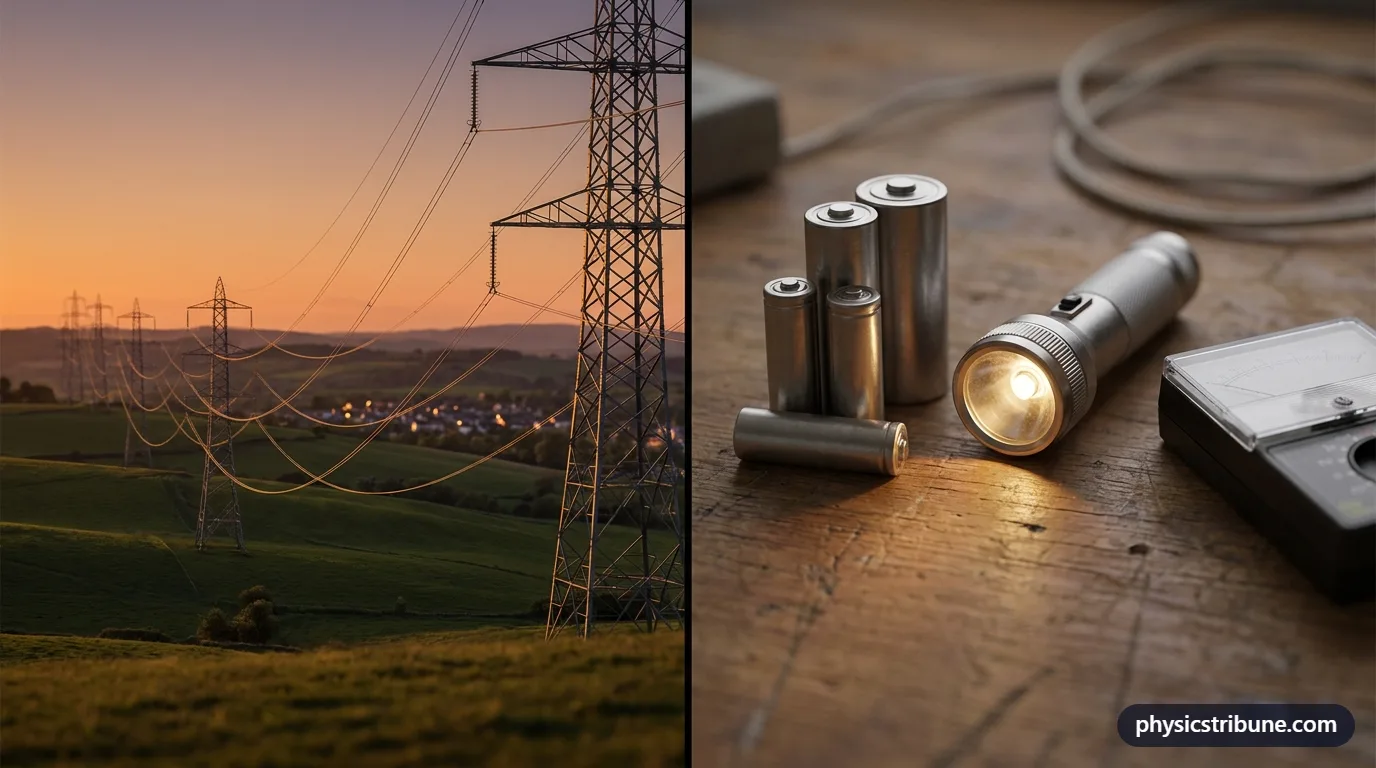
Power lines lose energy as heat in proportion to the square of the current. Sending the same power at a much higher voltage means a much smaller current, and so far smaller losses. Power stations therefore step their voltage up to hundreds of thousands of volts for long-distance lines, and local transformers step it back down for homes. The whole system is described in the power grid and mains electricity and household wiring.
AC also suits simple, rugged motors that run directly from the supply. Today some very long undersea and cross-country links use high-voltage DC, but the local grid and every home outlet are still AC.

How Much Power Does an AC Device Use?
For a simple heating load, such as a toaster, kettle or space heater, the average power is the RMS current times the RMS voltage,
Motors and other devices with coils behave differently, because their current can fall out of step with the voltage. Part of the energy then sloshes back and forth each cycle instead of being used, and the true power is smaller than the simple product. That correction is called the power factor and is explained in power in AC circuits. For quick everyday sums, use our electrical power calculator.
Example 3 Power drawn by a space heater
A portable space heater plugged into a 120 V RMS outlet draws an RMS current of 12.5 A. Treating the heater as a simple resistive load, what average power does it use?
- Given:
- current:
- voltage:
- current:
- Formula:
- Substitute:
- Answer:
Because both values are RMS, their product gives the true average power, the same heating a steady DC supply of 120 V and 12.5 A would give.
Who Invented Alternating Current?
No single person invented AC. Michael Faraday showed in 1831 that a changing magnetic field induces a current, the principle behind every AC generator. Several inventors in Europe and the United States built practical alternators and transformers in the following decades.
Nikola Tesla is the name most linked with AC because of his work on the AC induction motor and on complete multi-phase power systems in the 1880s. His designs, backed by the industrialist George Westinghouse, competed with Thomas Edison's DC networks in a public rivalry often called the war of the currents. AC won for long-distance supply because transformers made high-voltage transmission practical.
Going Deeper: How Do Capacitors and Inductors React to AC?
In a DC circuit a capacitor blocks current once it is charged, and an inductor acts like a plain wire. With AC both behave in a new way. A capacitor keeps charging and discharging, so AC passes through it more easily at high frequency. An inductor resists every change in current, so it opposes AC more strongly at high frequency.
This frequency-dependent opposition is called reactance, and combined with ordinary resistance it gives the impedance of a circuit. It is the basis of radio tuners, audio crossovers and the filters that keep electronic noise off power lines. The full treatment is in our AC circuits guide.
Practice Alternating Current Problems
Try converting between peak and RMS values for supplies around the world, then work out the power of a few appliances from their current. Our electricity worksheets include printable problems with answer keys, and every equation used here is on the electricity formulas sheet. Finish with the quiz below to check your understanding.
Common Misconceptions
Myth: In AC, electrons travel from the power station to your home.
Physics: The electrons mostly shuffle back and forth in place by a tiny distance. Energy travels through the electric and magnetic fields, not by electrons making the journey.
Myth: A 120 V outlet never goes above 120 V.
Physics: The 120 V is an RMS value. The voltage actually swings to about 170 V on each side of zero during every cycle.
Myth: Because AC averages to zero, it cannot deliver any energy.
Physics: The current averages to zero, but power depends on current squared, which is always positive. Heating happens on both halves of the cycle.
Myth: AC is always more dangerous than DC.
Physics: Both can kill at household voltages. The danger depends on current, voltage, path through the body and duration, not simply on whether it alternates.
Key Facts
- Alternating current reverses direction in a regular, repeating cycle, usually shaped like a sine wave.
- Mains electricity is 120 V at 60 Hz in North America and 230 V at 50 Hz in most other countries.
- AC voltages and currents are quoted as RMS values; for a sine wave V_rms = V0 / √2.
- A 60 Hz supply completes one cycle every 16.7 milliseconds and reverses direction 120 times a second.
- Generators produce AC by rotating a coil and a magnet relative to each other.
- Power grids use AC because transformers can raise and lower its voltage efficiently.
- Electronics run on DC, so their chargers rectify AC into DC.
Quick Quiz: How Well Do You Know Alternating Current (AC)?
6 questions. Tap an answer to check it.
What makes alternating current different from direct current?
AC reverses direction in a regular cycle, while DC always flows the same way.
A sine-wave supply is labeled 230 V. What kind of value is this?
Supply and appliance voltages are quoted as RMS values unless stated otherwise.
For a sine wave, how is the RMS voltage related to the peak voltage?
The RMS value of a sine wave is its peak divided by the square root of two, about 0.707 × V0.
How many times per second does a 50 Hz current change direction?
The current passes through zero twice in each of the 50 cycles, so it reverses 100 times a second.
Which device makes AC especially useful for power grids?
Transformers can step AC voltage up or down efficiently, which cuts losses in long power lines.
What does a phone charger mainly do to the AC from the wall?
Phone electronics run on DC, so the charger lowers the voltage and rectifies the AC into DC.
Frequently Asked Questions
What is alternating current in simple words?
Alternating current is electricity that keeps switching direction, flowing one way, then the other, many times every second. It is the kind of electricity that comes out of wall outlets. Even though it changes direction, it can still light lamps, heat water and run motors, because those devices work whether the charges move forward or backward.
What is the difference between AC and DC?
Direct current flows in one direction only, like the current from a battery. Alternating current reverses direction in a regular cycle, like the current from a wall outlet. AC is easier to transmit over long distances because transformers can change its voltage, while DC is what electronic circuits need inside, so chargers convert AC to DC.
Why do we use AC instead of DC in homes?
AC lets transformers raise the voltage for long-distance transmission and lower it again for safe use in buildings, which keeps energy losses in power lines small. When electric grids were first built, there was no cheap way to change DC voltages, so AC became the standard. It also runs simple motors directly and is easy to produce with rotating generators.
What does 60 Hz mean?
60 Hz means the alternating current completes 60 full cycles every second. Each cycle lasts about 16.7 milliseconds. Since the current passes through zero twice per cycle, it changes direction 120 times a second. North America uses 60 Hz, while most of Europe, Africa, Asia and Australia use 50 Hz, with cycles of 20 milliseconds.
What is RMS voltage?
RMS, or root-mean-square, voltage is the effective value of an AC voltage. It is the DC voltage that would deliver the same average power to a resistor. For a sine wave it equals the peak voltage divided by the square root of two, about 0.707 times the peak. The 120 V or 230 V printed on outlets and appliances are RMS values.
Is AC or DC more dangerous?
Both are dangerous at household and industrial levels. At the same voltage, AC at 50 or 60 Hz is especially good at disturbing the heart's rhythm and can make muscles clench so a person cannot let go of a wire. DC tends to cause a single strong jolt. What matters most is the current through the body, its path and how long it flows.
Do batteries produce AC or DC?
Batteries produce direct current. Their chemical reactions push charge out of one terminal and back into the other in a fixed direction, so the current always flows the same way. To get AC from a battery, for example in a camping power station or a solar home system, an electronic circuit called an inverter switches the DC back and forth to create an alternating output.
How is alternating current made?
Alternating current is made by a generator in which a coil of wire and a magnet rotate relative to each other. As the coil turns, the magnetic field passing through it keeps increasing, decreasing and reversing, which induces a voltage that flips direction every half turn. Turbines driven by steam, water, wind or gas provide the rotation in power plants.