At a Glance
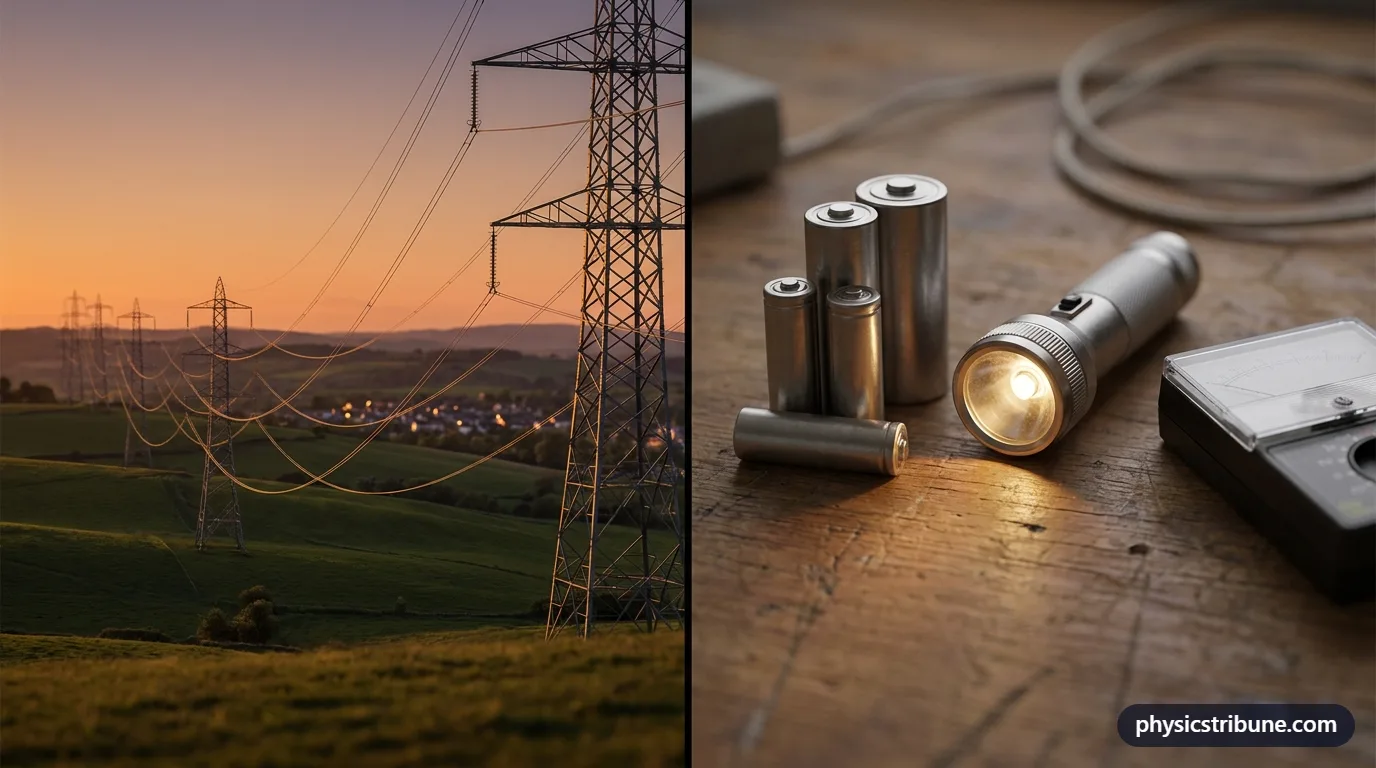
AC (alternating current) changes direction periodically, 60 times a second in the US and 50 in much of the world, and its effective voltage is V_rms = V0 / √2. DC (direct current) flows in one direction at a steady voltage, like the 1.5 V of an AA cell. Both deliver power P = I V, using rms values for AC.
- AC
- Current reverses direction periodically (sine wave)
- DC
- Current flows one way at steady voltage
- Typical source
- AC: generators, wall outlets · DC: batteries, solar cells
- Frequency
- AC: 50 or 60 Hz mains · DC: 0 Hz
- Key formula
- V_rms = V0 / √2 for AC; P = I V for both
- Unit of current
- ampere (A) for both
On this page
- What Is the Difference Between AC and DC?
- How Are Alternating and Direct Current Defined?
- How Do You Calculate AC and DC Voltage and Power?
- Why Is AC Used for the Power Grid?
- Where Is DC Better Than AC?
- What Are Examples of AC and DC?
- Is AC or DC More Dangerous?
- How Can You Practice AC and DC Problems?
- Common Misconceptions
- Key Facts
- Quiz
- FAQ
What Is the Difference Between AC and DC?
Electric current is a flow of charge, and the question is simply which way it flows. In direct current the charges drift in one direction around the circuit the whole time. In alternating current they drift one way, slow to a stop, then drift back the other way, repeating this cycle over and over.
The voltage behaves the same way. A DC source holds one terminal positive and the other negative, so a graph of its voltage against time is a flat line. An AC source swaps the polarity of its terminals smoothly, so its voltage traces a sine wave that rises, falls through zero and dips negative.
Both kinds of current can light a bulb, spin a motor or heat a wire. The difference shows up in how easily each can be generated, transformed, stored and sent over long distances. The table below lines them up feature by feature.
| Feature | AC (alternating current) | DC (direct current) |
|---|---|---|
| Direction of current | Reverses periodically | Always the same |
| Voltage vs time graph | Sine wave | Flat line |
| Frequency | 50 or 60 Hz for mains power | 0 Hz |
| Typical sources | Generators, alternators, wall outlets | Batteries, solar cells, fuel cells, chargers |
| How voltage is quoted | rms value (peak divided by √2) | Single steady value |
| Power formula | P = I_rms V_rms (resistive loads) | P = I V |
| Change voltage with a transformer? | Yes, easily | No, needs electronic converters |
| Can it be stored? | No, must be converted first | Yes, in batteries |
| Main uses | Grid transmission, heaters, many motors | Electronics, vehicles, portable devices |
| Converted to the other by | Rectifier (AC to DC) | Inverter (DC to AC) |
| Typical household value | 120 V at 60 Hz (US), 230 V at 50 Hz (Europe) | 1.5 V cell, 12 V car battery, 5 V USB |
| Circuit symbol | Circle with a sine wave | Long and short parallel lines |
| Source: Definitions as used in standard SI electricity; mains voltages and frequencies are typical published supply values; example values are illustrative · Retrieved October 2026 | ||
How Are Alternating and Direct Current Defined?
Direct current is current whose direction does not change over time. Its size can vary a little, as when a battery runs down, but it never reverses. Batteries, fuel cells, solar panels and the charger brick for a phone all supply DC.
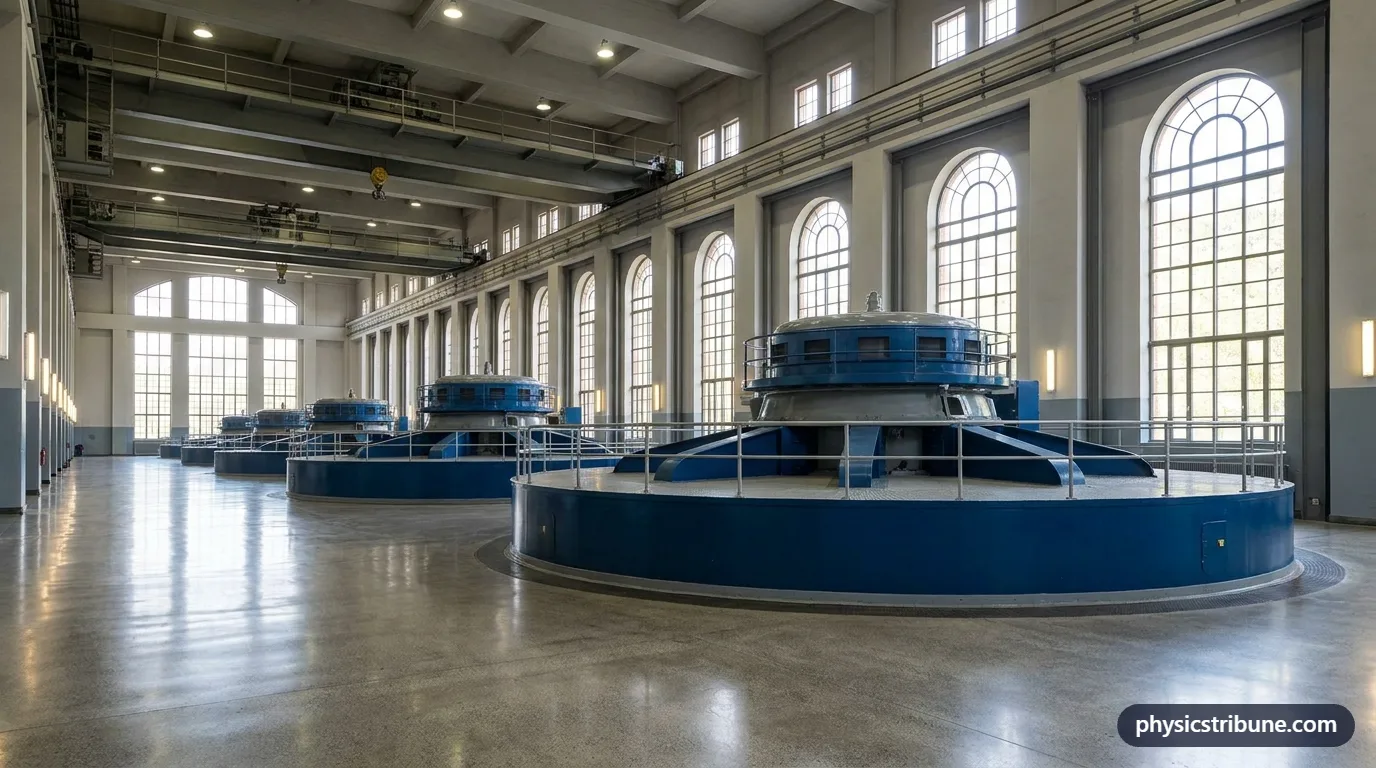
Alternating current is current that reverses direction at regular intervals. In power systems the reversal follows a smooth sine curve, set by the steady spinning of an electric generator in a power plant. The number of complete cycles each second is the frequency, measured in hertz.
Mains electricity in the United States runs at 60 Hz, so the current changes direction 120 times every second. Much of Europe, Asia and Africa uses 50 Hz. A DC supply has a frequency of zero, because it never completes a cycle.

How Do You Calculate AC and DC Voltage and Power?
For DC the numbers are straightforward. A 9 V battery provides 9 V, and the power to a device is
AC needs one extra idea, because its voltage is constantly changing. Engineers quote the root-mean-square (rms) value, which is the DC voltage that would heat a resistor at the same average rate. For a sine wave the rms value is the peak divided by
Once you use rms values, the DC formulas work for AC heaters and lamps too. Motors and other devices with coils or capacitors add a complication called phase, which our power in AC circuits page covers. The worked examples below compare the two kinds of supply.
This is how the effective (rms) value of an AC voltage or current relates to its peak value; a DC value needs no such conversion.
| Symbol | Quantity | SI unit |
|---|---|---|
| root-mean-square voltage | volt (V) | |
| peak voltage | volt (V) | |
| root-mean-square current | ampere (A) | |
| peak current | ampere (A) |
Rearranged to find another variable:
Valid for: sinusoidal AC only; average power P_ave = I_rms V_rms for a resistive load.
Example 1 Peak voltage hidden in a 120 V outlet
A North American wall outlet is rated 120 V, which is its rms value. The voltage swings between a positive and a negative peak V0. Taking V_rms = 120 V, what is the peak voltage V0?
- Given:
- root-mean-square voltage:
- root-mean-square voltage:
- Formula:
- Substitute:
- Answer:
The voltage actually reaches this peak twice in every cycle, once in each direction, which is why insulation is rated above the nameplate voltage.
Example 2 A DC car accessory
A portable cooler plugged into a car's 12 V DC socket draws a steady current of 4 A. How much electrical power does it use?
- Given:
- current:
- voltage:
- current:
- Formula:
- Substitute:
- Answer:
Because the current is DC, voltage and current are constant and no rms conversion is needed.
Example 3 An AC kettle
An electric kettle on a 230 V rms supply draws an rms current of 8 A. Using rms values, what average power does it deliver to the water?
- Given:
- current:
- voltage:
- current:
- Formula:
- Substitute:
- Answer:
Using rms values lets the familiar P = I V formula give the true average power of an AC heater.
Why Is AC Used for the Power Grid?
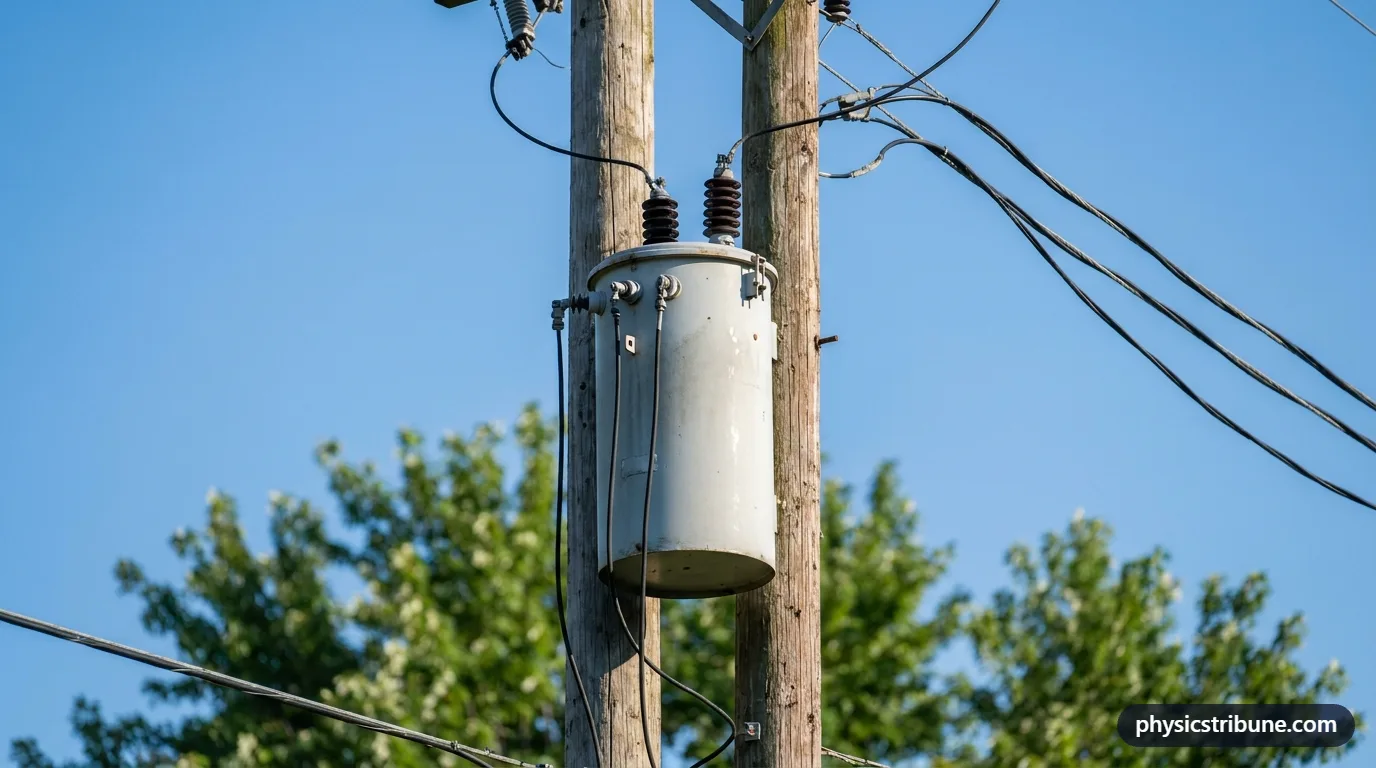
The main reason is the transformer. A transformer uses a changing magnetic field to raise or lower voltage, and only a changing current produces a changing field. AC changes all the time, so transformers work on it with no moving parts and very little waste. Steady DC passes through a transformer coil without inducing anything at all.
High voltage matters because power lost as heat in a cable grows with the square of the current. Sending the same power at a much higher voltage means a much smaller current, and so far smaller losses. Power stations step the voltage up for long-distance lines, and local transformers step it back down for homes. The step-up vs step-down transformer comparison shows how the turns ratio sets the change.
AC generators are also simple to build: a coil spinning in a magnetic field naturally produces a sine-wave voltage. That combination of easy generation and easy voltage change is why AC won the early contest between the two systems, a story tied to Nikola Tesla and his AC motor and power designs.
Where Is DC Better Than AC?
Electronics prefer DC. Transistors, computer chips, LEDs and memory all need a steady voltage of a fixed polarity, so every laptop and phone charger converts AC from the wall into low-voltage DC. That conversion uses a rectifier made of diodes, which let current through in one direction only, followed by smoothing parts.
DC is also the only kind you can store. Batteries hold energy chemically and release it as DC, which is why electric cars, flashlights and backup power systems are DC at heart. Solar cells produce DC directly, and an inverter converts it to AC when the energy feeds the grid.
Very long undersea and overland links now often use high-voltage DC, because over hundreds of kilometers DC avoids some losses that AC lines suffer. Modern power electronics can change DC voltages too, so the old advantage of AC is no longer absolute.
What Are Examples of AC and DC?
Devices that run on DC:
- A flashlight powered by two AA cells.
- A smartphone, after its charger converts the wall supply.
- A car's lights, radio and starter motor, fed by a 12 V battery.
- A solar garden lamp charging its battery during the day.
Devices that run directly on AC:
- A toaster or kettle plugged into a wall outlet.
- An old-style incandescent bulb in a ceiling fixture.
- A household refrigerator compressor or ceiling fan motor.
- The long-distance transmission lines of the national grid.
Many modern appliances use both. A washing machine takes AC from the wall but converts some of it to DC to run its control board and a variable-speed motor drive.
Is AC or DC More Dangerous?
Both can kill, and the danger depends mostly on the current that flows through the body, the path it takes and how long it lasts. Household AC is especially hazardous because a frequency of 50 or 60 Hz is good at disrupting the rhythm of the heart. It can also make muscles clamp, so a person may be unable to let go of a live wire.
High-voltage DC is just as able to cause deep burns and cardiac arrest. Low-voltage DC, such as a 9 V battery, is safe to touch because dry skin keeps the current tiny. Follow the rules in our electrical safety guide whichever supply you are working with.
How Can You Practice AC and DC Problems?
Try converting between peak and rms values, then compute power for the same appliance on 120 V and 230 V supplies. Our electrical power calculator checks the arithmetic, and the electricity worksheets include printable problems with answer keys. The quiz below tests the key ideas.
Common Misconceptions
Myth: In AC the electrons travel from the power station to your home and back.
Physics: In AC the electrons only jiggle back and forth by a tiny distance. Energy travels along the wires as an electromagnetic effect, not as electrons making the trip.
Myth: A 120 V AC outlet never goes above 120 V.
Physics: 120 V is the rms value. The voltage actually peaks at about 170 V in each direction during every cycle.
Myth: DC is always safe and AC is always dangerous.
Physics: Danger depends on the current through the body. Low-voltage DC is harmless, but high-voltage DC can be deadly, just like mains AC.
Myth: Batteries can be charged directly from AC.
Physics: Charging needs current in one direction, so chargers first rectify AC into DC before it reaches the battery.
Key Facts
- Alternating current reverses direction periodically, while direct current always flows the same way.
- US mains power is 120 V at 60 Hz, and much of the world uses 230 V at 50 Hz.
- AC voltage is quoted as an rms value, equal to the peak voltage divided by √2 for a sine wave.
- Transformers work only with changing current, which is why the power grid uses AC.
- Batteries, solar cells and electronic circuits produce or need DC.
- A rectifier converts AC to DC, and an inverter converts DC to AC.
- Electric power is P = I V for DC and for AC when rms values are used with resistive loads.
Quick Quiz: How Well Do You Know Ac vs Dc?
6 questions. Tap an answer to check it.
Which kind of current reverses direction periodically?
Alternating current changes direction in every cycle, while direct current always flows one way.
Which source produces direct current?
Batteries push charge in one direction only, so they supply DC.
Why does the power grid use AC?
Transformers need a changing current, so they work with AC and make high-voltage transmission practical.
A sine-wave supply has an rms voltage of 230 V. Its peak voltage is
The peak is √2 times the rms value, so it is higher, about 325 V.
What device converts AC to DC?
A rectifier uses diodes to let current pass in only one direction.
What is the frequency of an ideal DC supply?
DC never completes a cycle of reversal, so its frequency is zero.
Frequently Asked Questions
What is the difference between AC and DC current?
AC, or alternating current, reverses direction many times per second, following a sine wave. DC, or direct current, flows in one direction only at a steady voltage. Homes receive AC from the grid, while batteries and solar cells supply DC. Most electronic devices convert incoming AC to DC internally before using it.
Is household electricity AC or DC?
Household outlets supply AC. In the United States the standard is 120 V at 60 Hz, with 240 V circuits for large appliances, and much of the world uses 230 V at 50 Hz. Inside many devices the AC is converted to DC, which is what the small black chargers for phones and laptops do.
Why do we use AC instead of DC for power lines?
AC lets transformers raise the voltage for transmission and lower it again for homes. Higher voltage means lower current for the same power, and heat lost in cables depends on the square of the current, so losses drop sharply. AC generators are also simple to build. High-voltage DC is still used for some very long links.
Is a battery AC or DC?
A battery produces DC. Its chemical reactions push charge out of one terminal and into the other, always in the same direction, so the current never reverses. That is why batteries have fixed positive and negative ends. To run AC equipment from a battery, you need an inverter, which switches the DC back and forth electronically.
What does rms mean for AC voltage?
Rms stands for root mean square. It is the effective value of an AC voltage or current: the steady DC value that would deliver the same average heating power to a resistor. For a sine wave the rms value equals the peak value divided by the square root of 2, which is about 0.707 times the peak.
Can AC be converted to DC?
Yes. A rectifier made of diodes allows current through in only one direction, turning AC into a bumpy DC. Capacitors and voltage regulators then smooth it into a steady supply. Every phone charger, computer power supply and LED driver contains this kind of circuit. The reverse process, DC to AC, uses an inverter.
Which is more dangerous, AC or DC?
At the same voltage, household AC is often considered more dangerous because 50 or 60 Hz current easily upsets the heart's rhythm and can make muscles grip a wire. High-voltage DC is still deadly and causes severe burns. What matters most is how much current passes through the body, which depends on voltage and skin resistance.
Do cars use AC or DC?
A car's electrical system is DC, powered by a 12 V battery in most gasoline cars. The engine's alternator actually generates AC, which is rectified to DC before charging the battery. Electric cars store energy as DC in their battery packs and use inverters to drive AC motors, so they rely on both.
Keep Exploring




Sources
Constants come from NIST CODATA 2022 (public domain) and unit definitions from the BIPM SI Brochure (CC BY 4.0). Text, diagrams and illustrations are original work by Physics Tribune.