At a Glance
Force is a push or pull, a vector measured in newtons (N), given by F = m a. Energy is the capacity to do work, a scalar measured in joules (J). The bridge between them is work, W = F d: a force moving an object through a distance transfers energy, and 1 J = 1 N·m.
- Force
- Push or pull, vector, unit newton (N)
- Energy
- Capacity to do work, scalar, unit joule (J)
- Link
- Work: W = F d (1 J = 1 N·m)
- Conserved?
- Energy yes · force no
- Can be stored?
- Energy yes · force no
- Key formulas
- F = m a · KE = ½ m v²
On this page
- What Is the Difference Between Force and Energy?
- How Are Force and Energy Defined?
- How Is Force Related to Energy?
- Can a Force Act Without Transferring Energy?
- Can Energy Exist Without a Force?
- What Are Examples of Force and Energy?
- Why Do People Confuse Force and Energy?
- Common Misconceptions
- Key Facts
- Quiz
- FAQ
What Is the Difference Between Force and Energy?
Force and energy are both central ideas in physics, and both are linked to motion, so they are easy to blur together. They describe very different things. A force is an interaction, a push or pull happening right now. Energy is a quantity an object or system has, a measure of how much work it can do.
One way to see the difference is to ask what happens when the push stops. A force exists only while the interaction lasts; let go of a ball and your hand's force on it is gone. The energy you gave the ball does not vanish. It travels with the ball as kinetic energy until something else takes it away.
They also differ in type. Force is a vector, so direction matters and two equal forces can cancel. Energy is a scalar, so it is just a number of joules, and amounts simply add. The table below compares them feature by feature.
| Feature | Force | Energy |
|---|---|---|
| What it is | A push or pull, an interaction | The capacity to do work |
| Question it answers | How hard, and which way? | How much? |
| Type of quantity | Vector | Scalar |
| Key formula | F = m a | KE = ½ m v², PE = m g h |
| SI unit | newton (N) | joule (J) = N·m |
| Base SI units | kg·m/s² | kg·m²/s² |
| Can cancel out? | Yes, opposite forces sum to zero | No, amounts simply add as numbers |
| Conserved? | No | Yes, in an isolated system |
| Can be stored? | No | Yes, as potential, chemical or thermal energy |
| Exists after contact ends? | No | Yes, it stays with the object |
| Connected by | Work: W = F d | Work: W = F d |
| Measured with | Spring scale, force sensor | Calculated from mass, speed, height or heat |
| Key physicist | Isaac Newton | James Prescott Joule |
| Source: Definitions as used in standard SI mechanics; SI unit definitions per BIPM · Retrieved October 2026 | ||
How Are Force and Energy Defined?
A force is any push or pull that can change an object's motion or shape. Newton's second law defines its size through the acceleration it produces,
Energy is the capacity to do work or to heat something. It takes many forms, including kinetic energy of motion, potential energy of position and thermal energy of jiggling particles. The SI unit is the joule, which is defined through force: one joule is the work done when a 1 N force moves an object 1 m.
That definition of the joule already hints at the link. Energy is measured in newton-meters, a force multiplied by a distance. Without the distance, a force on its own transfers no energy.
How Is Force Related to Energy?
The connection is work. When a force
The work-energy theorem finishes the story: the net work done on an object equals its change in kinetic energy,
Our work calculator handles
Work is the bridge between force and energy: a force times the distance it moves an object along its direction gives the energy transferred.
| Symbol | Quantity | SI unit |
|---|---|---|
| work done | joule (J) | |
| force (component along the displacement) | newton (N) | |
| displacement | meter (m) |
Rearranged to find another variable:
Valid for: constant force parallel to displacement.
Example 1 Pushing a crate across a warehouse
A worker pushes a crate with a steady horizontal force of 150 N, and the crate slides 8 m in the direction of the push. How much energy does the worker transfer?
- Given:
- force (component along the displacement):
- displacement:
- force (component along the displacement):
- Formula:
- Substitute:
- Answer:
The crate moves at constant speed, so this energy goes into heating the floor and crate through friction rather than into extra speed.
Can a Force Act Without Transferring Energy?
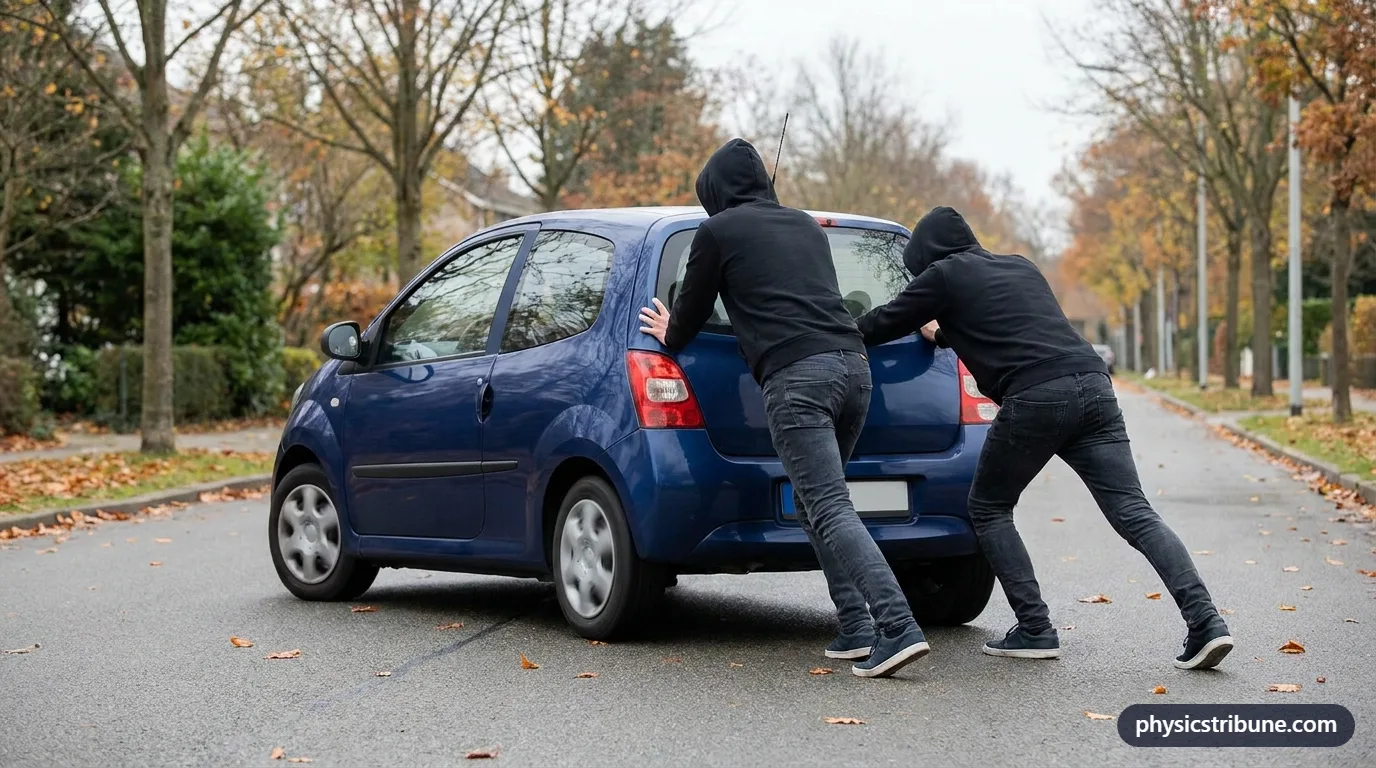
Yes, in several common situations. If you push against a solid wall, you exert a real force, but the wall does not move, so the distance is zero and no energy is transferred to the wall. You still feel tired because your muscles use chemical energy internally just to stay tense.
A force at right angles to the motion also does no work. The tension in a string swinging a ball in a circle pulls toward the center, while the ball moves along the circle, so the string never changes the ball's speed. The same is true of gravity on a satellite in a circular orbit.
Balanced forces are a third case. In the diagram below a crate slides at constant speed: the push and the friction are equal and opposite, so the net force is zero and the kinetic energy does not change. Energy is still flowing, though: the push transfers it in, and friction turns it into heat.

Can Energy Exist Without a Force?
Energy can certainly exist when no force is acting at that moment. A hockey puck gliding across nearly frictionless ice has kinetic energy,
Forces were usually involved in putting the energy there. A stick pushed the puck, and a charger drove charge into the battery. Potential energy is the clearest link: it is energy stored in a system because of forces between its parts, such as gravity between a raised book and Earth, or the springiness of a stretched band. Our kinetic vs potential energy page compares those two stores.
Energy also obeys a rule that force does not. The law of conservation of energy says the total energy of an isolated system stays constant. Forces come and go and can cancel to zero, but energy only moves between objects or changes form.
Example 2 Energy carried by a thrown ball
A pitcher throws a 0.15 kg ball so that it leaves his hand at 30 m/s. How much kinetic energy does the ball carry?
- Given:
- mass:
- speed:
- mass:
- Formula:
- Substitute:
- Answer:
Once the ball leaves the hand, no throwing force acts on it anymore, but the energy that force transferred stays with the ball.
What Are Examples of Force and Energy?
Statements about force describe a push or pull and its direction:
- A magnet pulls a paper clip toward it.
- A rope holds a climber with an upward tension of about 700 N.
- Air resistance pushes backward on a cyclist.
Statements about energy describe an amount, with no direction:
- A rolling bowling ball has kinetic energy.
- Water behind a dam stores gravitational potential energy.
- A cup of hot cocoa holds thermal energy that slowly spreads to the room.
A useful test is to ask "which way?" If the question makes sense, you are probably talking about a force. If only "how much?" makes sense, you are dealing with energy.
Why Do People Confuse Force and Energy?
Everyday language is part of the problem. People say a storm hit with great "force" when they mean energy, or that a person has lots of "energy" when they mean stamina. Older science writing also used the word force for what we now call energy, before the two ideas were cleanly separated in the 1800s.
The units add to the confusion. A newton-meter can mean a joule of energy, but it is also the unit of torque, a turning force. The two share the same base units yet describe different things, so physicists write energy in joules and torque in newton-meters to keep them apart.
For problems that mix the two ideas, try our force and motion worksheets with printable answer keys, and see energy vs power for the next step: how fast energy is transferred.
Common Misconceptions
Myth: Force and energy are the same thing.
Physics: Force is a push or pull at a moment, measured in newtons. Energy is a stored or transferred amount, measured in joules. A force only transfers energy when it acts through a distance.
Myth: If you push hard and get tired, you must have done work on the object.
Physics: In physics, work requires the object to move along the force. Pushing a wall that stays put does no work on the wall, even though your muscles use energy.
Myth: A moving object must have a force acting on it to keep its energy.
Physics: An object keeps moving and keeps its kinetic energy with no force at all. Forces are only needed to change its speed or direction.
Myth: A bigger force always means more energy.
Physics: The energy transferred depends on force and distance together. A small force over a long distance can transfer more energy than a large force over a short one.
Key Facts
- Force is a push or pull measured in newtons; energy is the capacity to do work measured in joules.
- Force is a vector, while energy is a scalar.
- A force transfers energy only when it moves an object through a distance: W = F d.
- One joule equals one newton-meter of work.
- Energy is conserved in an isolated system, but forces can appear, disappear or cancel.
- Pushing on a wall that does not move exerts a force but transfers no energy to the wall.
- Objects keep their kinetic energy after the force that gave it to them stops acting.
Quick Quiz: How Well Do You Know Force vs Energy?
6 questions. Tap an answer to check it.
What is the SI unit of energy?
Energy is measured in joules, where 1 J = 1 N·m.
A 40 N force moves a box 3 m in the direction of the force. How much work is done?
W = F d = 40 N × 3 m = 120 J.
Which quantity is a vector?
Force has a direction; energy and work are scalars.
You push on a brick wall for a minute and it does not move. How much work do you do on the wall?
Work needs a displacement along the force; with no movement the work is zero.
Which is conserved in an isolated system?
Total energy stays constant; forces can appear, vanish or cancel.
One joule is equal to:
A joule is the work done by a 1 N force over 1 m.
Frequently Asked Questions
What is the main difference between force and energy?
Force is a push or pull that acts on an object, measured in newtons and having a direction. Energy is the capacity to do work, measured in joules, with no direction. Force describes an interaction happening right now, while energy describes an amount an object or system has. They are connected through work, W = F d.
Is force a form of energy?
No. Force is not a type of energy, and it cannot be stored. It is an interaction between objects. Energy is a separate quantity that can be stored and transferred. A force becomes a way of transferring energy only when it moves an object through a distance, which is what physicists call doing work.
What is the unit of force and energy?
Force is measured in newtons (N), where 1 N = 1 kg·m/s². Energy is measured in joules (J), where 1 J = 1 N·m, the energy transferred when a 1 N force moves something 1 m. So the joule is built from the newton, which shows how closely the two ideas are related while still being different quantities.
How does force transfer energy?
A force transfers energy by doing work: pushing or pulling an object through a distance in the direction of the force. The energy transferred equals the force multiplied by that distance. If the object speeds up, the energy becomes kinetic energy; if it is lifted, it becomes potential energy; if friction is involved, some becomes thermal energy.
Can there be force without energy?
A force can act without transferring any energy. Holding a heavy bag still, pushing against a fixed wall or a string pulling a ball around a circle at constant speed are all examples. In each case either the object does not move or it moves at right angles to the force, so no work is done and no energy is transferred by that force.
Is energy a vector or a scalar?
Energy is a scalar. It has a size but no direction, so a ball moving east and the same ball moving west at the same speed have the same kinetic energy. Force, by contrast, is a vector, and its direction matters. This is one reason energy calculations are often simpler than force calculations.
Which is conserved, force or energy?
Energy is conserved: in an isolated system the total amount stays the same, even as it changes form. Force has no such rule. Forces can appear when objects touch, disappear when they separate and cancel when they are balanced. Momentum, which is related to force over time, is also conserved, but force itself is not.
Why do I get tired holding something still if no work is done?
No work is done on the object, because it does not move. Your muscles, however, keep contracting and relaxing their fibers to hold the load, and that process uses chemical energy and releases heat inside your body. The energy is used up internally, not transferred to the object.