At a Glance
Isaac Newton (born January 4, 1643, died March 31, 1727) was an English physicist and mathematician best known for his three laws of motion and the law of universal gravitation, both published in 1687. His second law, written today as F_net = m a, links the net force on an object to its mass and acceleration.
- Born
- January 4, 1643 (December 25, 1642 on the calendar England used then)
- Died
- March 31, 1727 (March 20, 1726 on the old calendar), age 84
- Nationality
- Kingdom of England; Kingdom of Great Britain
- Known for
- Laws of motion, universal gravitation, optics and calculus
- Key work
- Principia (1687) and Opticks (1704)
- Key equation
- F_net = m a (second law of motion)
On this page
Who Was Isaac Newton?
Isaac Newton was the scientist who turned motion into mathematics. Before him, people described how things moved; after him, they could predict it. His book Philosophiae Naturalis Principia Mathematica, usually shortened to the Principia, laid out three laws of motion and one law of gravity that together explained a thrown stone, the tides and the orbit of the Moon with the same handful of ideas.
He was also a careful experimenter. With glass prisms and a darkened room he showed that sunlight is a blend of colors, and he built the first working reflecting telescope. On top of that he invented the mathematics of change that we now call calculus, which he needed to handle quantities like speed that change from moment to moment.
Newton was a private, intense and often prickly man. He held a professorship at Cambridge, later ran England's Royal Mint, and served for many years as president of the Royal Society. He was knighted by Queen Anne in 1705.
Early Life and Education
Newton was born in the hamlet of Woolsthorpe in Lincolnshire, England. England still used the older Julian calendar at the time, so the date written down was Christmas Day, December 25, 1642. On the Gregorian calendar we use today, that same day is January 4, 1643, which is why you will see both years in different books. His father, a farmer, had died a few months before he was born.
As a boy he was sent to school in nearby Grantham, where he became known for building model windmills, water clocks and sundials rather than for his marks. His mother hoped he would run the family farm, but a teacher and an uncle persuaded her to send him to Trinity College, Cambridge, which he entered in 1661.
At Cambridge the official course still taught the ideas of Aristotle. Newton read the newer thinkers on his own, including Galileo, Kepler and Descartes, and filled notebooks with questions about light, motion and mathematics that would occupy him for decades.
| Year | Event |
|---|---|
| 1643 | Born at Woolsthorpe, Lincolnshire (January 4 on today's calendar) |
| 1661 | Enters Trinity College, Cambridge |
| 1665 to 1666 | Plague closes Cambridge; early work on calculus, color and gravity at home |
| 1669 | Becomes Lucasian Professor of Mathematics at Cambridge |
| 1668 to 1671 | Builds a reflecting telescope and shows it to the Royal Society |
| 1672 | Publishes his theory of light and color |
| 1687 | Publishes the Principia with the laws of motion and universal gravitation |
| 1696 | Appointed Warden of the Royal Mint in London |
| 1703 | Elected president of the Royal Society |
| 1704 | Publishes Opticks |
| 1705 | Knighted by Queen Anne |
| 1727 | Dies in London on March 31 (today's calendar), aged 84 |
| Source: Birth and death dates from our physicists data file (Wikidata, CC0); other years are standard biographical dates · Retrieved October 2026 | |
What Did Newton Discover During the Plague Years?
In 1665 an outbreak of plague closed the university, and Newton spent much of the next two years back at Woolsthorpe. Working alone, he made early progress on three of his biggest ideas: the method of fluxions (his name for calculus), the theory that white light is made of colors, and the idea that the force holding the Moon in orbit is the same force that pulls objects to the ground.
The famous story of a falling apple comes from Newton himself, who told it to friends when he was an old man. Whether or not an apple played a part, the real insight was bold. He asked whether gravity, weakening with distance, could reach all the way to the Moon, and he compared the Moon's motion with the fall of objects on Earth to test it.
He did not publish most of this work for many years. Some of the ideas needed better data and better mathematics, and Newton was reluctant to put unfinished results in front of critics.
Newton's Three Laws of Motion
The three laws appear at the start of the Principia. Together they explain how forces change the motion of objects:
- First law (inertia): an object keeps moving at a steady speed in a straight line, or stays at rest, unless a net force acts on it. Read more in Newton's first law.
- Second law: the net force on an object equals its mass times its acceleration. A bigger force gives a bigger acceleration, and a heavier object needs more force for the same change in motion. See Newton's second law.
- Third law: when one object pushes on another, the second object pushes back with a force equal in size and opposite in direction. See Newton's third law.
The first law built on Galileo's work on inertia, but Newton was the one who joined all three into a single system that could be used to calculate. Our overview of Newton's laws of motion walks through each one with everyday examples, and the SI unit of force, the newton, is named in his honor.
How Did Newton Explain Gravity?
Newton's law of universal gravitation says that every mass attracts every other mass. The force grows with the product of the two masses and falls off with the square of the distance between them, so doubling the distance cuts the pull to a quarter.
The word "universal" was the revolution. The same rule that makes an apple drop also keeps the Moon in orbit and steers the planets around the Sun. Combined with his laws of motion, it allowed Newton to derive the patterns that Johannes Kepler had found in planetary orbits, to explain the tides as the pull of the Moon and Sun on the oceans, and to show why Earth bulges slightly at the equator.
Newton could describe gravity precisely but admitted he could not say what it was. Two centuries later, Einstein's general relativity offered a deeper picture, yet Newton's law is still what engineers use to plan most spacecraft trajectories. If you wonder who really "discovered" gravity, our answer to who discovered gravity explains what came before and after him.
Newton's Work on Light and Color
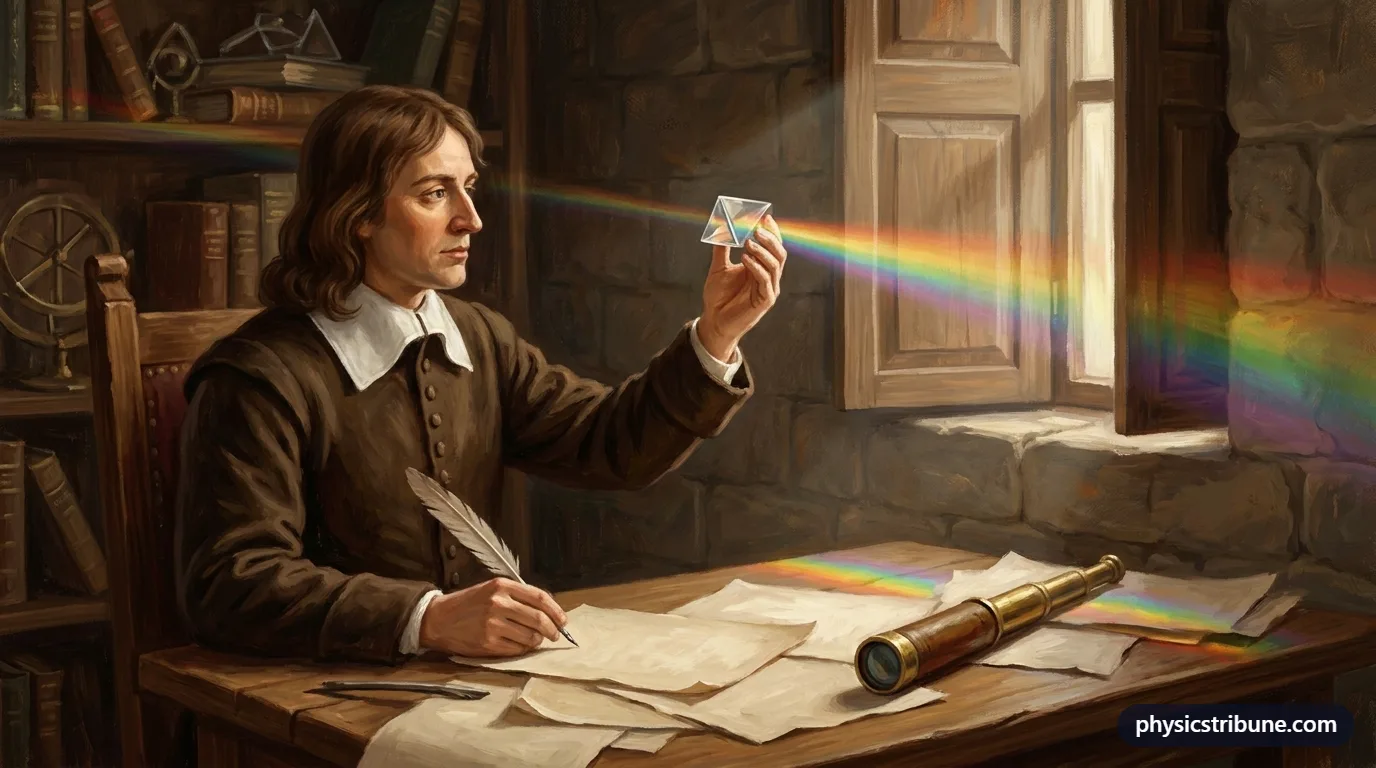
In his prism experiments, Newton let a narrow beam of sunlight pass through a triangular glass prism and watched it spread into a band of colors on the far wall. Others had seen this effect, but most thought the glass somehow added the color. Newton showed otherwise.
His key step was to pick out a single color from the spread-out band and send it through a second prism. That color bent again but did not split any further and did not change. He concluded that white light is a mixture of colors, each bending by its own amount when it enters glass, an effect now called dispersion. You can follow the steps in our write-up of Newton's prism experiment.
Because lenses bend different colors by different amounts, the telescopes of his day showed colored fringes around stars. Newton's fix was to replace the main lens with a curved mirror, which reflects all colors alike. His small reflecting telescope impressed the Royal Society, and reflectors of this kind lead directly to today's large observatory telescopes. He collected his light research in the book Opticks in 1704.

Did Newton Invent Calculus?
Yes, and so did someone else. Newton developed his method of fluxions in the mid-1660s to deal with quantities that change continuously, such as the position and speed of a moving body. The German mathematician Gottfried Wilhelm Leibniz developed his own version independently a few years later and published first.
The result was one of the most bitter priority disputes in the history of science, with supporters of each man accusing the other of copying. Historians today credit both. Leibniz's notation, with its dx and dy, is the one students learn, while Newton's ideas shaped how the tools were first applied to physics. You can see calculus at work in motion problems on our page about kinematics with calculus.
Newton's Key Equation
Newton wrote his second law in words and geometry, describing change in motion as proportional to the force applied. The compact modern form,
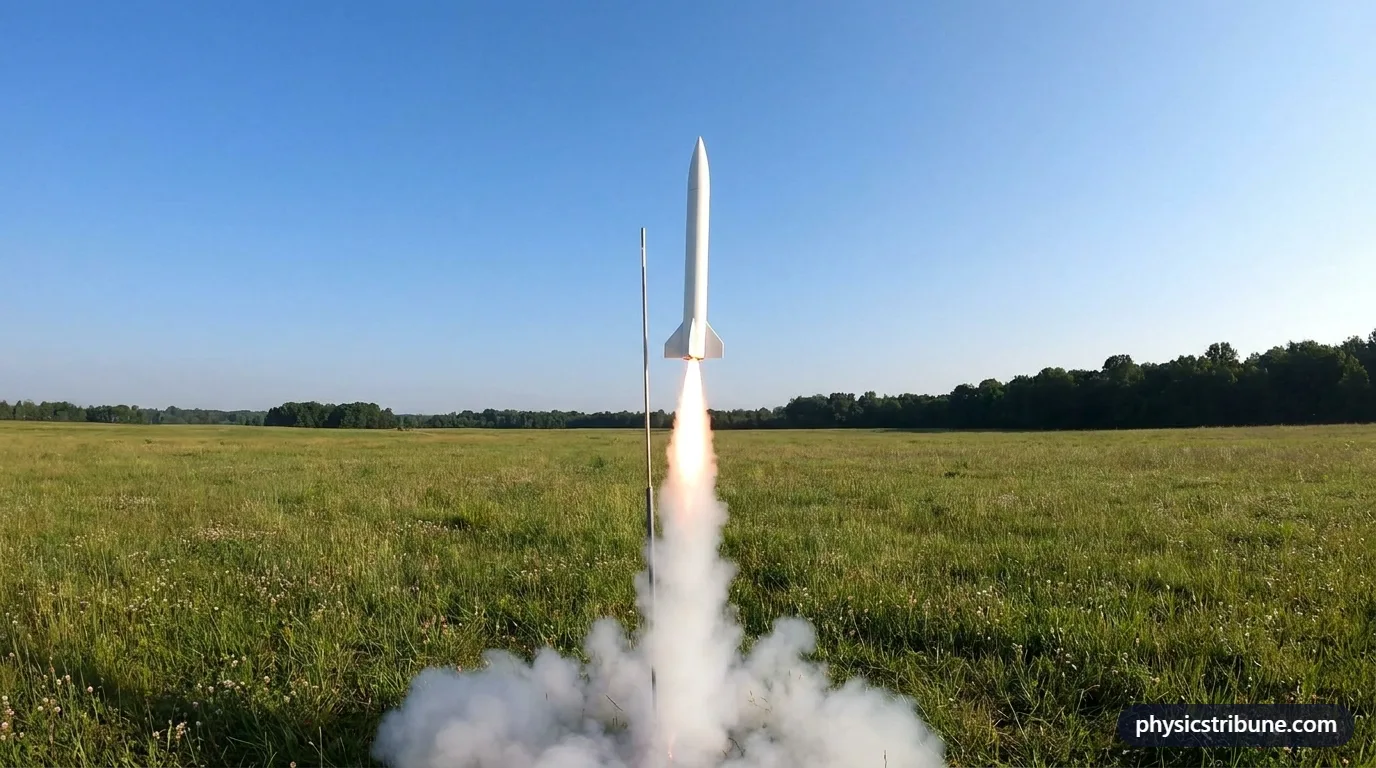
The equation is a workhorse. It tells you how hard a rocket must push to climb, how quickly a car can stop, and why a heavy truck needs more force than a bicycle to speed up at the same rate. Our force calculator solves it for any one of the three quantities.
Here is the second law in its modern form, with each variable and its SI unit, plus the two rearranged versions.
| Symbol | Quantity | SI unit |
|---|---|---|
| net external force | newton (N) | |
| mass | kilogram (kg) | |
| acceleration | meter per second squared (m/s²) |
Rearranged to find another variable:
Valid for: constant mass, inertial reference frame; vector equation (a points along F_net).
Example 1 Pushing a stalled go-kart
Two friends push a 150 kg go-kart (driver included) and it speeds up at 0.8 m/s². What net force are they applying?
- Given:
- mass:
- acceleration:
- mass:
- Formula:
- Substitute:
- Answer:
This is the net force, so the friends must actually push a little harder than this to also overcome rolling friction.
Later Life and Legacy
After the Principia made him famous, Newton left academic life for public office. In 1696 he became Warden of the Royal Mint in London and later its Master, where he oversaw a major recoinage and pursued counterfeiters with real energy. He was elected president of the Royal Society in 1703 and kept the post until his death.
Newton also spent a great deal of time on alchemy and on theology, subjects he wrote about at length but mostly kept private. He died in London in March 1727 and was buried in Westminster Abbey.
His influence is hard to overstate. For more than two hundred years, Newtonian mechanics was simply "physics", and it still works perfectly for everything from bridges to baseballs to satellites. Relativity and quantum mechanics later showed where his laws break down, at speeds near light and at atomic scales, but every physics course still begins where Newton began.
Key Facts
- Isaac Newton was born on January 4, 1643 (December 25, 1642 on the Julian calendar then used in England) and died on March 31, 1727.
- His three laws of motion and his law of universal gravitation were published together in the Principia in 1687.
- Newton showed with prisms that white light is a mixture of colors that bend by different amounts in glass.
- He built the first practical reflecting telescope, which avoided the color fringes of lens telescopes.
- Newton and Gottfried Leibniz developed calculus independently, which led to a long dispute over who came first.
- The SI unit of force, the newton, is named after him.
- He spent his later career running the Royal Mint and leading the Royal Society.
Quick Quiz: How Well Do You Know Isaac Newton?
6 questions. Tap an answer to check it.
In which book did Newton publish his laws of motion and universal gravitation?
The Principia, published in 1687, contains both the laws of motion and the law of universal gravitation.
Why do some sources say Newton was born in 1642 and others in 1643?
December 25, 1642 on the Julian calendar is January 4, 1643 on the Gregorian calendar we use now.
What did Newton's two-prism experiment show?
A single color from the first prism did not split again in the second, so the colors were already in the white light.
According to Newton's second law, what happens if you double the net force on an object of fixed mass?
With F_net = m a and m fixed, acceleration is directly proportional to net force.
Who developed calculus independently of Newton?
Leibniz developed calculus on his own and published first, which sparked a long priority dispute.
Why did Newton use a mirror instead of a lens in his telescope?
Lenses bend each color by a different amount, while a curved mirror brings all colors to the same focus.
Frequently Asked Questions
What is Isaac Newton best known for?
Newton is best known for his three laws of motion and his law of universal gravitation, published in the Principia in 1687. Together they explained how forces move everything from a rolling ball to the planets. He is also famous for showing that white light is a mixture of colors, for building the first practical reflecting telescope, and for developing calculus.
When was Isaac Newton born?
Newton was born on December 25, 1642, according to the Julian calendar that England used at the time. On the Gregorian calendar used today, that date is January 4, 1643. Both dates refer to the same day, which is why some sources give his birth year as 1642 and others as 1643.
Did an apple really fall on Newton's head?
No account says it hit his head. Late in life Newton told friends that seeing an apple fall in his mother's garden set him thinking about gravity. The story may be polished in the retelling, but the idea behind it is real: he asked whether the same pull that brings an apple down could reach the Moon and keep it in orbit.
What are Newton's three laws of motion in simple words?
First, things keep doing what they are doing, staying still or moving steadily, unless a net force acts. Second, a net force makes an object accelerate, and the acceleration equals the force divided by the mass. Third, forces come in pairs: if you push on something, it pushes back on you just as hard in the opposite direction.
Did Newton invent calculus?
Newton developed calculus, which he called the method of fluxions, in the mid-1660s. Gottfried Leibniz developed it independently soon after and published first. A long and bitter argument followed about who deserved the credit. Historians today recognize both men as inventors, and the notation students use comes mostly from Leibniz.
What is the unit named after Isaac Newton?
The newton, symbol N, is the SI unit of force. One newton is the force that gives a mass of one kilogram an acceleration of one meter per second squared, so 1 N equals 1 kg·m/s². A small apple held in your hand presses down with a weight of roughly one newton.
Was Newton's theory of gravity ever proven wrong?
It was improved rather than thrown out. Einstein's general relativity, published in 1915, explains gravity as the bending of space and time and gives more accurate answers near very massive objects and at very high speeds. For everyday situations and most space missions, Newton's law still gives results that are accurate enough to use.
Where is Isaac Newton buried?
Newton is buried in Westminster Abbey in London, a rare honor for a scientist in his time. He died in London in March 1727 at the age of 84, and his funeral was attended by leading figures of the day. His monument in the abbey shows him reclining beside symbols of his scientific work.
Keep Exploring
 forcesNewton's Laws of Motion
 forcesNewton's Second Law of Motion (F = ma)
 gravityNewton's Law of Universal Gravitation
 experimentsNewton's prism experiment
 lightDispersion of Light (Prisms)
 physicistsGalileo Galilei
 questionsWho discovered gravity?
 unitsNewton (N): SI Unit of Force
 kidsIsaac Newton for Kids