
At a Glance
Dispersion is the separation of white light into colors caused by the refractive index changing with wavelength. In ordinary glass the index is higher for violet than for red, so by Snell's law, n1 sin θ1 = n2 sin θ2, violet bends more and a prism fans the colors out into a spectrum.
- What it is
- White light splitting into colors as it refracts
- Cause
- Refractive index n depends on wavelength λ
- Bends most
- Violet (shortest visible wavelength)
- Bends least
- Red (longest visible wavelength)
- Governing rule
- Snell's law with a different n for each color
- Seen in
- Prisms, rainbows, cut gems, color fringes in lenses
On this page
- What Causes the Dispersion of Light?
- Dispersion Explained Simply
- Why Does Glass Slow Violet Light More Than Red?
- How Does a Prism Split White Light Step by Step?
- How Much Does the Refractive Index Change With Color?
- Where Do You See Dispersion of Light?
- How Does Dispersion Affect Lenses and Optical Fibers?
- Who Discovered That a Prism Splits White Light?
- Which Light Phenomena Are Related to Dispersion?
- Going Deeper: Is There Such a Thing as Anomalous Dispersion?
- Common Misconceptions
- Key Facts
- Quiz
- FAQ
What Causes the Dispersion of Light?
Dispersion happens because transparent materials do not treat all colors equally. When light enters glass, water or plastic, it slows down, and the amount it slows down depends on its wavelength. Shorter wavelengths, toward violet, slow down a little more than longer ones, toward red.
The index of refraction measures that slowing,
White light is a mixture of all the visible colors traveling together. As soon as it refracts at a slant, the colors start to part ways. A single flat surface separates them only a little, but a prism bends the light twice in the same direction, and the spread becomes easy to see.
Dispersion Explained Simply
Imagine a row of runners crossing from pavement onto sand at an angle. Every runner slows down on the sand, so the whole row swings around and changes direction. Now imagine some runners are slowed more by the sand than others. They swing around more sharply, and the row splits into separate groups heading off at different angles.
Light in glass behaves the same way. Violet light is like the runners who struggle most in the sand, so it turns the most. Red light is barely slowed in comparison and turns the least. The other colors land in between, which is why the spectrum always appears in the same order.
Why Does Glass Slow Violet Light More Than Red?
Glass is made of atoms whose electrons are bound to them a bit like masses on springs. The electric field of a light wave shakes those electrons, and they re-radiate their own small waves. The combination of the original wave and all the re-radiated waves travels more slowly than light in empty space.
Those bound electrons have natural frequencies in the ultraviolet, above the visible range. The closer the light's frequency is to that natural frequency, the more strongly the electrons respond, and the more the light is slowed. Violet light sits closest to the ultraviolet, so it gets the biggest effect, and red light the smallest.
This pattern, with the index rising from red to violet, is called normal dispersion. Almost every clear material shows it across the visible spectrum, which is why prisms made of glass, quartz, acrylic or water all produce the same color order.
How Does a Prism Split White Light Step by Step?
- White light arrives at the first face of the prism at an angle. All colors travel together in a single beam.
- First refraction: entering the glass, every color bends toward the normal, but violet bends slightly more than red. The beam begins to fan out inside the glass.
- Crossing the prism: the colors travel on slightly different paths toward the second face.
- Second refraction: leaving the glass, every color bends away from the normal. Because the second face is tilted the other way, this bend adds to the first instead of undoing it.
- A spectrum appears: the colors leave at clearly different angles and spread into a band of red, orange, yellow, green, blue and violet on a wall or screen.
A flat window pane bends light in and then straight back out, so the colors leave parallel and overlap again. That is why you rarely see rainbows through a window but often see them through a prism or a beveled glass edge. The short version of this story is on our question page why does a prism split light.

How Much Does the Refractive Index Change With Color?
The change is small, which is why dispersion goes unnoticed in everyday glass. For a common crown glass, the index rises from about 1.514 for deep red light to about 1.530 for violet, a difference of roughly 1 percent.
That small difference still adds up. In a 60° prism at its position of least bending, the computed deviation for violet is more than a degree larger than for red. On a wall a few meters away, a degree of spread becomes a spectrum several centimeters wide.
Optical designers summarize how strongly a glass disperses light with a single figure called the Abbe number. A high value means weak dispersion, good for camera lenses; a low value means strong dispersion, useful for prisms. Typical crown glass has a value near 64, computed from the indices in the table below, while dense flint glasses come in around the mid-30s.
| Color | Wavelength (nm) | Refractive index n | Speed in the glass (×108 m/s) | Refraction angle for 45° incidence from air | Minimum deviation in a 60° prism |
|---|---|---|---|---|---|
| Red | 656 | 1.5143 | 1.980 | 27.84° | 38.43° |
| Yellow | 589 | 1.5168 | 1.977 | 27.79° | 38.65° |
| Blue | 486 | 1.5224 | 1.969 | 27.68° | 39.14° |
| Violet | 405 | 1.5302 | 1.959 | 27.52° | 39.83° |
| Source: Refractive indices are typical values for a common borosilicate crown glass; speed computed with v = c/n (c from NIST CODATA 2022), angles computed with Snell's law and D = 2 arcsin(n sin 30°) − 60° · Retrieved October 2026 | |||||
Where Do You See Dispersion of Light?
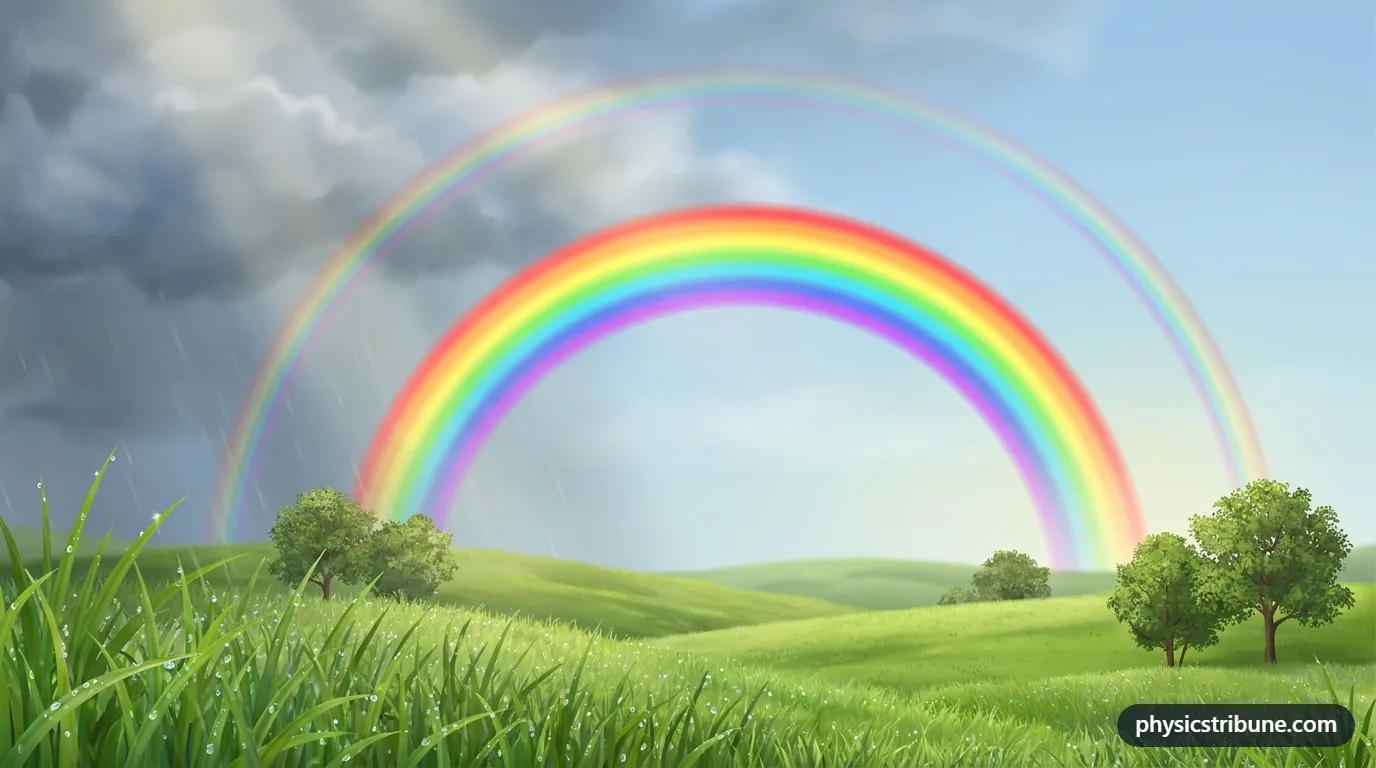
- Rainbows: sunlight refracts into raindrops, reflects off the back and refracts out again. Dispersion sends each color out at its own angle, so you see red on the outside of the bow and violet on the inside. See how does a rainbow form.
- Gemstones: the flashes of color from a cut diamond, called fire, come from strong dispersion combined with many internal reflections.
- Glass ornaments and beveled edges: sunlight through a hanging crystal or the slanted edge of a mirror throws small spectra around a room.
- Color fringes in lenses: cheap binoculars and magnifiers show blue or red edges around bright objects, an effect called chromatic aberration.
- Spectrometers: early instruments used a prism to spread starlight or flame light so scientists could read which elements were present.

How Does Dispersion Affect Lenses and Optical Fibers?
A lens is effectively a stack of tiny prisms, so it disperses light too. Its focal length is slightly shorter for violet than for red, which means the colors cannot all come to a sharp focus at once. Photographers see the result as colored outlines on high-contrast edges. Lens makers cancel most of it by cementing a crown glass lens to a flint glass lens, whose dispersions offset each other. More on this is on our lens aberrations page.
Dispersion also matters in optical fibers. A pulse of light always contains a small range of wavelengths, and each one travels at a slightly different speed in the glass. Over many kilometers, the pulse smears out. Engineers reduce this by sending light near a wavelength where the glass disperses very little and by using lasers with a very narrow color range.
Who Discovered That a Prism Splits White Light?
People had seen colors from glass and water for thousands of years, but most thinkers believed the prism added color to pure white light. In the 1660s Isaac Newton tested the idea with a beam of sunlight through a hole in a window shutter.
He spread the beam into a spectrum, then sent a single color through a second prism. That color bent again but did not change, and when he recombined the colors they made white again. His conclusion was that white light is a mixture and the prism only sorts it. You can repeat the key steps with our Newton's prism experiment guide.
Going Deeper: Is There Such a Thing as Anomalous Dispersion?
Yes. Close to a frequency at which a material strongly absorbs light, the usual pattern reverses over a narrow range, and the index falls as the wavelength gets shorter. Physicists call this anomalous dispersion.
You do not see it in clear glass with visible light, because glass absorbs mainly in the ultraviolet and infrared. It does show up in strongly colored dyes and in gases near their absorption lines, and it plays a role in lasers and in some fiber designs where engineers shape dispersion on purpose.
Common Misconceptions
Myth: A prism adds colors to white light.
Physics: The colors are already mixed together in white light. The prism only sends each color in a slightly different direction, which is why the spectrum can be recombined into white light with a second prism or a lens.
Myth: Red light bends the most because it has the most energy.
Physics: It is the reverse. Red light has the least energy per photon of the visible colors and bends the least in glass. Violet bends the most because the glass slows it down the most.
Myth: Every color travels at the same speed in glass; only the angle is different.
Physics: The angle is different precisely because the speeds are different. In glass, violet light travels a little more slowly than red light, and that difference in speed is what sets the difference in bending.
Key Facts
- Dispersion is the separation of white light into colors because the refractive index depends on wavelength.
- In glass and water, violet light has a higher index than red light, so it slows down more and bends more.
- A prism shows dispersion clearly because both of its faces bend the light in the same direction.
- In common crown glass the index changes by only about 1 percent from red to violet.
- Rainbows, the fire of cut diamonds and color fringes in simple lenses are all caused by dispersion.
- Newton showed in the 1660s that a prism sorts the colors already present in white light rather than creating them.
- Dispersion stretches light pulses in optical fibers, which limits how fast data can be sent.
Quick Quiz: How Well Do You Know Dispersion of Light (Prisms)?
6 questions. Tap an answer to check it.
What causes the dispersion of light in glass?
Each color has its own refractive index, so each bends by a different angle.
Which color has the highest refractive index in ordinary glass?
Violet is slowed the most in glass, which gives it the highest index.
Why does a flat window pane not produce a visible spectrum?
The second face bends each color back by the same amount, so the colors exit parallel and overlap.
What did Newton show with two prisms?
A color picked out by the first prism stayed the same color through the second.
Colored fringes around bright objects in a simple lens are called:
Chromatic aberration is the lens version of dispersion, with each color focusing at a different distance.
In a rainbow, which color appears on the outer edge of the main bow?
Red leaves the raindrops at the largest angle, so it forms the outer edge of the primary bow.
Frequently Asked Questions
What is dispersion of light in simple words?
Dispersion is the splitting of white light into its colors. It happens because materials such as glass and water bend each color by a slightly different amount. Violet light bends the most and red light bends the least, so a beam of white light fans out into a band of colors when it passes through a prism.
Which color of light bends the most in a prism?
Violet light bends the most and red light bends the least. In glass, violet has the highest refractive index of the visible colors, meaning it travels most slowly. The bigger the index, the more the light changes direction at each surface, so violet ends up on the side of the spectrum farthest from the original beam.
Why does a prism separate light but a window does not?
A window has two parallel faces. The colors spread slightly as light enters, then bend back by the same amount as they leave, so they come out parallel and overlap again. A prism's faces are tilted toward each other, so both bends push the colors the same way and the spread grows instead of canceling.
Is a rainbow an example of dispersion?
Yes. Sunlight entering a raindrop refracts, reflects off the back of the drop and refracts again on the way out. Because water disperses light, each color leaves at a slightly different angle. Millions of drops together send red to your eyes from a slightly higher arc and violet from a lower one, forming the bow.
What is the difference between dispersion and refraction?
Refraction is the bending of light when it crosses from one material into another. Dispersion is what happens when that bending is different for different colors. Every case of dispersion involves refraction, but refraction of a single color, such as a red laser beam, shows no dispersion at all.
Does dispersion happen in water?
Yes. Water's refractive index is about 1.331 for red light and about 1.343 for violet light, typical values that differ by roughly 1 percent. That is enough to spread sunlight into a rainbow when it passes through raindrops or a glass of water standing in a sunny window.
What is chromatic aberration?
Chromatic aberration is dispersion inside a lens. Because glass bends violet more than red, a simple lens focuses each color at a slightly different distance. Images show colored edges, especially around bright objects against dark backgrounds. Lens designers fix it by pairing two glasses with different dispersion so their color errors cancel.
Why do diamonds show so many colors?
Diamond has a high refractive index and strong dispersion. Light entering a cut stone bounces around inside by total internal reflection, and each time it refracts, the colors spread a little more. When the light finally leaves through the top facets, separate colors flash in different directions, an effect jewelers call fire.
Keep Exploring


Sources
Constants come from NIST CODATA 2022 (public domain) and unit definitions from the BIPM SI Brochure (CC BY 4.0). Text, diagrams and illustrations are original work by Physics Tribune.