At a Glance
Matter is anything that has mass and occupies volume. It is made of tiny particles in constant motion, and how tightly those particles are held together decides whether a sample is a solid, liquid, gas or plasma. Key properties include density, ρ = m / V, melting and boiling points, specific heat and hardness.
- What it covers
- States of matter, phase changes, density and material properties
- Defining features
- Matter has mass (kg) and takes up volume (m³)
- Common states
- Solid, liquid, gas and plasma, plus exotic states such as a Bose-Einstein condensate
- Key formulas
- ρ = m / V, Q = m c ΔT, Q = m L, P V = n R T
- Core idea
- Particle motion and the forces between particles explain bulk behavior
- Sub-guides
- 3 topic groups, 30+ pages
On this page
What Is Matter in Physics?
Matter is the stuff the universe is built from: anything with mass that also fills some volume. A brick, a glass of juice, a puff of steam and the glowing gas of a neon sign are all matter. Light, sound and heat are not, because they are forms of energy moving through matter or space.
Zoom in far enough and every sample turns out to be made of atoms and molecules. They are always moving, and they pull on each other with intermolecular forces. Almost everything on this branch comes down to a contest between that motion, which spreads particles apart, and those forces, which hold them together.
The structure inside the atom itself, with its nucleus and electrons, belongs to our atomic structure page. Here we stay at the scale of everyday samples you can weigh, heat and squeeze.
Matter Explained Simply
Picture a crowd of people. When everyone stands in tight rows holding hands, the crowd keeps its shape, like a solid. When people let go of hands but stay close, they can shuffle past each other and fill the shape of a room, like a liquid. When everyone runs freely around a field, they spread out to fill all the space, like a gas.
Heating matter is like playing faster music for the crowd. The particles move more, and at some point the hand-holding breaks. That is a phase change, and it happens at a fixed temperature for each pure substance.
What Are the States of Matter?
The states of matter describe how particles are arranged and how freely they move. Solids keep their own shape and volume. Liquids keep their volume but flow to fit a container. Gases fill any container completely and are easy to compress.
Heat a gas enough and electrons are stripped from its atoms, producing plasma, the state of lightning and the Sun. Cool certain atoms to within a whisker of absolute zero and they merge into a Bose-Einstein condensate. The particle model of matter explains all of these with one picture.
How Does Matter Change From One State to Another?
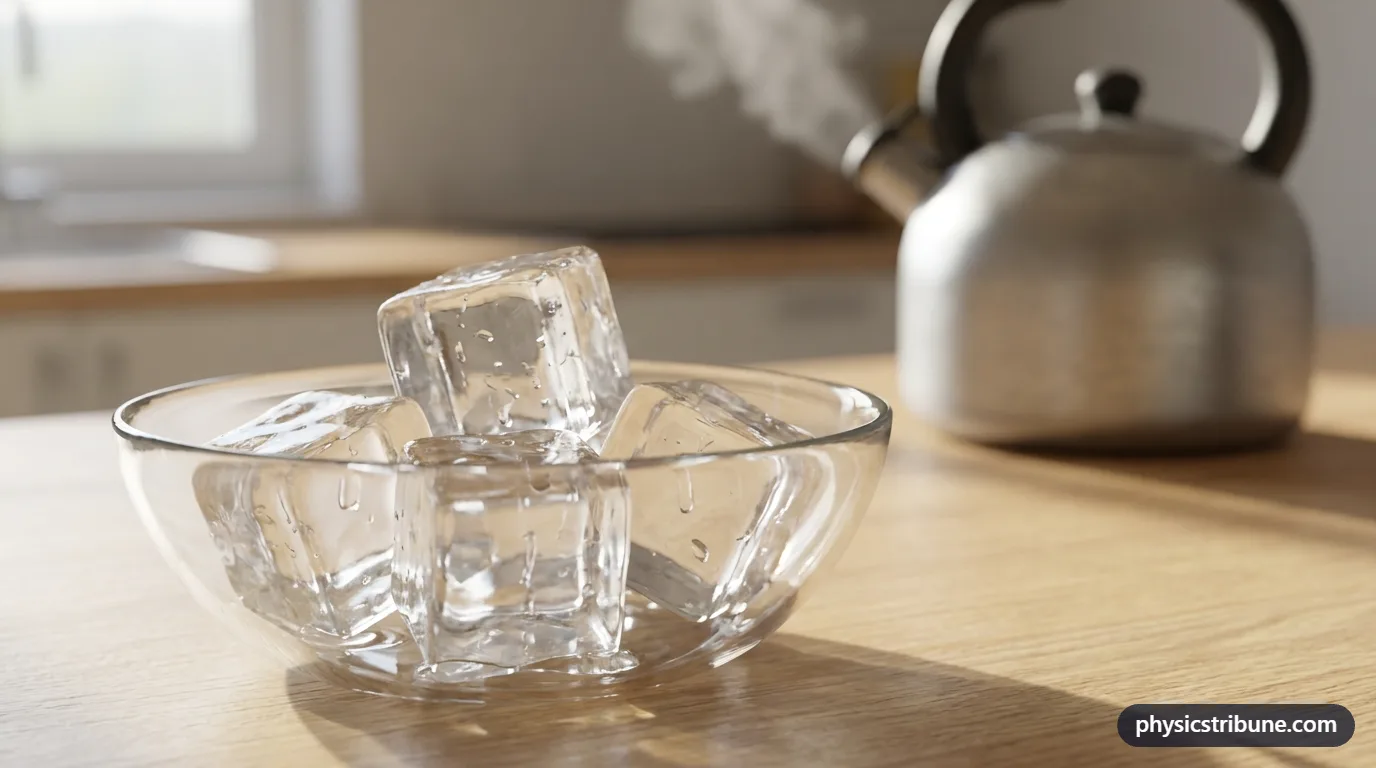
Adding or removing energy moves matter between states. Melting and freezing link solids and liquids, evaporation, boiling and condensation link liquids and gases, and sublimation jumps straight from solid to gas.
During a change of state the temperature stays flat even though heat keeps flowing in. That hidden energy is latent heat, and it is used to break the bonds between particles rather than to speed them up. Our phase changes guide covers melting points, boiling points, heating curves and phase diagrams.
What Properties Describe a Material?
Physical properties can be measured without turning a substance into something else. Density tells you how much mass is packed into each cubic meter. Specific heat, thermal conductivity, hardness, elasticity and electrical conductivity each describe how a material responds to heat, force or voltage.
These numbers decide which material suits which job: copper for wires, aluminum for aircraft, glass for windows and rubber for tires. Our properties of matter guide explains each one, and physical properties of matter lists them with everyday examples.
| Quantity | Formula | SI unit |
|---|---|---|
| Density | ρ = m / V | kilogram per cubic meter (kg/m³) |
| Specific gravity | SG = ρ / ρ_water | no unit |
| Heat to change temperature | Q = m c ΔT | joule (J) |
| Heat to change state | Q = m L | joule (J) |
| Linear thermal expansion | ΔL = α L ΔT | meter (m) |
| Ideal gas law | P V = n R T | pascal times cubic meter (J) |
| Number of moles | n = m / M | mole (mol) |
| Pressure | P = F / A | pascal (Pa) |
| Hooke's law (springs and elastic solids) | F = −k x | newton (N) |
| Surface tension | γ = F / L | newton per meter (N/m) |
| Source: Formulas from our formula data set (data/formulas.json) · Retrieved October 2026 | ||
Why Do Density and Floating Depend on Matter?
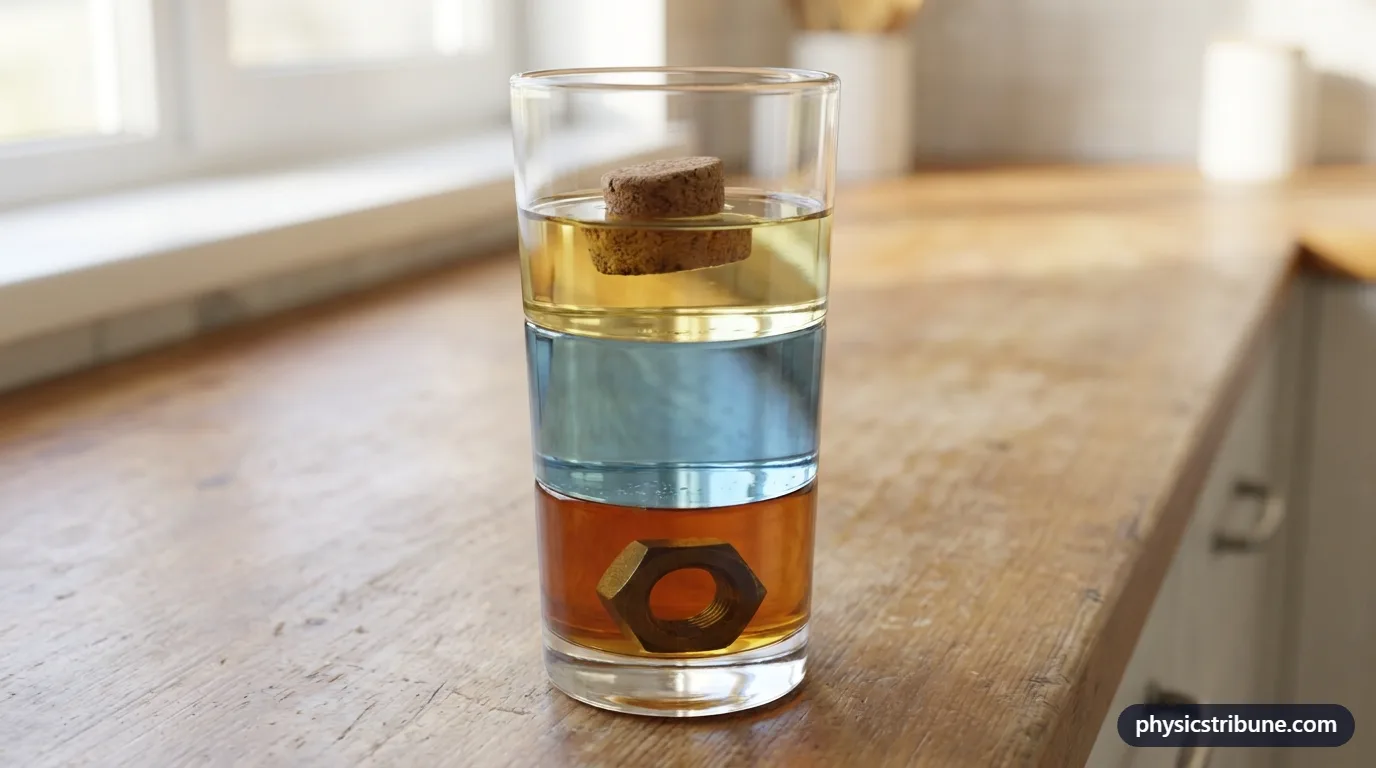
Whether an object floats or sinks depends on how its density compares with the fluid around it. Ice is a little less dense than liquid water, so an ice cube floats with most of its volume below the surface. A steel bolt is far denser than water and drops straight down.
The upward push that balances the weight of a floating object is the buoyant force, explained in our buoyancy guide. The odd fact that water expands when it freezes has its own page: why does ice float.

In What Order Should You Learn About Matter?
Each stage builds on the last. We suggest this path:
- The particle model of matter, the picture behind everything else.
- States of matter: solids, liquids, gases and plasma.
- Phase changes, including melting, boiling and latent heat.
- Density and the other properties of matter.
- The kinetic theory of gases, which links particle speed to temperature and pressure.
Practice with the density calculator and the latent heat calculator, then test yourself with our states of matter worksheets and density worksheets. Younger learners can start with matter for kids.
All Matter & Its Properties (3)


Key Facts
- Matter is anything that has mass and takes up space.
- All matter is made of particles that are always moving and that attract each other.
- The four common states of matter are solid, liquid, gas and plasma.
- A pure substance changes state at a fixed temperature for a given pressure.
- During a phase change, added heat breaks bonds instead of raising the temperature.
- Density, ρ = m / V, decides whether an object floats or sinks in a fluid.
- Mass is conserved when matter melts, boils or freezes; only the arrangement of particles changes.
Frequently Asked Questions
What is matter in physics?
In physics, matter is anything that has mass and occupies space. It is made of atoms and molecules that are always in motion and that attract each other through electric forces. Solids, liquids, gases and plasma are all matter. Energy, light and sound are not matter, although they can travel through it and change it.
What are the 4 states of matter?
The four common states are solid, liquid, gas and plasma. A solid holds a fixed shape, a liquid holds a fixed volume but flows, a gas spreads to fill its container, and a plasma is a gas so hot that electrons have been torn from its atoms. Scientists have also made exotic states, such as Bose-Einstein condensates, in the laboratory.
Is light matter?
No. Light is electromagnetic radiation, a form of energy carried by photons, which have no rest mass and do not take up space the way particles of matter do. Light can push on matter, heat it and be absorbed by it, but a beam of light is not itself made of atoms or molecules.
What is the difference between mass and matter?
Matter is the material itself, the atoms and molecules that make up objects. Mass is a measured quantity that tells you how much matter there is and how strongly it resists changes in motion. Mass is measured in kilograms. So a rock is matter, and its mass might be 2 kilograms.
Can matter be created or destroyed?
In ordinary heating, cooling, dissolving and chemical reactions, matter is not created or destroyed, so the total mass stays the same. This is the law of conservation of mass. In nuclear reactions and particle physics a tiny amount of mass can turn into energy and back again, as described by E = mc², but total mass-energy is still conserved.
What are physical properties of matter?
Physical properties are features you can observe or measure without changing what the substance is. Examples include density, color, hardness, melting point, boiling point, electrical conductivity, thermal conductivity and specific heat. Chemical properties, such as how easily something burns or rusts, can only be seen when the substance turns into something new.