At a Glance
Gravity is a pull between masses described by Newton's law F = G m1 m2 / r², where G = 6.674 30 × 10^-11 N·m²/kg². Near Earth's surface it makes falling objects speed up at about 9.8 m/s², and the same force bends the paths of moons and satellites into orbits.
- What it covers
- Gravitation, g, weight, tides, orbits, Kepler's laws, satellites, escape velocity
- Core law
- F = G m1 m2 / r² (Newton's law of universal gravitation)
- Gravitational constant
- G = 6.674 30 × 10^-11 N·m²/kg² (CODATA 2022)
- Standard gravity
- g_n = 9.806 65 m/s² (exact, by definition)
- Unit of force
- newton (N) = 1 kg·m/s²
- Sub-guides
- Gravitation and Orbits & Kepler's Laws
On this page
- What Is Gravity in Physics?
- Gravity Explained Simply
- Why Do Objects Fall at 9.8 m/s²?
- What Is the Difference Between Mass and Weight?
- How Does Newton's Law of Gravitation Work?
- How Does Gravity Keep Planets and Satellites in Orbit?
- In What Order Should You Learn Gravity?
- All pages in this guide
- Key Facts
- FAQ
What Is Gravity in Physics?
Gravity is the force of attraction that every bit of mass exerts on every other bit of mass. It is by far the weakest of the four fundamental forces, yet it rules the large-scale universe because it only ever pulls and because planets and stars contain enormous amounts of mass. Two apples on a table attract each other too, but the pull is far too small to notice.
Gravity acts at a distance, with no contact and no medium needed. The Sun tugs on Earth across 150 million kilometers of nearly empty space. Physicists describe this with a gravitational field, an invisible map around every mass that tells any other mass placed there how hard it will be pulled and in which direction.
Two descriptions of gravity are in everyday use. Newton's law of universal gravitation treats it as a force and works extremely well for bridges, rockets and planets. Einstein's general relativity treats it as the curving of spacetime and is needed for black holes, GPS clock corrections and very precise orbits.
Gravity Explained Simply
Picture every object as having an invisible rope that pulls on everything else. The more mass an object has, the stronger its rope. The farther apart two things are, the weaker the pull gets, and it fades quickly: double the distance and the pull drops to a quarter.
Earth is so massive that its pull on you is the only one you feel. That pull is your weight. When you jump, Earth's pull slows you, stops you and brings you back down, all within a second or so.
Why Do Objects Fall at 9.8 m/s²?
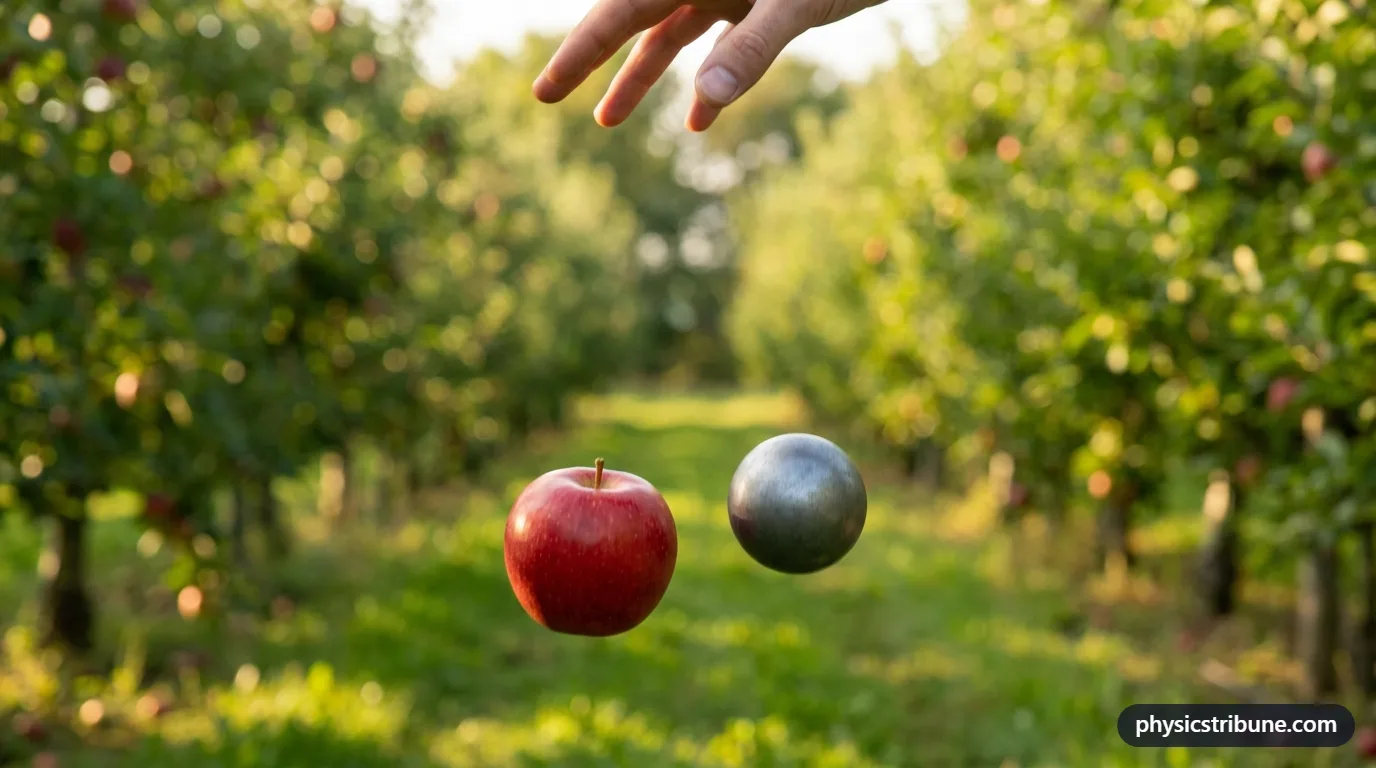
Near Earth's surface, gravity makes any falling object gain about 9.8 m/s of speed every second, if air resistance is small. This value is the acceleration due to gravity, written g. A heavier rock feels a bigger pull, but it also has more inertia, and the two effects cancel exactly, so a hammer and a marble dropped together land together.
That is the heart of free fall. For calculations, scientists use the agreed standard value of 9.806 65 m/s², while the real value varies a little with latitude and height. You can try your own numbers in our free fall calculator.

What Is the Difference Between Mass and Weight?
Mass is how much matter an object contains, measured in kilograms, and it stays the same everywhere. Weight is the gravitational force on that mass,
Our page on mass vs weight sorts out the difference in detail. Floating astronauts are a related puzzle: they are not beyond gravity at all. Weightlessness happens because the astronauts and their station fall together, so nothing presses on anything else.
| World | Surface gravity (about) | Weight of 60 kg | Compared with Earth |
|---|---|---|---|
| Moon | 1.62 m/s² | 97 N | 0.17 × |
| Mars | 3.71 m/s² | 223 N | 0.38 × |
| Earth (standard) | 9.806 65 m/s² | 588 N | 1 × |
| Jupiter (cloud tops) | 24.79 m/s² | 1,487 N | 2.5 × |
| Source: Standard gravity from NIST CODATA 2022 (exact); other surface gravities are typical published values; weights computed with W = m g · Retrieved October 2026 | |||
How Does Newton's Law of Gravitation Work?
Newton's law says the force between two masses grows with the product of the masses and shrinks with the square of the distance between their centers,
The squared distance makes gravity an inverse square law. The same rule explains tides, because the Moon pulls harder on the side of Earth that faces it than on the far side. Our gravitation guide collects every page on the law, the field and gravitational potential energy, and the gravitational force calculator runs the numbers for you.
| Quantity | Formula | SI unit |
|---|---|---|
| Weight | W = m g | newton (N) |
| Gravitational force between two masses | F = G m1 m2 / r² | newton (N) |
| Surface gravity of a planet | g = G M / R² | m/s² (or N/kg) |
| Gravity at altitude h | g_h = G M / (R + h)² | m/s² |
| Gravitational field strength | g = F / m | N/kg |
| Potential energy near the surface | PE = m g h | joule (J) |
| Potential energy, universal form | U = −G M m / r | joule (J) |
| Circular orbital speed | v = √(G M / r) | m/s |
| Orbital period | T = 2π √(r³ / (G M)) | second (s) |
| Kepler's third law (ratio form) | T1² / T2² = r1³ / r2³ | no unit |
| Escape velocity | v_esc = √(2 G M / R) | m/s |
| Source: Formulas from our formula data set (data/formulas.json); G from NIST CODATA 2022 · Retrieved October 2026 | ||
How Does Gravity Keep Planets and Satellites in Orbit?
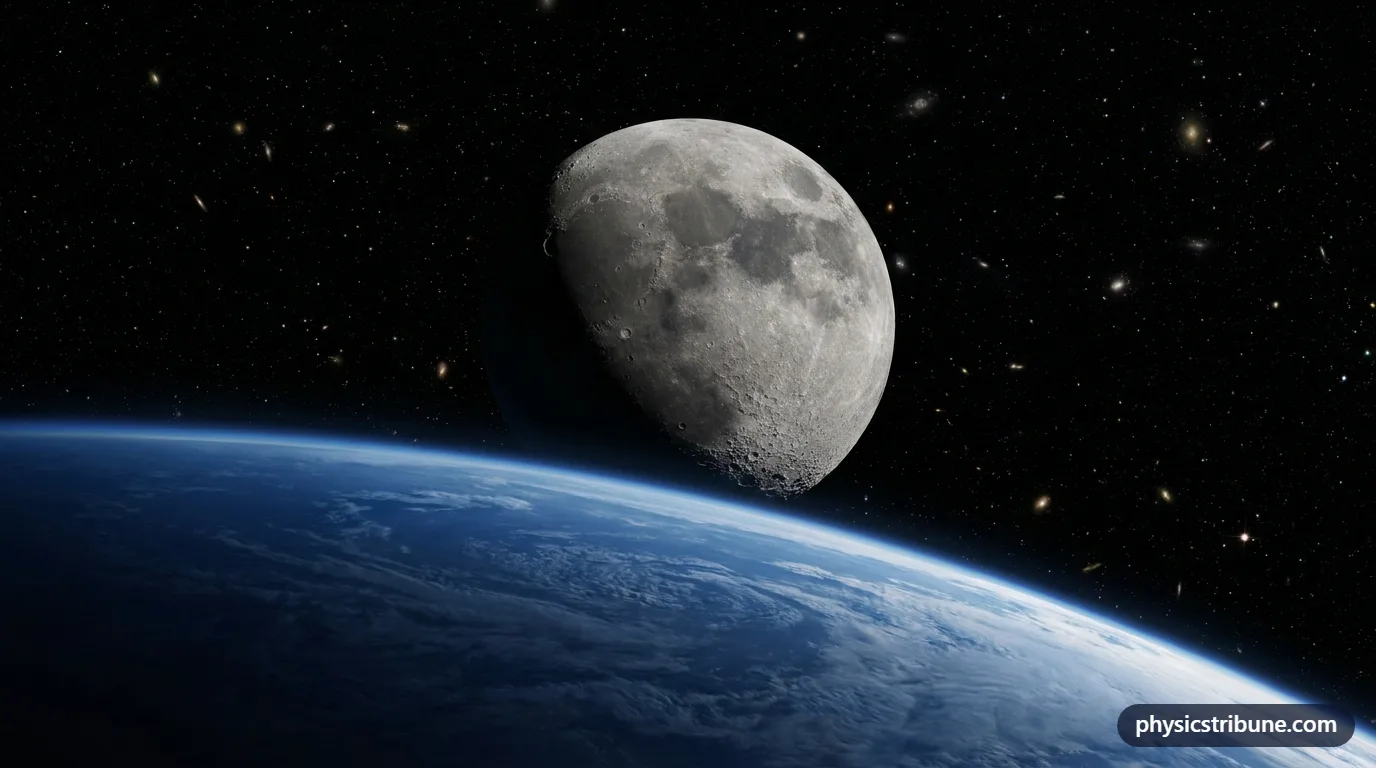
An orbit is a path where an object moves sideways fast enough that, while gravity pulls it inward, the curved surface below keeps falling away. The satellite is always falling but always missing. Gravity supplies the centripetal force that bends a straight-line path into a circle or ellipse.
Johannes Kepler described the shapes and timing of planetary orbits in his three laws of planetary motion, and Newton later showed that all three follow from his law of gravity. Our orbits and Kepler's laws guide covers orbital velocity, the orbital period, how satellites stay up and escape velocity, the launch speed needed to leave a planet for good.
In What Order Should You Learn Gravity?
Each step builds on the one before. We suggest this path:
- Weight and the acceleration due to gravity, using
- Free fall, where g becomes a motion problem.
- Newton's law of universal gravitation and the inverse square law.
- The gravitational field, weightlessness and tides.
- Kepler's laws, orbital velocity and satellites.
- Escape velocity and gravitational potential energy in its universal form.
Practice with our gravity worksheets and universal gravitation worksheets, and keep the gravity and orbit formulas sheet nearby. Younger learners can start with gravity for kids.
All Gravity & Orbits (2)


Key Facts
- Gravity is an attraction between all masses and never pushes objects apart.
- Newton's law gives the force as F = G m1 m2 / r², with G = 6.674 30 × 10^-11 N·m²/kg².
- Near Earth's surface, falling objects speed up by about 9.8 m/s every second when air resistance is small.
- Mass stays the same everywhere, while weight depends on the local strength of gravity.
- Doubling the distance between two masses cuts the gravitational force to one quarter.
- A satellite in orbit is in constant free fall, moving sideways fast enough to keep missing the ground.
- General relativity describes gravity as curved spacetime and refines Newton's predictions.
Frequently Asked Questions
What is gravity in simple words?
Gravity is the pull that every object with mass has on every other object with mass. It is what makes dropped things fall, gives you weight and keeps the Moon going around Earth. The pull is stronger for bigger masses and weaker when objects are farther apart, which is why you feel Earth's gravity but not the tiny pull of the chair next to you.
What causes gravity?
Mass causes gravity. In Newton's picture, every mass attracts every other mass with a force that depends on both masses and the distance between them. In Einstein's general relativity, mass and energy curve spacetime, and objects moving through that curved spacetime follow paths that look like they are being pulled. Both pictures agree for everyday speeds and ordinary planets.
Why is gravity 9.8 m/s² on Earth?
The value comes from Earth's mass and radius through g = G M / R². Earth is massive enough and its surface is close enough to its center that the pull per kilogram works out to roughly 9.8 newtons, which is the same as an acceleration of 9.8 m/s². The real value ranges slightly with latitude and altitude, so scientists use the standard 9.806 65 m/s² for calculations.
Is there gravity in space?
Yes. Gravity reaches across all of space and only gets weaker with distance, never switching off. Astronauts on a station in low orbit still feel most of Earth's pull. They appear weightless because they and their spacecraft are falling around Earth at the same rate, so nothing presses against them. Far from any planet or star, gravity is weak but still present.
Who discovered gravity?
People have always known that things fall, but Isaac Newton was the first to explain gravity with one mathematical law, published in 1687, that covered both falling apples and the motion of the Moon and planets. Galileo had earlier shown that objects fall at the same rate, and Kepler had described planetary orbits. Einstein later replaced Newton's force picture with curved spacetime.
Does gravity affect light?
Yes. Although light has no mass, gravity bends its path because, in general relativity, mass curves spacetime and light follows that curvature. Starlight passing close to the Sun is deflected by a small angle, an effect first measured during the 1919 solar eclipse. Near a black hole the bending is so strong that light inside a certain boundary cannot escape at all.