
At a Glance
Each topic page offers five or six printable US Letter worksheets with the answer key on page 2 of every PDF, plus a single bundle download. Sets run from grade 2 through high school and AP Physics 1, and each one comes with a short refresher, a worked example and tips for using it by grade.
- Topics
- 60 worksheet sets across every branch of physics
- Per topic
- 5 to 6 printable sheets plus a bundle PDF
- Answer keys
- Page 2 of every PDF, with worked steps
- Grades
- Grade 2 to 12, plus AP Physics 1
- Format
- PDF, US Letter, low-ink, preview image for each sheet
- Cost
- Free, no sign-up
On this page
What Is Included in Each Physics Worksheet Set?
Every topic page holds a set of five or six worksheets that build from simple recognition to multi-step problems. Each sheet is a single US Letter PDF: page 1 is the student worksheet and page 2 is the answer key with the working shown, not just the final numbers. A preview image lets you see the sheet before you download it, and one bundle file gathers the whole set for printing in one go.
The sheets are designed to print cleanly in black and white, with light shading and plenty of room to write. Diagrams such as force arrows, circuits, ray paths and motion graphs are drawn in code, so lines stay sharp at any print size. Alongside the downloads, each topic page gives a short science refresher, a worked example that matches one of the sheets and a list of common student mistakes.
How Are the Worksheets and Answer Keys Made?
Every question is written from scratch by our editors; nothing is copied from textbooks, other worksheet sites or exam papers. The numbers in each problem are chosen to be realistic, such as a 1,200 kg car or a 9 V battery, and the answers are then computed by the same code that builds the PDF. That means a key cannot drift out of step with its sheet.
Physical constants come from the NIST CODATA 2022 set and units follow the SI. Sheets use g = 9.8 m/s² unless a problem states another value, so students always know which number to plug in. Our editorial policy explains how we check every page.
Which Physics Worksheets Suit Each Grade?
The table groups the topics by the grade band they are written for. Younger students meet ideas through pictures, sorting and simple observations. Middle school sets introduce formulas with one step, and high school and AP sets ask students to rearrange equations, read graphs and combine several ideas in one problem.
Bands are a guide, not a rule. A strong grade 7 class may be ready for the acceleration worksheets, while a high school class reviewing basics can start with forms of energy. Each topic page lists the exact grades for its own sheets.
| Grade band | Sample topics | What students practice |
|---|---|---|
| Grades 2 to 5 | Push and pull, force and motion, gravity, forms of energy, magnetism, light, states of matter | Sorting, labeling pictures, predicting what happens, simple observations |
| Grades 6 to 8 | Speed, density, Newton's laws, kinetic and potential energy, work and power, circuits, waves, pressure, levers | One-step formulas, reading tables and simple graphs, drawing force arrows |
| Grades 9 to 12 | Acceleration, free-body diagrams, projectile motion, vectors, Ohm's law, specific heat, half-life, ray diagrams | Rearranging equations, unit conversion, multi-step problems, motion graphs |
| AP Physics 1 and college | Circular motion, universal gravitation, torque, Coulomb's law | Combining several laws, vector components, reasoning from graphs and data |
| Source: Grade bands as assigned in our worksheet plan; each topic page lists its own exact grades · Retrieved October 2026 | ||
How Can Teachers, Parents and Students Use Them?
Teachers can use the first sheet in a set as a warm-up, the middle sheets for classwork and the last one as an exit ticket or quiz. Because the key shows the working, it also doubles as a model answer to project after students try the problems on their own.
Homeschool parents can follow a set in order across a week, reading the refresher on the topic page together first. Students revising for a test can attempt a sheet, then check each answer against the key or with one of our physics calculators, which show every step of the math.
In What Order Should Students Work Through the Topics?
Physics ideas build on each other, so a sensible path for a first course is:
- Force and motion and push and pull to meet forces in everyday language.
- Speed, then distance-time graphs and acceleration.
- Balanced and unbalanced forces, free-body diagrams and Newton's laws.
- Kinetic and potential energy, work and power and conservation of energy.
- Density and pressure for matter and fluids.
- Waves, sound and light.
- Electricity, series and parallel circuits and Ohm's law.
- Atomic structure and half-life to finish with the atom and its nucleus.
For a quick reference beside any sheet, keep the physics formula sheets open; they list every equation with its variables and SI units.
All Physics Worksheets (60)
 worksheetsAcceleration Worksheets
 worksheetsAtomic Structure Worksheets
 worksheetsBalanced and Unbalanced Forces Worksheets
 worksheetsBuoyancy Worksheets
 worksheetsCircuit Diagram Worksheets
 worksheetsCircular Motion Worksheets
 worksheetsConservation of Energy Worksheets
 worksheetsCoulomb's Law Worksheets
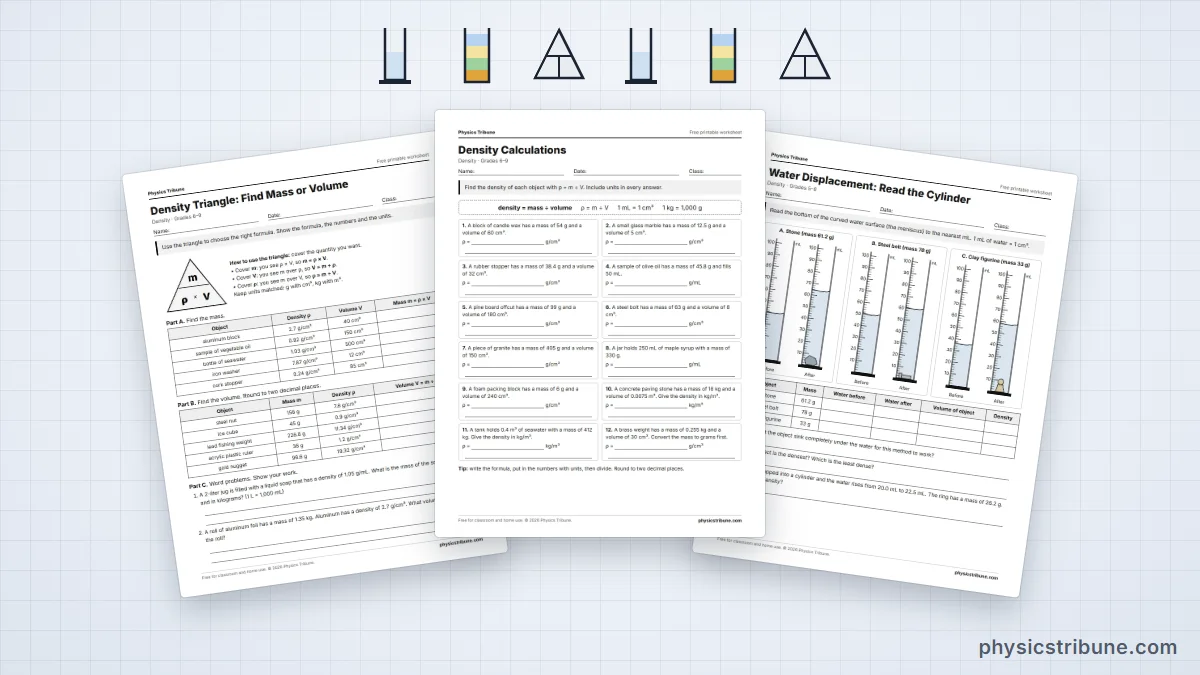 worksheetsDensity Worksheets
 worksheetsDistance and Displacement Worksheets
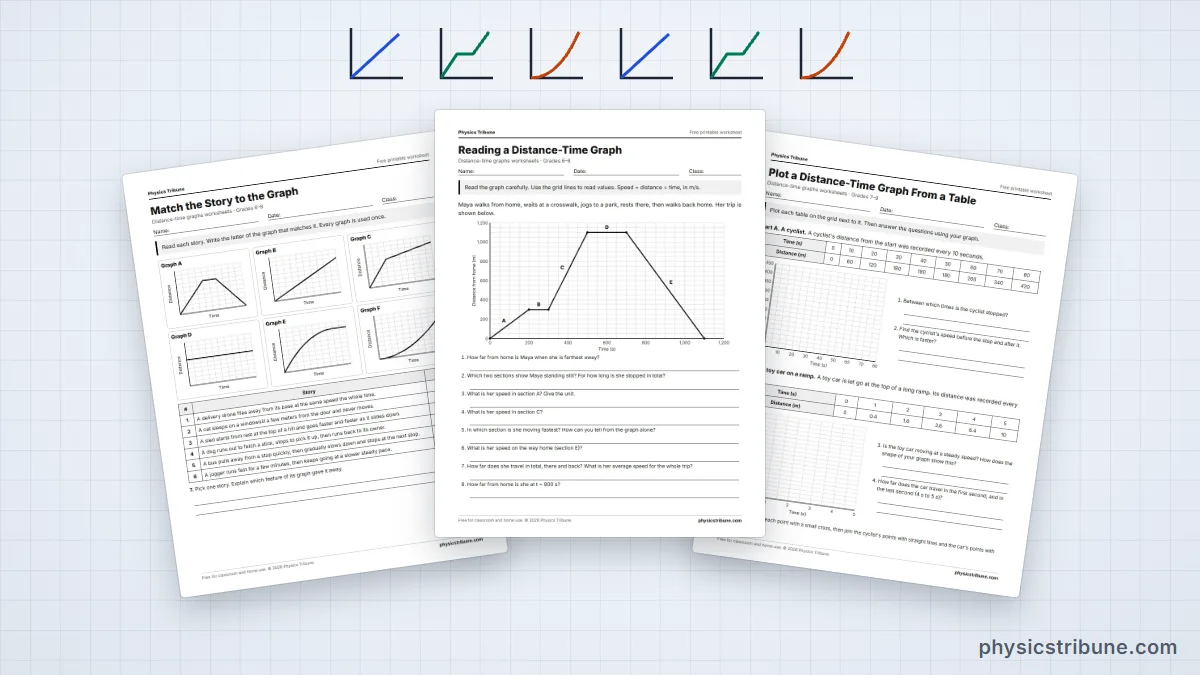 worksheetsDistance Time Graph Worksheets
 worksheetsElectricity Worksheets
 worksheetsElectromagnetic Spectrum Worksheets
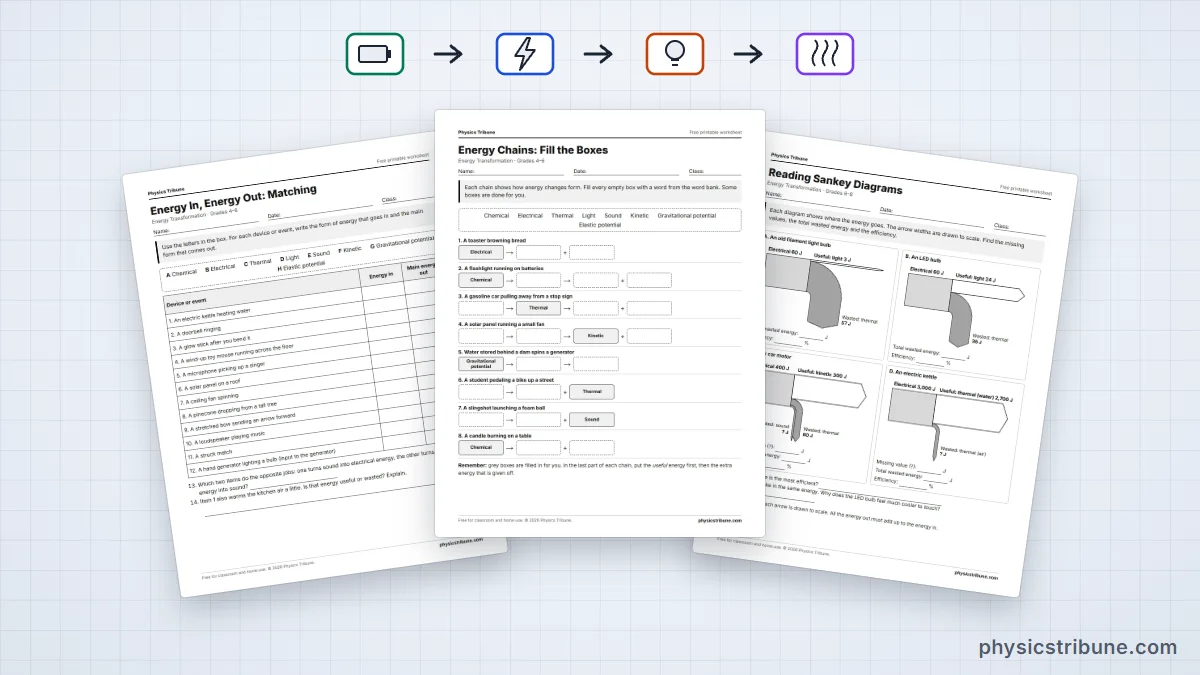 worksheetsEnergy Transformation Worksheets
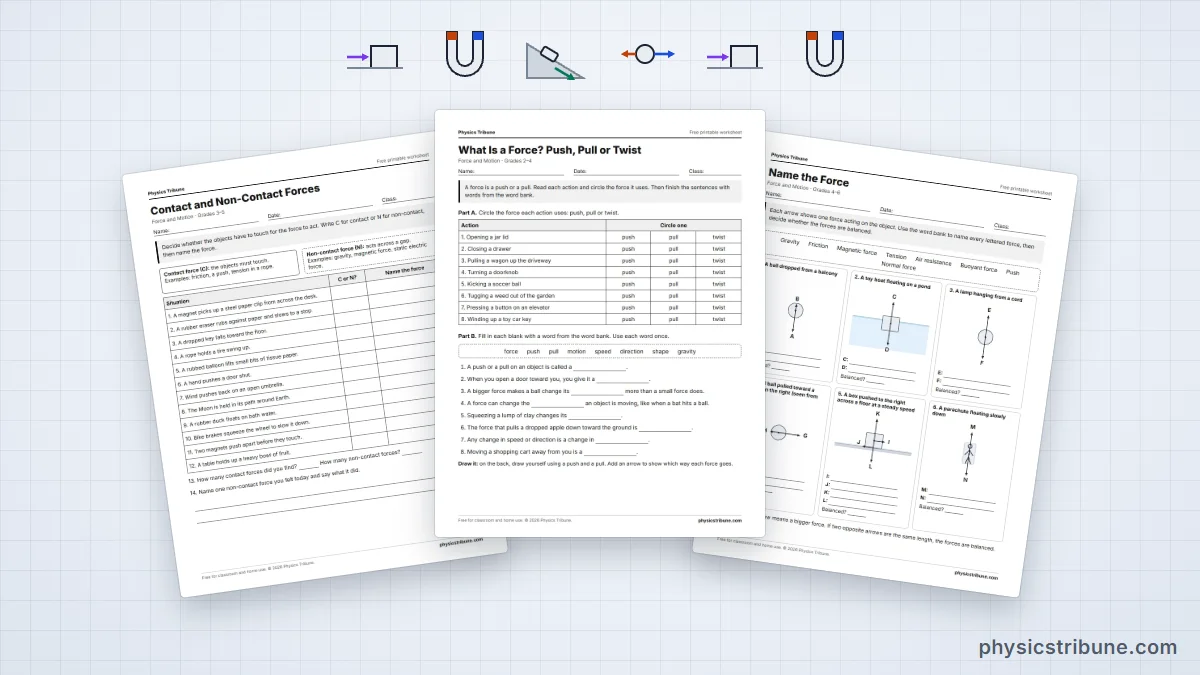 worksheetsForce and Motion Worksheets
 worksheetsForms of Energy Worksheets
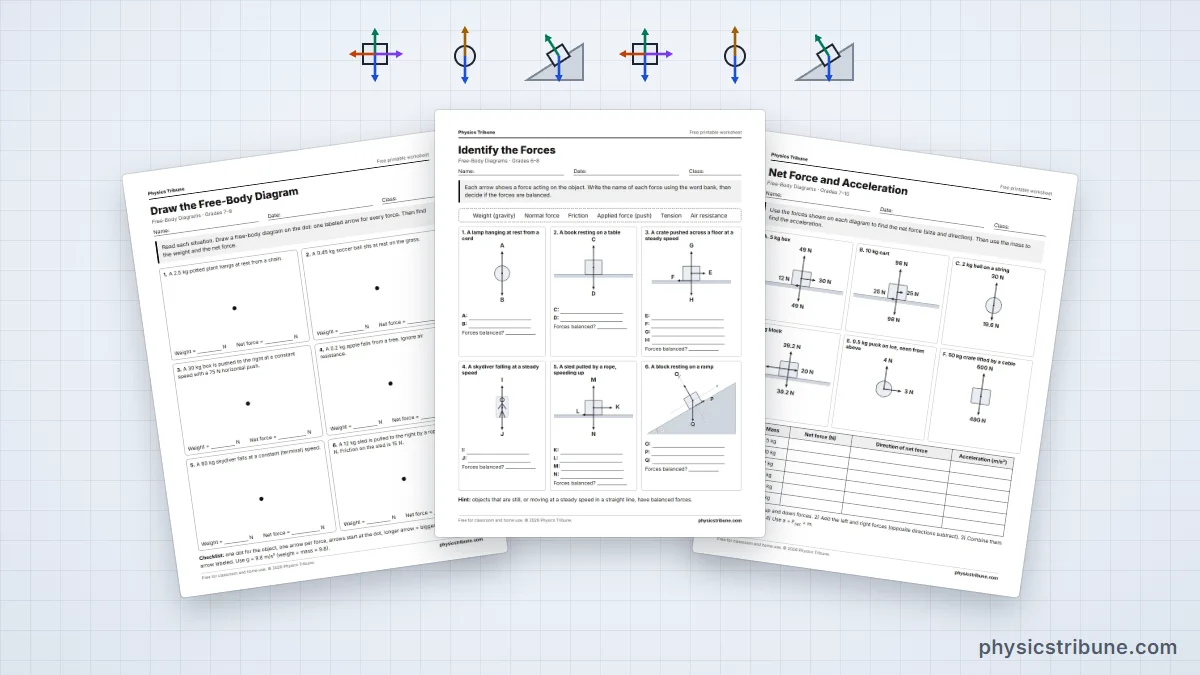 worksheetsFree Body Diagram Worksheets
 worksheetsFree Fall Worksheets
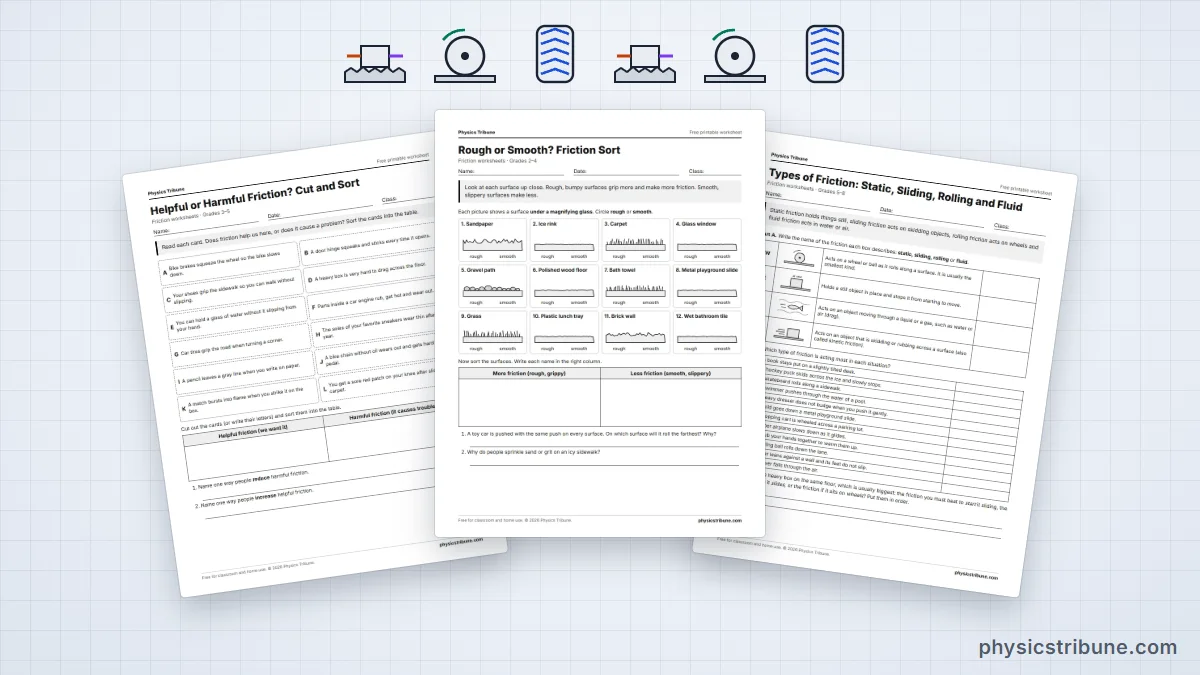 worksheetsFriction Worksheets
 worksheetsGravity Worksheets
 worksheetsHalf Life Worksheets
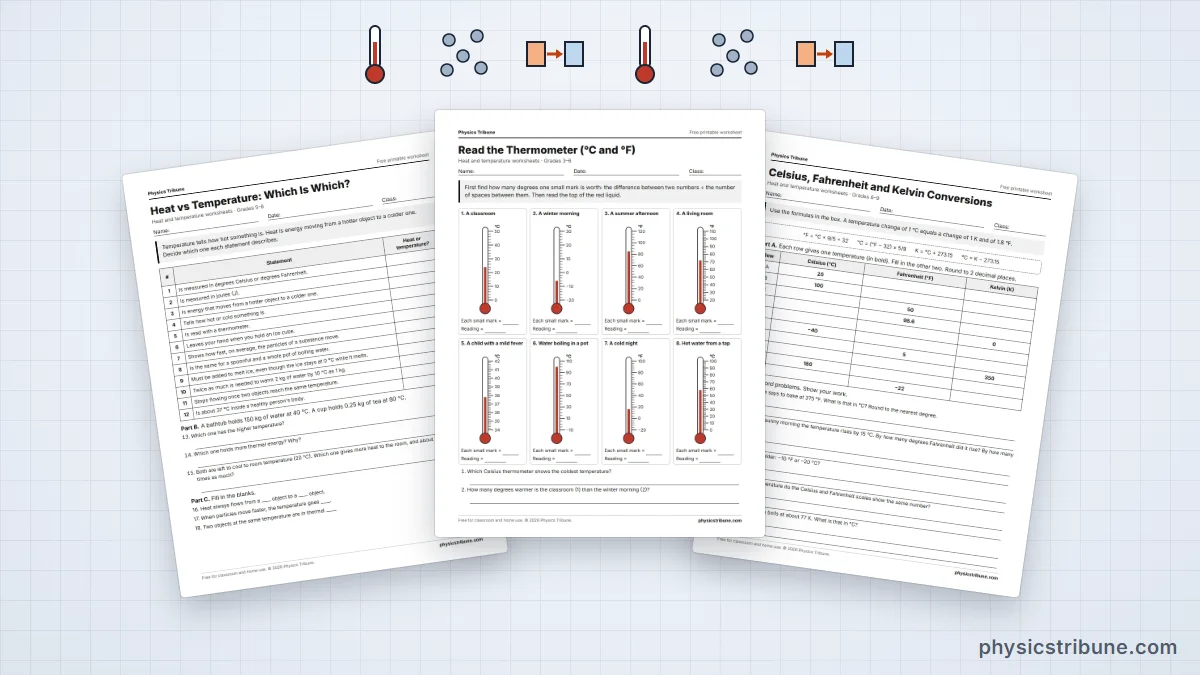 worksheetsHeat and Temperature Worksheets
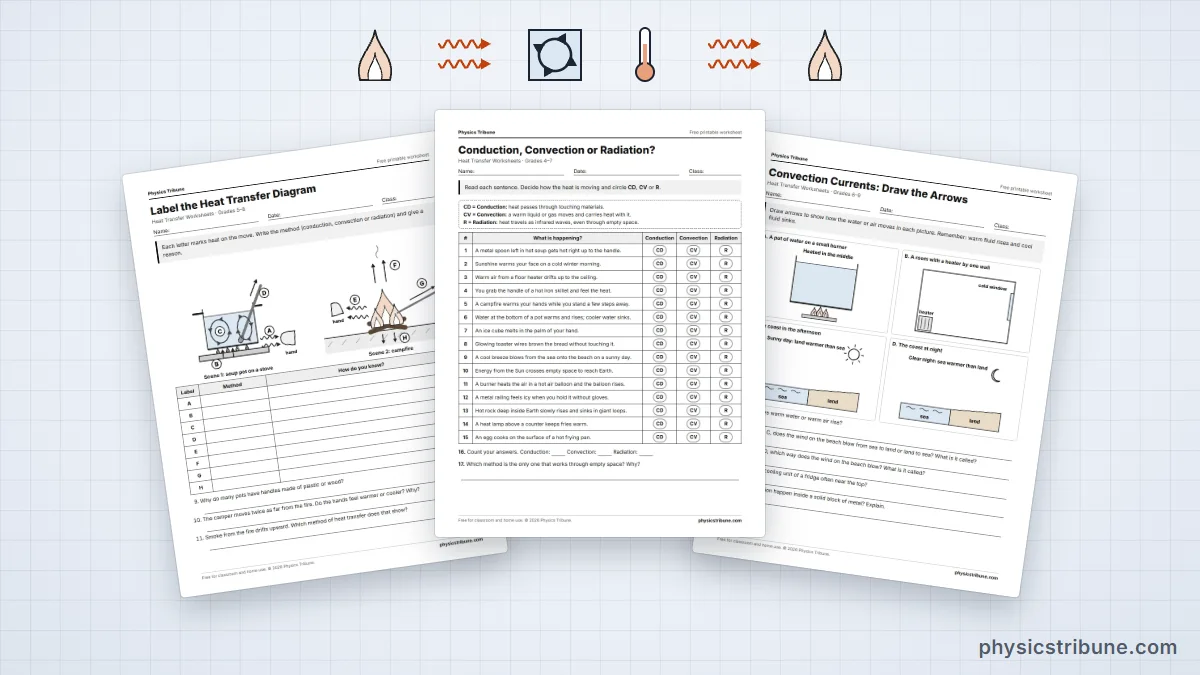 worksheetsHeat Transfer Worksheets
 worksheetsHooke's Law Worksheets
 worksheetsInclined Plane Worksheets
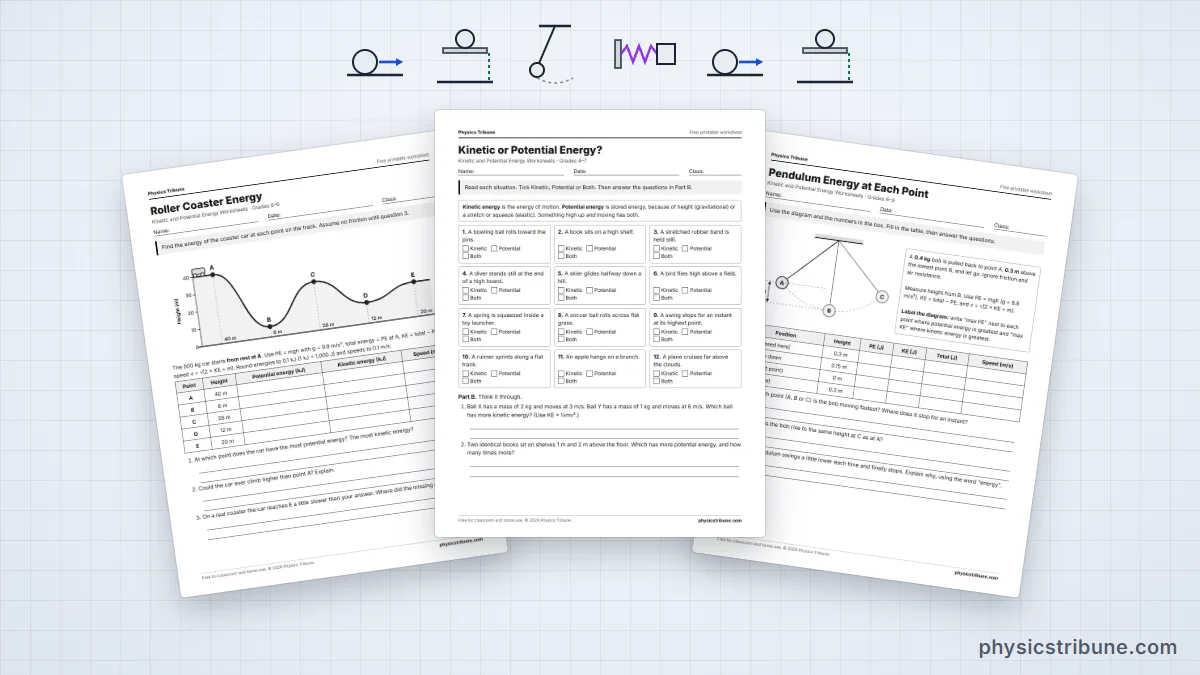 worksheetsKinetic and Potential Energy Worksheets
 worksheetsLevers Worksheets
 worksheetsLight Worksheets
 worksheetsMagnetism Worksheets
 worksheetsMechanical Advantage Worksheets
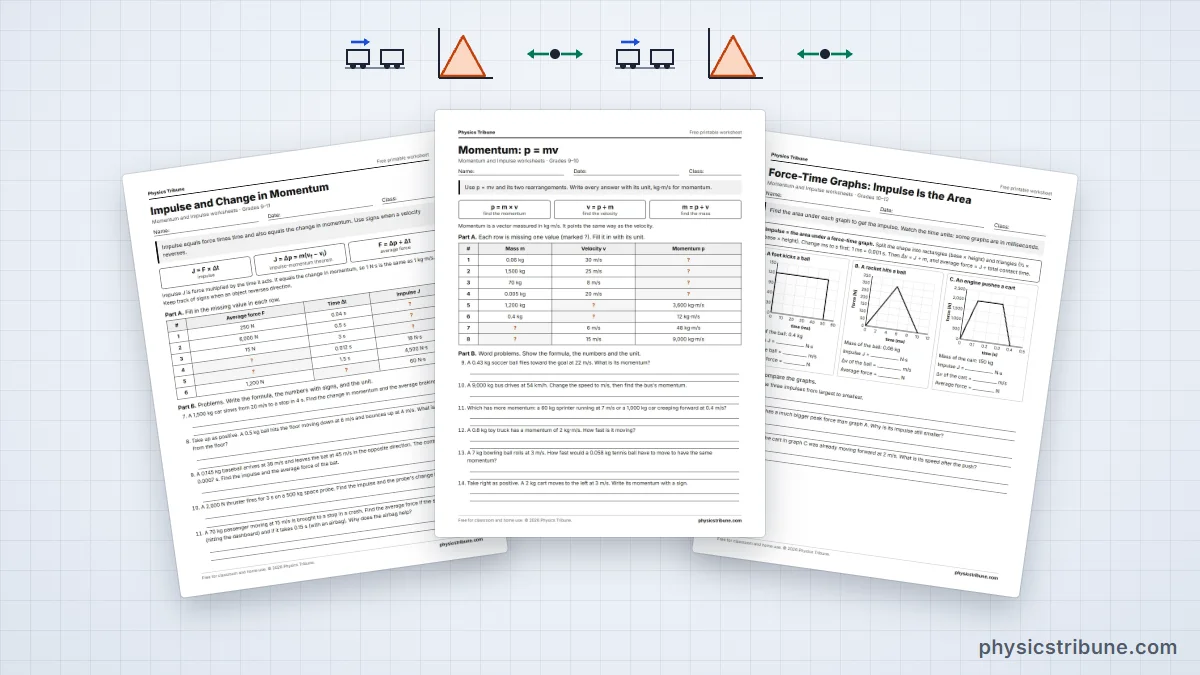 worksheetsMomentum and Impulse Worksheets
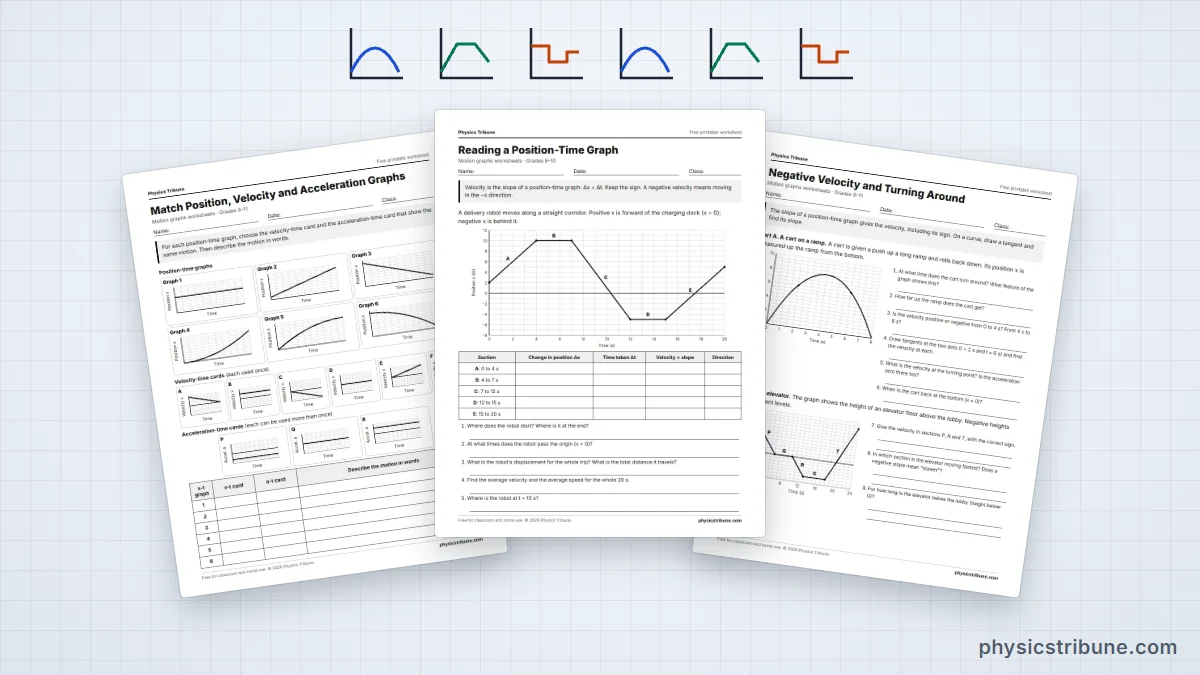 worksheetsMotion Graphs Worksheets
 worksheetsNet Force Worksheets
 worksheetsNewton's Laws Worksheets
 worksheetsNewton's Second Law Worksheets
 worksheetsOhm's Law Worksheets
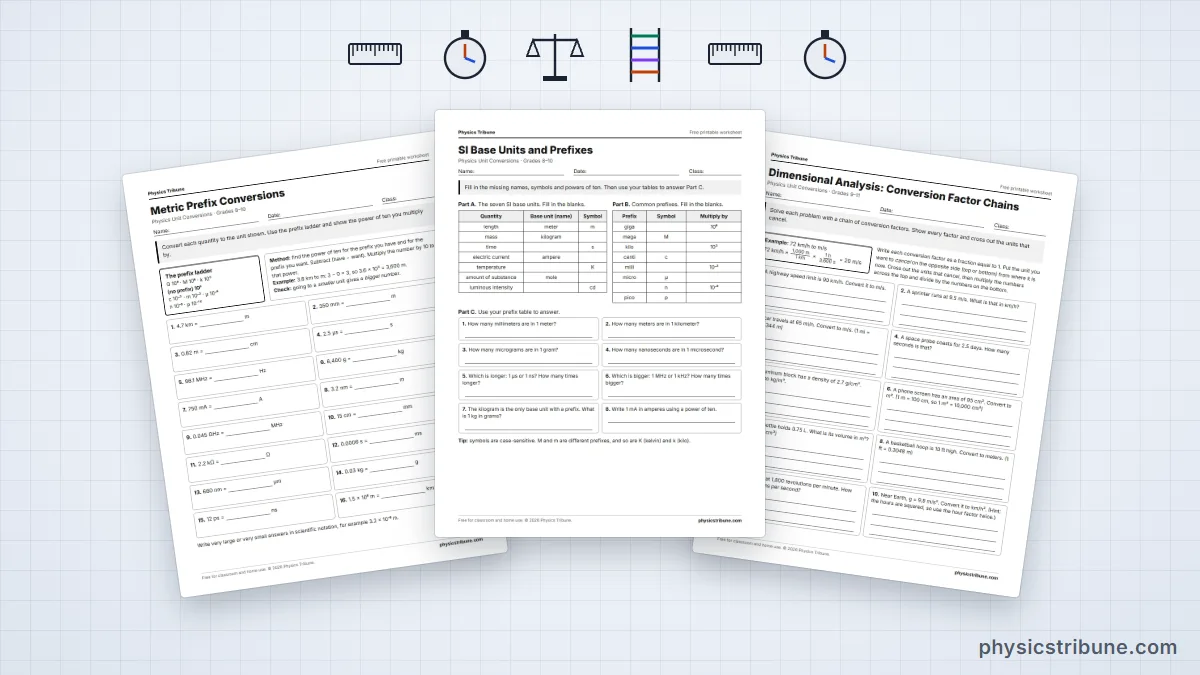 worksheetsPhysics Unit Conversion Worksheets
 worksheetsPhysics Word Search and Crossword Puzzles
 worksheetsPressure Worksheets
 worksheetsProjectile Motion Worksheets
 worksheetsPulley Worksheets
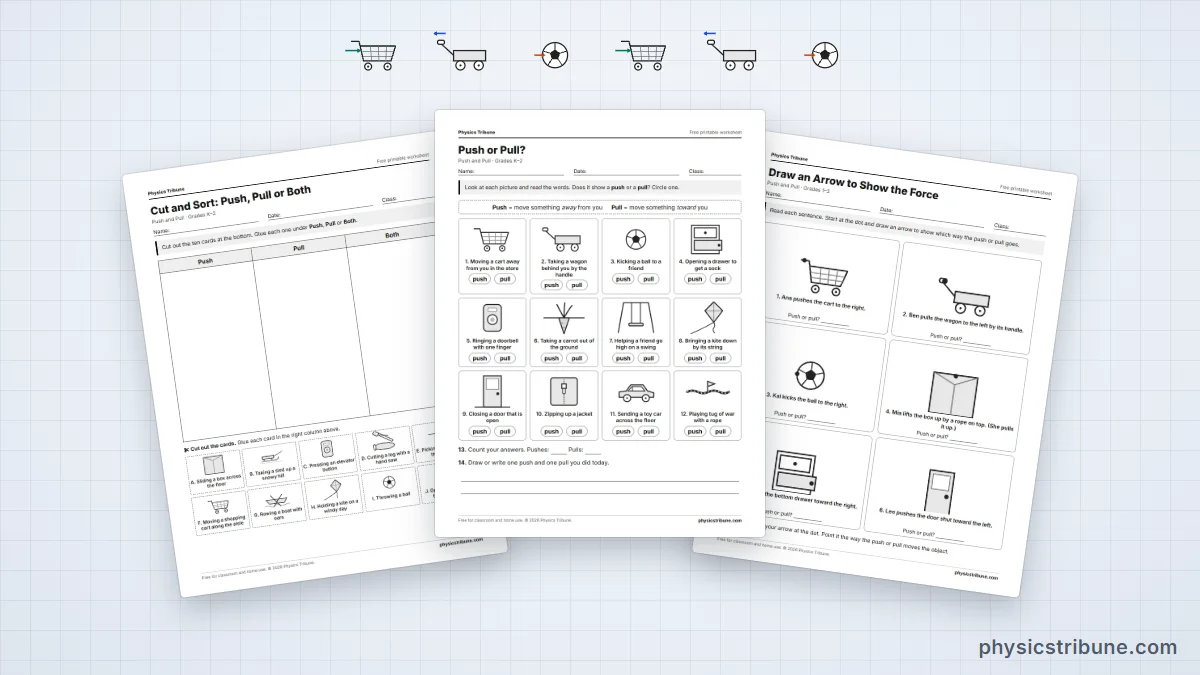 worksheetsPush and Pull Worksheets
 worksheetsRadioactivity Worksheets
 worksheetsRay Diagram Worksheets
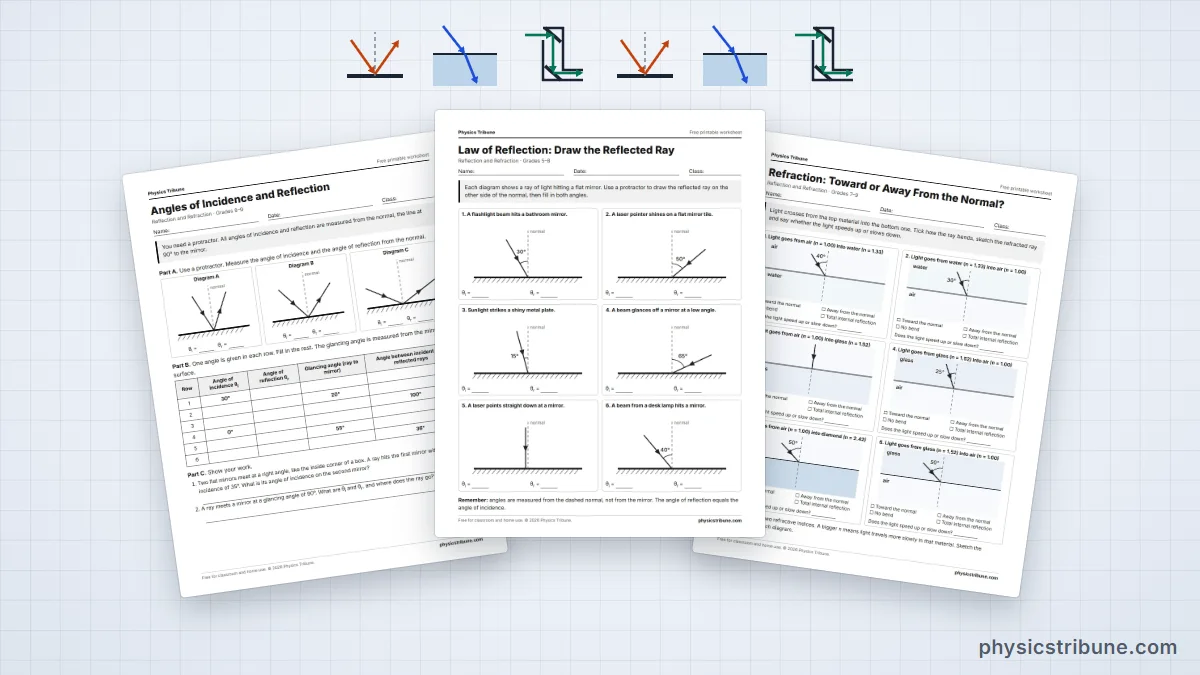 worksheetsReflection and Refraction Worksheets
 worksheetsSeries and Parallel Circuits Worksheets
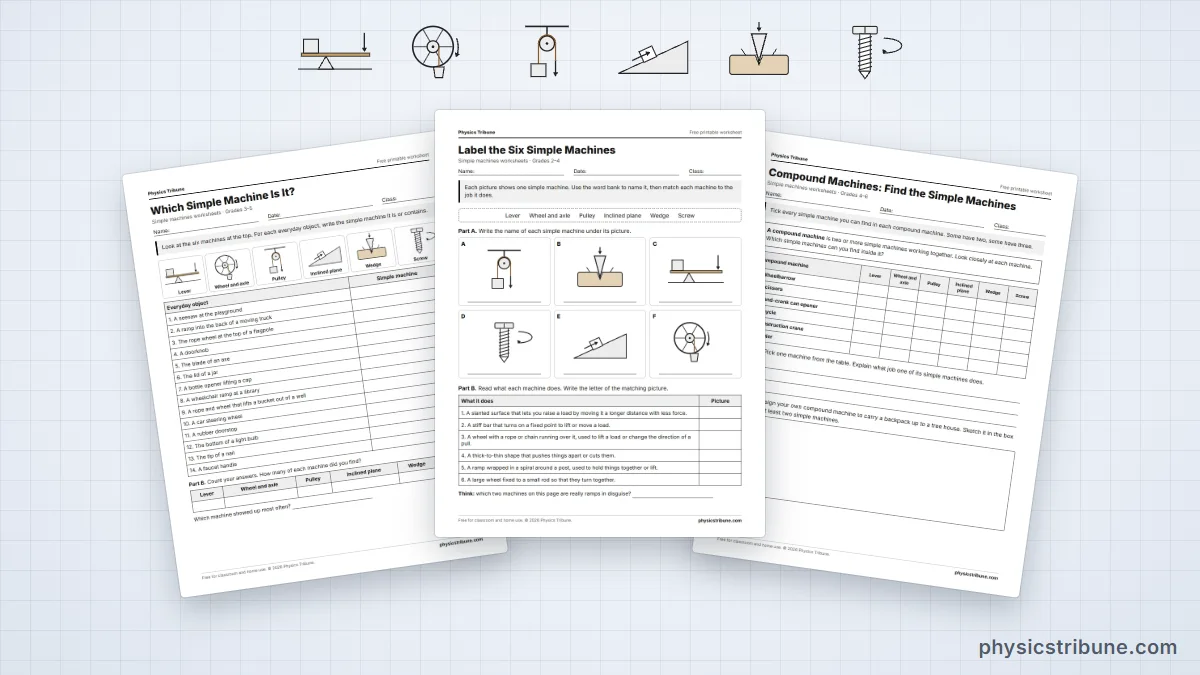 worksheetsSimple Machines Worksheets
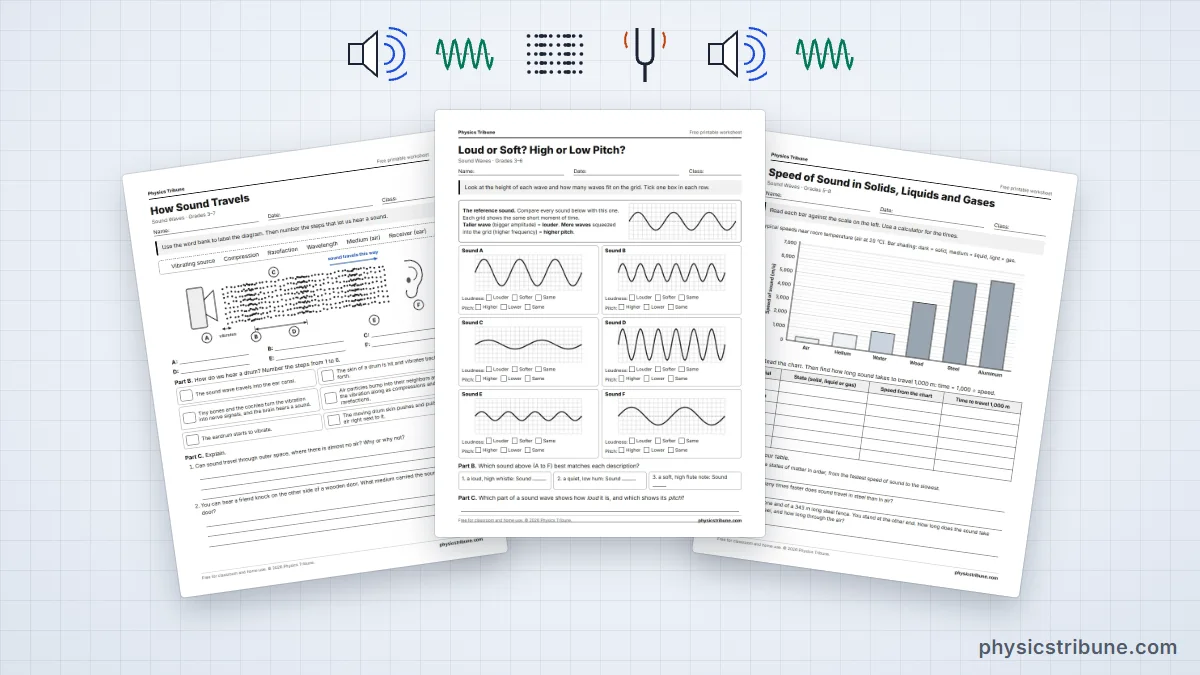 worksheetsSound Waves Worksheets
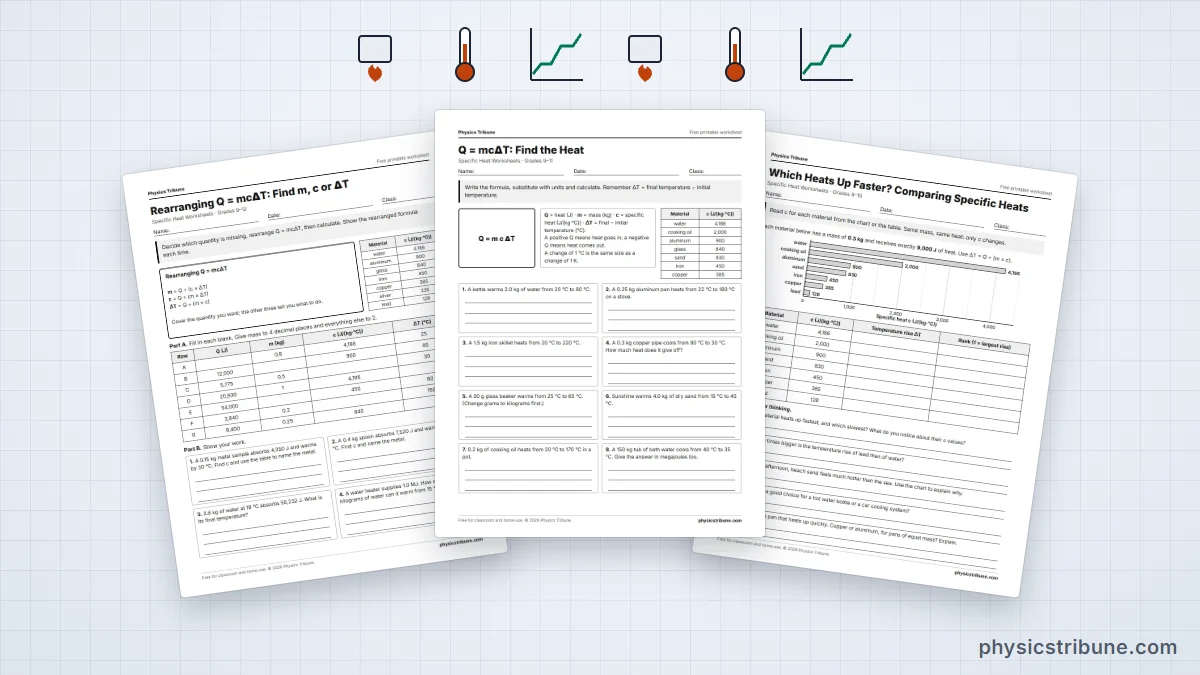 worksheetsSpecific Heat Worksheets
 worksheetsSpeed Velocity and Acceleration Worksheets
 worksheetsSpeed Worksheets
 worksheetsStates of Matter Worksheets
 worksheetsStatic Electricity Worksheets
 worksheetsTorque Worksheets
 worksheetsUniversal Gravitation Worksheets
 worksheetsVectors Worksheets
 worksheetsVelocity Time Graph Worksheets
 worksheetsWave Speed Worksheets
 worksheetsWaves Worksheets
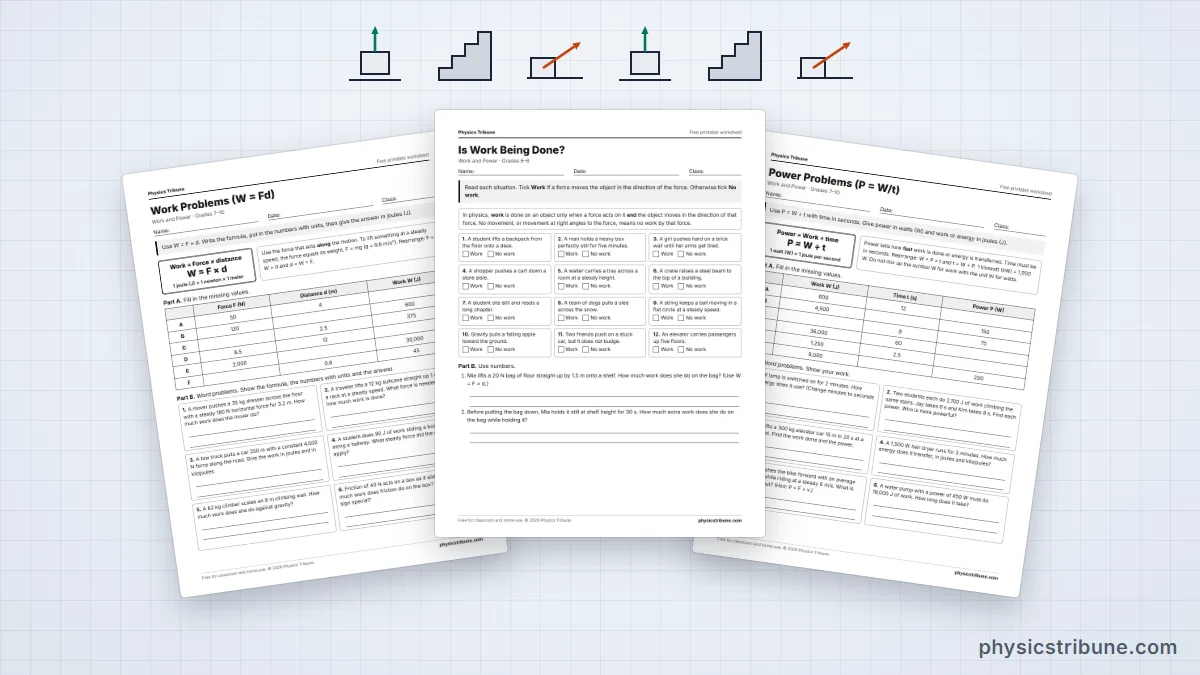 worksheetsWork and Power Worksheets
Key Facts
- There are 60 physics worksheet topics, each with five or six printable sheets.
- Every PDF has its answer key on page 2, with the working shown.
- Sets cover grade 2 through high school and AP Physics 1.
- All questions and diagrams are original, and every answer is computed in code.
- Sheets print on US Letter paper in black and white with light shading.
- Constants follow NIST CODATA 2022 and units follow the SI.
Frequently Asked Questions
Are these physics worksheets really free?
Yes. Every worksheet, answer key and bundle download is free to print for classroom, homeschool or personal study, with no sign-up and no email required. Each topic page always carries the latest version of its sheets, so bookmarking the page is the easiest way to make sure you print the newest copy after any correction.
Do the physics worksheets come with answers?
Every worksheet PDF has its answer key on page 2. The key shows the formula used, the numbers substituted and the final answer with its unit, so students can see where a mistake happened, not just that one did. Because the answers are computed by the same code that writes the questions, the key always matches the sheet.
What grades are the worksheets for?
The sets run from about grade 2, with picture-based topics like push and pull, through middle school and high school, up to AP Physics 1 topics such as torque and universal gravitation. Each topic page states its exact grade range and suggests which sheets to use with younger or older students.
Can I use the worksheets for AP Physics or GCSE revision?
Yes. The high school and AP-level sets practice the same skills those courses test: rearranging equations, converting units, reading graphs and combining two or three ideas in one problem. They are not copies of exam questions, so they make good fresh practice. Pair them with our calculators to check answers step by step.
How should I print the worksheets?
Print the PDFs at 100 percent scale on US Letter paper; A4 also works if you choose fit to page. The sheets are designed for black-and-white printing with light shading, so they save ink. Print only page 1 for students and keep page 2, the answer key, for yourself, or print both for self-checking.
Which physics worksheet should I start with?
For a new course, start with force and motion or speed, then move to acceleration and Newton's laws before energy. The learning path on this page lists a full order. If a student struggles with the math, try the matching calculator first so they can see each step, then return to the worksheet.
Keep Exploring
worksheetsForce and Motion WorksheetsworksheetsNewton's Laws WorksheetsworksheetsKinetic and Potential Energy WorksheetsworksheetsDensity WorksheetsworksheetsFree Body Diagram WorksheetsworksheetsElectricity Worksheets calculatorsPhysics Calculators
 formulasPhysics Formulas
 experimentsPhysics Experiments & Labs