
At a Glance
Snell's law says n1 sin θ1 = n2 sin θ2, where n1 and n2 are the refractive indices of the two materials and θ1 and θ2 are the angles of the ray measured from the normal. Light entering a material with a higher index bends toward the normal, and light entering a lower index bends away from it.
- Also called
- Law of refraction, Snell–Descartes law
- Formula
- n1 sin θ1 = n2 sin θ2
- Named after
- Willebrord Snellius, who derived it in 1621
- First found
- Ibn Sahl, Baghdad, 984
- Units
- None: indices are dimensionless, angles in degrees or radians
- Applies to
- Any wave crossing a boundary where its speed changes: light, sound, water waves
On this page
- What Is Snell's Law?
- Snell's Law Explained Simply
- What Is the Formula for Snell's Law?
- How Do You Calculate Snell's Law Step by Step?
- Why Does Light Bend Toward the Normal in Water and Glass?
- What Happens When Light Goes From Glass Into Air?
- Who Discovered Snell's Law?
- Where Is Snell's Law Used in Real Life?
- Going Deeper: When Does Snell's Law Need Extra Care?
- Practice Snell's Law Problems
- Common Misconceptions
- Key Facts
- Quiz
- FAQ
What Is Snell's Law?
Snell's law is the rule that predicts the direction of a light ray after it passes from one material into another. Whenever light crosses a boundary at a slant, such as air to water or glass to air, it changes direction. This bending is called refraction, and Snell's law turns it from a vague observation into a precise calculation.
The law compares two quantities: the index of refraction of each material and the angle the ray makes with the normal, an imaginary line drawn perpendicular to the surface at the point where the ray hits. On each side of the boundary, multiply the index by the sine of the angle. Snell's law says the two products are equal.
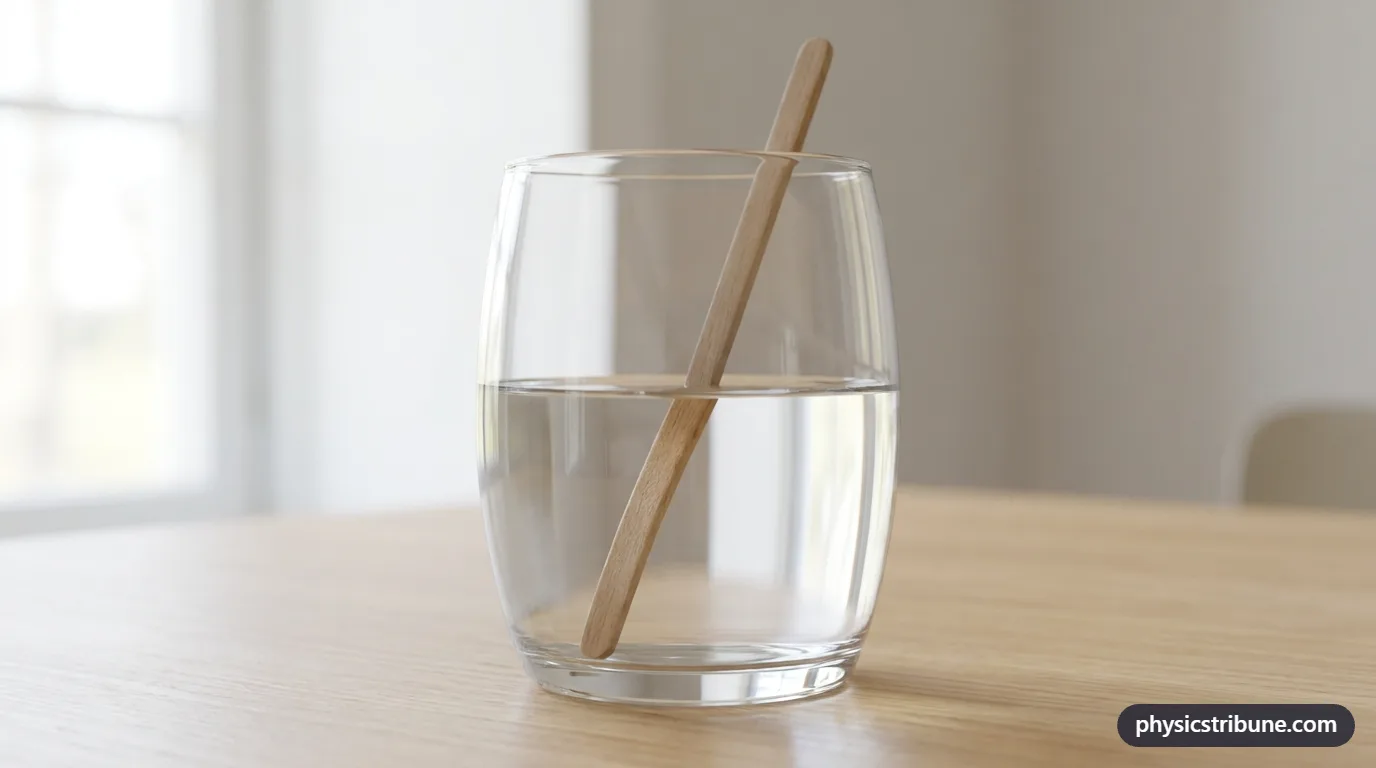
Because the products must match, a material with a large index forces the angle to be small, and a material with a small index allows a larger angle. That single balance explains why a straw looks broken in a glass of water, why lenses focus light and why diamonds sparkle.
Snell's Law Explained Simply
Picture a marching band crossing from a paved parking lot onto a muddy field at an angle. The musicians who reach the mud first slow down, while those still on pavement keep their pace. The whole line swings around and heads off in a new direction. Light does the same thing when one edge of its wavefront enters a slower material before the other edge.
The index of refraction is simply a measure of how slow the material is for light. Air is barely slower than empty space, water is noticeably slower and diamond is very slow. When light slows down, it turns toward the normal. When it speeds up, it turns away from the normal.
If the light hits the surface straight on, along the normal, every part of the wavefront slows at the same moment. Nothing swings around, so the ray goes straight through without bending, even though it still changes speed.
What Is the Formula for Snell's Law?
The law is written
The indices have no units because each one is a ratio of two speeds, so the law works in any unit system. Angles can be in degrees or radians, as long as your calculator is set to match. Solved for the unknown angle, the law becomes
To skip the arithmetic and see every step, use our Snell's law calculator, which also finds the critical angle. The first worked example below shows the same method by hand.
Here is Snell's law with every symbol explained, followed by the rearranged forms for each unknown.
| Symbol | Quantity | SI unit |
|---|---|---|
| index of refraction of medium 1 | dimensionless (1) | |
| angle of incidence (from the normal) | radian (rad) | |
| index of refraction of medium 2 | dimensionless (1) | |
| angle of refraction (from the normal) | radian (rad) |
Rearranged to find another variable:
Valid for: angles from the normal.
Example 1 A flashlight beam entering a swimming pool
At night, a flashlight beam travels through air (n1 = 1.00) and strikes the flat surface of a pool at 40° (0.6981 rad) from the normal. The water has n2 = 1.33. What is the angle of refraction inside the water?
- Given:
- index of refraction of medium 1:
- angle of incidence (from the normal):
- index of refraction of medium 2:
- index of refraction of medium 1:
- Formula:
- Substitute:
- Answer:
The answer is in radians. It is smaller than the incoming angle, so the beam has bent toward the normal as it slowed down in the water.

How Do You Calculate Snell's Law Step by Step?
Every Snell's law problem follows the same short routine:
- Sketch the boundary and the normal. Draw the surface, then a dashed line perpendicular to it where the ray strikes.
- Measure angles from the normal. If a problem gives the angle from the surface, subtract it from 90° first.
- Label the sides. Side 1 is where the light comes from and side 2 is where it goes. Write down both indices.
- Solve for the unknown. Rearrange
- Check the direction. Going into a higher index, the new angle must be smaller. Going into a lower index, it must be larger.
That last check catches most mistakes. If you find the ray bending the wrong way, you have probably swapped the two indices.
Example 2 Identifying an unknown clear plastic
A student shines a laser from air (n1 = 1.00) onto a flat block of clear plastic at 50° (0.8727 rad) from the normal and measures the refracted ray at 31° (0.5411 rad) inside the block. What is the refractive index of the plastic?
- Given:
- index of refraction of medium 1:
- angle of incidence (from the normal):
- angle of refraction (from the normal):
- index of refraction of medium 1:
- Formula:
- Substitute:
- Answer:
Compare the result with the table of typical indices below to guess which plastic the block is made of.
Why Does Light Bend Toward the Normal in Water and Glass?
Water, glass and plastic all have indices larger than air, so light slows down as it enters them. For the products
The table below shows how strongly three common materials bend light coming in from air. Notice that the bending grows with the angle of incidence, and that diamond bends light far more than water does. Even a ray that skims in almost parallel to the surface can only reach a limited angle inside, about 48.8° in water and 24.4° in diamond (computed).
This squeezing of every possible incoming direction into a narrower cone is why a fish under a calm pond can see the entire sky through a circle of surface directly above it.
| Angle of incidence in air | Into water (n = 1.33) | Into crown glass (n = 1.52) | Into diamond (n = 2.42) |
|---|---|---|---|
| 0° | 0.0° | 0.0° | 0.0° |
| 10° | 7.5° | 6.6° | 4.1° |
| 20° | 14.9° | 13.0° | 8.1° |
| 30° | 22.1° | 19.2° | 11.9° |
| 40° | 28.9° | 25.0° | 15.4° |
| 50° | 35.2° | 30.3° | 18.5° |
| 60° | 40.6° | 34.7° | 21.0° |
| 70° | 45.0° | 38.2° | 22.8° |
| 80° | 47.8° | 40.4° | 24.0° |
| Source: Computed with θ2 = arcsin(n1 sin θ1 / n2), n1 = 1.00 for air · indices are typical values for yellow light · Retrieved October 2026 | |||
What Happens When Light Goes From Glass Into Air?
Run the light the other way and Snell's law still holds, but now
This has a striking consequence. As the inside angle grows, the outside angle grows faster and eventually reaches 90°, skimming along the surface. The inside angle where this happens is the critical angle. Beyond it, Snell's law has no solution because a sine cannot exceed 1, and all of the light reflects back inside.
That effect is called total internal reflection. It traps light inside the thin glass strands of an optical fiber and gives a well-cut gem its brilliant flashes.
Example 3 Light leaving a glass window from the inside
A ray inside a pane of crown glass (n1 = 1.52) reaches the glass-to-air surface at 25° (0.4363 rad) from the normal. Air has n2 = 1.00. At what angle does the ray leave into the air?
- Given:
- index of refraction of medium 1:
- angle of incidence (from the normal):
- index of refraction of medium 2:
- index of refraction of medium 1:
- Formula:
- Substitute:
- Answer:
This time the refracted angle is larger than the incident angle, because the ray speeds up as it passes into air.

Who Discovered Snell's Law?
The law carries the name of the Dutch astronomer and mathematician Willebrord Snellius, who worked it out in 1621. He never published it, and it became widely known only after his death. In 1637 the French philosopher René Descartes published the same relationship independently, which is why it is called the Snell–Descartes law in France.
Snellius was not the first. The Persian scholar Ibn Sahl described the correct rule in Baghdad in 984, in a work on burning mirrors and lenses. The English scientist Thomas Harriot also found it around 1602 but left it in his private notes.
Later, Pierre de Fermat showed in 1662 that the law follows if light takes the path of least time, and Christiaan Huygens derived it from his wave picture of light. Both explanations require light to travel more slowly in glass and water than in air, a prediction confirmed in the 1800s.
Where Is Snell's Law Used in Real Life?
- Eyeglasses and camera lenses. Lens designers trace thousands of rays through each curved surface with Snell's law to make images sharp. See our page on the convex lens.
- Swimming pools and ponds. Water always looks shallower than it is because rays from the bottom bend as they leave the surface.
- Gem cutting. Jewelers choose facet angles so that light entering a stone bounces around inside rather than leaking out the back.
- Fiber-optic internet. Engineers use the law to pick core and cladding materials that keep light trapped over long distances.
- Measuring liquids. A refractometer measures the bending angle to find a liquid's index, which reveals sugar content in fruit juice or the strength of antifreeze.
You can test the law yourself with a ray box and a rectangular block, as described in our refraction through a glass block experiment.

Going Deeper: When Does Snell's Law Need Extra Care?
The index of a material is not quite the same for every color. Violet light usually sees a slightly higher index than red, so it bends a little more. This small difference spreads white light into a rainbow of colors, an effect called dispersion. Precise work must state which wavelength an index refers to.
Snell's law gives only the direction of the refracted ray, not how bright it is. Part of the light always reflects at the boundary, and that fraction grows at steep angles. Some special crystals, such as calcite, have two different indices at once and split a single ray into two.
Finally, the law assumes a sharp, flat boundary. When the index changes gradually, as in air heated above a hot road, the ray curves smoothly instead of bending at one point. That gradual bending produces mirages.
Practice Snell's Law Problems
Build confidence with our printable reflection and refraction worksheets, which include answer keys. Check each answer with the Snell's law calculator, then compare refraction with the other way light changes direction in reflection vs refraction. When you are ready, try the quiz below.
Common Misconceptions
Myth: Angles in Snell's law are measured from the surface.
Physics: They are measured from the normal. An angle given from the surface must be subtracted from 90° before you use the law.
Myth: Light always bends toward the normal when it refracts.
Physics: It bends toward the normal only when it enters a higher-index, slower material. Entering a lower-index material, it bends away.
Myth: The angles themselves are proportional to the indices.
Physics: It is the sines of the angles that follow the ratio of the indices. The angles are close to proportional only when they are small.
Myth: Light that hits a boundary head-on does not change at all.
Physics: It keeps its direction but still changes speed and wavelength. Only the bending disappears at normal incidence.
Key Facts
- Snell's law states that n1 sin θ1 = n2 sin θ2 at the boundary between two materials.
- All angles in Snell's law are measured from the normal, the line perpendicular to the surface.
- Light entering a higher-index material slows down and bends toward the normal.
- Light entering a lower-index material speeds up and bends away from the normal.
- A ray that hits a boundary straight on does not bend at all.
- Ibn Sahl described the law in 984, and it is named after Willebrord Snellius, who derived it in 1621.
- When Snell's law has no solution, light undergoes total internal reflection.
Quick Quiz: How Well Do You Know Snell's Law?
6 questions. Tap an answer to check it.
In Snell's law, from which line are the angles measured?
Both the angle of incidence and the angle of refraction are measured from the normal to the surface.
Light passes from air into glass at a slant. How does it bend?
Glass has a higher index than air, so the light slows down and bends toward the normal.
A ray hits the surface of water exactly along the normal. What is its angle of refraction?
With θ1 = 0, sin θ1 = 0, so sin θ2 = 0 and the ray continues straight through.
Which quantity has no unit in Snell's law?
The index is a ratio of two speeds, so the units cancel.
Light travels from diamond into air. Compared with the angle inside the diamond, the angle in air is
Air has a lower index, so the light speeds up and bends away from the normal, giving a larger angle.
Who first described the correct law of refraction, centuries before Snellius?
Ibn Sahl described the law in Baghdad in 984.
Frequently Asked Questions
What is Snell's law in simple terms?
Snell's law says that when light passes from one clear material into another at a slant, it bends by an amount you can predict. Multiply each material's index of refraction by the sine of the ray's angle from the normal, and the two results are equal. Slower materials have higher indices and pull the ray closer to the normal.
What is the formula for Snell's law?
The formula is n1 sin θ1 = n2 sin θ2. Here n1 and n2 are the indices of refraction of the first and second materials, θ1 is the angle of incidence and θ2 is the angle of refraction, both measured from the normal. To find the refracted angle, use θ2 = arcsin(n1 sin θ1 / n2).
How do you calculate the angle of refraction with Snell's law?
Multiply the first index by the sine of the incident angle, then divide by the second index. That gives the sine of the refracted angle. Take the inverse sine to get the angle itself. For light entering water from air at 30°, this gives about 22.1°. Always check that the angle shrank when entering a denser material.
Why is it called Snell's law?
It is named after Willebrord Snellius, a Dutch mathematician who derived the relationship in 1621. He did not publish it, and the name became attached later. The rule had already been found by Ibn Sahl in 984 and by Thomas Harriot around 1602, and René Descartes published it independently in 1637.
What does the index of refraction mean in Snell's law?
The index of refraction is the speed of light in a vacuum divided by its speed in the material. A higher index means light travels more slowly there. Air is very close to 1, water is about 1.33, crown glass is about 1.52 and diamond is about 2.42. Because it is a ratio of speeds, the index has no unit.
Does Snell's law work for sound waves?
Yes. Snell's law applies to any wave whose speed changes at a boundary. For sound, you replace the indices with the inverse of the wave speeds, so the ratio of sines equals the ratio of speeds. Sound bends when it passes between warm and cold layers of air, which is why distant sounds can carry farther on some evenings.
What happens when Snell's law gives a sine greater than 1?
A sine can never be greater than 1, so there is no refracted ray at all. This happens when light inside a denser material hits the boundary at more than the critical angle. All of the light then reflects back into the denser material. This is total internal reflection, the effect that keeps light trapped inside optical fibers.
How is Snell's law related to Fermat's principle?
Fermat's principle says light follows the path between two points that takes the least time. Because light is slower in water than in air, the fastest route from a point in air to a point under water is not a straight line. Working out that quickest path mathematically gives exactly Snell's law.
Keep Exploring




Sources
Constants come from NIST CODATA 2022 (public domain) and unit definitions from the BIPM SI Brochure (CC BY 4.0). Text, diagrams and illustrations are original work by Physics Tribune.