At a Glance
Energy is the capacity to do work and is measured in joules (J). Work is energy transferred by a force, W = F × d, and power is the rate of that transfer, P = W / t, measured in watts. Energy is never created or destroyed; it only changes form or moves between objects.
- What it covers
- Forms of energy, conservation, work, power, machines, resources
- Unit of energy and work
- joule (J) = 1 N·m = 1 kg·m²/s²
- Unit of power
- watt (W) = 1 J/s
- Core law
- Energy is conserved; it only changes form
- Key formulas
- KE = ½mv², PE = mgh, W = Fd, P = W/t
- Sub-guides
- 5 topic groups, 45+ pages
On this page
- What Is Energy in Physics?
- Energy Explained Simply
- What Are the Main Forms of Energy?
- Can Energy Be Created or Destroyed?
- How Are Work, Energy and Power Related?
- How Do Simple Machines Make Work Easier?
- Where Does Our Energy Come From?
- In What Order Should You Learn Energy?
- All pages in this guide
- Key Facts
- FAQ
What Is Energy in Physics?
In physics, energy is a number that measures how much a system can change things around it: speed something up, lift it, warm it, bend it or light it. A moving baseball has energy because it can shatter a window. A battery has energy because it can drive a current through a motor. A hot pan has energy because it can boil water.
Energy is a scalar, so it has a size but no direction, and its SI unit is the joule. One joule is roughly the energy needed to lift a small apple one meter. Because a joule is small, everyday amounts are often given in kilojoules, food Calories or kilowatt-hours.
The idea that makes energy so useful is bookkeeping. You can follow it from one form to another, from one object to another, and the total always adds up. That single rule, conservation of energy, runs through every page in this section.
| Unit | Symbol | Value in joules | Where you meet it |
|---|---|---|---|
| joule | J | 1 | Physics problems, SI standard |
| kilojoule | kJ | 1,000 | Food labels outside the US, car energies |
| calorie (thermochemical) | cal | 4.184 | Chemistry and heat experiments |
| food Calorie (kilocalorie) | kcal | 4,184 | US nutrition labels |
| watt-hour | Wh | 3,600 | Phone and laptop batteries |
| kilowatt-hour | kWh | 3,600,000 | Electricity bills |
| foot-pound | ft·lbf | 1.356 | US engineering and ballistics |
| electronvolt | eV | 1.602 176 634 × 10-19 | Atomic and particle physics |
| Source: Electronvolt from BIPM SI Brochure (data/si-units.json); calorie = 4.184 J by definition; Wh and kWh computed as 1 W × 3,600 s; foot-pound computed from 1 ft = 0.3048 m and 1 lbf = 4.448 221 615 260 5 N · Retrieved October 2026 | |||
Energy Explained Simply
Think of energy as a kind of money that nature spends. It can sit in a savings account, like a book on a high shelf or a stretched spring, or it can be spent on motion, heat, light or sound. Spending moves it around, but it never disappears from the bank as a whole.
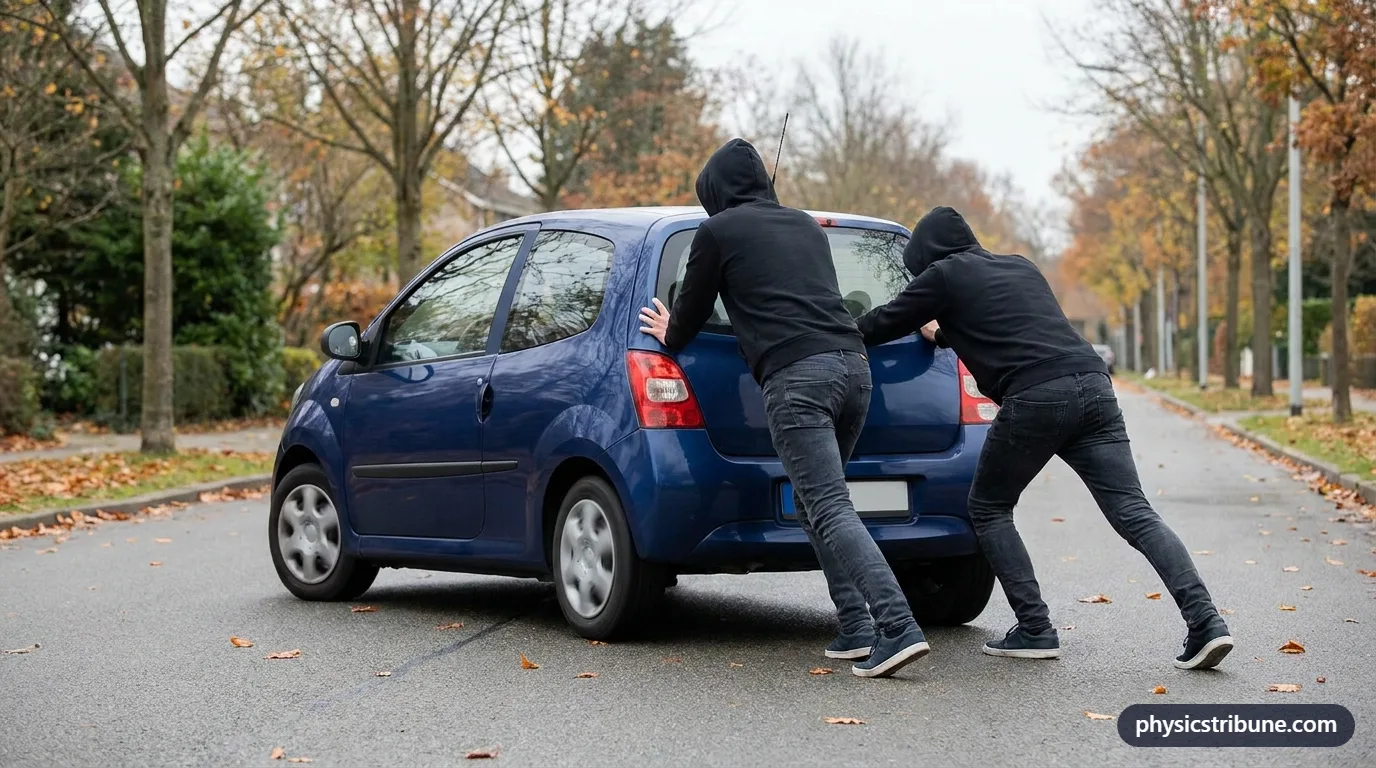
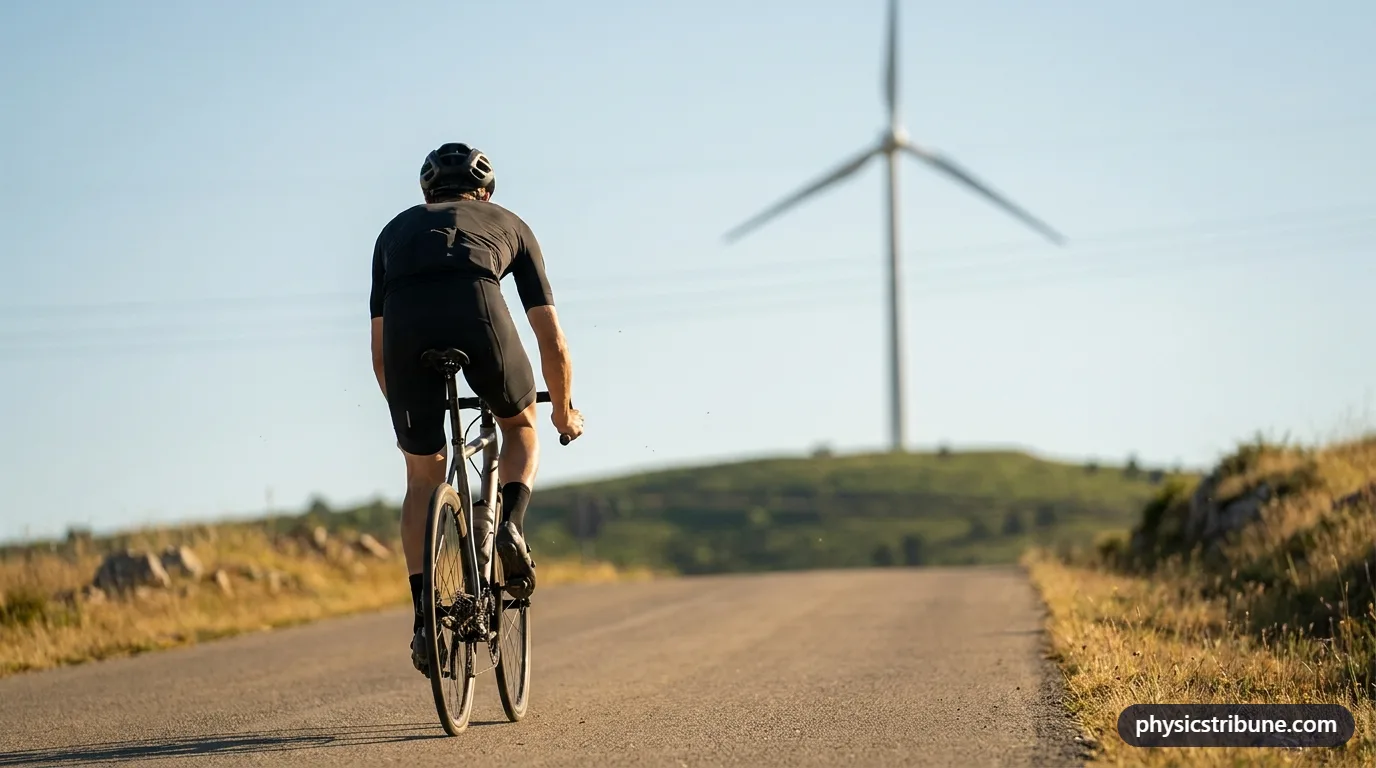
Work is the act of paying: when you push a shopping cart and it speeds up, you hand some of your energy to the cart. Power is how fast you pay. Two people can climb the same staircase and do the same work, but the one who runs up uses more power.
What Are the Main Forms of Energy?
Physicists sort energy into two big families. Kinetic energy is energy of motion, from a rolling bowling ball to vibrating air molecules. Potential energy is stored energy that depends on position or arrangement, such as gravitational potential energy in a raised weight and elastic potential energy in a drawn bow.
Many everyday names are combinations of these. Chemical energy is stored in the arrangement of atoms in food and fuel. Electrical energy is carried by moving charges, radiant energy by light, and sound energy by pressure waves, while thermal energy is the random motion of particles. The full map is in our forms of energy guide.
Can Energy Be Created or Destroyed?
No. The law of conservation of energy says the total energy of an isolated system stays constant. Energy can change form, which we call an energy transformation, or move from one object to another, but the books always balance.
A roller coaster shows this clearly. At the top of the first hill the train has a large store of gravitational potential energy. As it drops, that store becomes kinetic energy, and as it climbs the next hill the trade runs the other way. Each hill must be lower than the first, because some energy leaks away as heat and sound through friction and air drag.
That leak is called energy dissipation. It is the reason no real machine is perfectly efficient, and why a perpetual motion machine can never work. Energy efficiency measures how much of the input ends up as the useful output.

How Are Work, Energy and Power Related?
Work is the energy transferred when a force moves something along the direction of the force,
The work-energy theorem makes the link exact: the net work done on an object equals its change in kinetic energy. Power is the rate of doing work,
| Quantity | Formula | SI unit |
|---|---|---|
| Kinetic energy | KE = ½ m v² | joule (J) |
| Gravitational potential energy | PE = m g h | joule (J) |
| Elastic potential energy | PE = ½ k x² | joule (J) |
| Mechanical energy | E = KE + PE | joule (J) |
| Work (force along the motion) | W = F d | joule (J) |
| Work at an angle | W = F d cos θ | joule (J) |
| Work-energy theorem | W_net = ½ m v² − ½ m v0² | joule (J) |
| Power | P = W / t | watt (W) |
| Power from force and speed | P = F v | watt (W) |
| Efficiency | Eff = useful energy out / energy in | no unit (fraction or %) |
| Mechanical advantage | MA = F_out / F_in | no unit |
| Source: Formulas from our formula data set (data/formulas.json) · Retrieved October 2026 | ||
How Do Simple Machines Make Work Easier?
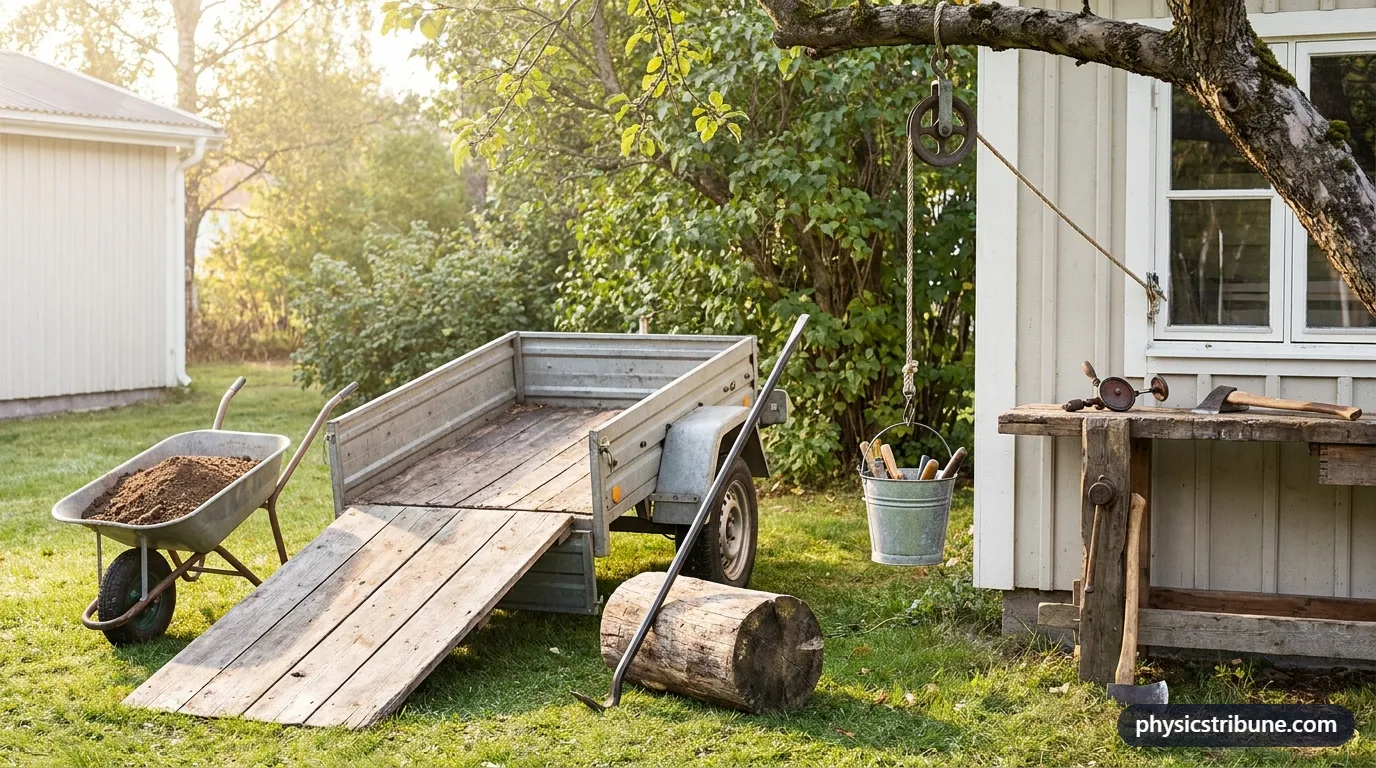
A simple machine lets you trade force for distance. A lever, a pulley or an inclined plane lets a small force lift a heavy load, but only by moving that small force through a longer distance. The work you put in is never less than the work you get out.
The ratio of output force to input force is the mechanical advantage. Our simple machines guide covers all six classic machines, plus gears and compound machines like bicycles and cranes.
Where Does Our Energy Come From?
Almost all the energy people use started as sunlight, nuclear energy or the heat of Earth's interior. Fossil fuels store ancient sunlight as chemical energy. Solar, wind and hydroelectric power tap the Sun's energy as it arrives, while geothermal energy draws on heat from below.
Our energy resources guide explains how each one works, and the comparison of renewable vs nonrenewable energy weighs them side by side.
In What Order Should You Learn Energy?
Each step uses ideas from the one before. We suggest this path:
- Forms of energy, starting with kinetic and potential energy.
- Work and power, including the work-energy theorem.
- Conservation of energy, with mechanical energy and efficiency.
- Simple machines, which apply work and efficiency to real tools.
- Energy resources, which connect the physics to power plants and the grid.
Practice along the way with the kinetic energy calculator, the work calculator and our kinetic and potential energy worksheets. All the equations sit together on the energy formulas sheet.
All Energy, Work & Power (5)



Key Facts
- Energy is the capacity to do work, and its SI unit is the joule.
- Kinetic energy belongs to moving objects, while potential energy is stored by position or arrangement.
- Energy cannot be created or destroyed; it only changes form or moves between objects.
- Work is energy transferred by a force acting through a distance, W = F d.
- Power is the rate of doing work, and one watt equals one joule per second.
- Simple machines reduce the force needed for a job but never reduce the work required.
- No real machine is 100 percent efficient, because some energy is always dissipated as heat.
Frequently Asked Questions
What is energy in physics?
In physics, energy is the capacity of a system to do work, meaning to exert a force through a distance and cause change. It comes in many forms, including kinetic energy of motion, potential energy stored by position, thermal, chemical, electrical and radiant energy. It is measured in joules and is always conserved, so the total amount in an isolated system stays the same.
What is the difference between energy, work and power?
Energy is what a system has, the ability to cause change. Work is energy being transferred by a force, so it is energy on the move, measured in joules like energy itself. Power is how quickly work is done or energy is transferred, measured in watts. Lifting a box slowly or quickly takes the same work, but doing it quickly takes more power.
What is the unit of energy?
The SI unit of energy is the joule, written J. One joule is the work done by a one-newton force acting over one meter, and it equals one kilogram meter squared per second squared. Other common units include the food Calorie, equal to 4,184 J, the kilowatt-hour of 3.6 million joules on electricity bills, and the tiny electronvolt used in atomic physics.
What are the two main types of energy?
The two main types are kinetic energy and potential energy. Kinetic energy is the energy an object has because it moves, and potential energy is energy stored because of an object's position or the arrangement of its parts. Most other named forms, such as thermal, chemical and sound energy, turn out to be kinetic energy, potential energy or a mix of both at the scale of atoms.
Why can't energy be created or destroyed?
Conservation of energy is one of the most thoroughly tested laws in physics, and no experiment has ever found it broken. At a deeper level, it follows from the fact that the laws of physics do not change over time. Energy can only move from place to place or change form, which is why every energy calculation must balance, including the hard-to-see heat lost to friction.
Is energy a scalar or a vector?
Energy is a scalar. It has a size but no direction, so two identical balls moving at the same speed in opposite directions carry the same kinetic energy. Work and power are scalars too. This makes energy methods popular for solving problems, because you can add energies as plain numbers instead of combining forces as arrows in different directions.