
At a Glance
The most famous physicists include Galileo Galilei, Isaac Newton, Michael Faraday, James Clerk Maxwell, Marie Curie, Albert Einstein, Niels Bohr and Richard Feynman. Our 89 biographies are grouped into three eras: the Scientific Revolution before 1700, classical physics in the 1700s and 1800s, and modern physics from the late 1800s onward.
- Profiles
- 89 physicists, each with a dated timeline
- Eras covered
- Ancient Greece to the 2020s
- Nobel Prize in Physics laureates
- 41 of the 89 profiles
- Women physicists
- 7 profiles, from Marie Curie to Anne L'Huillier
- Data source
- Birth and death dates and Nobel years from our physicist data set
On this page
Who Are the Most Famous Physicists?
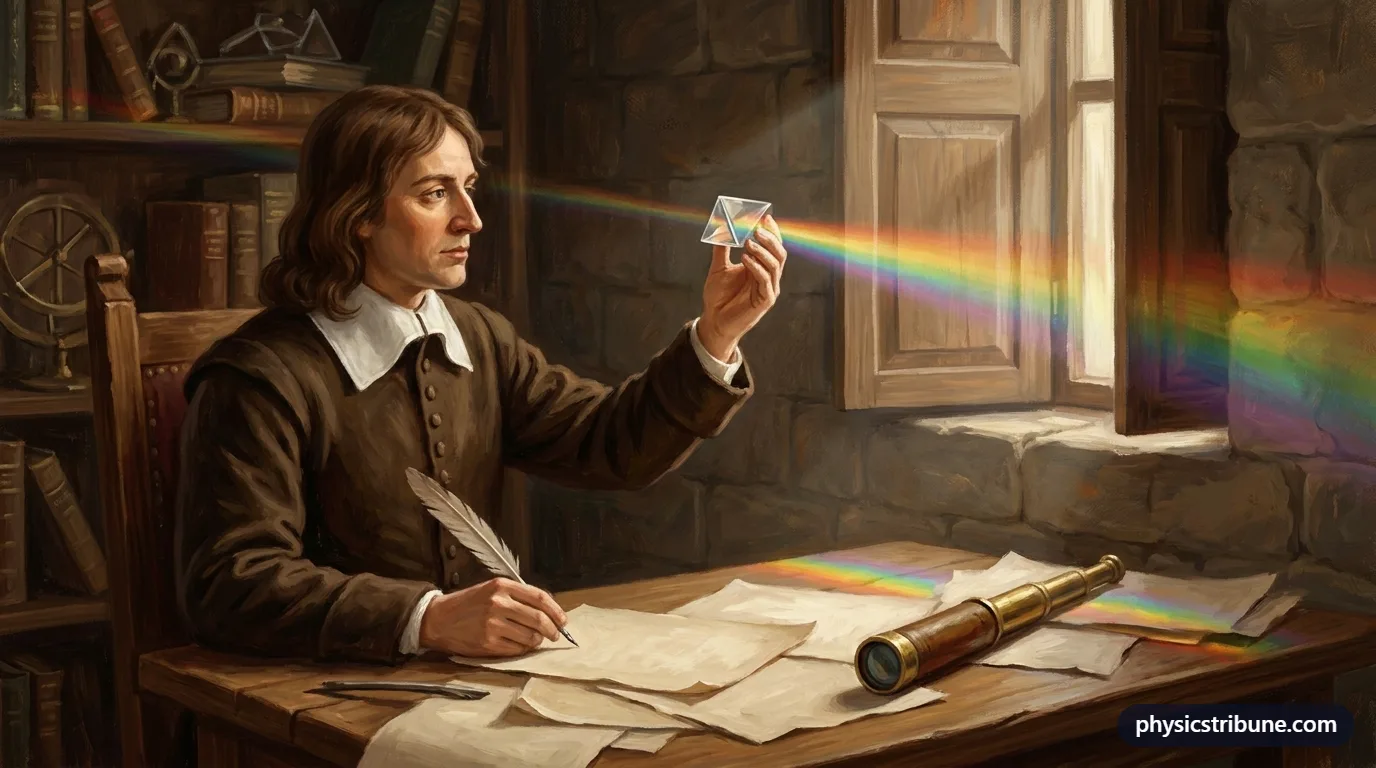
A handful of names come up in every physics class, because each one changed how we see the world. Galileo Galilei showed that experiments, not old authorities, settle questions about motion. Isaac Newton wrote down the laws of motion and universal gravitation. Michael Faraday discovered electromagnetic induction, and James Clerk Maxwell joined electricity, magnetism and light into one theory.
In the twentieth century, Albert Einstein rewrote our ideas of space, time and energy, Marie Curie opened up the study of radioactivity, and Niels Bohr built the first quantum model of the atom. The table below lists fourteen of the most influential, with the work each is best known for.
Fame is only part of the story. Many of our profiles cover people whose names live on in units and laws you use every day, such as Georg Ohm, James Prescott Joule and Alessandro Volta.
| Physicist | Lived | Best known for | Nobel Prize |
|---|---|---|---|
| Galileo Galilei | 1564–1642 | Free fall, inertia, the pendulum and telescopic astronomy | None |
| Isaac Newton | 1643–1727 | Laws of motion, universal gravitation, optics and calculus | None |
| Michael Faraday | 1791–1867 | Electromagnetic induction, the electric motor, field lines | None |
| James Clerk Maxwell | 1831–1879 | Maxwell's equations; kinetic theory of gases | None |
| Max Planck | 1858–1947 | Quantum hypothesis and the Planck constant | Physics 1918 |
| Marie Curie | 1867–1934 | Radioactivity, polonium and radium | Physics 1903, Chemistry 1911 |
| Ernest Rutherford | 1871–1937 | Nuclear model of the atom; alpha and beta radiation | Chemistry 1908 |
| Lise Meitner | 1878–1968 | Co-discovery of nuclear fission | None |
| Albert Einstein | 1879–1955 | Special and general relativity, E = mc², photoelectric effect | Physics 1921 |
| Niels Bohr | 1885–1962 | Bohr model of the atom; quantum theory | Physics 1922 |
| Enrico Fermi | 1901–1954 | First nuclear reactor; Fermi-Dirac statistics | Physics 1938 |
| Richard Feynman | 1918–1988 | Quantum electrodynamics and Feynman diagrams | Physics 1965 |
| Peter Higgs | 1929–2024 | Higgs mechanism and the Higgs boson | Physics 2013 |
| Stephen Hawking | 1942–2018 | Hawking radiation and black-hole physics | None |
| Source: Dates, fields and Nobel years from our physicist data set (data/physicists.json, built from Wikidata CC0 and nobelprize.org) · Retrieved October 2026 | |||
How Are the Physicists Grouped?
We sort every profile into one of three eras, each with its own guide:
- Physicists of the Scientific Revolution, born before 1700: 12 profiles, from Archimedes and Copernicus to Kepler, Galileo, Huygens and Newton. This era turned natural philosophy into a science based on measurement and mathematics.
- Classical physics pioneers, born from 1700 to 1849: 28 profiles covering heat, electricity, magnetism and light, including Franklin, Coulomb, Faraday, Maxwell, Kelvin and Boltzmann.
- Modern physicists, born in 1850 or later: 49 profiles spanning radioactivity, relativity, quantum theory, nuclear and particle physics, and today's astrophysics and laser science.
Each biography follows the same plan: a short answer to who the person was, a dated timeline, their major discoveries with links to the concept pages, a key equation, their legacy and a short quiz.
What Did Famous Physicists Discover?
The discoveries of these scientists form the backbone of every branch of physics on our site. Newton's three laws are the foundation of forces and motion. Joule, Carnot, Clausius and Kelvin built the laws of thermodynamics. Coulomb, Volta, Ampère, Ohm, Faraday and Maxwell worked out electricity and magnetism.
From 1895 onward, discoveries came fast. Röntgen found X-rays, Becquerel and the Curies found radioactivity, Thomson identified the electron, Rutherford found the nucleus, and Planck, Einstein, Bohr, Heisenberg and Schrödinger built quantum theory. Meitner and Fermi opened the age of nuclear physics, and Gell-Mann, Weinberg and Higgs helped assemble the Standard Model of particles.
Which Physicists Won the Nobel Prize?
The Nobel Prize in Physics has been awarded since 1901, and 41 of the people in our collection received it. Marie Curie won twice, in physics in 1903 and in chemistry in 1911, and John Bardeen won the physics prize twice, in 1956 and 1972. Our list of Nobel Prize in Physics winners covers the laureates and what each prize recognized.
Women have shaped physics from its early modern days, often against heavy obstacles. Lise Meitner explained nuclear fission, Emmy Noether linked symmetries to conservation laws, and Chien-Shiung Wu showed that nature can tell left from right. Andrea Ghez, Donna Strickland and Anne L'Huillier won the physics prize in 2020, 2018 and 2023. Read their stories in famous women in physics.
Where Should You Start?
If you are new to the history of physics, this order tells the story from the beginning:
- Start with the timeline of physics discoveries for the big picture.
- Read Galileo and Newton to see how modern science began.
- Follow electricity and magnetism through Faraday and Maxwell.
- Move to the atom with Marie Curie and Ernest Rutherford.
- Finish with Einstein, Bohr and Feynman for relativity and quantum physics.
Want to repeat a famous result yourself? Our famous physics experiments guide explains the tests behind many of these discoveries.
All Famous Physicists (6)
Key Facts
- Our collection profiles 89 physicists, from Archimedes to Nobel laureates of the 2020s.
- The profiles are grouped into three eras: before 1700, 1700 to 1849, and 1850 onward.
- 41 of the 89 physicists won the Nobel Prize in Physics.
- Marie Curie is the only person in our list with Nobel Prizes in two different sciences.
- Many units, such as the newton, joule, watt, volt, ohm and kelvin, honor physicists profiled here.
Frequently Asked Questions
Who is the most famous physicist of all time?
There is no official ranking, but Isaac Newton and Albert Einstein are the names most often given. Newton's laws of motion and gravity shaped science for over two centuries, and Einstein's relativity and E = mc² reshaped it again in the twentieth. Galileo, Maxwell, Marie Curie and Niels Bohr are close behind on most lists.
Who is considered the father of physics?
Galileo Galilei is often called the father of modern physics, because he insisted on testing ideas with careful experiments and mathematics. Isaac Newton is also given the title, since he turned those methods into universal laws of motion and gravity. In the ancient world, Archimedes is sometimes named for his work on levers and buoyancy.
Who are some famous women physicists?
Marie Curie pioneered radioactivity and won two Nobel Prizes. Lise Meitner explained nuclear fission, Emmy Noether proved the theorem linking symmetries to conservation laws, and Chien-Shiung Wu showed that the weak force breaks mirror symmetry. More recently, Donna Strickland, Andrea Ghez and Anne L'Huillier won the Nobel Prize in Physics in 2018, 2020 and 2023.
How many physicists have won the Nobel Prize?
More than two hundred people have received the Nobel Prize in Physics since it was first awarded in 1901. In our own collection of 89 physicists, 41 are physics laureates. John Bardeen is the only person to have won the physics prize twice, while Marie Curie won one prize in physics and another in chemistry.
What do physicists study?
Physicists study matter, energy and the forces that act between them, from the smallest particles to the whole universe. Some test ideas in laboratories, others work out theories with mathematics, and many do both. Their work explains how things move, why materials behave as they do, how light and electricity work, and what stars and atoms are made of.
Which physicists have units named after them?
Many SI units honor physicists. The newton is named for Isaac Newton, the joule for James Prescott Joule, the watt for James Watt, the volt for Alessandro Volta, the ampere for André-Marie Ampère, the ohm for Georg Ohm and the kelvin for Lord Kelvin. The coulomb, hertz, tesla and becquerel are named after physicists too.
Keep Exploring
 physicistsIsaac Newton
 physicistsAlbert Einstein
 physicistsMarie Curie
 physicistsModern Physicists (born 1850 or later)
 physicistsClassical Physics Pioneers (1700s-1800s)
 physicistsPhysicists of the Scientific Revolution (before 1700)
 physicistsNobel Prize in Physics Winners
 physicistsFamous Women in Physics
 physicistsTimeline of Physics Discoveries