At a Glance
Energy is the capacity to do work, measured in joules (J). Power is the rate of energy transfer, P = W / t or P = E / t, measured in watts (1 W = 1 J/s). Energy equals power multiplied by time, which is why electricity bills charge for kilowatt-hours.
- Energy
- Amount transferred, unit joule (J)
- Power
- Rate of transfer, unit watt (W) = J/s
- Formula
- P = W / t, so E = P × t
- Type
- Both scalars
- Billing unit
- kilowatt-hour (kWh) = 3,600,000 J
- Analogy
- Energy is distance driven · power is speed
On this page
- What Is the Difference Between Energy and Power?
- How Are Energy and Power Defined?
- What Is the Formula Linking Energy and Power?
- Can Two Devices Use the Same Energy at Different Powers?
- Why Do Electricity Bills Use Kilowatt-Hours?
- What Are Everyday Examples of Energy and Power?
- How Do Energy and Power Relate to Efficiency?
- Common Misconceptions
- Key Facts
- Quiz
- FAQ
What Is the Difference Between Energy and Power?
Energy and power are often used as if they meant the same thing, especially in talk about electricity. They are linked, but they answer different questions. Energy answers "how much?" Power answers "how fast?"
Energy is a quantity you can store, transfer and add up: the chemical energy in a battery, the heat that warms a bath, the work done lifting a box onto a shelf. Power is a rate. It tells you how many joules are moved or converted every second, and on its own it says nothing about the total.
A car trip makes a handy comparison. Energy is like the distance you drive, and power is like your speed. A slow car and a fast car can cover the same 100 km; the fast one simply gets there sooner. The table below sets the two quantities side by side.
| Feature | Energy | Power |
|---|---|---|
| Question it answers | How much? | How fast? |
| What it describes | Amount of work done or heat transferred | Rate of energy transfer |
| Formula | E = P × t | P = W / t |
| SI unit | joule (J) | watt (W) = J/s |
| Base SI units | kg·m²/s² | kg·m²/s³ |
| Type of quantity | Scalar | Scalar |
| Conserved? | Yes, always | No |
| Can be stored? | Yes, in batteries, fuel, springs | No, it is a rate |
| Everyday units | kWh, calorie, BTU | kilowatt, horsepower |
| What an electric bill charges for | Yes, in kWh | Not directly |
| Car analogy | Distance driven | Speed |
| Named after | James Prescott Joule | James Watt |
| Source: Definitions as used in standard SI mechanics; SI unit definitions per BIPM · Retrieved October 2026 | ||
How Are Energy and Power Defined?
Energy is the capacity to do work or to heat something. It comes in many forms, from kinetic and gravitational to chemical, thermal and electrical, as described on our forms of energy page. Its SI unit is the joule, the work done when a force of 1 N moves something 1 m.
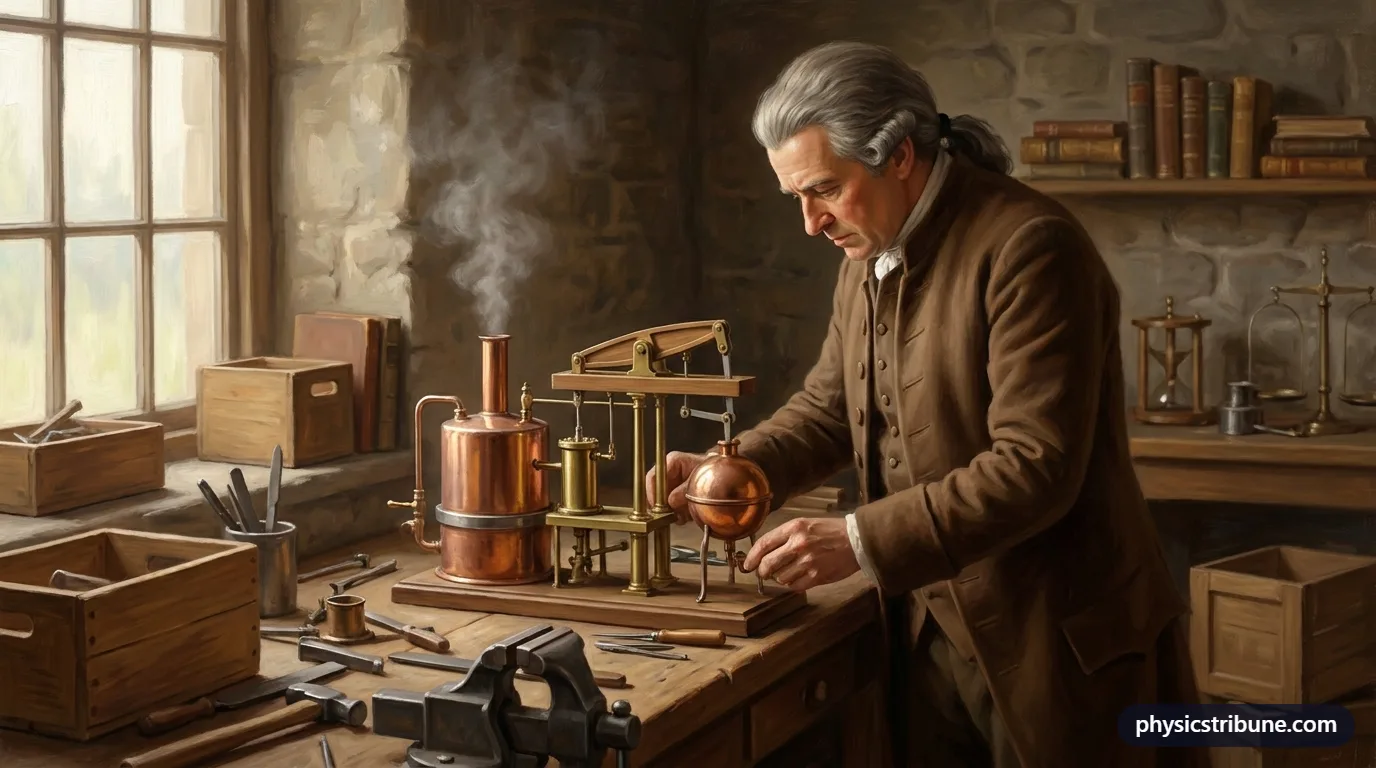
Power is the rate at which energy is transferred or work is done. Its SI unit is the watt, one joule per second, named after the steam engine improver James Watt. A 60 W lamp converts 60 J of electrical energy every second it is on.
Energy is conserved: it is never created or destroyed, only moved and changed in form, as the law of conservation of energy states. Power has no conservation law of its own. It can jump from zero to a large value the instant you flip a switch.
What Is the Formula Linking Energy and Power?
Average power is energy divided by time,
For electrical devices the power also equals current times voltage,
Our power calculator solves
Power is the work done, or energy transferred, divided by the time it takes; here is the formula with each variable, its SI unit and the rearranged forms.
| Symbol | Quantity | SI unit |
|---|---|---|
| average power | watt (W) | |
| work done or energy transferred | joule (J) | |
| time | second (s) |
Rearranged to find another variable:
Example 1 How powerful is the kettle?
An electric kettle transfers 360,000 J of energy to the water in 180 s. What is its power?
- Given:
- work done or energy transferred:
- time:
- work done or energy transferred:
- Formula:
- Substitute:
- Answer:
That is a typical power rating for a kettle; a higher rating would boil the same water faster.
Can Two Devices Use the Same Energy at Different Powers?
Yes, and the chart below shows three of them. A 2,000 W kettle running for 180 s, a 1,000 W hair dryer running for 360 s and a 500 W heater running for 720 s each turn the same 360,000 J (computed) of electrical energy into thermal energy. The total energy bars are equal, even though the kettle has four times the power of the heater.
The difference is entirely in the time. High power means the energy is delivered in a short burst; low power spreads it out. This is why a powerful device is not automatically an expensive one to run: what matters for cost is power multiplied by hours of use.
The same logic applies to people. A sprinter and a hiker climbing the same stairs gain the same gravitational potential energy, because their weight and height are the same. The sprinter just has a much higher power output, because she climbs in a few seconds instead of a minute.

Why Do Electricity Bills Use Kilowatt-Hours?
A kilowatt-hour is a unit of energy, not power, even though it contains the word "watt." It is the energy transferred by a 1,000 W device running for one hour: 1,000 J/s times 3,600 s, which is 3,600,000 J.
Utilities bill in kilowatt-hours because the joule is too small for household amounts. A home might use hundreds of kilowatt-hours in a month, which would be hundreds of millions of joules. The kilowatt-hour keeps the numbers readable and matches the way people think: a device's power times the hours it runs.
A common slip is to write "kilowatts per hour." That would describe how fast power changes, which is not what the meter measures. The correct phrase is kilowatt-hour, a power multiplied by a time.
Example 2 Energy used by a space heater
A 1,500 W space heater runs for 600 s (10 minutes). How much energy does it transfer?
- Given:
- average power:
- time:
- average power:
- Formula:
- Substitute:
- Answer:
In billing units this is 0.25 kWh (computed), because 1 kWh is 3,600,000 J.
What Are Everyday Examples of Energy and Power?
Energy statements describe totals:
- A slice of toast provides roughly 300,000 J of food energy.
- A typical phone battery stores about 50,000 J when full.
- A household might use around 30 kWh of electricity on a busy day.
Power statements describe rates:
- A resting adult gives off heat at roughly 100 W.
- A microwave oven is often rated at about 1,000 W.
- A car engine might be rated at about 100 kW, or roughly 134 horsepower.
The table further down shows how long common devices take to use one kilowatt-hour. It is a quick way to see that a small power running for a long time can add up to as much energy as a big power running briefly.
| Device | Typical power | Time to use 1 kWh |
|---|---|---|
| LED bulb | about 10 W | 100 h |
| Laptop | about 50 W | 20 h |
| Microwave oven | about 1,000 W | 1 h |
| Electric kettle | about 2,000 W | 30 min |
| Home EV charger | about 7,200 W | about 8.3 min |
| Source: Computed with t = E / P from typical power ratings; real devices vary · Retrieved October 2026 | ||
How Do Energy and Power Relate to Efficiency?
Efficiency compares useful output with total input, and it can be written with either quantity. A motor that takes in 1,000 J and delivers 800 J of useful work is 80% efficient. The same motor taking in 1,000 W and delivering 800 W of mechanical power is also 80% efficient, because the time cancels.
The missing 20% is not lost from the universe. It is converted into thermal energy in the motor's wires and bearings. Better design raises efficiency, which means less input energy, and lower bills, for the same useful work.
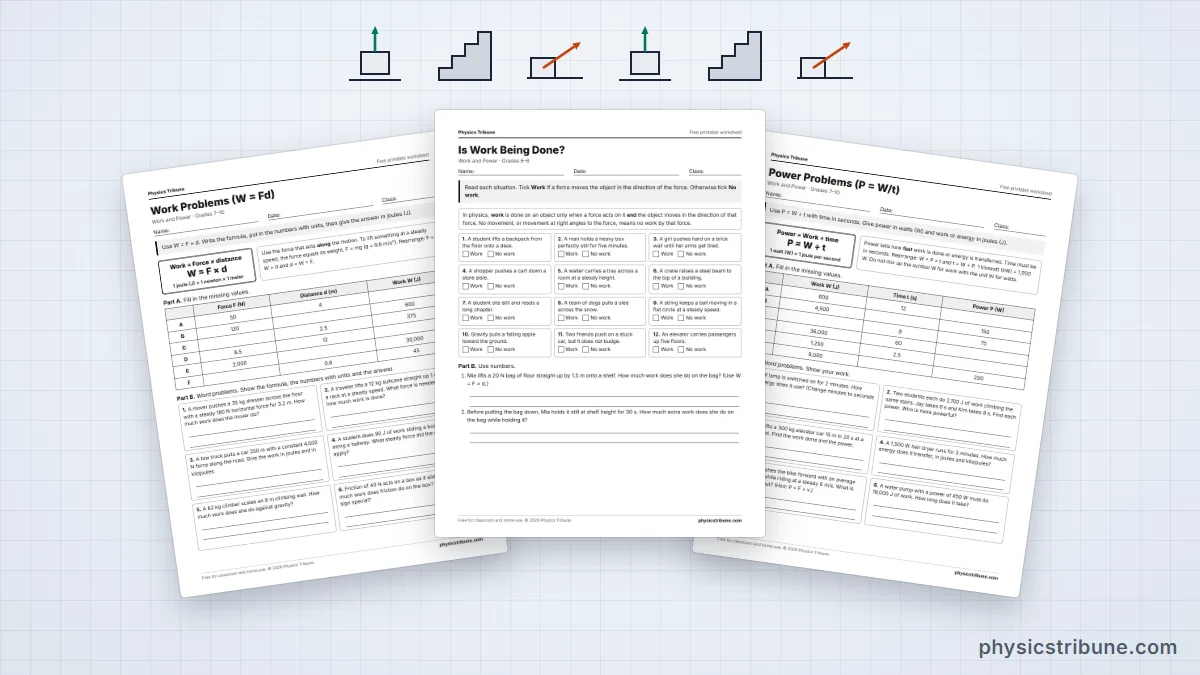
For practice with mixed energy and power problems, try our work and power worksheets, and see work vs power for the mechanical side of the same idea.
Common Misconceptions
Myth: Energy and power mean the same thing.
Physics: Energy is a total amount, while power is how fast that amount is transferred. Power is energy divided by time.
Myth: A kilowatt-hour is a unit of power.
Physics: It is a unit of energy: a power of 1 kW kept up for one hour, which equals 3,600,000 J.
Myth: A higher-power device always uses more energy.
Physics: Only if it runs for the same time. A 2,000 W kettle used for three minutes uses less energy than a 100 W lamp left on all day.
Myth: Power gets used up the way fuel does.
Physics: Energy is what a device draws on and converts. Power describes how fast that happens and is not a stored quantity.
Key Facts
- Energy is an amount, measured in joules; power is a rate, measured in watts.
- One watt is one joule of energy transferred every second.
- Energy equals power multiplied by time, E = P t.
- A kilowatt-hour is a unit of energy equal to 3,600,000 J.
- Two devices with different powers can use the same energy if they run for different times.
- Energy is conserved, but power is not; it can change instantly.
- Both energy and power are scalar quantities.
Quick Quiz: How Well Do You Know Energy vs Power?
6 questions. Tap an answer to check it.
What is the SI unit of power?
Power is measured in watts, where 1 W = 1 J/s.
A motor does 3,000 J of work in 10 s. What is its power?
P = W / t = 3,000 J / 10 s = 300 W.
Which of these is a unit of energy?
A kilowatt-hour is a power multiplied by a time, which is energy.
A 100 W lamp runs for 20 s. How much energy does it use?
E = P t = 100 W × 20 s = 2,000 J.
Two students climb the same stairs; one runs and one walks. Which statement is true if they weigh the same?
Same weight and height mean the same energy; the runner does it in less time, so her power is higher.
Which quantity is always conserved?
Energy is conserved; power is a rate that can change at any moment.
Frequently Asked Questions
What is the main difference between energy and power?
Energy is the total amount of work done or heat transferred, measured in joules. Power is the rate at which that energy is transferred, measured in watts, where one watt is one joule per second. Energy tells you how much; power tells you how fast. Multiply power by time to get energy.
Is a watt a unit of energy or power?
A watt is a unit of power. It means one joule of energy transferred every second. A 100 W bulb converts 100 J of electrical energy into light and heat each second. The related unit, the watt-hour or kilowatt-hour, is a unit of energy because it multiplies a power by a time.
How do you calculate energy from power?
Multiply the power by the time: E = P t. Use watts and seconds to get joules, or kilowatts and hours to get kilowatt-hours. For example, a 2,000 W heater running for half an hour uses 2 kW times 0.5 h, which is 1 kWh, or 3,600,000 J.
Is a kWh energy or power?
A kilowatt-hour is energy. It is the amount of energy transferred when a power of 1,000 W runs for one hour, which works out to 3,600,000 J. Electricity companies use it because household energy use in joules would be inconveniently large numbers.
Can something have a lot of energy but little power?
Yes. A large lake behind a dam stores a huge amount of gravitational potential energy, but if the water trickles out slowly, the power is small. A car battery stores a lot of energy yet delivers modest power to a dashboard light. Power depends on how fast the energy is released, not on how much is stored.
Why is power measured in watts and energy in joules?
The joule measures an amount of work or heat, so it fits energy. Power is a rate, so its unit is joules per second, which was given its own name, the watt. Naming it saves writing J/s every time and honors James Watt, whose engine work made power ratings important.
Does a higher wattage use more electricity?
Per hour of use, yes. A 1,500 W heater uses fifteen times as much energy per hour as a 100 W lamp. Over a day, though, the total depends on how long each one runs. A high-wattage appliance used briefly can cost less than a low-wattage one left on for many hours.
What is the difference between energy, work and power?
Work is energy transferred by a force acting through a distance, so work and energy share the unit joule. Power is the rate of doing work or transferring energy, measured in watts. Lifting a box onto a shelf takes the same work whether you do it fast or slow; doing it fast takes more power.