At a Glance
Special relativity (1905) applies to observers moving at constant velocity and predicts time dilation, Δt = γΔt₀, length contraction and E = mc². General relativity (1915) includes acceleration and gravity, treating gravity as curved spacetime, and predicts that clocks run slower deeper in a gravitational field and that light bends around massive objects. Special relativity is the flat-spacetime special case of general relativity.
- Special relativity
- 1905, constant velocity, flat spacetime
- General relativity
- 1915, acceleration and gravity, curved spacetime
- Key SR formula
- Δt = γ Δt₀, with γ = 1 / √(1 − v²/c²)
- Key GR idea
- Mass and energy curve spacetime; curvature guides motion
- Relationship
- SR is the no-gravity special case of GR
On this page
- What Is the Difference Between Special and General Relativity?
- What Are Special Relativity and General Relativity?
- What Formulas Do Special and General Relativity Use?
- How Does General Relativity Explain Gravity?
- What Did Each Theory Predict?
- Where Do Special and General Relativity Matter in Everyday Life?
- How Did Einstein Get From Special to General Relativity?
- How Can You Check Your Understanding?
- Common Misconceptions
- Key Facts
- Quiz
- FAQ
What Is the Difference Between Special and General Relativity?
Both theories come from Albert Einstein, and both say that space and time are not fixed backdrops but depend on the observer. The difference is scope. Special relativity handles observers gliding at constant velocity relative to each other, with gravity left out. General relativity handles everything else: speeding up, slowing down, turning and, above all, gravity.
Special relativity rests on two ideas. The laws of physics are the same for every observer moving at constant velocity, and light in a vacuum always travels at the same speed, c, for all of them. From those two rules come time dilation, length contraction and
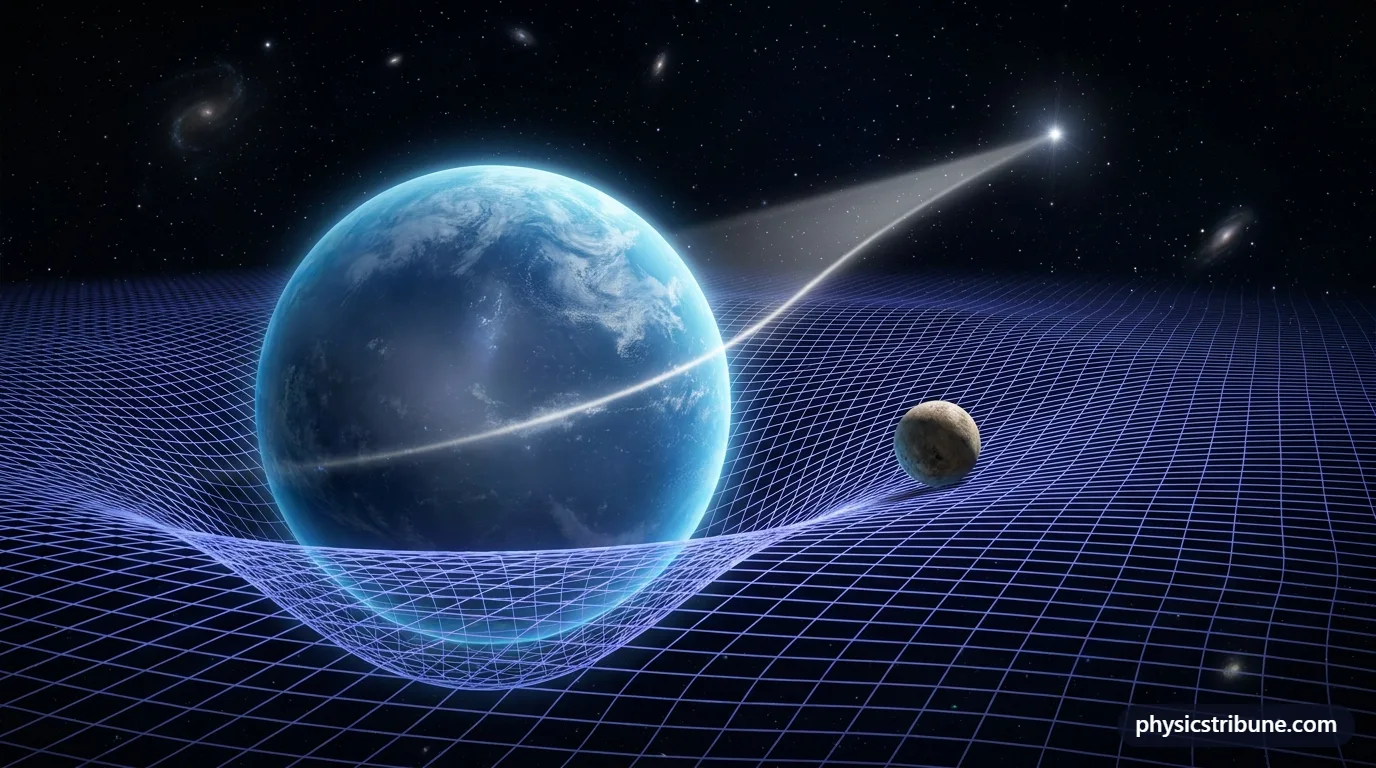
General relativity adds one bold step: gravity is not a force pulling across space but the shape of spacetime itself. A planet orbits the Sun because it follows the straightest possible path through spacetime that the Sun's mass has curved. The table below lines up the two theories.
| Feature | Special relativity | General relativity |
|---|---|---|
| Published | 1905 | 1915 |
| Main subject | Motion at constant velocity | Gravity and acceleration |
| Includes gravity? | No | Yes |
| Shape of spacetime | Flat | Curved by mass and energy |
| Starting principles | Same laws for all inertial observers; constant speed of light | Equivalence principle; general covariance |
| Key math | Lorentz factor, algebra | Tensor calculus, field equations |
| Signature formula | Δt = γΔt₀ and E = mc² | Einstein field equations |
| Cause of time dilation | Relative motion | Gravity (plus motion) |
| Symmetric between observers? | Yes, each sees the other's clock slow | No, the lower clock is slower for both |
| Classic tests | Muon lifetimes, particle accelerators | Light bending, Mercury's orbit, gravitational waves |
| Famous predictions | Length contraction, mass-energy equivalence | Black holes, gravitational waves |
| Everyday use | GPS speed correction | GPS altitude correction |
| Relationship | A special case of GR | Reduces to SR where gravity is negligible |
| Source: Standard statements of both theories; dates from the history of physics; GPS figures are typical published values · Retrieved October 2026 | ||
What Are Special Relativity and General Relativity?
Special relativity is the 1905 theory of how measurements of time, length, mass and energy change between observers in uniform motion. It is called special because it only works in a special set of conditions: no acceleration and no significant gravity. Its foundations are Einstein's postulates.
General relativity is the 1915 theory of gravity. It treats space and time as one four-dimensional fabric, spacetime, and says that matter and energy bend that fabric. Its central equation, the Einstein field equations, links the curvature of spacetime to the mass and energy within it.
A short way to remember the split: special relativity tells you what happens when you move fast, and general relativity tells you what happens near something heavy.
What Formulas Do Special and General Relativity Use?
Special relativity is built around the Lorentz factor,
General relativity's full equations use tensors and are far beyond high school algebra. Some results, though, have simple forms. Near a round, non-spinning mass, a clock at distance
The first two worked examples below use special relativity. The third, after the next section, uses general relativity. To try your own numbers, open our time dilation calculator.
The signature formula of special relativity is time dilation for a moving clock, with the Lorentz factor built in.
| Symbol | Quantity | SI unit |
|---|---|---|
| time interval measured by the observer who sees the clock moving | second (s) | |
| proper time (measured in the clock's rest frame) | second (s) | |
| relative speed | meter per second (m/s) | |
| speed of light in vacuum (2.998 × 10⁸ m/s (exact: 299 792 458 m/s)) | meter per second (m/s) |
Rearranged to find another variable:
Valid for: special relativity, inertial frames; Δt ≥ Δt₀.
Example 1 The Lorentz factor at 90% of light speed
A particle in an accelerator moves at 0.9c, which is 269,813,212.2 m/s. What is its Lorentz factor γ?
- Given:
- relative speed:
- speed of light in vacuum:
- relative speed:
- Formula:
- Substitute:
- Answer:
A Lorentz factor above 2 means the particle's clocks run at less than half the rate of the lab's clocks.
Example 2 An hour on a fast spaceship
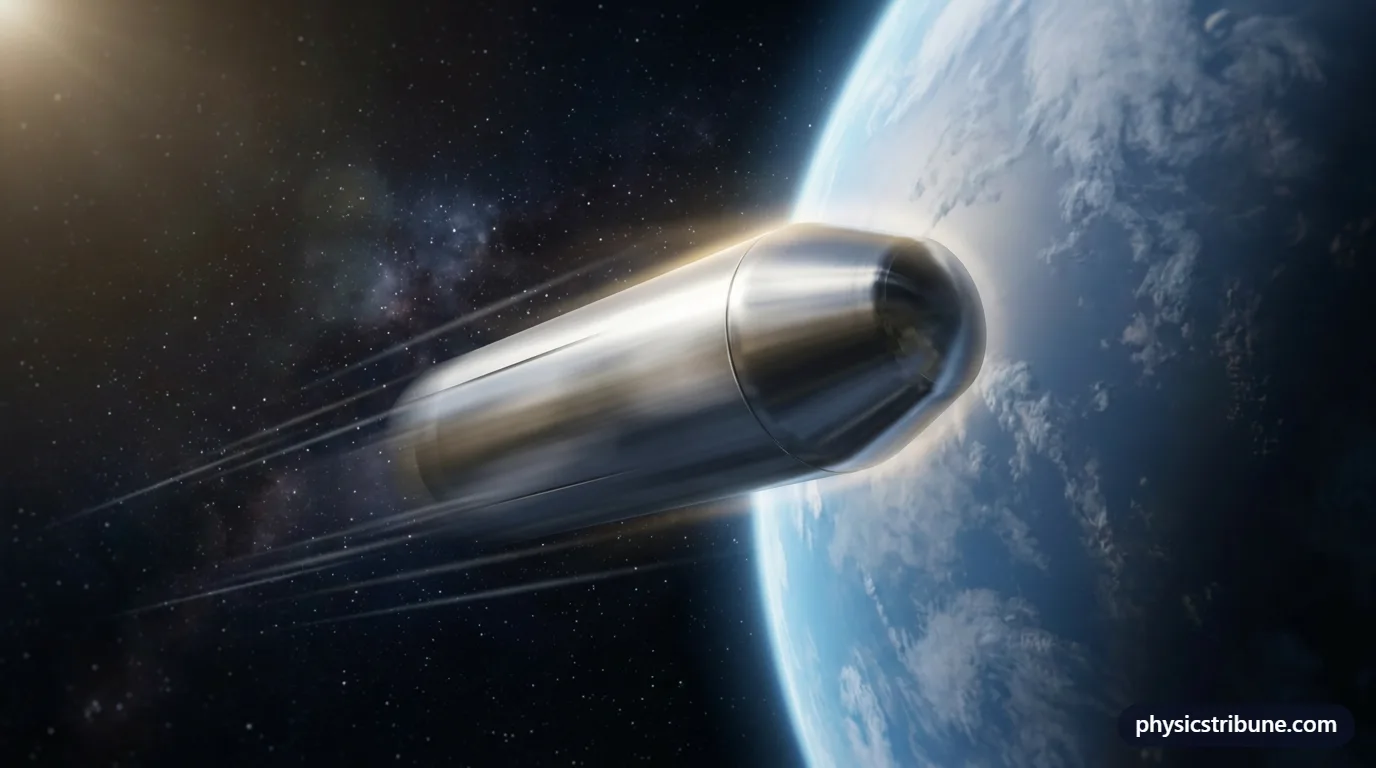
A spaceship passes Earth at half the speed of light, 149,896,229 m/s. A clock on board ticks off 60 minutes. How much time passes on Earth's clocks during that hour, according to special relativity?
- Given:
- proper time (measured in the clock's rest frame):
- relative speed:
- speed of light in vacuum:
- proper time (measured in the clock's rest frame):
- Formula:
- Substitute:
- Answer:
Observers on the ship would say the same about Earth's clocks; in special relativity the effect is symmetric between the two frames.
How Does General Relativity Explain Gravity?
The key insight is the equivalence principle. Inside a closed elevator, you cannot tell whether you are resting on Earth or accelerating through empty space at 9.8 m/s². Gravity and acceleration feel identical, so a theory of acceleration must also be a theory of gravity.
Einstein's answer was that mass curves spacetime and objects move along the straightest available paths in that curved geometry. Far from any mass, those paths are straight lines, and general relativity reduces to special relativity. Near a star or a planet, the paths bend, and what we call the pull of gravity is that bending. The diagram below shows Earth's field as Newton would draw it; general relativity reproduces the same pull from curvature.
Curved spacetime also affects time. Clocks deeper in a gravitational field tick more slowly, an effect called gravitational time dilation. On Earth's surface it amounts to roughly 60 microseconds per day compared with a clock far out in space (computed), small but measurable with atomic clocks.
Example 3 A clock on the surface of a neutron star
A neutron star has a mass of 2.6 × 10³⁰ kg and a radius of 11,000 m. A clock on its surface ticks off 60 minutes. How much time passes for an observer far from the star, according to general relativity?
- Given:
- time on the clock at the star's surface:
- gravitational constant:
- mass of the neutron star:
- radius of the neutron star:
- speed of light in vacuum:
- time on the clock at the star's surface:
- Formula:
- Substitute:
- Answer:
Here no one is moving; the slowdown comes from the star's gravity alone, which is the kind of effect only general relativity can describe.

What Did Each Theory Predict?
Special relativity predicts that moving clocks run slow (time dilation), that moving objects are shorter along their direction of travel (length contraction), that nothing with mass can reach the speed of light, and that mass and energy are interchangeable. Fast-moving muons created high in the atmosphere reaching the ground, and particle accelerators that must account for growing relativistic momentum, confirm these predictions every day.
General relativity predicts that light bends around massive objects, that clocks run slower in stronger gravity, that Mercury's orbit slowly swings around the Sun a little faster than Newton's law allows, that black holes can form, and that accelerating masses send out ripples called gravitational waves. Starlight bending during the 1919 solar eclipse made the theory famous, and gravitational waves were first detected directly in 2015.
Where Do Special and General Relativity Matter in Everyday Life?
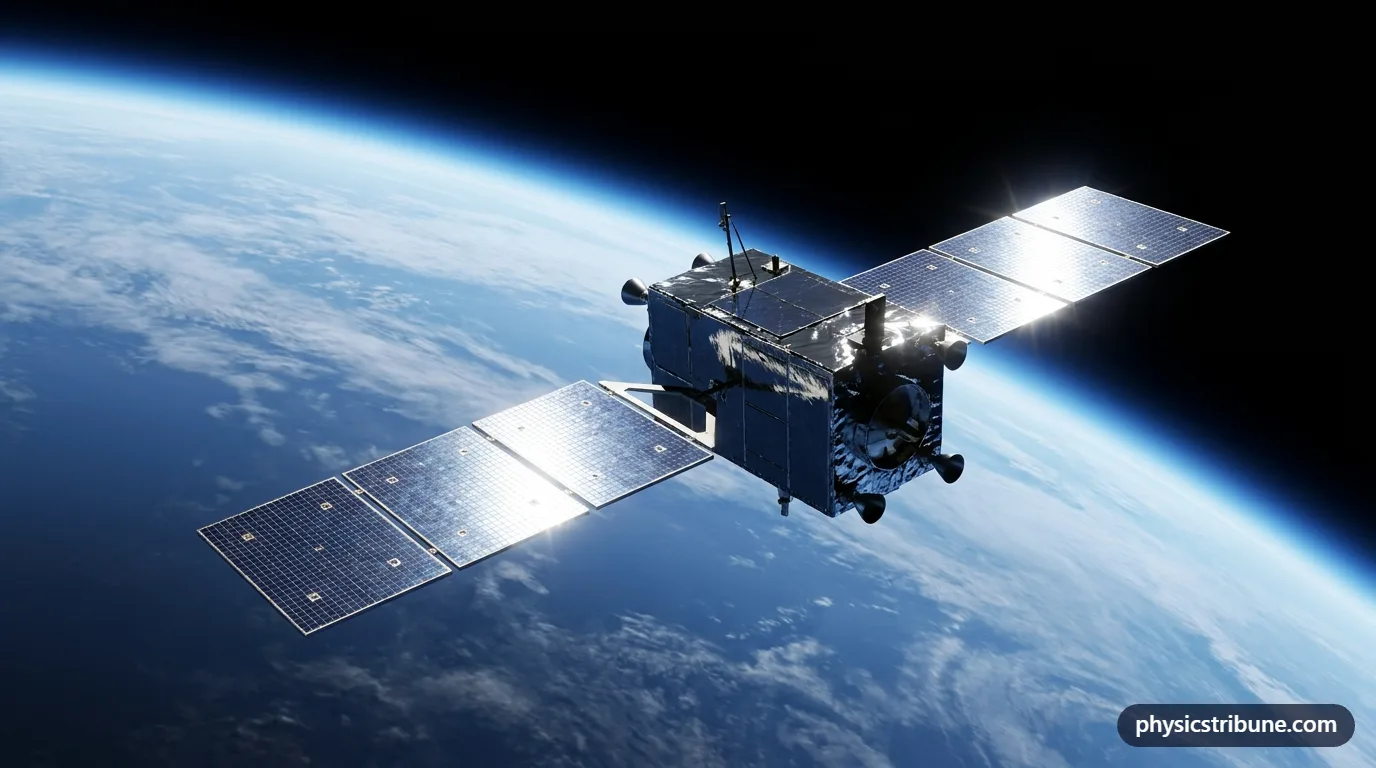
The best everyday example is satellite navigation, which needs both theories at once. GPS satellites orbit at about 3.9 km/s, so special relativity makes their clocks lose roughly 7 microseconds per day compared with clocks on the ground. They also sit about 20,000 km up, where gravity is weaker, so general relativity makes their clocks gain roughly 45 microseconds per day.
The net effect is a gain of about 38 microseconds per day. That sounds tiny, but radio signals travel about 300 meters in a microsecond, so uncorrected clocks would let position errors grow by kilometers each day. Engineers build the correction into the satellite clocks before launch.
Other examples split more cleanly. Particle accelerators and cosmic ray detectors are mostly special relativity territory. Black holes, the bending of light by galaxies and the expansion of the universe belong to general relativity; see black hole for one of its most dramatic predictions.
How Did Einstein Get From Special to General Relativity?
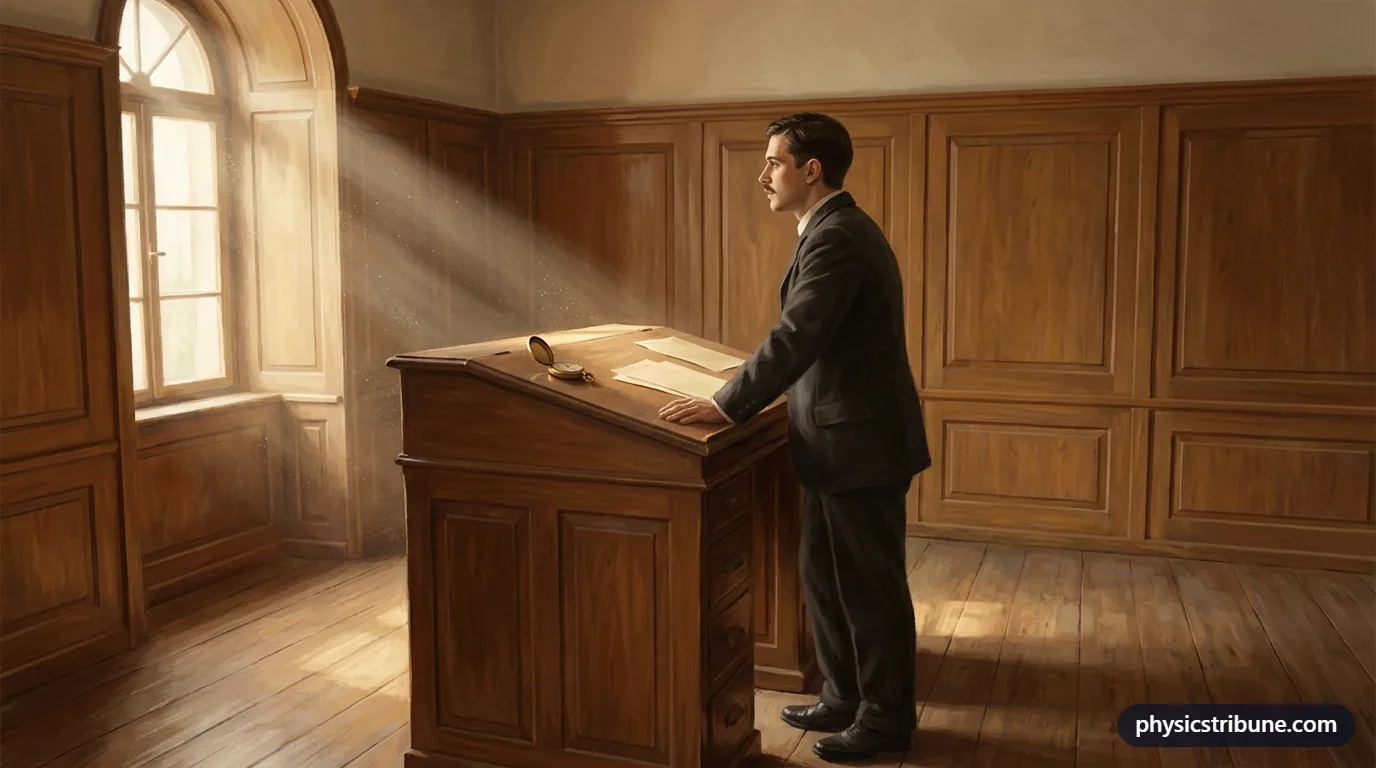
Albert Einstein published special relativity in 1905, while working at a patent office in Bern. It solved a clash between Newton's mechanics and the fixed speed of light that comes out of the laws of electricity and magnetism. Its limits were clear to him from the start: it said nothing about gravity or acceleration.
Einstein spent about ten years extending it. The equivalence principle came to him around 1907, and the hard part was finding the mathematics of curved geometry to express it. He presented the finished field equations in late 1915. Early on, the theory explained the long-standing puzzle of Mercury's orbit, which gave him confidence it was right.
How Can You Check Your Understanding?
Most relativity questions come down to two choices: is gravity or acceleration involved, and do you need the Lorentz factor or the gravitational factor? Try the quiz below to test the key differences, then explore the background on who discovered relativity.
Common Misconceptions
Myth: General relativity replaced special relativity.
Physics: General relativity contains special relativity. Wherever gravity is weak and spacetime is nearly flat, the two give the same answers.
Myth: Special relativity cannot handle anything that accelerates.
Physics: Special relativity can describe accelerating objects as long as gravity is negligible. What it cannot do is describe gravity or curved spacetime.
Myth: Relativity only matters near the speed of light.
Physics: Its effects exist at all speeds and in all gravity fields; they are just small. GPS works only because engineers correct for both theories.
Myth: General relativity means gravity is not real.
Physics: Gravity is very real; general relativity changes the explanation. Instead of a force acting at a distance, it describes gravity as the curvature of spacetime.
Key Facts
- Special relativity (1905) applies to observers moving at constant velocity with no gravity.
- General relativity (1915) is Einstein's theory of gravity and includes acceleration.
- Special relativity uses flat spacetime; general relativity describes spacetime curved by mass and energy.
- Time dilation in special relativity comes from motion; in general relativity, gravity also slows clocks.
- E = mc² comes from special relativity.
- GPS satellites need corrections from both theories, a net gain of about 38 microseconds per day.
- Special relativity is the limit of general relativity where gravity is negligible.
Quick Quiz: How Well Do You Know Special vs General Relativity?
6 questions. Tap an answer to check it.
Which theory includes gravity?
General relativity is Einstein's theory of gravity; special relativity leaves gravity out.
In what year did Einstein publish special relativity?
Special relativity appeared in 1905; general relativity followed in 1915.
According to general relativity, what is gravity?
Mass and energy curve spacetime, and objects follow the straightest paths through it.
What is the Lorentz factor γ at everyday speeds?
When v is tiny compared with c, v²/c² is nearly zero, so γ is nearly 1.
Which principle says gravity and acceleration feel the same?
The equivalence principle is the starting point of general relativity.
GPS satellite clocks need corrections from which theory?
Orbital speed slows the clocks (special) and weaker gravity speeds them up (general).
Frequently Asked Questions
What is the main difference between special and general relativity?
The main difference is gravity. Special relativity describes how time, length and energy change for observers moving at constant velocity when gravity can be ignored. General relativity is Einstein's theory of gravity: it includes acceleration and describes gravity as the curvature of spacetime by mass and energy. Special relativity is the flat-spacetime special case of general relativity.
Which came first, special or general relativity?
Special relativity came first. Einstein published it in 1905, the same year as his work on the photoelectric effect and Brownian motion. He then spent about a decade generalizing it to include acceleration and gravity, presenting the field equations of general relativity in late 1915 and publishing the full theory in 1916.
Why is it called special relativity?
It is called special because it applies only in a special case: observers moving at constant velocity, in inertial frames, with gravity left out. General relativity removes that restriction and works for any observer, including accelerating ones and those in gravitational fields, which is why it is called general.
Does E = mc² come from special or general relativity?
E = mc² comes from special relativity. Einstein derived it in a short 1905 paper that followed his main paper on special relativity. It says that mass is a form of energy, and it explains the energy released in nuclear reactions. General relativity uses the idea too, since all forms of energy, not only mass, curve spacetime.
Is time dilation part of special or general relativity?
Both theories predict time dilation, for different reasons. In special relativity, a clock moving relative to you runs slow because of its speed. In general relativity, a clock deeper in a gravitational field runs slow because of gravity. Real situations, such as satellites in orbit, often involve both effects at once.
Do you need general relativity to understand gravity on Earth?
For most everyday purposes, no. Newton's law of universal gravitation predicts falling objects, projectile paths and most orbits extremely well. General relativity becomes necessary for very precise timing, like GPS, for strong gravity near neutron stars and black holes, and for the behavior of light and of the universe as a whole.
Is special relativity harder than general relativity?
No, special relativity is much easier. Its main results need only algebra and the Lorentz factor, so it is often taught in high school and first-year college physics. General relativity requires differential geometry and tensor calculus, and it is usually studied in graduate-level courses, although its main ideas can be explained without the full math.
Have both theories been confirmed by experiments?
Yes. Special relativity is confirmed every day in particle accelerators and by the long lifetimes of fast muons from cosmic rays. General relativity has passed tests including the bending of starlight, Mercury's orbit, gravitational redshift, precise clock comparisons, images of black hole shadows and the direct detection of gravitational waves.
Keep Exploring
 modern physicsSpecial Relativity
 modern physicsGeneral Relativity
 modern physicsTime Dilation
 modern physicsGravitational Time Dilation
 modern physicsSpacetime
 modern physicsMass-Energy Equivalence (E = mc²)
 physicistsAlbert Einstein
 calculatorsTime Dilation & Lorentz Factor Calculator
 modern physicsGravitational Waves