At a Glance
An electric motor converts electrical energy into kinetic energy using the force on a current-carrying coil in a magnetic field, with maximum torque τ = N I A B. A generator converts kinetic energy into electrical energy by spinning a coil in a field, producing an emf ε = N A B ω sin(ω t). The hardware is nearly identical; only the energy flow is reversed.
- Motor
- Electrical energy in, mechanical energy out
- Generator
- Mechanical energy in, electrical energy out
- Motor principle
- Force on a current in a magnetic field (motor effect)
- Generator principle
- Electromagnetic induction (Faraday's law)
- Shared parts
- Coil, magnets, shaft, brushes or slip rings
- Hand rule (UK courses)
- Motor: left hand · Generator: right hand
On this page
- What Is the Difference Between a Generator and a Motor?
- How Does an Electric Motor Work?
- How Does a Generator Work?
- What Formulas Describe Motors and Generators?
- Why Does a Generator Get Harder to Turn?
- What Are Examples of Motors and Generators?
- How Can You Remember Which Is Which?
- Common Misconceptions
- Key Facts
- Quiz
- FAQ
What Is the Difference Between a Generator and a Motor?
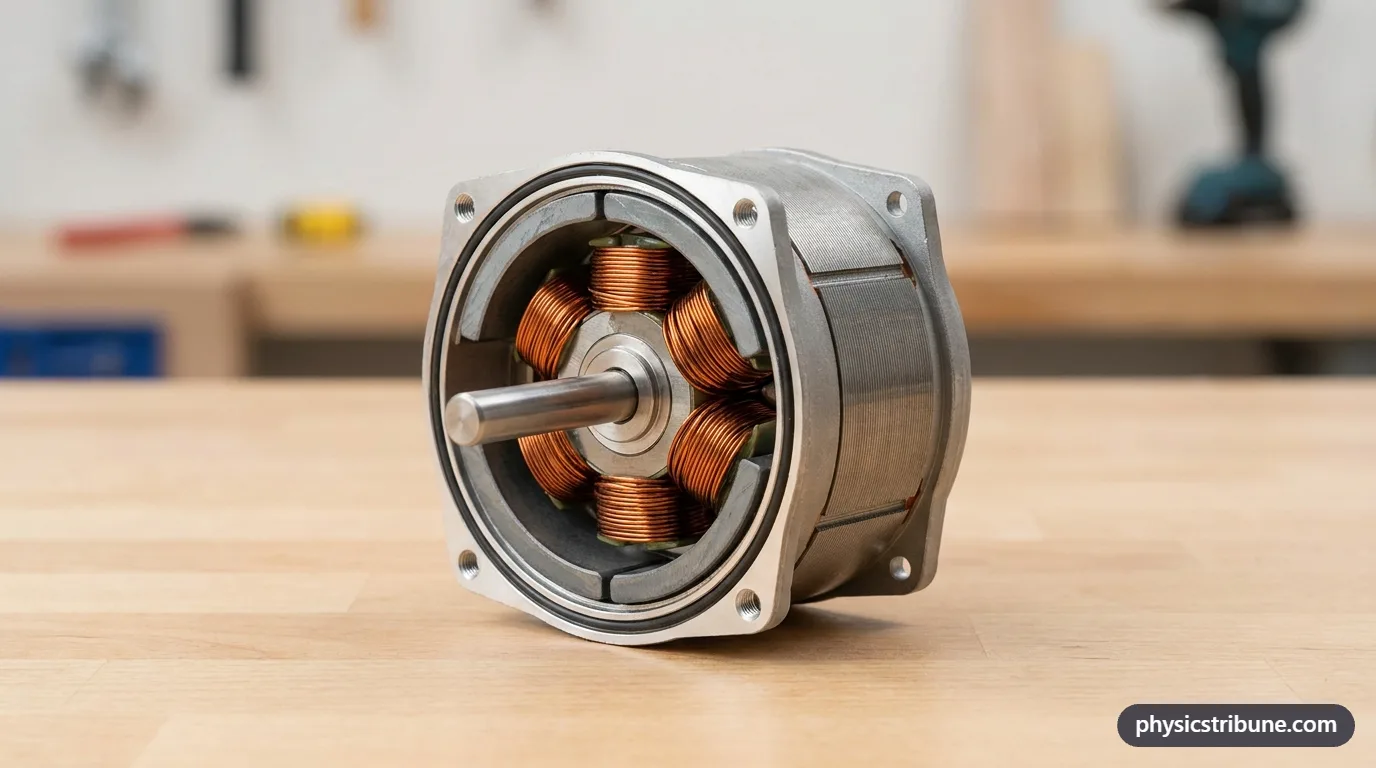
An electric motor and an electric generator are built from the same ingredients: a coil of wire on a shaft, a magnetic field from magnets or electromagnets, and a way to connect the spinning coil to an outside circuit. What separates them is which way the energy flows.
A motor takes in electrical energy and gives out mechanical energy, turning a fan, a wheel or a pump. A generator takes in mechanical energy, from a turbine, an engine or a hand crank, and gives out electrical energy. You can think of them as two directions on the same road.
That is why a single machine can often do both jobs. Push current through a small DC motor and it spins; spin its shaft by hand and it lights a small bulb. The table below lists the differences point by point.
| Feature | Electric motor | Generator |
|---|---|---|
| Energy input | Electrical | Mechanical (rotation) |
| Energy output | Mechanical (rotation) | Electrical |
| Physical principle | Force on a current in a magnetic field | Electromagnetic induction |
| Governing idea | τ = N I A B sin θ | ε = N A B ω sin(ω t) |
| Current in the coil | Supplied by a source | Induced by the motion |
| What drives the shaft | Magnetic forces on the coil | An outside turbine, engine or hand |
| Back effect | Back emf opposes the supply | Magnetic drag opposes the turning |
| UK hand rule | Fleming's left-hand rule | Fleming's right-hand rule |
| Ring on a DC version | Split-ring commutator | Split-ring commutator for DC output |
| Ring on an AC version | Usually none (rotating field) | Slip rings for AC output |
| Everyday examples | Fan, blender, electric car | Wind turbine, dynamo, alternator |
| Can it swap roles? | Yes, it can act as a generator | Yes, it can act as a motor |
| Source: Standard electromagnetism; formulas from our formula data · Retrieved October 2026 | ||
How Does an Electric Motor Work?
A motor relies on the motor effect: a wire carrying current in a magnetic field feels a sideways force. In a rectangular coil, the current flows one way along one side and the opposite way along the other, so the two sides are pushed in opposite directions. That pair of forces makes a twisting effect, or torque, that turns the coil.
The force on one straight side is
In a DC motor, a split-ring commutator reverses the current every half turn, so the coil keeps turning the same way instead of rocking back and forth. AC motors use the alternating supply itself to create a rotating magnetic field.
How Does a Generator Work?
A generator relies on electromagnetic induction. When the coil turns in the magnetic field, the amount of field passing through it, the magnetic flux, keeps changing. Faraday's law says a changing flux induces an emf, a push on the charges in the wire, so current flows in any connected circuit.
Because the coil faces the field at a constantly changing angle, the emf rises, falls and reverses in a smooth sine pattern. Slip rings pass this alternating current straight out. If a split-ring commutator is used instead, the output is flipped every half turn and comes out as pulsing direct current.
The faster the coil spins, the faster the flux changes and the larger the voltage. That is why a bicycle light glows brighter as you pedal harder. For the big picture of power stations, see how electricity is generated.
What Formulas Describe Motors and Generators?
For a motor, the key quantity is torque. A flat coil of
For a generator, the key quantity is emf. The same coil spun at angular velocity
Here is the emf of a generator coil spinning at a steady rate in a uniform magnetic field.
| Symbol | Quantity | SI unit |
|---|---|---|
| instantaneous emf | volt (V) | |
| number of turns | dimensionless (1) | |
| coil area | square meter (m²) | |
| magnetic field | tesla (T) | |
| angular velocity of the coil | radian per second (rad/s) | |
| time | second (s) |
Valid for: coil rotating at constant ω in a uniform field; peak emf ε₀ = NABω.
Example 1 Peak voltage of a bicycle-sized generator
A generator coil has 200 turns, each enclosing 0.012 m², and spins 50 times per second in a uniform 0.35 T field. What is the peak emf? Use ω = 2πf.
- Given:
- number of turns:
- coil area:
- magnetic field:
- rotation frequency (ω = 2πf):
- number of turns:
- Formula:
- Substitute:
- Answer:
The output swings between plus and minus this value 50 times each second, which is alternating current.
Example 2 Maximum torque of a small motor
A motor coil has 150 turns of area 0.008 m² and carries 2.5 A in a 0.4 T field. What is the largest torque it can feel, which happens when the coil's plane lies along the field (θ = 90° between the loop normal and B)?
- Given:
- number of turns:
- current:
- loop area:
- magnetic field:
- number of turns:
- Formula:
- Substitute:
- Answer:
As the coil turns, the torque falls toward zero, so motors use a commutator or several coils to keep the turning effort steady.
Why Does a Generator Get Harder to Turn?
When a generator delivers current, that current flows through its own coil, which sits in the magnetic field. So the generator coil also feels a motor-effect force. Lenz's law says this force always opposes the motion that caused it. The more current you draw, the harder you must push to keep the shaft turning.
The diagram below shows one side of a generator coil turning at steady speed. The turbine pushes it forward, and the magnetic drag from the induced current pushes it back by the same amount. This balance is energy conservation in action: the electrical energy delivered comes from the work the turbine does.
Motors show the mirror effect. A spinning motor coil also acts as a generator and produces a back emf that opposes the supply. That is why a motor draws a large current when it starts and a smaller one once it is up to speed.

What Are Examples of Motors and Generators?
Motors are everywhere that electricity makes something move:
- ceiling fans, washing machines and blenders
- electric cars, scooters and trains
- hard drives, phone vibration buzzers and drones
Generators appear wherever motion makes electricity:
- turbines in hydroelectric dams, wind farms and thermal power stations
- portable gasoline generators and car alternators
- hand-crank flashlights and bicycle hub dynamos
Some machines switch roles. An electric car's drive motor acts as a generator when the driver lifts off the pedal, slowing the car and charging the battery. This is called regenerative braking.
How Can You Remember Which Is Which?
Ask what goes in. If you plug it in and it moves, it is a motor. If you move it and it makes electricity, it is a generator. Many UK courses also use Fleming's left-hand rule for motors and the right-hand rule for generators.
To practice both ideas with printable problems, try our magnetism worksheets, then check yourself with the quiz below.
Common Misconceptions
Myth: Generators create energy.
Physics: A generator only converts energy. The electrical energy it delivers comes from the mechanical work done to turn it, minus losses to heat and friction.
Myth: Motors and generators are completely different machines.
Physics: They share the same basic parts. Many motors can generate electricity when turned by hand, and many generators spin when current is fed into them.
Myth: A generator is just as easy to turn whether or not a load is connected.
Physics: With no load, almost no current flows and turning is easy. Connecting a load lets current flow, and Lenz's law then creates a magnetic drag that resists the motion.
Myth: Generators always produce alternating current.
Physics: A coil in a field always has an alternating emf, but a commutator can flip the connections every half turn to deliver direct current.
Key Facts
- A motor converts electrical energy into mechanical energy; a generator does the reverse.
- Motors work by the force on a current-carrying wire in a magnetic field.
- Generators work by electromagnetic induction, as described by Faraday's law.
- Both machines use a coil, a magnetic field and a rotating shaft.
- The maximum torque on a motor coil is N I A B, and the peak emf of a generator coil is N A B ω.
- A generator becomes harder to turn as more current is drawn, because of Lenz's law.
- Electric cars use their motors as generators during regenerative braking.
Quick Quiz: How Well Do You Know Generator vs Motor?
6 questions. Tap an answer to check it.
What does an electric motor do?
A motor uses electrical energy to produce motion.
A generator works because of:
A changing magnetic flux through the coil induces an emf.
Why does a generator get harder to turn when a lamp is connected?
Lenz's law says the induced current always opposes the change that caused it.
Which part lets a generator deliver AC directly?
Slip rings keep each end of the coil connected to the same terminal, so the alternating emf passes straight out.
During regenerative braking, an electric car's motor acts as a:
The turning wheels drive the motor, which then produces electrical energy.
If a generator spins twice as fast, its peak emf:
The peak emf N A B ω is proportional to the angular velocity ω.
Frequently Asked Questions
What is the main difference between a motor and a generator?
The main difference is the direction of energy conversion. A motor uses electrical energy to produce motion, while a generator uses motion to produce electrical energy. A motor works by the force on a current in a magnetic field, and a generator works by electromagnetic induction, but both use a coil turning inside a magnetic field.
Can a motor be used as a generator?
Yes. Most motors with permanent magnets will produce a voltage if you spin the shaft, because the moving coil in a magnetic field induces an emf. Small DC motors from toys can light an LED when turned quickly. Electric cars and some trains use this effect deliberately in regenerative braking.
Which law is used in generators and which in motors?
Generators are based on Faraday's law of electromagnetic induction, which says a changing magnetic flux induces an emf. Motors are based on the magnetic force on a current-carrying conductor, often called the motor effect. Lenz's law applies to both, setting the direction of induced currents and back emf.
What is Fleming's left-hand rule and right-hand rule?
They are memory aids used in many UK physics courses. With the thumb, first finger and second finger held at right angles, the left hand gives the direction of force on a current in a motor, and the right hand gives the direction of induced current in a generator. The first finger points along the field.
Is an alternator a generator?
Yes. An alternator is a generator that produces alternating current, usually by spinning a magnet inside fixed coils. In a car, the alternator is turned by a belt from the engine, and diodes inside convert its AC output to DC to charge the battery and run the electrical system.
What is back emf in a motor?
Back emf is the voltage induced in a motor's spinning coil, which opposes the supply voltage. It grows as the motor speeds up, so the current drops once the motor is running. When a motor starts, or is jammed, there is little back emf and the current can be very high, which can overheat the windings.
Why do power stations use generators instead of motors?
Power stations need to make electrical energy, not use it, so they use generators. Steam, falling water or wind turns a turbine, which spins the generator's rotor inside its coils. The machines are much larger than a household motor but follow the same physics of a magnetic field and a moving conductor.