At a Glance
Mass measures how much matter something contains (SI unit: kilogram), and volume measures how much space it takes up (SI unit: cubic meter). They are connected by density, ρ = m / V, so two objects with the same volume can have very different masses.
- Mass
- Amount of matter, symbol m, unit kg
- Volume
- Space occupied, symbol V, unit m³
- Link between them
- Density: ρ = m / V
- Measured with
- Mass: balance · Volume: ruler, cylinder, displacement
- Changes with temperature?
- Mass: no · Volume: usually a little
On this page
- What Is the Difference Between Mass and Volume?
- How Are Mass and Volume Defined?
- How Do You Measure Mass and Volume?
- How Are Mass and Volume Related?
- Can Two Objects Have the Same Volume but Different Mass?
- What Are Everyday Examples of Mass and Volume?
- Does Mass or Volume Change With Temperature and Pressure?
- How Is Mass Different From Weight and Volume?
- Common Misconceptions
- Key Facts
- Quiz
- FAQ
What Is the Difference Between Mass and Volume?
Mass and volume both describe "how much" of something there is, but they answer different questions. Mass tells you how much stuff, or matter, an object contains. Volume tells you how much room the object takes up. One is about content and the other is about size.
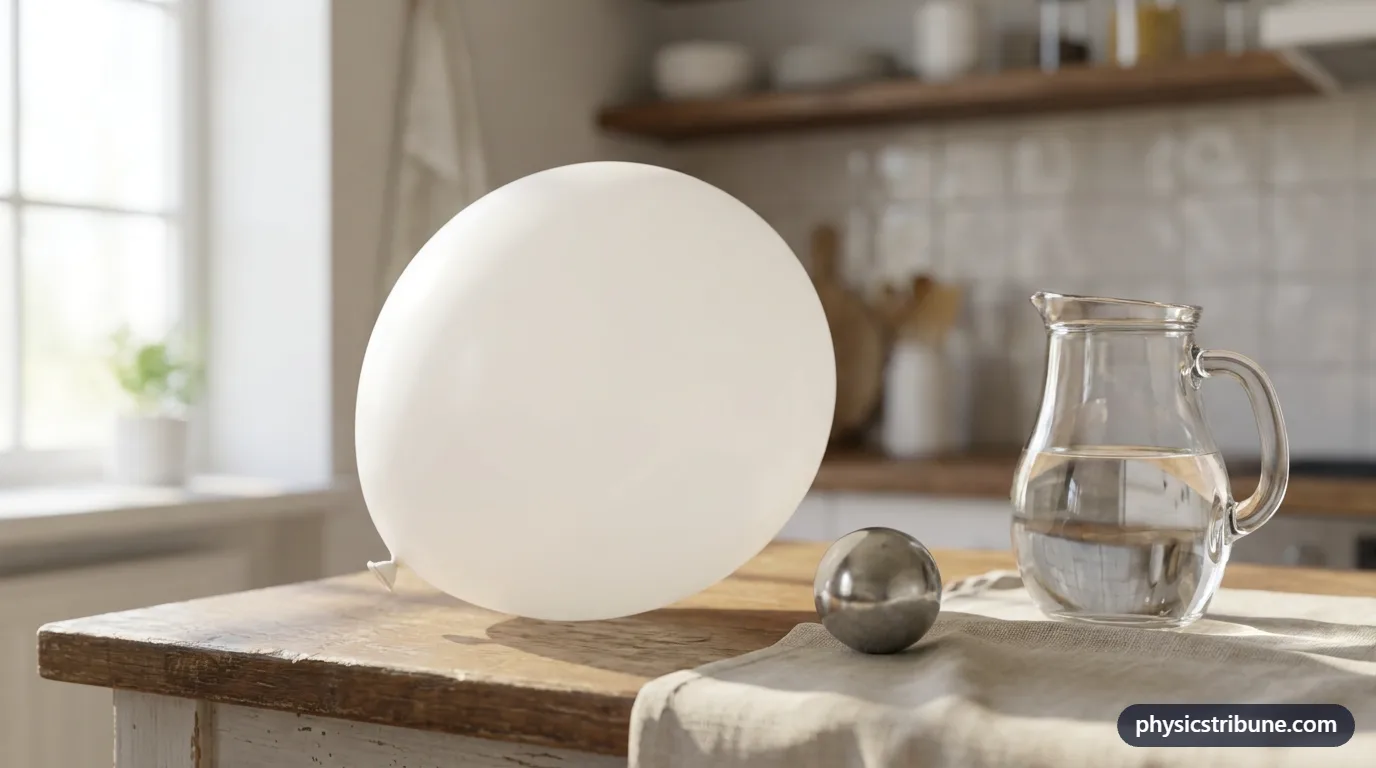
A simple test shows the split. Squeeze a slice of fresh bread into a tight ball. Its volume shrinks a lot, but no crumbs fell off, so its mass is exactly the same. Now compare a party balloon and a golf ball: the balloon fills far more space, yet the golf ball has more mass.
Because they measure different things, mass and volume use different units and different tools. The table below lines them up feature by feature.
| Feature | Mass | Volume |
|---|---|---|
| What it measures | Amount of matter | Amount of space occupied |
| Symbol | m | V |
| SI unit | kilogram (kg) | cubic meter (m³) |
| Common everyday units | gram, kilogram, pound | milliliter, liter, gallon, cm³ |
| Measuring tool | Balance or scale | Ruler, graduated cylinder, displacement |
| Scalar or vector | Scalar | Scalar |
| Changes with location (Earth vs Moon)? | No | No |
| Changes when heated? | No | Usually expands slightly |
| Changes when squeezed? | No | Yes, especially for gases |
| Also measures inertia? | Yes | No |
| Link to the other | m = ρV | V = m / ρ |
| Example | A bag of sugar has a mass of 1 kg | A carton holds 1 L of juice |
| Source: Definitions as used in standard SI measurement; 1 L = 0.001 m³ exactly (BIPM); examples are illustrative · Retrieved October 2026 | ||
How Are Mass and Volume Defined?
Mass is a measure of the amount of matter in an object and of its inertia, its resistance to being speeded up or slowed down. The SI unit is the kilogram. A full grocery bag is hard to swing and hard to stop because of its mass, whether you are on Earth, on the Moon or floating in a space station.
Volume is the three-dimensional space inside the boundaries of an object or a container. Its SI unit is the cubic meter (m³), a cube one meter on each side. Everyday measurements usually use the liter (L), which is exactly one thousandth of a cubic meter, and the milliliter (mL), which equals one cubic centimeter.
Neither quantity has a direction, so both are scalars. Both are also extensive properties: cut a loaf in half and each half has half the mass and half the volume. Their ratio, density, does not change when you cut the loaf, which is why density is the property that identifies a material.
How Do You Measure Mass and Volume?
Mass is measured with a balance. A two-pan or triple-beam balance compares an unknown object with known masses, and a digital scale converts a force reading into kilograms or grams. Because a balance compares masses directly, it gives the same answer on any planet.
Volume depends on the shape of the object:
- Regular solids: measure the sides with a ruler and calculate, for example length × width × height for a box.
- Liquids: pour the liquid into a graduated cylinder and read the bottom of the curved surface at eye level.
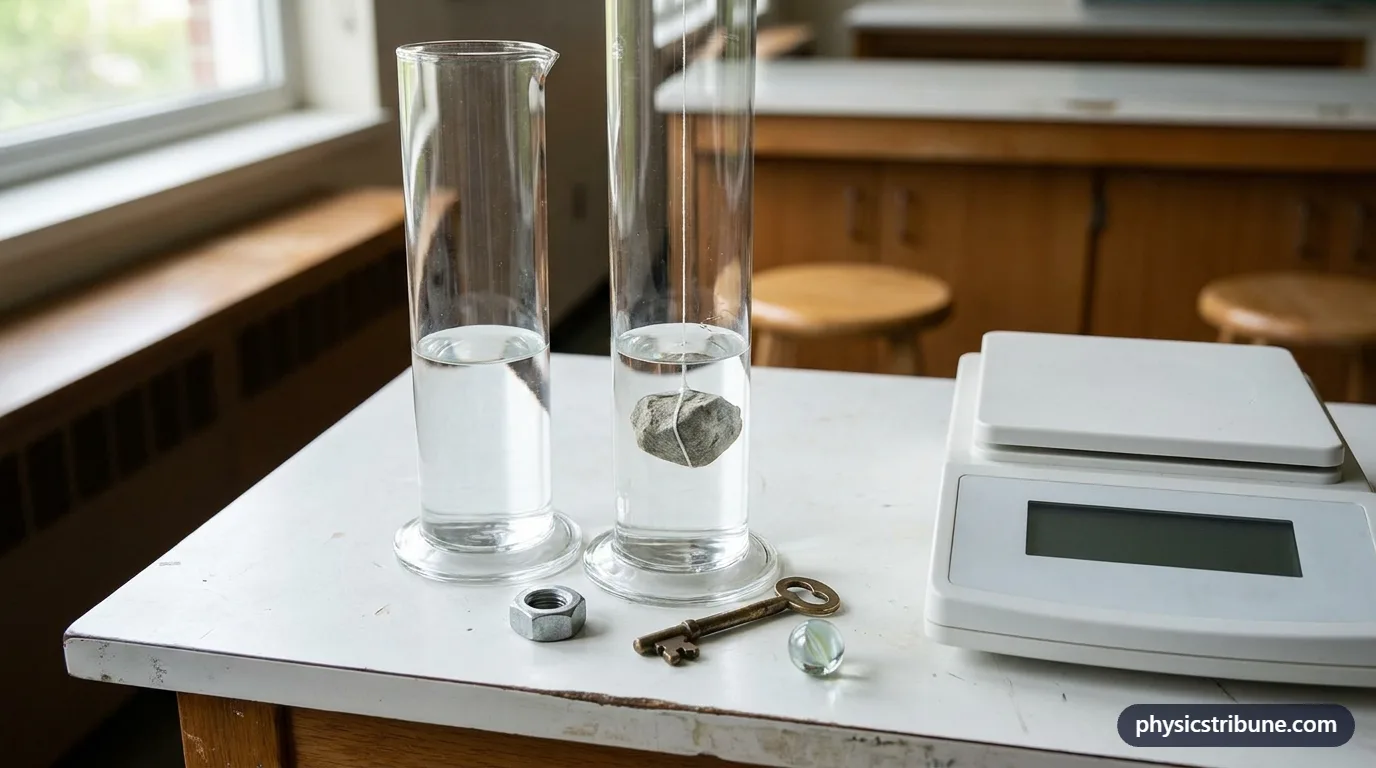
- Irregular solids: lower the object into water and measure how much the water level rises. The rise equals the object's volume.
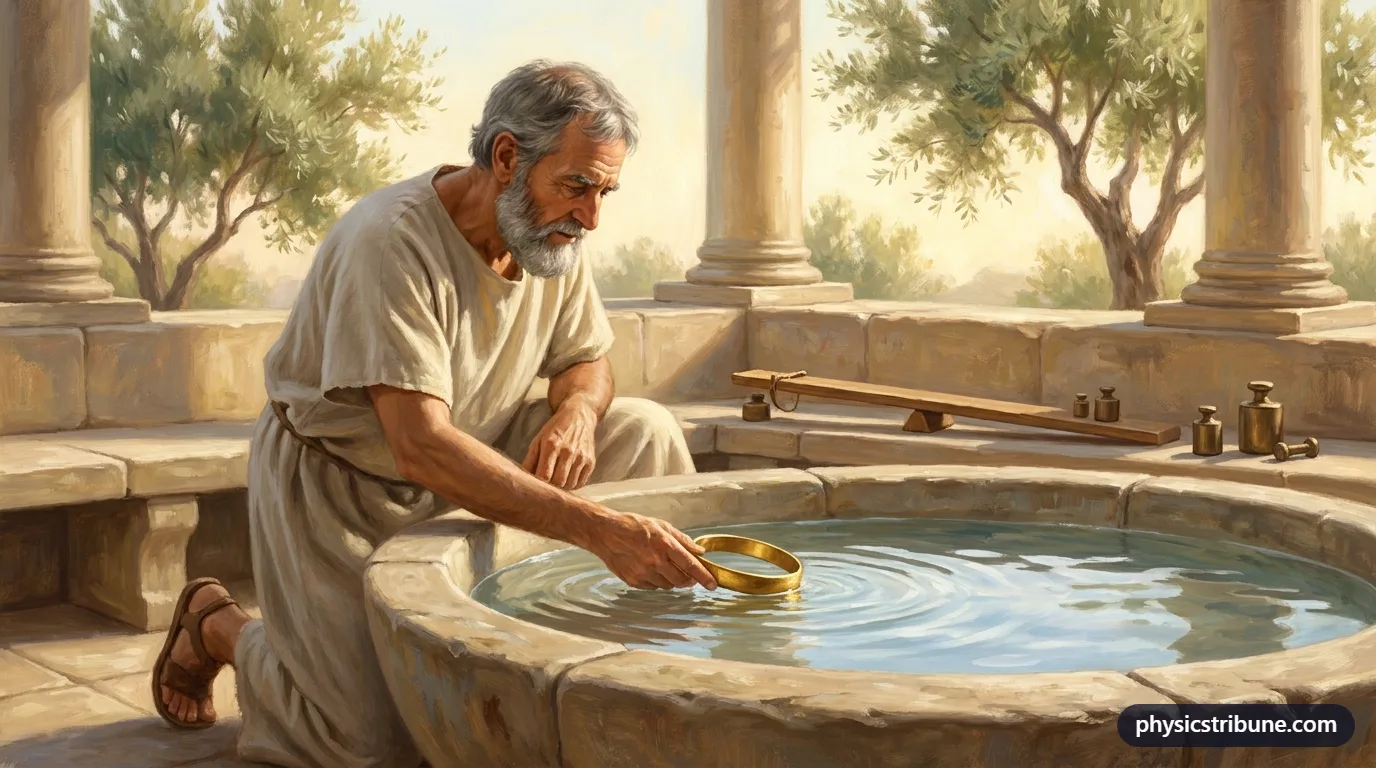
The displacement method is the one Archimedes is famously linked with, and you can try it yourself in our density of irregular objects lab.
How Are Mass and Volume Related?
Mass and volume are tied together by density, the mass per unit volume of a material:
For a single material, mass grows in direct proportion to volume. Two liters of water have twice the mass of one liter. Plot mass against volume for samples of one substance and you get a straight line through the origin, and the slope of that line is the density.
Change the material and the slope changes. One liter of water has a mass of about 1 kg, one liter of air about 1.2 g and one liter of steel nearly 8 kg. To work these out quickly, use our density calculator.
Density is the bridge between the two quantities. Here is the formula with each variable and its SI unit, plus the forms solved for mass and for volume.
| Symbol | Quantity | SI unit |
|---|---|---|
| density | kilogram per cubic meter (kg/m³) | |
| mass | kilogram (kg) | |
| volume | cubic meter (m³) |
Rearranged to find another variable:
Valid for: average density for non-uniform objects.
Example 1 Mass of a bottle of olive oil
A kitchen bottle holds 2 L of olive oil, which is 0.002 m³. Olive oil has a typical density of about 910 kg/m³. What is the mass of the oil?
- Given:
- density:
- volume:
- density:
- Formula:
- Substitute:
- Answer:
The same 2 L bottle filled with water would hold about 2 kg, so the oil is lighter for the same volume, which is why it floats on water.
Example 2 Volume of a pine block
A block of dry pine has a mass of 0.25 kg. Taking a typical density for pine of about 500 kg/m³, what volume does the block take up?
- Given:
- mass:
- density:
- mass:
- Formula:
- Substitute:
- Answer:
That is half a liter of space, the size of a small juice carton, for a block that weighs about as much as a quarter liter of water.
| Material | Typical density (kg/m³) | Mass of 1 L |
|---|---|---|
| Air (room conditions) | about 1.2 | about 1.2 g |
| Pine wood (dry) | about 500 | about 0.5 kg |
| Olive oil | about 910 | about 0.91 kg |
| Ice | about 917 | about 0.92 kg |
| Water | about 1,000 | about 1 kg |
| Aluminum | about 2,700 | about 2.7 kg |
| Steel | about 7,850 | about 7.85 kg |
| Gold | about 19,300 | about 19.3 kg |
| Source: Densities are typical values; mass computed with m = ρV for V = 0.001 m³ · Retrieved October 2026 | ||
Can Two Objects Have the Same Volume but Different Mass?
Yes, and it happens all the time. A tennis ball and a solid rubber ball of the same size have the same volume, but the solid one has far more mass. A liter carton of milk and a liter of popcorn fill the same space, yet one is heavy and the other is almost weightless.
The diagram below shows why this matters in water. A 1 L aluminum block hangs from a string, fully under water. The water pushes up with a buoyant force set by the block's volume, about 9.81 N for one liter. The weight pulling down depends on the block's mass, about 26.48 N (computed for a typical aluminum density of 2,700 kg/m³). The string supplies the difference.
Any 1 L object would feel that same upward push. Whether it floats or sinks depends on how its mass compares with the mass of 1 L of water. That is the idea behind Archimedes' principle and floating and sinking.

What Are Everyday Examples of Mass and Volume?
Statements about mass tell you how much matter is present:
- A bag of rice has a mass of 2 kg.
- A newborn kitten has a mass of about 100 g.
- A loaded delivery truck has a mass of several tonnes.
Statements about volume tell you how much space is filled:
- A water bottle holds 500 mL.
- A car's fuel tank holds about 50 L.
- A small bedroom has an air volume of roughly 30 m³.
Recipes mix the two. A baker who measures flour by the cup is using volume, while one who weighs it on a kitchen scale is using mass. The scale gives more consistent cakes because a cup of tightly packed flour holds noticeably more mass than a cup of loosely sifted flour.
Does Mass or Volume Change With Temperature and Pressure?
Mass stays the same unless matter is added or removed. Heating a steel rod, freezing a bottle of juice or carrying a backpack up a mountain leaves the mass untouched. This is the everyday face of conservation of mass.
Volume is less stable. Most materials expand slightly when warmed and contract when cooled, and gases change volume dramatically with both temperature and pressure. A sealed bag of chips puffs up on a flight because the outside pressure drops, not because the chips gained mass.
Water is a famous exception near freezing. It expands as it turns to ice, so the same mass takes up more volume, the density drops and the ice floats. Our page on why ice floats explains the details.
How Is Mass Different From Weight and Volume?
Students often mix up three ideas at once. Mass is the amount of matter. Weight is the gravitational force on that mass, measured in newtons. Volume is the space the object fills. A rock carried to the Moon keeps its mass and its volume, but its weight drops to about a sixth.
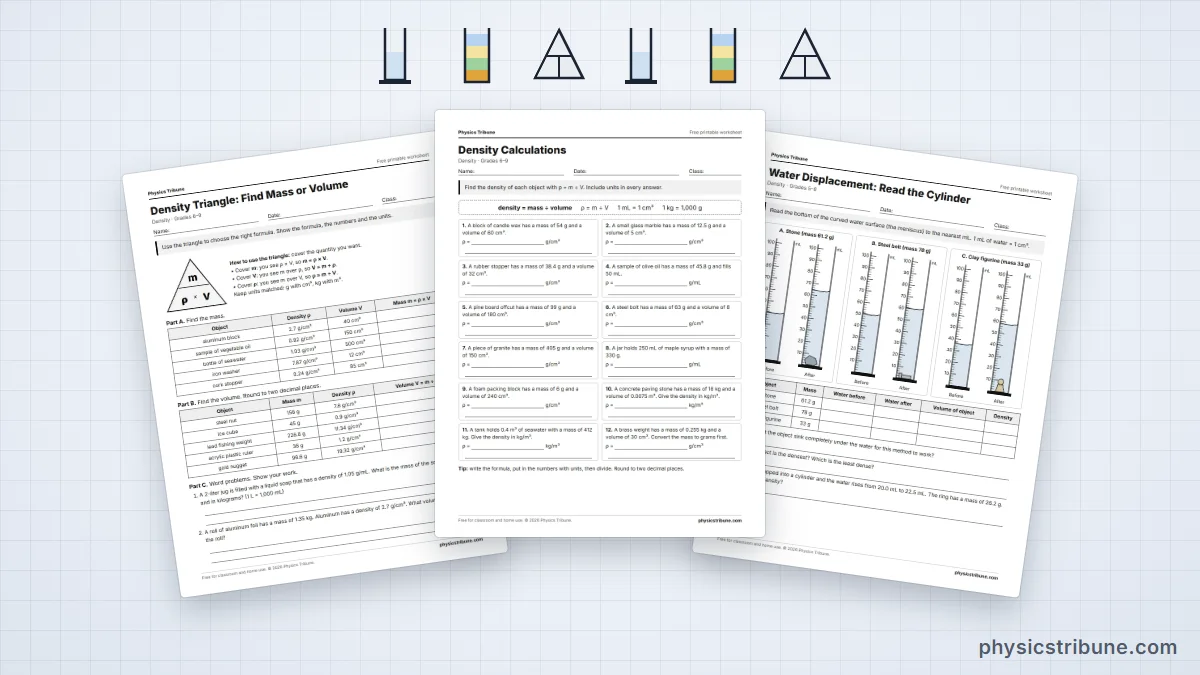
The full comparison of the first two lives on our mass vs weight page. When you compare a material's density with water's, you are using specific gravity. For printable practice that mixes all three quantities, try our density worksheets with answer keys.
Common Misconceptions
Myth: Bigger objects always have more mass.
Physics: Size tells you volume, not mass. A beach ball is larger than a bowling ball, but the bowling ball has far more mass because its material is much denser.
Myth: A kilogram of feathers has more mass than a kilogram of iron.
Physics: Both have exactly 1 kg of mass. The feathers simply take up a much larger volume because they are far less dense.
Myth: Squashing an object reduces its mass.
Physics: Compressing an object reduces its volume and increases its density, but the amount of matter, and so the mass, stays the same.
Myth: Mass and weight are the same, so mass changes on the Moon.
Physics: Weight is the pull of gravity and does change on the Moon. Mass and volume stay the same wherever the object goes.
Key Facts
- Mass is the amount of matter in an object; volume is the amount of space it takes up.
- The SI unit of mass is the kilogram and the SI unit of volume is the cubic meter.
- One liter equals exactly 0.001 m³, and one milliliter equals one cubic centimeter.
- Density links the two quantities through ρ = m / V.
- Objects with the same volume can have very different masses if they are made of different materials.
- Mass does not change with temperature, pressure or location, while volume often changes with temperature and pressure.
- The volume of an irregular object can be found by measuring the water it displaces.
Quick Quiz: How Well Do You Know Mass vs Volume?
6 questions. Tap an answer to check it.
Which quantity measures the amount of matter in an object?
Mass is the amount of matter; volume is the space it fills.
What is the SI unit of volume?
The cubic meter is the SI unit; the liter is an accepted everyday unit equal to 0.001 m³.
A slice of bread is squeezed into a small ball. What happens?
Squeezing removes air spaces, so the volume shrinks while the amount of bread stays the same.
Two blocks have the same volume. Block A has twice the mass of block B. Which is true?
Density is mass divided by volume, so doubling the mass at the same volume doubles the density.
Which method finds the volume of an irregular stone?
The rise in water level when the stone is submerged equals the stone's volume.
An astronaut takes a 1 kg bag of rice to the Moon. What changes?
Weight depends on gravity; mass and volume stay the same.
Frequently Asked Questions
What is the main difference between mass and volume?
Mass is how much matter an object contains, and volume is how much space it occupies. Mass is measured in kilograms with a balance, while volume is measured in cubic meters or liters with a ruler, a measuring cylinder or by water displacement. A brick and a sponge of the same size share a volume but have very different masses.
What is the difference between mass and density?
Mass is the total amount of matter in an object, so it depends on how big the object is. Density is the mass in each unit of volume, so it depends only on the material. Cutting a candle in half halves its mass but leaves its density unchanged. Density is found by dividing mass by volume and is measured in kilograms per cubic meter.
What is the difference between mass, volume and density?
Mass tells you how much matter there is, volume tells you how much space it fills, and density tells you how tightly that matter is packed. The three are linked by the formula density equals mass divided by volume. Knowing any two lets you calculate the third, which is how scientists identify unknown materials.
Is volume the same as mass for water?
Not the same, but conveniently close in number. Water has a density of about 1,000 kg/m³, so one liter of water has a mass of about one kilogram and one milliliter has a mass of about one gram. This handy match only works for water and similar liquids. One liter of honey or mercury has a much larger mass.
Can an object have mass but no volume?
Every ordinary object made of atoms takes up some space, so anything you can hold has both mass and volume. In particle physics, electrons are treated as point particles with mass but no measurable size. For everyday objects, though, if it has mass, it also has volume.
Which is bigger, a kilogram or a liter?
They cannot be compared directly because they measure different things: a kilogram is a unit of mass and a liter is a unit of volume. For water, one liter happens to have a mass of about one kilogram. For lighter materials such as cork, a kilogram fills several liters, while a kilogram of lead fits in less than a tenth of a liter.
How do you find volume if you know mass?
Divide the mass by the density of the material: V = m / ρ. For example, a 3 kg block of a material with density 1,500 kg/m³ has a volume of 0.002 m³, or 2 liters. You need to know the density first, either from a reference table or by measuring a sample of the same material.
Does mass or volume change when ice melts?
The mass stays the same, because no water molecules are added or lost. The volume shrinks a little, because liquid water is denser than ice. That is why a glass filled to the brim with ice and water does not overflow as the floating ice melts: the melted ice exactly fills the space its submerged part was taking up.
Keep Exploring



Sources
Constants come from NIST CODATA 2022 (public domain) and unit definitions from the BIPM SI Brochure (CC BY 4.0). Text, diagrams and illustrations are original work by Physics Tribune.