Density Calculator
- Convert to SI: m = 0.54 kg, V = 0.0002 m³
- ρ = m ÷ V = 0.54 ÷ 0.0002
- ρ = 2,700 kg/m³
At a Glance
Density is calculated with rho = m / V, mass divided by volume. Grams over cubic centimeters gives g/cm^3 and kilograms over cubic meters gives kg/m^3, where 1 g/cm^3 = 1000 kg/m^3. To find mass use m = rho x V, and to find volume use V = m / rho.
- Formula
- ρ = m / V
- Solves for
- Density, mass or volume
- Density units
- kg/m³, g/cm³, g/mL, kg/L, lb/ft³, lb/in³, lb/gal
- Mass units
- kg, g, mg, lb, oz, metric ton
- Volume units
- m³, L, mL, cm³, in³, ft³, US gal
On this page
- Density calculator: solve for density, mass or volume
- How to Use the Density Calculator
- What Is the Density Formula?
- How Do You Calculate Density With Mass and Volume?
- How Do You Find Mass or Volume From Density?
- How Do You Convert g/cm³ to kg/m³ or lb/ft³?
- What Are the Densities of Common Materials?
- Related Calculators and Practice for Density
- Key Facts
- FAQ
How to Use the Density Calculator
Pick the unknown first: density, mass or volume. Type the two values you know, choose a unit for each, and the answer appears straight away in the unit selected for the result. Below it you get the conversion to SI units, the formula, the substitution and the value, so you can follow or copy the method.
Units can be mixed freely. You might weigh a stone in ounces, measure its volume in milliliters and ask for the density in g/cm³; the tool converts everything to kilograms and cubic meters before dividing. When you solve for density, the result line also tells you whether a solid piece of the material would float or sink in water.
What Is the Density Formula?
The density formula is
For an object made of several materials, the formula gives the average density of the whole thing. To understand what density tells you about a material and why it changes with temperature, read our guide to density. Density is easy to confuse with related quantities, so density vs specific gravity and mass vs volume set them side by side.
The calculator uses this formula and its two rearranged forms, converting every value to SI units first.
| Symbol | Quantity | SI unit |
|---|---|---|
| density | kilogram per cubic meter (kg/m³) | |
| mass | kilogram (kg) | |
| volume | cubic meter (m³) |
Rearranged to find another variable:
Valid for: average density for non-uniform objects.
How Do You Calculate Density With Mass and Volume?
Calculating density takes three steps:
- Measure the mass. Use a kitchen or lab scale and note the unit, usually grams.
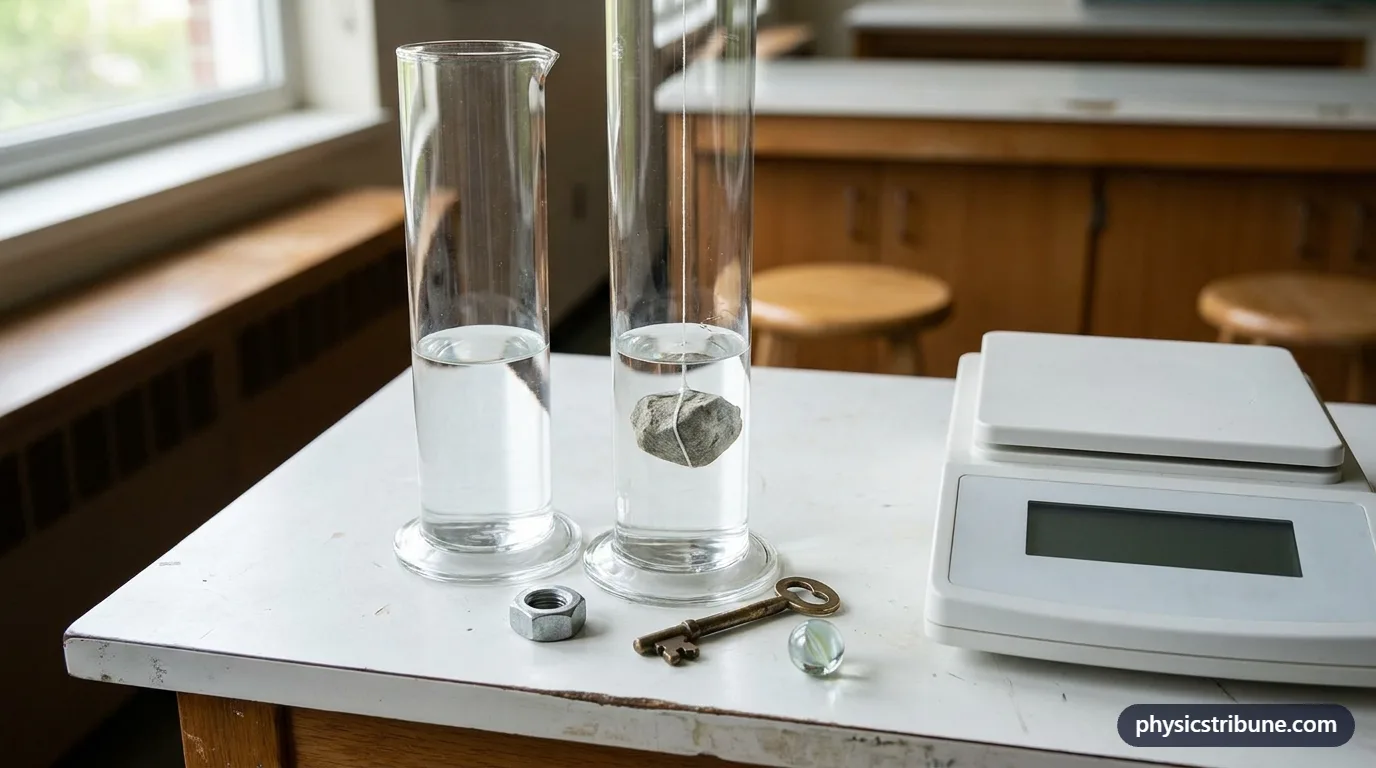
- Find the volume. For a box shape, multiply length by width by height. For an odd shape, lower it into a measuring cup of water and read how much the level rises.
- Divide mass by volume. Grams over cubic centimeters gives g/cm³ directly.
Suppose a pebble weighs 162 g and raises the water in a measuring cup from 150 mL to 210 mL. The volume is 60 mL, and 162 divided by 60 gives 2.7 g/cm³. Our density of irregular objects experiment walks through this water method at home.
Example 1 Identifying a metal block
A shiny metal block has a mass of 0.81 kg and a volume of 0.0003 m³ (300 cm³). What is its density?
- Given:
- mass:
- volume:
- mass:
- Formula:
- Substitute:
- Answer:
Compare the answer with the table below to guess which metal the block is made of.
How Do You Find Mass or Volume From Density?
Rearranging the formula gives the other two quantities. Mass is density times volume,
The units must match before you multiply or divide. If the density is in g/cm³ and the volume is in liters, convert liters to cubic centimeters first (1 L = 1,000 cm³), or let the calculator handle it. The worked examples below find the mass of an aquarium's water and the volume of a batch of honey.
Example 2 How heavy is a saltwater aquarium?
A reef aquarium holds 0.12 m³ (120 L) of seawater with a density of 1,025 kg/m³. What is the mass of the water?
- Given:
- density:
- volume:
- density:
- Formula:
- Substitute:
- Answer:
That mass sits on a small footprint, so large tanks need a sturdy stand placed over a solid floor.
Example 3 Fitting honey into a jar
A beekeeper has 0.25 kg of honey with a typical density of 1,420 kg/m³. What volume will it fill?
- Given:
- density:
- mass:
- density:
- Formula:
- Substitute:
- Answer:
Multiply the result by 1,000,000 to read it in milliliters, the unit printed on most jars.
How Do You Convert g/cm³ to kg/m³ or lb/ft³?
Density units convert with these exact relationships, which the calculator applies automatically:
- g/cm³ to kg/m³: multiply by 1,000. Water at about 1 g/cm³ is about 1,000 kg/m³.
- g/mL and kg/L: both are identical to g/cm³, since 1 mL equals 1 cm³.
- kg/m³ to lb/ft³: divide by about 16.0185, which comes from 0.45359237 kg per pound and 0.028316846592 m³ per cubic foot.
- kg/m³ to lb/gal: divide by about 119.826, using the US gallon of 3.785411784 L.
So water comes out near 62.4 lb/ft³ or 8.35 lb per US gallon, numbers that engineers and pool builders in the United States use every day. Other unit changes are covered by our physics unit converter.
What Are the Densities of Common Materials?
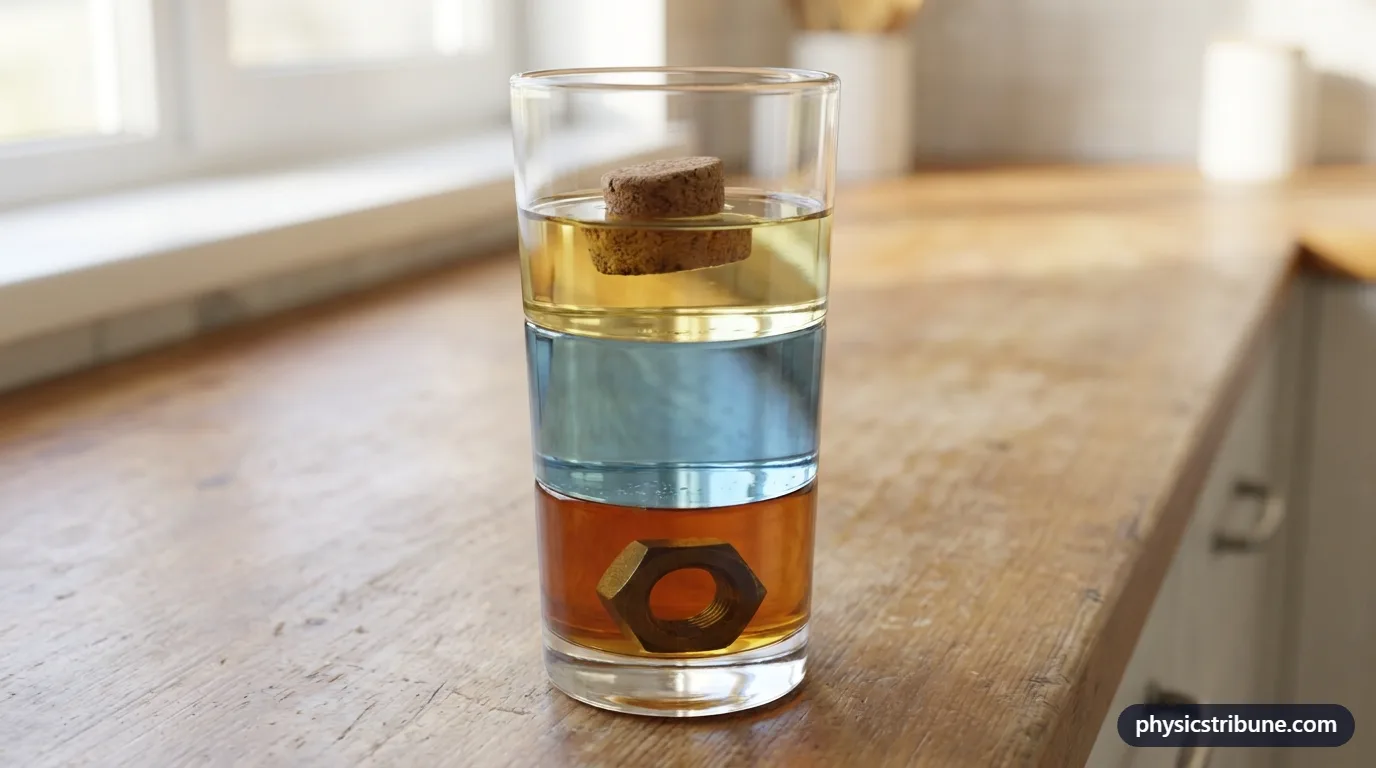
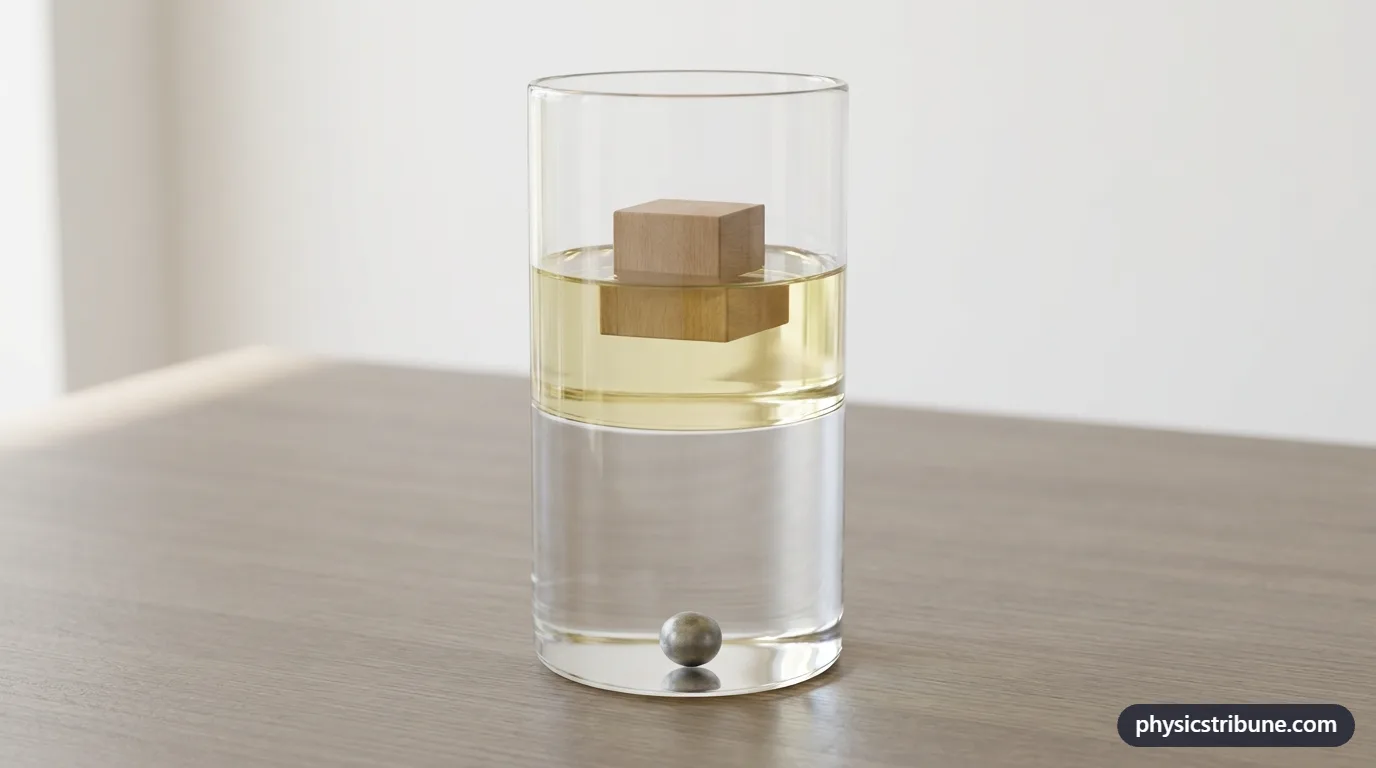
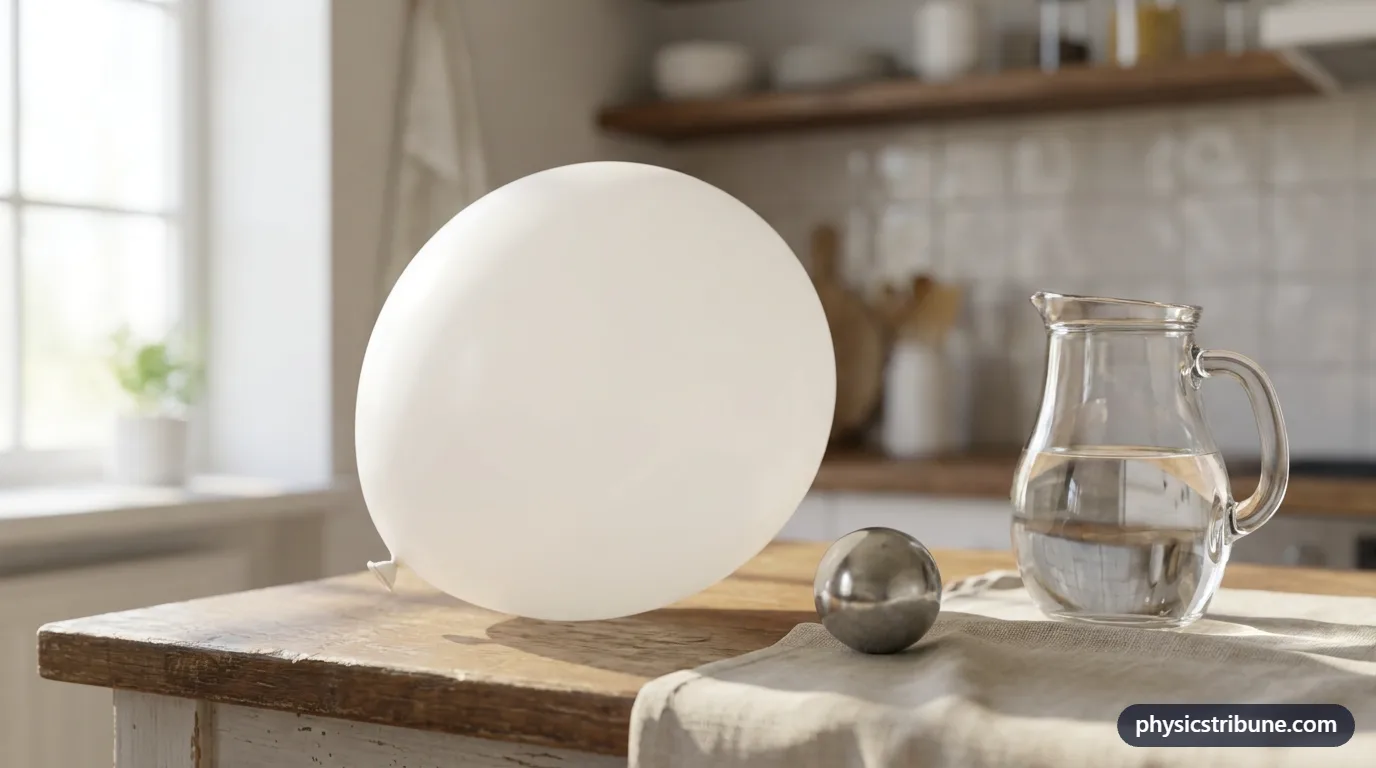
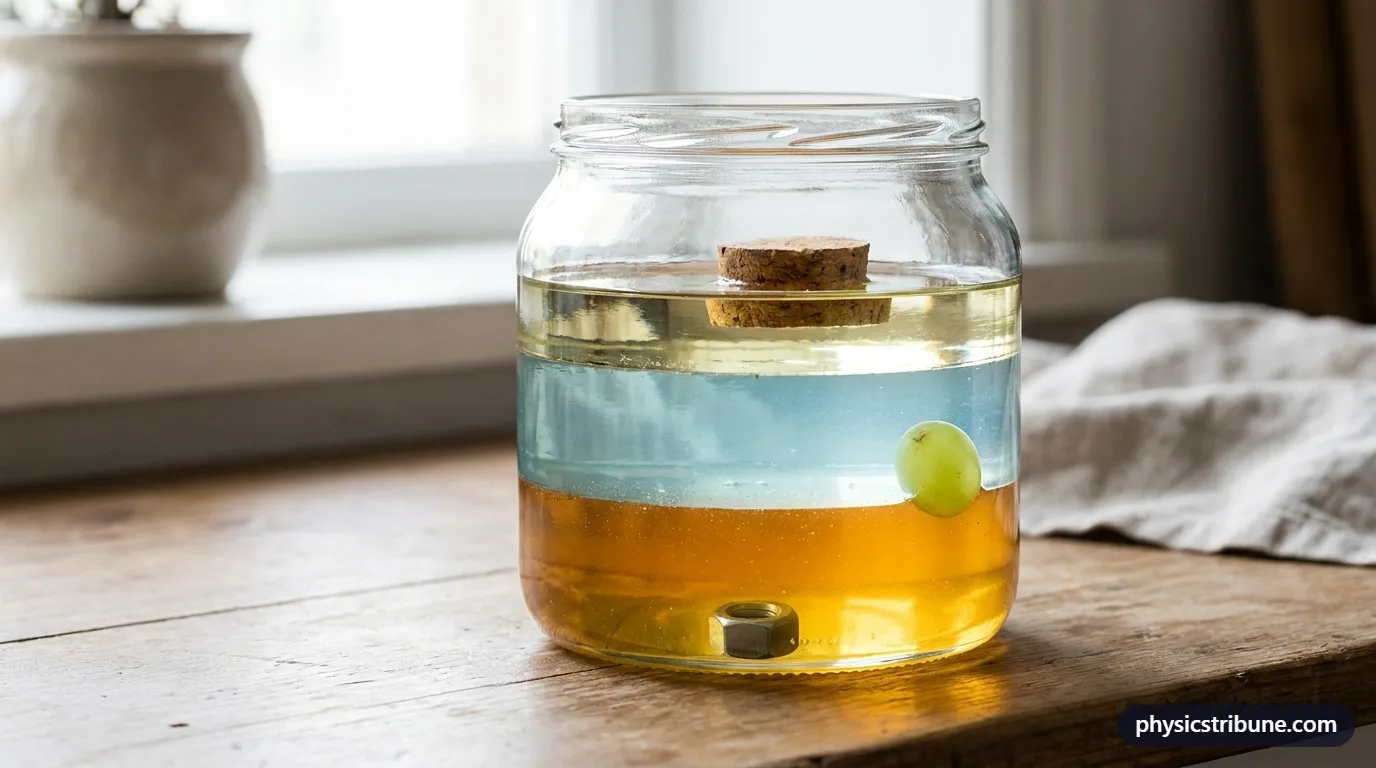
The table lists typical densities near room temperature, from the gas inside a party balloon to a bar of gold. Anything with a density below fresh water, about 1,000 kg/m³, floats in it when solid, which is why ice, cork and most woods stay on the surface while metals sink.
The diagram shows a floating wooden ball. Its weight pulls down while the water pushes up with an equal buoyant force. The ball sinks only until it displaces water with the same mass as itself, an idea explained on our buoyancy and Archimedes' principle pages.
| Material | Density (kg/m³) | Density (g/cm³) | Density (lb/ft³) | Behavior |
|---|---|---|---|---|
| Helium (balloon gas) | 0.164 | 0.000164 | 0.0102 | Rises in air |
| Air at sea level | 1.2 | 0.0012 | 0.0749 | Bubbles rise in water |
| Cork | 240 | 0.24 | 15.0 | Floats |
| Pine wood | 500 | 0.50 | 31.2 | Floats |
| Gasoline | 740 | 0.74 | 46.2 | Floats as a layer |
| Olive oil | 910 | 0.91 | 56.8 | Floats as a layer |
| Ice | 917 | 0.917 | 57.2 | Floats |
| Fresh water | 1,000 | 1.00 | 62.4 | Reference |
| Seawater | 1,025 | 1.025 | 64.0 | Sinks below fresh water |
| Concrete | 2,400 | 2.4 | 150 | Sinks |
| Aluminum | 2,700 | 2.7 | 169 | Sinks |
| Steel | 7,850 | 7.85 | 490 | Sinks |
| Copper | 8,960 | 8.96 | 559 | Sinks |
| Lead | 11,340 | 11.34 | 708 | Sinks |
| Mercury (liquid metal) | 13,530 | 13.53 | 845 | Sinks |
| Gold | 19,300 | 19.3 | 1,205 | Sinks |
| Source: Typical values near 20 °C and 1 atm; g/cm³ and lb/ft³ columns computed with exact factors (1 g/cm³ = 1,000 kg/m³, 1 lb/ft³ = 16.0185 kg/m³) · Retrieved October 2026 | ||||

Key Facts
- Density is mass divided by volume: ρ = m/V.
- The SI unit of density is the kilogram per cubic meter (kg/m³).
- One g/cm³ equals one g/mL, one kg/L and 1,000 kg/m³.
- To find mass from density, multiply by volume; to find volume, divide mass by density.
- Fresh water has a density of about 1,000 kg/m³, or about 62.4 lb/ft³.
- A solid less dense than water floats in it, and a denser one sinks.
- For an odd-shaped object, measure volume by the rise of water in a measuring cup.
Frequently Asked Questions
How do you calculate density?
Divide the mass of the object by its volume. With mass in grams and volume in cubic centimeters or milliliters, the result is in g/cm³. With kilograms and cubic meters, it is in kg/m³. For example, 300 g of a material that fills 120 cm³ has a density of 2.5 g/cm³. The calculator above converts any mix of units for you.
What is the formula for density?
The formula is ρ = m/V, where ρ is density, m is mass and V is volume. It can be rearranged to m = ρV to find mass, or V = m/ρ to find volume. The formula gives the average density, so for a hollow or mixed object it describes the whole object rather than any single material inside it.
Is g/mL the same as g/cm³?
Yes. One milliliter is defined as exactly one cubic centimeter, so a density in g/mL has the same number as the density in g/cm³. Both also equal kg/L. Chemists often use g/mL for liquids and g/cm³ for solids, but they are interchangeable. To get kg/m³, multiply either one by 1,000.
How do you find mass from density and volume?
Multiply the density by the volume: m = ρV. Make sure the units match first. A density of 0.8 g/cm³ times 250 cm³ gives 200 g. If the volume is in liters and the density in kg/m³, convert liters to cubic meters by dividing by 1,000. In the calculator, choose Mass as the unknown and enter the other two values.
How do you find the volume of an irregular object for density?
Use water displacement. Partly fill a measuring cup or graduated cylinder, read the level, then lower the object in until it is fully covered. The rise in the water level, in milliliters, equals the object's volume in cubic centimeters. Divide the mass by this volume to get the density. This works for solids that do not absorb water or dissolve.
Why do some objects float and others sink?
An object floats when its average density is lower than the liquid around it, and sinks when it is higher. A steel ship floats because its hull encloses a lot of air, which lowers its average density below that of water. A solid steel bolt, with no air inside, sinks. The buoyant force equals the weight of the liquid pushed aside.
Does density change with temperature?
Yes, a little. Most materials expand when heated, so the same mass takes up more volume and the density drops. Gases change the most, which is why hot air rises. Water is unusual: it is densest at about 4 °C, and ice is less dense than liquid water, so ponds freeze from the top down.