At a Glance
Archimedes (about 287 to 212 BC) was a Greek scientist from Syracuse best known for Archimedes' principle, which says a submerged object is pushed up by a force equal to the weight of fluid it displaces: F_B = ρ_f g V_disp. He also proved the law of the lever and bounded pi between 3 10/71 and 3 1/7.
- Born
- About 287 BC, Syracuse, Sicily
- Died
- 212 BC, Syracuse, during the Roman capture of the city
- Nationality
- Greek, of the city-state of Syracuse
- Known for
- Buoyancy (Archimedes' principle), the law of the lever, early statics
- Key works
- On Floating Bodies, On the Equilibrium of Planes, Measurement of a Circle
- Key equation
- F_B = ρ_f g V_disp (buoyant force)
On this page
- Who Was Archimedes?
- Where Did Archimedes Live and Work?
- What Is Archimedes' Principle?
- Did Archimedes Really Shout Eureka?
- How Did Archimedes Explain the Lever?
- What Did Archimedes Discover in Mathematics?
- What Did Archimedes Invent?
- Archimedes' Key Equation
- Why Is Archimedes Still Important?
- Key Facts
- Quiz
- FAQ
Who Was Archimedes?
Archimedes was the greatest scientist of the ancient world, and one of the few whose work still sits at the start of modern textbooks. He was the first person we know of who combined careful mathematical proof with questions about the physical world. When he asked why a lever lets a child lift a heavy stone, or why a ship floats, he did not just describe what happened. He proved it, step by step, from a few simple assumptions.
His interests were wide. He wrote on geometry, on large numbers, on the balance of weights and on floating bodies, and he was famous in his own time as a builder of clever machines. Much of what we know about his life comes from Roman and Greek writers who lived long after him, so the stories should be read with some care. His own books, which survive in copies, are far more reliable.
Where Did Archimedes Live and Work?
Archimedes was born in Syracuse, a wealthy Greek city on the island of Sicily, around 287 BC. In one of his books he mentions that his father, Phidias, was an astronomer. He was on close terms with King Hiero II, who ruled Syracuse for much of his life, and several stories about him begin with a request from the king.
He very likely spent time in Alexandria in Egypt, the great center of Greek learning, because he wrote letters to mathematicians working there, including Eratosthenes, and sent them his results. Most of his career, though, was spent at home in Syracuse.
He died in 212 BC, when a Roman army captured the city after a long siege. According to the ancient accounts, a Roman soldier killed him, against the orders of the Roman commander Marcellus, who had wanted him spared. One popular version says he was studying a diagram drawn in the sand when the soldier arrived, but the details vary from writer to writer.
| Year | Event |
|---|---|
| About 287 BC | Born in Syracuse, Sicily; his father Phidias is an astronomer |
| About 270 BC | Hiero II begins his long rule of Syracuse |
| Middle of his life | Probably spends time in Alexandria and corresponds with scholars there |
| Date unknown | Writes On the Equilibrium of Planes, proving the law of the lever |
| Date unknown | Writes Measurement of a Circle and On the Sphere and Cylinder |
| Date unknown | Writes On Floating Bodies, stating the principle of buoyancy |
| About 214 to 212 BC | Helps defend Syracuse against the Roman siege with war machines |
| 212 BC | Killed by a Roman soldier when Syracuse falls |
| 75 BC | The Roman orator Cicero finds his overgrown tomb, marked by a sphere and cylinder |
| 1906 | Scholars identify The Method hidden beneath a medieval prayer book |
| Source: Birth and death years from our physicists data file (Wikidata, CC0); other dates are standard historical dates, many only approximate · Retrieved October 2026 | |
What Is Archimedes' Principle?
In his book On Floating Bodies, Archimedes showed that any object placed in a fluid is pushed upward by a force equal to the weight of the fluid it pushes aside. This is Archimedes' principle, and the upward push is called the buoyant force.
The principle explains at once why some things float and others sink. If an object's weight is less than the weight of water it could displace, it rises until just enough of it is underwater to balance its weight. If its weight is greater, the buoyant force can never catch up and the object sinks. Our pages on floating and sinking and on why a boat floats apply the idea to everyday objects, and buoyancy collects the whole topic.
Archimedes went further than simple floating. He studied how a floating shape tips and rights itself, a problem that ship designers still care about, and he worked out stable positions for floating bodies shaped like segments of a paraboloid.
Did Archimedes Really Shout Eureka?
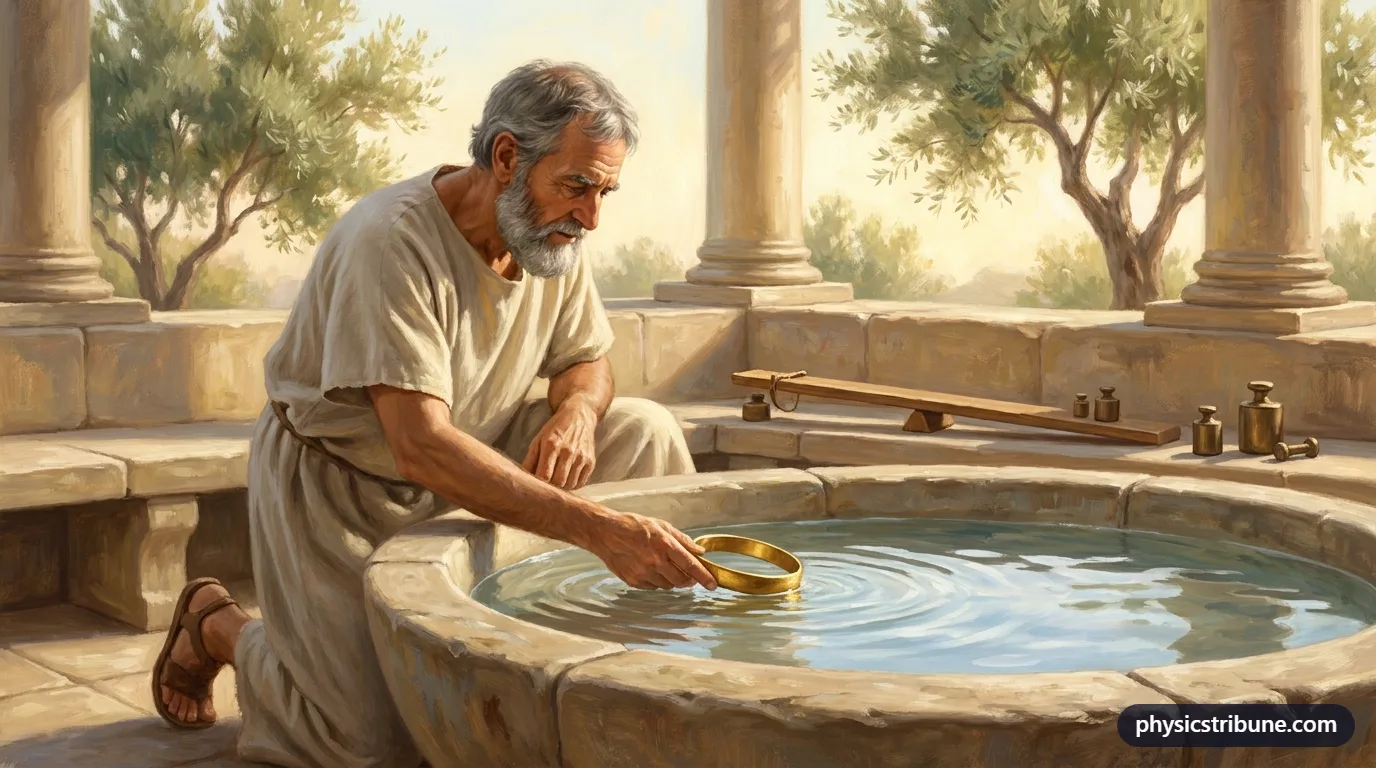
The best-known story about Archimedes comes from Vitruvius, a Roman architect who wrote about two centuries after his death. King Hiero had given a goldsmith gold to make a crown and suspected he had been cheated with silver mixed in. Archimedes, the story goes, noticed the water rising as he stepped into a bath, realized how to solve the problem, and ran home shouting "Eureka!", which means "I have found it!"
The physics behind the story is sound. Silver is less dense than gold, so a crown with silver mixed in would take up more space than pure gold of the same weight, and it would push aside more water. Whether Archimedes really measured spilled water is doubtful, since the difference would be tiny. Many historians think a balance held underwater, with the crown on one side and pure gold on the other, is a likelier method. Our write-up of the Archimedes crown story works through both versions with real numbers, and density explains the property being tested.
How Did Archimedes Explain the Lever?
People had used levers long before Archimedes, but in On the Equilibrium of Planes he gave the first known proof of how they work. Two weights balance on a lever when their distances from the pivot are in inverse proportion to the weights. A load three times heavier balances at one third of the distance.
This simple rule is the heart of every lever and of the idea of mechanical advantage: a small force far from the pivot can hold a large force close to it. In the same book Archimedes found the center of gravity of triangles, parallelograms and other flat shapes, ideas that engineers use every day.
Later writers credit him with the boast "Give me a place to stand, and I will move the Earth." Whether or not he said it, the saying captures the law exactly: with a long enough lever and a firm pivot, any weight can in principle be balanced by a small force.

What Did Archimedes Discover in Mathematics?
Archimedes was above all a mathematician. In Measurement of a Circle he trapped pi between two values by drawing polygons with 96 sides inside and outside a circle. He proved that pi lies between 3 10/71 and 3 1/7, which pins it down to about 3.14.
In On the Sphere and Cylinder he proved that a sphere has exactly two thirds of the volume and two thirds of the surface area of the smallest cylinder that can hold it. He was so proud of this result that he asked for a sphere inside a cylinder to be carved on his tomb. In The Sand Reckoner he invented a way to write enormous numbers and used it to estimate how many grains of sand would fill the universe as the Greeks pictured it.
His methods for finding areas and volumes, which sliced shapes into thin pieces and summed them, came remarkably close to the ideas of integral calculus that Newton and Leibniz developed nearly two thousand years later.
What Did Archimedes Invent?
Archimedes is linked to several machines, though for some of them the evidence is only that later writers named him. The best known is the Archimedes screw, a spiral tube inside a cylinder that lifts water when it is turned. It is still used today to move water and grain and in some wastewater plants. According to Plutarch, he also used systems of pulleys to let one person haul a fully loaded ship onto land.
During the Roman siege of Syracuse, from about 214 to 212 BC, he is said to have designed powerful catapults and a crane-like "claw" that could grab the bow of an attacking ship and lift it out of the water. A later legend claims he set ships on fire with mirrors focusing sunlight. Modern tests suggest this would have been very hard to pull off, and most historians treat it as a story rather than a fact.
Archimedes' Key Equation
Archimedes never wrote algebraic equations; Greek mathematics was done with geometry and words. His principle, however, translates neatly into the modern formula
The formula shows why a steel ship floats while a steel bolt sinks: the ship's hollow hull displaces a huge volume of water for its weight. Our buoyant force calculator solves the equation for any of its quantities, and you can practice with our buoyancy worksheets.
Archimedes stated his principle in words and geometry. Written as a modern equation, with each variable and its SI unit, it looks like this.
| Symbol | Quantity | SI unit |
|---|---|---|
| buoyant force | newton (N) | |
| density of the fluid | kilogram per cubic meter (kg/m³) | |
| acceleration due to gravity (9.80 m/s² (standard 9.80665 m/s²)) | meter per second squared (m/s²) | |
| volume of fluid displaced (submerged volume) | cubic meter (m³) |
Rearranged to find another variable:
Valid for: equals the weight of the displaced fluid.
Example 1 Testing a crown in a water tank
A jeweler lowers a crown with a volume of 64 cm³ (6.4 × 10^-5 m³) completely into fresh water with a density of 1,000 kg/m³. Taking g = 9.81 m/s², what buoyant force does the water exert on the crown?
- Given:
- density of the fluid:
- acceleration due to gravity:
- volume of fluid displaced (submerged volume):
- density of the fluid:
- Formula:
- Substitute:
- Answer:
The force depends only on the crown's volume, not on what it is made of, so a fake crown with the same weight but a larger volume would get a bigger upward push.
Why Is Archimedes Still Important?
Archimedes showed for the first time that the physical world could be described with exact mathematical laws. Statics, the study of balanced forces, and hydrostatics, the study of fluids at rest, both begin with his books, and the way he reasoned from simple assumptions to proven results became a model for later scientists. Galileo admired him deeply and studied his work closely, and Newton worked in the same tradition.
Some of his writing was nearly lost. A book called The Method, in which he explained how he used imagined weights and balances to discover results before proving them, survived only in a medieval prayer book whose pages had been scraped and reused. Scholars identified the hidden text in 1906, and modern imaging later recovered much more of it.
Today his name lives on in a principle, a screw, a lunar crater and countless classroom experiments with water and balances. If you are curious about who first understood floating, our answer to who discovered buoyancy traces the story.
Key Facts
- Archimedes was born in Syracuse, Sicily, about 287 BC and died there in 212 BC.
- Archimedes' principle states that a submerged object is pushed up by a force equal to the weight of the fluid it displaces.
- He gave the first known proof of the law of the lever in On the Equilibrium of Planes.
- Using 96-sided polygons, he showed that pi lies between 3 10/71 and 3 1/7.
- He proved that a sphere has two thirds of the volume of the cylinder that just encloses it.
- The Eureka story comes from the Roman writer Vitruvius, about two centuries after Archimedes lived.
- He was killed by a Roman soldier when Syracuse was captured in 212 BC.
Quick Quiz: How Well Do You Know Archimedes?
6 questions. Tap an answer to check it.
What does Archimedes' principle say the buoyant force equals?
The upward force on a submerged object equals the weight of the fluid it pushes aside.
In which city did Archimedes live most of his life?
He was born in Syracuse in Sicily and died there in 212 BC.
A 300 N load sits 0.5 m from a pivot. How far from the pivot must a 100 N weight sit to balance it?
By the law of the lever, 300 N × 0.5 m = 100 N × 1.5 m.
Between which two values did Archimedes prove that pi lies?
His 96-sided polygons gave a lower bound of 3 10/71 and an upper bound of 3 1/7.
Who wrote down the Eureka and crown story?
Vitruvius told the story about two centuries after Archimedes died.
What shape did Archimedes want carved on his tomb?
He was proudest of proving that a sphere has two thirds the volume of its enclosing cylinder.
Frequently Asked Questions
What is Archimedes best known for?
Archimedes is best known for Archimedes' principle, the rule that a submerged object feels an upward force equal to the weight of the fluid it displaces. He is also famous for proving the law of the lever, calculating pi between 3 10/71 and 3 1/7, finding the volume of a sphere and the story of shouting Eureka in his bath.
What did Archimedes invent?
He is credited with the Archimedes screw, a turning spiral that lifts water, with compound pulley systems and with war machines used to defend Syracuse, including catapults and a ship-grabbing claw. Some of these attributions come from later writers, so historians are more confident about his mathematical and physical discoveries than about every machine named after him.
What does Eureka mean and why did Archimedes say it?
Eureka is Greek for "I have found it." According to the Roman writer Vitruvius, Archimedes shouted it after noticing water rise as he got into a bath, which showed him how to test whether a gold crown contained cheaper silver. The story may be embellished, but the physics of comparing volumes is correct.
How did Archimedes die?
Archimedes died in 212 BC when a Roman army captured Syracuse after a siege of about two years. Ancient writers say he was killed by a Roman soldier, even though the Roman commander Marcellus had ordered that he be spared. Some versions claim he was absorbed in a geometry problem and refused to stop when the soldier approached.
What is the law of the lever?
The law of the lever says two weights balance when each weight multiplied by its distance from the pivot is the same on both sides. A heavy load near the pivot can therefore be balanced by a light force far away. Archimedes gave the first known mathematical proof of this rule in his book On the Equilibrium of Planes.
How did Archimedes calculate pi?
He drew regular polygons inside and outside a circle, starting with hexagons and doubling the number of sides until he reached 96. The circle's perimeter must lie between the perimeters of the inner and outer polygons, which he could compute. This showed that pi is greater than 3 10/71 and less than 3 1/7.
Did Archimedes really burn ships with mirrors?
Probably not. The story appears in writers who lived centuries after the siege of Syracuse, and early accounts of the siege do not mention it. Modern experiments have shown that setting a distant wooden ship on fire with mirrors would require near-perfect conditions, so most historians treat the burning mirror as a legend.
Why is Archimedes important to physics?
Archimedes was the first to treat parts of physics with rigorous mathematical proof. His books founded statics and hydrostatics, and his principle of buoyancy is still used to design ships, submarines and balloons. His habit of starting from simple assumptions and deriving exact laws became a model for Galileo, Newton and later physicists.