At a Glance
A screw is an inclined plane coiled around a shaft that converts rotation into linear motion with a large force. Its ideal mechanical advantage is IMA = 2πR / p, where R is the radius of the handle or turning arm and p is the pitch, the distance the screw advances in one turn.
- Type
- One of the six classic simple machines
- Shape
- Inclined plane wrapped around a cylinder
- What it does
- Turns rotation into a strong straight push
- Ideal mechanical advantage
- 2πR ÷ p
- Key measurement
- Pitch: distance advanced per turn
- Everyday examples
- Wood screw, bolt, jar lid, car jack, vise
On this page
- What Is a Screw in Physics?
- How Does a Screw Work, Step by Step?
- What Is the Pitch of a Screw?
- What Is the Formula for a Screw?
- What Forces Act on a Screw Thread?
- How Does Friction Affect a Screw?
- What Are the Types of Screws?
- Where Are Screws Used?
- What Is the History of the Screw?
- How Can You Practice Screw Problems?
- Common Misconceptions
- Key Facts
- Quiz
- FAQ
What Is a Screw in Physics?
In physics, a screw is any cylinder or cone with a spiral ridge, the thread, running around it. Turn it, and the thread slides along a matching groove in wood, metal or a nut, pulling the screw forward or pushing a load along its axis. A small turning force produces a large straight-line force.
The screw is one of the six classic simple machines. Picture a long, gentle inclined plane cut from paper, then wrap it around a pencil. The slanted edge spirals up the pencil just like a thread. That is why a screw is often called an inclined plane wrapped around a shaft.
Screws fasten things together (wood screws and bolts), move loads (car jacks and adjustable desks), press things (vises, clamps and old wine presses) and move fluids or grains (water pumps and grain augers).
How Does a Screw Work, Step by Step?
- You apply a turning force. Your hand, a screwdriver, a wrench or a motor twists the screw around its axis.
- The thread rides a slope. As the screw turns, its thread slides along the matching groove, like a block being pushed up a very long, shallow ramp.
- One turn, one pitch. Each full turn moves the screw forward by its pitch, the distance between neighboring threads on a single-thread screw.
- The force is multiplied. Your hand moves around a large circle while the screw moves forward a tiny distance. The ratio of those two distances sets how much the force grows.
- Friction holds the load. In most screws, friction is large enough that the load cannot turn the screw backward, so the screw stays where you leave it.
The diagram below shows one turn of a wood screw thread unrolled into a ramp. It rises at only about 7°, so the slope is gentle and the push needed along it is small.

What Is the Pitch of a Screw?
The pitch is the distance between one thread crest and the next, measured along the screw's length. For an ordinary single-thread screw, it also equals the lead, the distance the screw advances in one full turn. A fine thread has a small pitch; a coarse thread has a large one.
In the United States, threads are often described by threads per inch instead. A bolt with 20 threads per inch has a pitch of 1/20 inch. Metric screws state the pitch directly in millimeters, such as M8 × 1.25.
Some screws have two or more threads running side by side, called multi-start threads. A bottle cap and some jar lids use them so that a small turn closes the lid quickly. For these, the lead equals the pitch times the number of starts, and the lead is what goes into the mechanical advantage.
What Is the Formula for a Screw?
The ideal mechanical advantage of a screw comes from comparing distances. In one turn, your hand moves around a circle of circumference
Because a pitch is usually just a few millimeters while a handle radius is several centimeters or more, screws reach very large mechanical advantages, often in the hundreds. A longer handle or a finer thread both increase it. The general definition, output force divided by input force, is shown below; the mechanical advantage formula page compares the screw with the other machines.
The turning effect you apply is a torque, force times the radius at which it acts. That is why a wrench with a long handle loosens a stuck bolt more easily than your fingers can.
Like any simple machine, a screw is rated by how much it multiplies the force you apply. Here is the general formula with each symbol and its unit.
| Symbol | Quantity | SI unit |
|---|---|---|
| mechanical advantage | dimensionless (1) | |
| output force (exerted on the load) | newton (N) | |
| input force (effort) | newton (N) |
Rearranged to find another variable:
Valid for: for a lever in equilibrium MA = l_i / l_o (input arm / output arm).
Example 1 Ideal mechanical advantage of a screw jack
A screw jack has a thread pitch of 0.005 m, and you turn it with a handle whose grip is 0.25 m from the screw's axis. Ignoring friction, what is the jack's ideal mechanical advantage?
- Given:
- R:
- p:
- R:
- Formula:
- Substitute:
- Answer:
Your hand travels about 1.57 m around each circle while the load rises just 5 mm, so the force is multiplied by the same large ratio.
What Forces Act on a Screw Thread?
Think of the load as a small block resting on the thread of a screw jack. Its weight pulls straight down. The thread pushes back on it at right angles to the sloping surface. To make the block climb, the screw must supply a sideways push at the thread as it turns.
The diagram shows those three forces for a 6,000 N load on a jack thread that rises at about 4.5°. Without friction, a sideways push of only about 477 N at the thread balances the load. The handle, which is much farther from the axis than the thread, then reduces the force your hand must supply by another large factor.

How Does Friction Affect a Screw?
A screw is one of the least efficient simple machines. The thread presses on its groove with a force close to the full load, and it slides a long way around the spiral, so friction wastes a large share of the input work. Many everyday screws and jacks have efficiencies well below one half.
That low efficiency is a feature, not a flaw. When more energy is lost to friction than the load could return, the load cannot drive the screw backward. This self-locking behavior keeps a car jack from sinking, a vise from loosening and a wood screw from backing out on its own. Machines that need easy back-driving, such as some precision positioning stages, use ball screws with rolling balls to cut friction.
You can compare ideal and actual values for any machine with the mechanical advantage calculator, or read how efficiency is defined on our energy efficiency page.
Example 2 Actual mechanical advantage of the same jack
When the jack above lifts a load of 6,000 N, you measure that the handle needs a steady push of 80 N. What is its actual mechanical advantage?
- Given:
- output force (exerted on the load):
- input force (effort):
- output force (exerted on the load):
- Formula:
- Substitute:
- Answer:
The actual value is far below the ideal one because the thread rubs hard against the nut.
Example 3 Efficiency of the screw jack
Using the same jack, one full turn of the handle (grip radius 0.25 m, push 80 N) raises the 6,000 N load by one pitch of 0.005 m. What percentage of the input work ends up lifting the load?
- Given:
- F_o:
- p:
- F_i:
- R:
- F_o:
- Formula:
- Substitute:
- Answer:
An efficiency below half is what makes the jack self-locking: the load cannot spin the screw backward when you let go.
What Are the Types of Screws?
- Wood screws have a pointed tip and a tapered, coarse thread that cuts its own groove in wood.
- Machine screws and bolts have a straight, fine thread that fits a nut or a tapped hole in metal.
- Lifting and press screws, such as car jacks, vises and bookbinding presses, use a strong square or trapezoidal thread to push heavy loads.
- Lead screws move tools and tables precisely in lathes, 3D printers and adjustable desks.
- Conveying screws, including the water-lifting Archimedes screw and grain augers, use a wide spiral blade to move material along a tube.
- Caps and lids on bottles and jars use short, often multi-start threads for a quick, tight seal.
Where Are Screws Used?
Screws hold together furniture, electronics, cars and buildings. A single bolt tightened with a wrench can clamp two steel plates with thousands of newtons of force, which is why bolted joints are used on bridges and engines.
Screws also move things. Turning the crank of a car jack lifts one corner of a car. A bench vise grips a piece of wood tight enough to saw.
The spiral staircase in a lighthouse is a giant screw-shaped ramp. Even an office chair often uses a screw or a spiral mechanism to set its height. The table below compares several screws by handle radius and pitch.
| Screw | Turning radius R | Pitch p | Ideal MA (2πR ÷ p) |
|---|---|---|---|
| Bolt turned with a wrench | 0.20 m | 1.5 mm | 837.76 |
| Car screw jack | 0.25 m | 5 mm | 314.16 |
| Bench vise | 0.15 m | 4 mm | 235.62 |
| C-clamp | 3 cm | 2 mm | 94.25 |
| Jar lid | 4 cm | 3 mm | 83.78 |
| Wood screw with a screwdriver | 1.5 cm | 1.6 mm | 58.90 |
| Source: Computed with ideal MA = 2πR / p; radii and pitches are typical values, friction ignored · Retrieved October 2026 | |||

What Is the History of the Screw?
The water-lifting screw, a spiral inside a tilted tube, is traditionally credited to Archimedes in the 3rd century BC, although some historians think similar devices were used earlier. Greek and Roman workers also built large wooden screw presses for squeezing olives and grapes.
Hero of Alexandria, writing in the 1st century AD, listed the screw among his basic machines. Metal screws and bolts made in quantity came much later. Accurate screw-cutting lathes developed in the 1700s and 1800s, and standard thread sizes followed in the 1800s, which made parts from different factories interchangeable.
How Can You Practice Screw Problems?
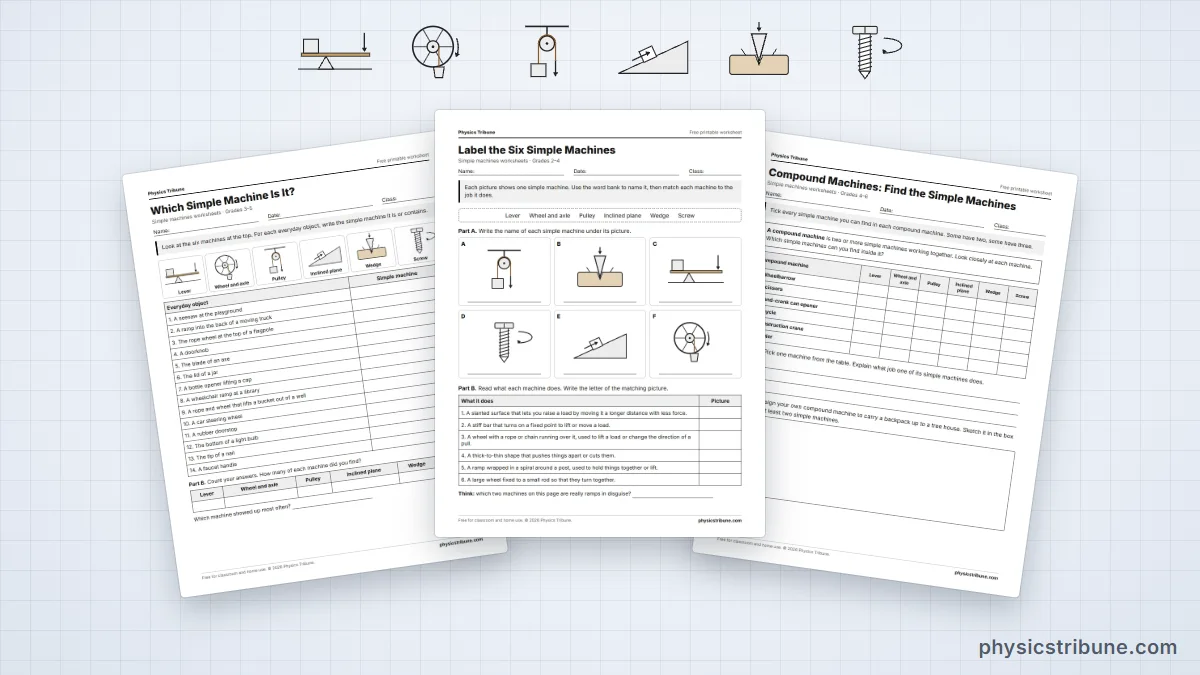
Measure the pitch of a bolt by counting threads over a known length, then work out the ideal mechanical advantage for a wrench of a given length. Compare it with the wedge, which also uses sloping faces to multiply force. Our simple machines worksheets include printable problems with answer keys, and the screw for kids page explains the idea for younger learners. Then try the quiz below.
Common Misconceptions
Myth: A screw with a huge mechanical advantage lets you do less work.
Physics: It reduces the force, not the work. Your hand travels a long way around for a tiny forward motion, and friction adds extra work on top.
Myth: The pitch of a screw is the same as the number of threads.
Physics: Pitch is a distance, the gap from one thread to the next. Threads per inch is the reciprocal of the pitch measured in inches.
Myth: Friction in a screw is always a problem to be removed.
Physics: Friction is what makes jacks, vises and wood screws self-locking, so the load stays put when you stop turning.
Key Facts
- A screw is an inclined plane wrapped in a spiral around a cylinder.
- The pitch is the distance between neighboring threads, and a single-thread screw advances one pitch per turn.
- The ideal mechanical advantage of a screw is 2πR divided by the pitch.
- Screws can multiply force by hundreds of times because the pitch is tiny compared with the handle's circle.
- Friction makes most screws inefficient, which also makes them self-locking.
- Bolts, jar lids, car jacks, vises and augers are all screws.
- The water-lifting screw is traditionally credited to Archimedes in the 3rd century BC.
Quick Quiz: How Well Do You Know Screw (Simple Machine)?
6 questions. Tap an answer to check it.
A screw is best described as which simple machine wrapped around a cylinder?
The thread is a long ramp coiled in a spiral around the shaft.
How far does a single-thread screw move forward in one full turn?
On a single-thread screw, the lead per turn equals the pitch.
Which change increases the ideal mechanical advantage of a screw jack?
IMA = 2πR / p, so a larger handle radius R raises it.
Why does a car jack not sink when you let go of the handle?
Friction in the thread is large enough that the load cannot turn the screw backward.
A bolt has 20 threads per inch. What is its pitch?
Pitch is one divided by the threads per inch.
What does a screw trade to multiply force?
Your hand moves a long way around for a tiny forward motion of the screw.
Frequently Asked Questions
Why is a screw an inclined plane?
A screw's thread is a long, gentle slope wound in a spiral around a shaft. If you could unwrap one turn of the thread and lay it flat, you would see a ramp whose length is the circumference of the screw and whose height is the pitch. Turning the screw is like pushing a load up that ramp, so it trades a long distance for a smaller force.
How does a screw make work easier?
A screw lets a small turning force produce a large straight-line force. Your hand moves around a large circle while the screw advances only a tiny distance, so the force is multiplied by roughly the ratio of those distances. The total work does not shrink; in fact friction adds some, but the force needed at any moment is far smaller.
What is the formula for the mechanical advantage of a screw?
The ideal mechanical advantage of a screw is IMA = 2πR / p, where R is the radius of the handle, wrench or grip you turn and p is the pitch, the distance the screw advances per turn. A handle 0.1 m in radius on a screw with a 2 mm pitch gives an ideal value of about 314. Friction makes the actual value lower.
What is the pitch of a screw?
The pitch is the distance from one thread to the next, measured along the length of the screw. On a single-thread screw it equals how far the screw moves forward in one full turn. Metric screws list the pitch in millimeters, while inch screws usually list threads per inch, which is one divided by the pitch in inches.
What are 5 examples of a screw?
Five common examples are a wood screw, a bolt with a nut, a jar lid, a car jack and a bench vise. Others include a light bulb base, a corkscrew, a drill bit, a grain auger, an adjustable desk leg and the Archimedes screw used to lift water. Each one turns rotation into motion along an axis.
Why do screws not unscrew by themselves?
Friction between the thread and the material is large enough to stop the load from turning the screw backward. Because a screw wastes a big share of the input energy as friction, the load cannot push hard enough to spin it in reverse. Vibration can slowly loosen screws, which is why lock washers and thread-locking glue exist.
Does a finer thread make a screw stronger?
A finer thread, with a smaller pitch, gives a larger mechanical advantage, so the same twist on the handle produces a larger clamping force. It also needs more turns to move the same distance. Fine threads are used where precise adjustment or high clamping force matters, while coarse threads go in quickly and grip soft materials like wood well.
Is a screw a wedge or an inclined plane?
Most textbooks describe the screw as an inclined plane wrapped around a cylinder, and that is the clearest way to calculate its mechanical advantage. Its thread also acts a little like a wedge as it cuts into wood, and the pointed tip of a wood screw is a small wedge that opens the hole for the thread to follow.