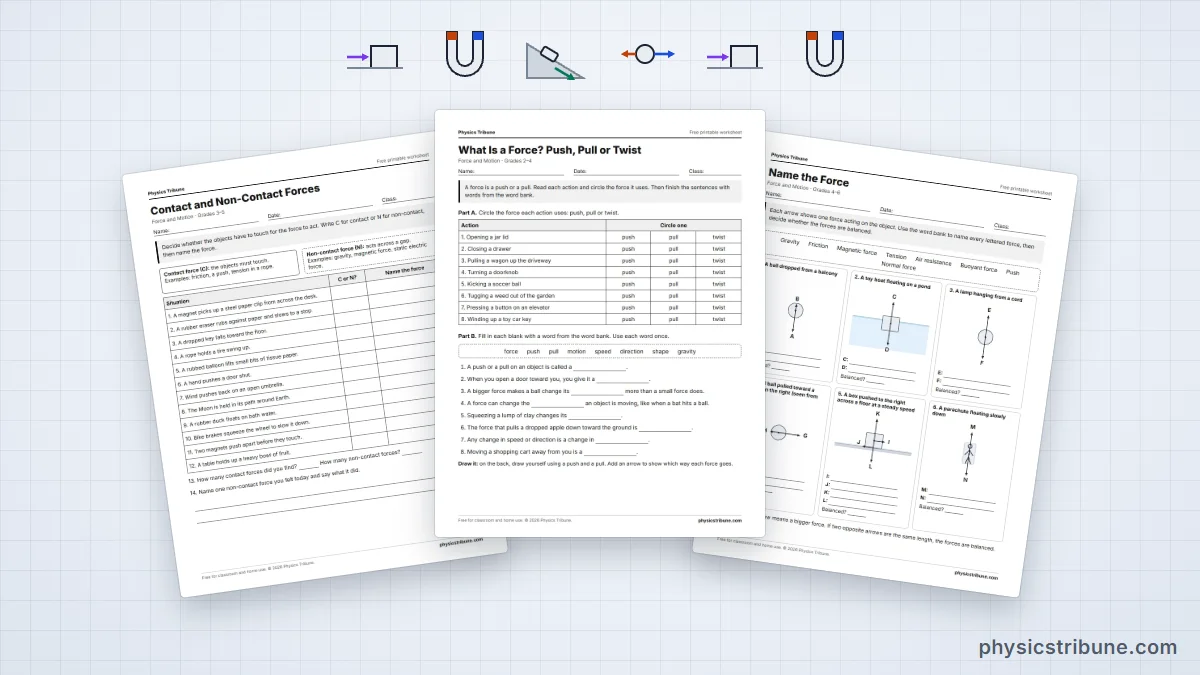
At a Glance
A force is a push or pull measured in newtons (N), where 1 N = 1 kg·m/s². Forces are vectors, so direction matters, and only the net force changes motion: F_net = m a. Newton's three laws describe how forces and motion are linked.
- What it covers
- Newton's laws, types of forces, friction, springs and elasticity
- Unit of force
- newton (N) = 1 kg·m/s²
- Scalar or vector
- Vector: every force has a size and a direction
- Core law
- Fnet = ma
- Key formulas
- W = mg, f = μN, F = −kx
- Sub-guides
- 4 topic groups, 35+ pages
On this page
What Is a Force in Physics?
A force is an interaction between two objects that pushes or pulls on each of them. Kick a ball and your foot pushes it; let go of an apple and Earth pulls it down. A force can start an object moving, stop it, speed it up, slow it down, change its direction or squash and stretch it.
Every force has a size and a direction, so force is a vector. Its SI unit is the newton: one newton is the force that gives 1 kg an acceleration of 1 m/s². An apple of medium size weighs roughly one newton. Other units, such as the pound-force, are covered in our guide to units of force.
When several forces act at once, what matters is their vector sum, the net force. Forces that cancel each other leave the motion unchanged, while an unbalanced total makes the object accelerate.
Forces Explained Simply
Think of a tug-of-war. Each team pulls on the rope, and if both pull equally hard, the rope does not move. When one side pulls harder, the rope slides toward it. The rope only cares about the difference between the two pulls.
Every motion problem in this section works the same way. List the pushes and pulls, add them with their directions, and the leftover force tells you how the object will move. A free-body diagram is simply a sketch of that list, with one arrow per force.
What Are Newton's Three Laws of Motion?
Newton's laws of motion are the foundation of this whole topic. The first law says an object keeps its velocity unless a net force acts on it, a property called inertia. The second law puts a number on the change:
Together they let you predict the motion of almost anything bigger than an atom and slower than light, from a sliding book to a spacecraft. Isaac Newton published all three in 1687.
What Are the Main Types of Forces?
Our types of forces guide sorts them into contact and non-contact forces. Contact forces need touching surfaces: the normal force from a floor, the tension in a rope, friction and air resistance. Non-contact forces act across space, such as gravity, magnetism and the electric force.
The most familiar non-contact force is weight, the pull of gravity on an object's mass, found with
| Quantity | Formula | SI unit |
|---|---|---|
| Newton's second law | F_net = m a | newton (N) |
| Newton's third law | F_AB = −F_BA | newton (N) |
| Weight | W = m g | newton (N) |
| Maximum static friction | f_s,max = μs N | newton (N) |
| Kinetic friction | f_k = μk N | newton (N) |
| Hooke's law (spring force) | F = −k x | newton (N) |
| Normal force on an incline | N = m g cos θ | newton (N) |
| Force along an incline | F_parallel = m g sin θ | newton (N) |
| Apparent weight (accelerating up) | N = m (g + a) | newton (N) |
| Drag force | F_D = ½ C ρ A v² | newton (N) |
| Stress | σ = F / A | pascal (Pa) |
| Source: Formulas from our formula data set (data/formulas.json) · Retrieved October 2026 | ||
How Do Friction and Springs Fit In?
Friction is the force that resists sliding between surfaces. It explains why a pushed box stops, why tires grip the road and why brakes work. Its size depends on how hard the surfaces press together and on a coefficient of friction for the pair of materials. Air resistance is a similar drag force from moving through air.
Springs and solid materials push back when they are stretched or squeezed. Our elasticity guide covers Hooke's law, the spring constant and stress and strain.
The diagram below puts several of these forces on one object: a box pulled across a floor, with weight, the normal force, a pull and friction all acting at the same moment.

In What Order Should You Learn About Forces?
Each step builds on the one before. We suggest this order:
- Types of forces, including weight and the normal force.
- Net force and balanced and unbalanced forces.
- Free-body diagrams, the drawing skill used in every later problem.
- Newton's laws of motion, starting with the first law and ending with the third.
- Friction and forces on an inclined plane.
- Springs and elasticity.
Practice as you go with the force calculator and our Newton's laws worksheets. Every equation from this section is collected on the force formulas sheet.
All Forces & Newton's Laws (4)


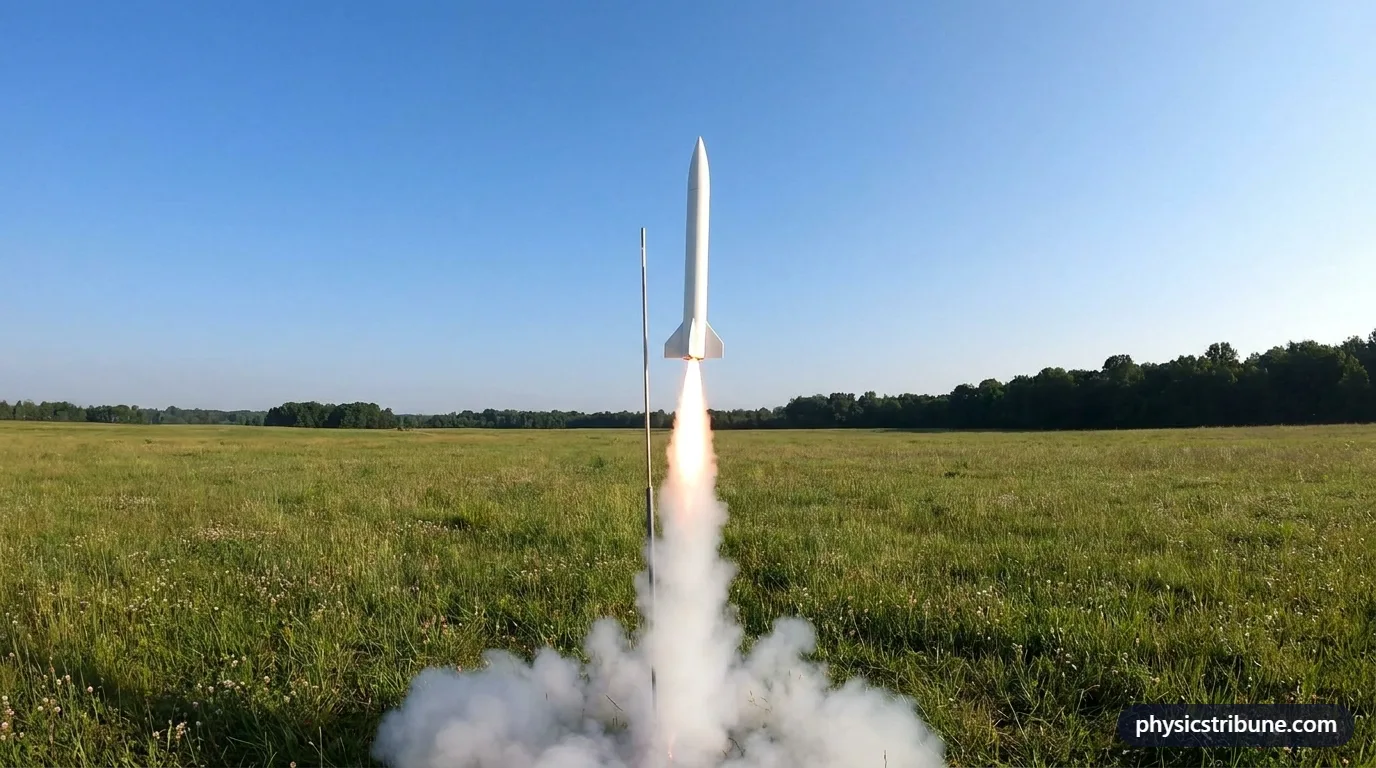

Key Facts
- A force is a push or pull between two objects, measured in newtons.
- Force is a vector, so its direction matters as much as its size.
- Only the net force changes an object's motion, as F = ma describes.
- Forces always come in equal and opposite pairs acting on different objects.
- Weight is the force of gravity on a mass, W = mg.
- Friction opposes sliding and depends on how hard two surfaces press together.
- Springs push back in proportion to how far they are stretched, as Hooke's law states.
Frequently Asked Questions
What is a force in physics?
A force is a push or a pull that one object exerts on another. It can change how fast an object moves, the direction it travels or its shape. Forces are measured in newtons and are vectors, which means each one has both a size and a direction. Gravity, friction, tension and the push of a hand are all forces.
What are the 4 types of forces?
In physics, the four fundamental forces are gravity, electromagnetism, the strong nuclear force and the weak nuclear force. Everyday forces such as friction, tension, the normal force and air resistance are all electromagnetic at the level of atoms. In school science, forces are often grouped instead as contact forces, which need touching, and non-contact forces, which act at a distance.
What is the unit of force?
The SI unit of force is the newton, written N. One newton is the force that gives a one-kilogram mass an acceleration of one meter per second squared, so 1 N equals 1 kg·m/s². In the United States, force is also given in pounds-force, where one pound-force is about 4.45 newtons.
What is the difference between mass and weight?
Mass is the amount of matter in an object and measures how hard it is to accelerate. It is measured in kilograms and is the same everywhere. Weight is the force of gravity on that mass, measured in newtons, and it changes with location. A 10 kg bag weighs about 98 N on Earth but only about a sixth of that on the Moon.
Can an object move if no force acts on it?
Yes. Newton's first law says an object with zero net force keeps whatever velocity it already has. A hockey puck sliding on nearly frictionless ice glides on in a straight line at almost constant speed. A force is needed to change motion, such as starting, stopping or turning, but not to keep an object moving steadily.
How do you find the net force on an object?
Draw a free-body diagram with one arrow for each force, then add the forces as vectors. Forces in the same direction add, and forces in opposite directions subtract. For forces at angles, split each one into horizontal and vertical parts and add each direction separately. The result is the net force, which sets the acceleration through F = ma.