
At a Glance
Momentum is mass times velocity, p = m v, a vector measured in kg·m/s. A net force changes momentum at a rate F = Δp / Δt, and the change itself is called impulse. When no outside force acts, the total momentum of a system is conserved, which is the key to solving every collision, explosion and recoil problem.
- What it covers
- Momentum, impulse, conservation, collisions, recoil, rockets, car safety
- Momentum
- p = mv, a vector in kg·m/s
- Impulse
- J = FΔt = Δp, in N·s (same as kg·m/s)
- Core law
- Total momentum is conserved when no net outside force acts
- Collision types
- Elastic, inelastic, perfectly inelastic
- Sub-guides
- 3 topic groups, 15+ pages
On this page
What Is Momentum in Physics?
Momentum measures how hard it is to stop a moving object. It depends on two things at once: how much mass the object has and how fast it moves. A slowly rolling bus can carry far more momentum than a fast bicycle courier, while a parked truck, however heavy, carries none at all.
The definition is
Every page in this guide starts from the definition of momentum, shown here with its variables and SI units.
| Symbol | Quantity | SI unit |
|---|---|---|
| momentum | kilogram meter per second (kg·m/s) | |
| mass | kilogram (kg) | |
| velocity | meter per second (m/s) |
Valid for: vector (same direction as v); non-relativistic.
| Object | Mass (kg) | Speed (m/s) | Momentum p = mv (kg·m/s) |
|---|---|---|---|
| Table tennis ball smash | 0.0027 | 8 | 0.0216 |
| Golf ball off the tee | 0.046 | 70 | 3.22 |
| Pitched baseball | 0.145 | 40 | 5.8 |
| Kicked soccer ball | 0.43 | 25 | 10.75 |
| Cyclist with bike | 85 | 6 | 510 |
| Sprinter at top speed | 80 | 10 | 800 |
| Car on the highway | 1,500 | 25 | 37,500 |
| Loaded truck on the highway | 30,000 | 25 | 750,000 |
| Source: Computed with p = mv; masses and speeds are typical values · Retrieved October 2026 | |||
Momentum Explained Simply
Think of momentum as "oomph" that a moving thing carries. A tennis ball tossed gently has a little, a bowling ball rolling down the lane has a lot more, and a loaded freight train has an enormous amount. The more oomph something has, the more push you need, or the longer you need to push, to bring it to rest.
Momentum can be passed around, as when a cue ball hands its motion to another ball, but it never appears from nowhere or vanishes. That simple bookkeeping rule makes it one of the most powerful tools in physics.
How Do Force and Impulse Change Momentum?
Newton originally stated his second law in terms of momentum: the net force on an object equals the rate at which its momentum changes,
Multiply force by the time it acts and you get impulse, which equals the change in momentum. The same change can come from a large force acting briefly or a small force acting for longer. A 1,500 kg car stopping from 25 m/s loses 37,500 kg·m/s of momentum; spread over 1 second, the average force is 37,500 N, but squeezed into 0.1 seconds it is 375,000 N, values we computed from
Why Is Momentum Always Conserved?
The law of conservation of momentum says the total momentum of a system stays constant if no net outside force acts on it. It follows from Newton's third law: when two objects push on each other, the forces are equal and opposite and last for exactly the same time, so whatever momentum one gains, the other loses.
The law holds whether objects bounce, stick, shatter or push apart. A skater who shoves a friend on the ice moves backward while the friend moves forward, and their momenta still add to zero. You can test it yourself with our colliding carts experiment.
What Happens to Momentum in a Collision?
In every collision, total momentum is the same just before and just after impact. What differs between collision types is kinetic energy. In an elastic collision, kinetic energy is also conserved, as in near-perfect bounces of steel balls. In an inelastic collision, some kinetic energy turns into heat, sound and deformation.
When the objects stick together and move as one, the collision is perfectly inelastic, and the largest possible share of kinetic energy is lost. Our collisions guide covers all three types, two-dimensional impacts and the coefficient of restitution, and the collision calculator works out final velocities for you.
| Quantity or law | Formula | SI unit |
|---|---|---|
| Linear momentum | p = m v | kg·m/s |
| Newton's second law (momentum form) | F_net = Δp / Δt | newton (N) |
| Impulse | J = F Δt | N·s |
| Impulse-momentum theorem | J = Δp = m v_f − m v_i | N·s = kg·m/s |
| Conservation of momentum | m1 v1 + m2 v2 = m1 v1' + m2 v2' | kg·m/s |
| Perfectly inelastic collision | v' = (m1 v1 + m2 v2) / (m1 + m2) | m/s |
| Elastic collision, object 1 | v1' = ((m1 − m2) v1 + 2 m2 v2) / (m1 + m2) | m/s |
| Coefficient of restitution | e = (v2' − v1') / (v1 − v2) | no unit |
| Angular momentum | L = I ω | kg·m²/s |
| Source: Formulas from our formula data set (data/formulas.json) · Retrieved October 2026 | ||
Where Does Momentum Matter in Real Life?
Momentum explains how a rocket accelerates in empty space: it throws exhaust backward, and the rocket gains equal momentum forward, with no air needed to push against. The same idea governs recoil, from a cannon kicking back to a garden hose pushing against your hand.
It also shapes everyday safety. Seat belts, airbags and crumple zones, covered on our car safety physics page, all stretch out the time of a crash so the force on passengers drops. Athletes use the same trick when they bend their knees on landing or pull their hands back while catching a ball. Browse more cases in our momentum examples.
In What Order Should You Learn Momentum?
Each step builds on the one before. We suggest this order:
- Momentum and impulse, starting with p = mv and the impulse-momentum theorem.
- Conservation of momentum, the law behind every interaction.
- Collisions: elastic, inelastic and perfectly inelastic, then collisions in two dimensions.
- Momentum in the real world: rockets, recoil and vehicle safety.
- Extensions: angular momentum for spinning objects and relativistic momentum near light speed.
Practice along the way with our momentum and impulse worksheets, and keep the momentum formulas sheet handy for quick reference.
All Momentum & Collisions (3)

Key Facts
- Momentum is mass times velocity, p = mv, and its SI unit is kg·m/s.
- Momentum is a vector, so its direction matters when you add momenta.
- Net force equals the rate of change of momentum, F = Δp/Δt.
- Impulse, force times time, equals the change in momentum.
- In an isolated system, total momentum is conserved in every collision and explosion.
- Kinetic energy is conserved only in elastic collisions, while momentum is conserved in all of them.
- Airbags and crumple zones reduce injury by stretching the stopping time, which lowers the force.
Frequently Asked Questions
What is momentum in physics?
Momentum is the product of an object's mass and its velocity, written p = mv. It measures how much motion an object has and how hard it is to stop. Because velocity has a direction, momentum is a vector. Its SI unit is the kilogram meter per second, and it is conserved in any system with no net outside force.
What is the difference between momentum and impulse?
Momentum is a property of a moving object at one instant, equal to mass times velocity. Impulse is what changes momentum: a force acting over a period of time, equal to force multiplied by time. The impulse-momentum theorem says the impulse on an object equals its change in momentum, and both share the same unit, N·s or kg·m/s.
Is momentum always conserved?
Total momentum is conserved whenever the net external force on a system is zero. Inside the system, objects can exchange momentum freely through collisions or pushes. If an outside force acts, such as friction from the ground over a long time, the system's momentum changes. During brief collisions, outside forces are usually small enough that momentum is very nearly conserved.
What is the unit of momentum?
The SI unit of momentum is the kilogram meter per second, written kg·m/s. It is equal to the newton second, N·s, which is the unit of impulse, because a newton is one kilogram meter per second squared. Momentum has no special named unit of its own, unlike energy with the joule or force with the newton.
What are the three types of collisions?
The three types are elastic, inelastic and perfectly inelastic. In an elastic collision both momentum and kinetic energy are conserved. In an inelastic collision momentum is conserved but some kinetic energy becomes heat, sound or deformation. In a perfectly inelastic collision the objects stick together and move as one, losing the largest possible amount of kinetic energy.
How is momentum different from kinetic energy?
Momentum, p = mv, is a vector that depends on speed directly, while kinetic energy, ½mv², is a scalar that depends on the square of speed. Momentum is conserved in every collision, but kinetic energy is conserved only in elastic ones. Two objects can have zero total momentum while still carrying plenty of kinetic energy, such as two carts rushing toward each other.
Keep Exploring
 momentumMomentum & Impulse
 momentumCollisions
 momentumLaw of Conservation of Momentum
 momentumImpulse and the Impulse-Momentum Theorem
 momentumLinear Momentum (p = mv)
 calculatorsMomentum Calculator
 compareMomentum vs Kinetic Energy
 formulasMomentum and Impulse Formulas
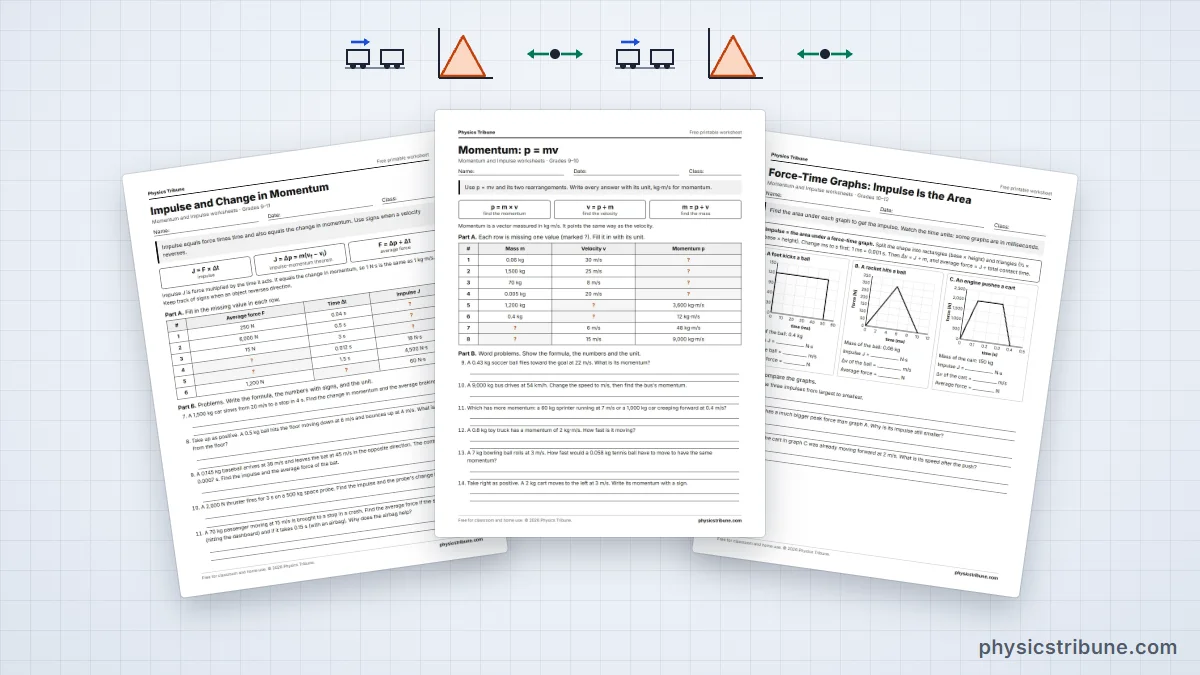 worksheetsMomentum and Impulse Worksheets