At a Glance
Archimedes of Syracuse (about 287 to 212 BC) discovered the law of buoyancy and wrote it down in On Floating Bodies: the upward force on an object in a fluid equals the weight of the fluid it pushes aside, F_B = ρ_f g V_disp. The famous story of him shouting "Eureka" in the bath was written about two centuries later and is probably embellished.
- Discovered by
- Archimedes of Syracuse
- When
- 3rd century BC (exact year unknown)
- Where written
- On Floating Bodies
- The law
- Buoyant force = weight of displaced fluid
- Formula today
- F_B = ρ_f g V_disp
- Famous legend
- The golden crown and "Eureka"
On this page
- Who Really Discovered Buoyancy?
- What Exactly Did Archimedes Discover About Buoyancy?
- Did Archimedes Really Shout "Eureka" in the Bath?
- Who Built on Archimedes' Work Later?
- Step by Step: How the Idea of Buoyancy Grew
- Why Does Archimedes' Discovery Still Matter?
- Try It at Home: Weigh an Object Under Water
- Key Facts
- FAQ
Who Really Discovered Buoyancy?
People knew that wood floats and stones sink long before anyone explained why. The first person to turn that everyday experience into an exact law was Archimedes, a mathematician and engineer from the Greek city of Syracuse on the island of Sicily. He worked in the 3rd century BC, and he is credited with the law of the lever as well.
Archimedes did not just say that water pushes things up. He worked out how big that push is: it equals the weight of the water the object shoves out of the way. This rule, today called Archimedes' principle, is still taught almost unchanged more than two thousand years later.
So the short answer is Archimedes, though later scientists built on his work and gave it the modern language of pressure and density.
What Exactly Did Archimedes Discover About Buoyancy?
In his treatise On Floating Bodies, Archimedes reasoned about fluids with the same careful geometry he used for shapes and levers. He concluded that a body wholly or partly sunk in a fluid is pressed upward by a force equal to the weight of the fluid it displaces. If that upward push is greater than the body's own weight, it rises; if smaller, it sinks.
He also explained floating. A floating object sinks only until the water it pushes aside weighs as much as the object itself. That is why a heavy wooden log floats low in the water while a light piece of cork rides high, and why a boat sits deeper when it is loaded.
Today we write his result as
In modern notation, Archimedes' result for the upward push on a submerged object is written as:
| Symbol | Quantity | SI unit |
|---|---|---|
| buoyant force | newton (N) | |
| density of the fluid | kilogram per cubic meter (kg/m³) | |
| acceleration due to gravity (9.80 m/s² (standard 9.80665 m/s²)) | meter per second squared (m/s²) | |
| volume of fluid displaced (submerged volume) | cubic meter (m³) |
Valid for: equals the weight of the displaced fluid.
Did Archimedes Really Shout "Eureka" in the Bath?
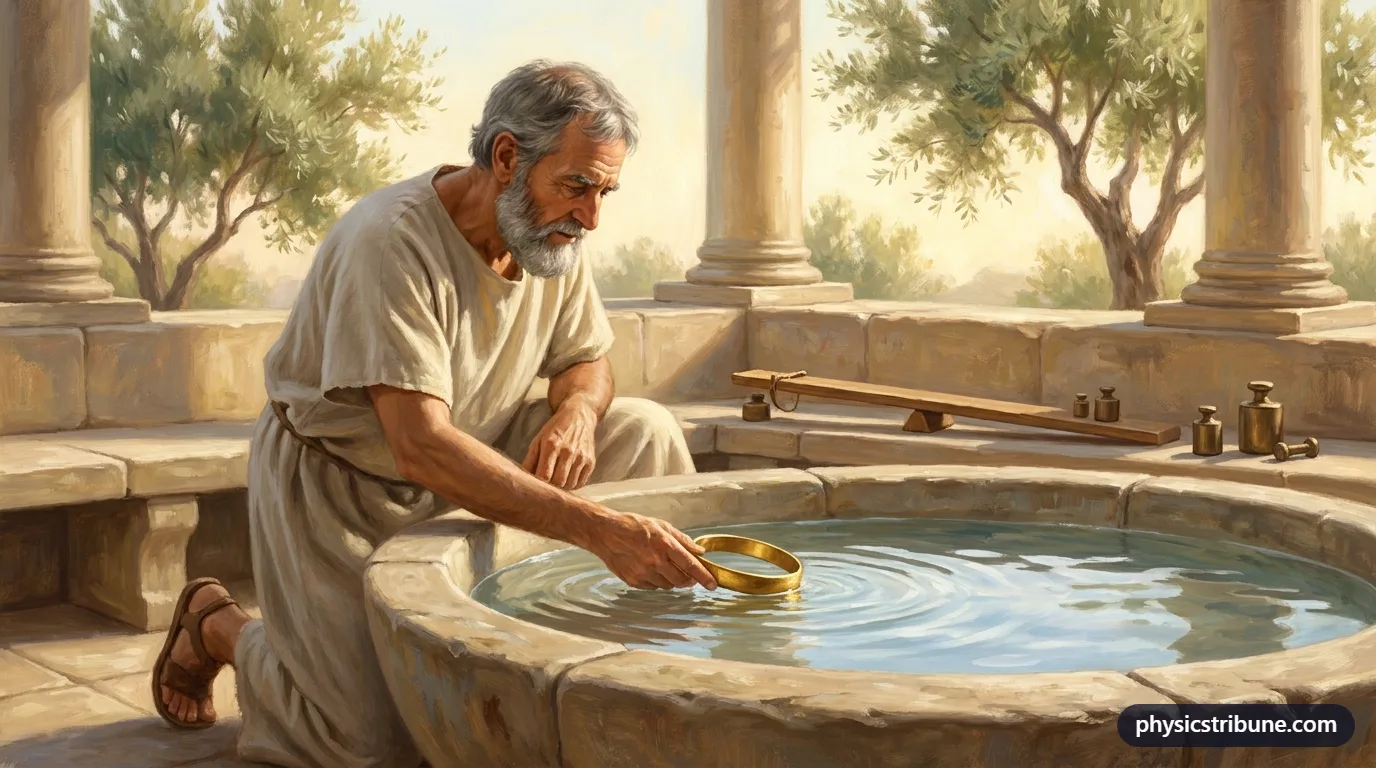
The famous tale goes like this. King Hiero of Syracuse suspected that a goldsmith had mixed cheaper silver into a gold crown. He asked Archimedes to find out without damaging it. Stepping into a full bath, Archimedes noticed the water rising and realized he could measure the crown's volume by the water it displaced. He supposedly ran through the streets shouting "Eureka," Greek for "I have found it."
The trouble is the source. The story appears in the writings of the Roman architect Vitruvius, roughly two centuries after Archimedes died, and Archimedes' own surviving works never mention it. Many historians doubt the details, because measuring overflow water would be too crude to catch a small amount of silver.
A method closer to Archimedes' own principle works far better: hang the crown and an equal mass of pure gold from a balance and lower both into water. If the crown contains silver, it has a larger volume, gets a larger buoyant push and the balance tips. You can read more in our Archimedes crown story page.
Example 1 The buoyant force on a pure gold crown
A crown of pure gold with a mass of 1.00 kg has a volume of about 51.8 cm³ (5.181 × 10⁻⁵ m³). When it hangs fully under water of density 1,000 kg/m³, with g = 9.81 m/s², how large is the buoyant force on it?
- Given:
- density of the fluid:
- acceleration due to gravity:
- volume of fluid displaced (submerged volume):
- density of the fluid:
- Formula:
- Substitute:
- Answer:
A crown of the same mass made partly of silver has a larger volume, so it would feel a larger buoyant force and weigh less under water.
| Quantity | Pure gold crown | Gold and silver crown |
|---|---|---|
| Mass | 1.00 kg | 1.00 kg |
| Density | 19,300 kg/m³ | About 15,400 kg/m³ |
| Volume | 51.8 cm³ | 64.9 cm³ |
| Extra water displaced | None | About 13.1 cm³ |
| Buoyant force in water | 0.508 N | 0.636 N |
| Apparent weight in water | 9.30 N | 9.17 N |
| Source: Computed with ρ = m/V and F_B = ρ_f g V, g = 9.81 m/s², water 1,000 kg/m³; gold 19,300 kg/m³ and silver 10,490 kg/m³ are typical room-temperature densities · Retrieved October 2026 | ||

Who Built on Archimedes' Work Later?
For many centuries, Archimedes' results were copied and studied with little change. Interest returned in the late 1500s. In 1586 a young Galileo Galilei wrote a short essay called The Little Balance, describing a hydrostatic balance for weighing metals in air and in water, very much in the spirit of the crown test. Around the same time, the Flemish engineer Simon Stevin studied the pressure of water on walls and the floors of vessels.
In the 1600s, Blaise Pascal showed how pressure spreads through a fluid, the idea now called Pascal's principle. Once scientists understood that pressure increases with depth, buoyancy had a deeper explanation: the water pushes harder on the bottom of an object than on its top, and the difference is the buoyant force.
Step by Step: How the Idea of Buoyancy Grew
- Everyday knowledge. Long before any theory, boat builders knew which woods float and how to load a hull.
- Archimedes' law (3rd century BC). He showed that the upward force equals the weight of displaced fluid and explained floating and sinking.
- The crown legend (about 200 years later). Vitruvius told the Eureka story, which made displacement famous.
- Weighing in water (late 1500s). Galileo's hydrostatic balance turned the idea into a practical tool for testing metals.
- Pressure in fluids (1600s). Stevin and Pascal explained fluid pressure, which tells us why buoyancy happens.
- Density and specific gravity. Comparing an object's density with the fluid's became the standard test for floating and sinking.
Why Does Archimedes' Discovery Still Matter?
Every ship, submarine, hot-air balloon and life jacket is designed with Archimedes' principle. Engineers use it to decide how much cargo a ship can carry before it sits too low, and submarines rise and dive by changing how much water they hold in ballast tanks. It also explains why a steel boat floats while a steel bolt sinks.
The crown idea lives on too. Weighing an object in air and in water is a simple way to find its density and specific gravity, a test still used for gems, metals and even to estimate body fat.
Try It at Home: Weigh an Object Under Water
You need a small kitchen spring scale or luggage scale with a hook, a piece of string, a heavy object that will not be harmed by water (a large metal spoon or a stone) and a deep bowl or bucket of water.
- Tie the object to the string and hang it from the scale. Read its weight in air.
- Slowly lower the object into the water until it is completely covered but not touching the bottom.
- Read the scale again. It should show a smaller value.
- Subtract the two readings. The difference is the buoyant force, which equals the weight of the water your object pushed aside.
For an extra check, put the bowl on a second scale before you start. As the object goes in, that scale should rise by about the same amount the hanging scale dropped, just as Archimedes' principle predicts.
Key Facts
- Archimedes of Syracuse, who lived from about 287 to 212 BC, discovered the law of buoyancy.
- He described it in his treatise On Floating Bodies in the 3rd century BC.
- Archimedes' principle says the buoyant force equals the weight of the fluid an object displaces.
- The Eureka bath story first appears in Vitruvius, about two centuries after Archimedes, and is probably embellished.
- A crown with hidden silver has a larger volume than pure gold of the same mass, so it feels a larger buoyant force.
- Galileo described a hydrostatic balance for weighing metals in water in 1586.
- Later work on fluid pressure by Stevin and Pascal explained why buoyancy happens.
Frequently Asked Questions
Who discovered buoyancy?
Archimedes, the Greek mathematician and inventor from Syracuse in Sicily, discovered the law of buoyancy in the 3rd century BC. He wrote that an object in a fluid is pushed upward by a force equal to the weight of the fluid it displaces. This rule, now called Archimedes' principle, explains why objects float or sink and is still used by engineers today.
Who discovered buoyancy while taking a bath?
According to legend, it was Archimedes. The story says he noticed the water level rise as he stepped into a bath, realized how to measure the volume of King Hiero's crown and shouted "Eureka." The tale comes from the Roman writer Vitruvius about two centuries later, so historians treat the details with caution, but the discovery of buoyancy itself is firmly credited to Archimedes.
Who discovered density?
No single person discovered density. The idea that some materials are heavier than others for the same size is very old. Archimedes used it in his work on floating bodies, and the crown story is built on comparing densities. The modern definition, mass divided by volume, grew gradually as scientists measured materials more precisely from the 1500s onward.
When was buoyancy discovered?
Archimedes described the law of buoyancy in the 3rd century BC, in his book On Floating Bodies. The exact year is not known. He lived from about 287 to 212 BC, so the work dates from his adult life in Syracuse. People used floating objects for thousands of years before that, but he was the first to state the rule exactly.
What does Eureka mean?
Eureka is a Greek word meaning "I have found it." In the famous story, Archimedes shouted it after realizing in the bath how to check whether the king's crown was pure gold. Today people use the word for any sudden moment of discovery, and it has become a symbol of scientific insight, even though the bath story itself may be exaggerated.
How did Archimedes prove the crown was not pure gold?
In the story, he compared the crown's volume with that of an equal mass of pure gold by measuring displaced water. Silver is less dense than gold, so a crown with silver mixed in takes up more space and displaces more water. A more sensitive method uses a balance in water: the mixed crown gets a larger buoyant push, so the balance tips toward the pure gold.
Is Archimedes' principle the same as buoyancy?
Not quite. Buoyancy is the upward push that a fluid exerts on anything placed in it. Archimedes' principle is the rule that tells you how big that push is: equal to the weight of the displaced fluid. So buoyancy is the force, and Archimedes' principle is the law that measures it, which is why the two names are often used together.