
At a Glance
Archimedes' principle says the upward buoyant force on an immersed object equals the weight of the fluid it pushes aside: F_B = ρ_fluid × g × V_displaced. A floating object sinks until it displaces its own weight of fluid, so the fraction submerged is V_sub / V_obj = ρ_obj / ρ_fluid.
- Discovered by
- Archimedes of Syracuse
- Stated
- In On Floating Bodies, around 250 BC (exact year unknown)
- Formula
- FB = ρfluid g Vdisp
- Floating rule
- Vsub / Vobj = ρobj / ρfluid
- SI unit of buoyant force
- newton (N)
- Applies to
- Any object in any liquid or gas, wherever there is gravity
On this page
- What Does Archimedes' Principle Say?
- Archimedes' Principle Explained Simply
- What Is the Formula for Archimedes' Principle?
- Why Is the Buoyant Force Equal to the Weight of Displaced Fluid?
- How Does Archimedes' Principle Explain Floating?
- Who Discovered Archimedes' Principle?
- What Are Some Examples of Archimedes' Principle?
- Going Deeper: When Does Archimedes' Principle Need Extra Care?
- How Can You Practice Archimedes' Principle Problems?
- Common Misconceptions
- Key Facts
- Quiz
- FAQ
What Does Archimedes' Principle Say?
Archimedes' principle says that any object placed in a fluid feels an upward push, and that push is exactly as strong as the weight of the fluid the object has moved out of the way. It does not matter whether the object is a ship, a pebble, a helium balloon or a submarine, or whether the fluid is water, oil or air. The rule is the same.
The principle turns a slippery idea into something you can calculate. Instead of adding up the pressure on every tiny patch of an object's surface, you just ask one question: how much fluid did it displace, and what does that fluid weigh? The answer is the buoyant force.
It is the central law of buoyancy, and it explains floating, sinking and hovering in one sentence.
Archimedes' Principle Explained Simply
Fill a glass to the brim and lower a toy boat into it. Some water spills over the edge. Archimedes' principle says that if you could weigh that spilled water, its weight would equal the upward push the water now gives the boat.
The boat sinks lower until the spill matches its own weight, and then it stops and floats. A marble, on the other hand, spills only a marble-sized amount of water. That small weight of water is less than the marble's weight, so the marble keeps going down to the bottom.
What Is the Formula for Archimedes' Principle?
The buoyant force equals the weight of displaced fluid, and that weight is the fluid's mass times
Each piece has a clear meaning.
When an object is submerged and hanging from a scale, the scale reads its apparent weight, the true weight minus the buoyant force. Our buoyant force calculator handles these numbers for you.
Example 1 Weighing a stone under water
A smooth river stone with a volume of 0.0025 m³ hangs from a string, fully submerged in a bucket of fresh water. Fresh water has a density of 1,000 kg/m³. What buoyant force does the water exert on the stone?
- Given:
- density of the fluid:
- acceleration due to gravity:
- volume of fluid displaced (submerged volume):
- density of the fluid:
- Formula:
- Substitute:
- Answer:
The string now has to hold the stone's weight minus this amount, which is why the stone feels lighter under water.
| Fluid | Typical density (kg/m³) | Buoyant force on 1 L |
|---|---|---|
| Air at sea level | about 1.2 | 0.0118 N |
| Gasoline | about 740 | 7.25 N |
| Fresh water | 1,000 | 9.80 N |
| Seawater | about 1,025 | 10.0 N |
| Mercury | about 13,534 | 132.6 N |
| Source: Computed with F_B = ρ_fluid g V, g = 9.8 m/s², V = 0.001 m³ · densities are typical values at room temperature · Retrieved October 2026 | ||
Why Is the Buoyant Force Equal to the Weight of Displaced Fluid?
Here is a thought experiment that proves it. Picture a region of still water shaped exactly like a stone. That water is not rising or sinking, so the surrounding water must be pushing up on it with a force equal to its own weight. The push comes from the pressure on its surface, which is greater on the lower parts because they are deeper.
Now swap that water out for the stone. The surrounding water cannot tell the difference, since it presses on the same surface at the same depths. So the stone receives the same upward push the water region had, which is the weight of that water. The stone's own material never enters the argument, which is why the principle works for anything.

How Does Archimedes' Principle Explain Floating?
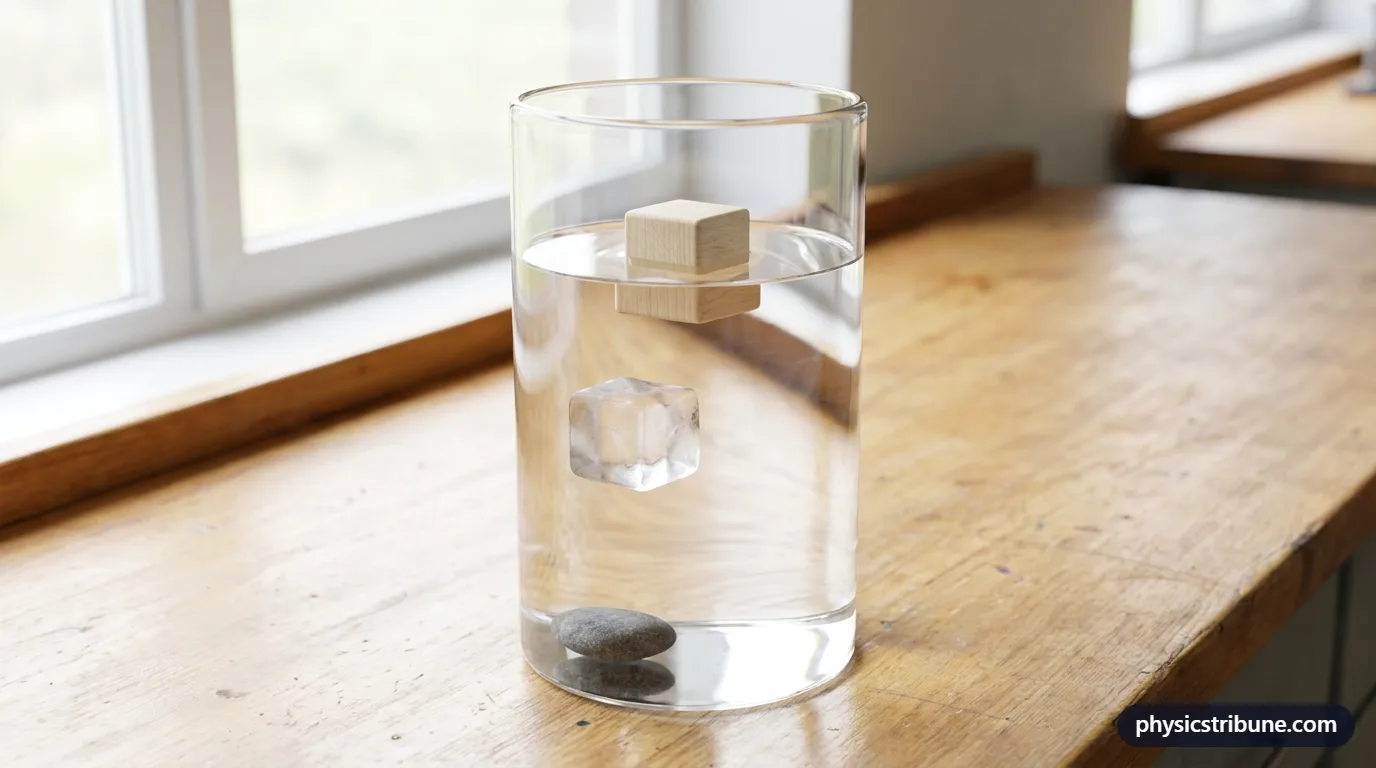
A floating object is in balance: the buoyant force equals its weight. Since the buoyant force is the weight of the displaced fluid, a floating object displaces exactly its own weight of fluid. A loaded barge sits lower than an empty one because it needs to push aside more water to carry the extra load.
Writing both weights in terms of density gives a neat rule. The fraction of the object below the surface equals its average density divided by the fluid's density. A block of wood with 60 percent of its volume submerged must be 60 percent as dense as the water. If the ratio is greater than one, no floating position exists and the object sinks. Our page on why things float or sink explores the cases, and specific gravity gives the ratio a name when the fluid is water.
Here is the floating-fraction form of Archimedes' principle with each variable and its SI unit, plus the rearranged forms for the object's density and the submerged volume.
| Symbol | Quantity | SI unit |
|---|---|---|
| submerged volume | cubic meter (m³) | |
| total volume of the object | cubic meter (m³) | |
| average density of the object | kilogram per cubic meter (kg/m³) | |
| density of the fluid | kilogram per cubic meter (kg/m³) |
Rearranged to find another variable:
Valid for: floating object in equilibrium (ρ_obj < ρ_fluid).
Example 2 How much of an ice block hides under the sea?
A block of ice with a total volume of 2.0 m³ floats in seawater. Ice has a density of about 917 kg/m³ and seawater about 1,025 kg/m³. What volume of the block lies below the waterline?
- Given:
- total volume of the object:
- average density of the object:
- density of the fluid:
- total volume of the object:
- Formula:
- Substitute:
- Answer:
Only a small slice of the block shows above the surface, which is the same reason icebergs hide most of their bulk.
Example 3 Finding the density of a floating block of wood
A wooden block with a volume of 0.0060 m³ floats in fresh water (1,000 kg/m³). Marking the waterline shows that 0.0036 m³ of the block is under the surface. What is the average density of the wood?
- Given:
- submerged volume:
- total volume of the object:
- density of the fluid:
- submerged volume:
- Formula:
- Substitute:
- Answer:
No scale is needed: the waterline alone reveals the density, a trick that hydrometers use for liquids.
| Object | Typical density (kg/m³) | In fresh water | In seawater (about 1,025 kg/m³) |
|---|---|---|---|
| Cork stopper | about 240 | 24.0% | 23.4% |
| Pine plank | about 500 | 50.0% | 48.8% |
| Wooden block from worked example 3 | 600 | 60.0% | 58.5% |
| Oak beam | about 750 | 75.0% | 73.2% |
| Ice | about 917 | 91.7% | 89.5% |
| Source: Computed with V_sub / V_obj = ρ_obj / ρ_fluid · densities are typical values · Retrieved October 2026 | |||

Who Discovered Archimedes' Principle?
The principle is named after Archimedes, the Greek mathematician and engineer who lived in Syracuse on the island of Sicily in the third century BC. He set it out in a work known as On Floating Bodies, written around 250 BC, where he treated floating objects with careful geometric proofs.
A famous story says he worked out how to test whether a king's crown was pure gold while stepping into a bath, then ran through the streets shouting "Eureka." Historians treat the tale as a legend written down long after his death, and the method in the story is not quite the one his own writings describe. Our page on Archimedes and the golden crown separates the story from the physics, and who discovered buoyancy traces the idea further.
What Are Some Examples of Archimedes' Principle?
- Ships: a steel hull displaces a large volume of water, so its average density, air included, is below that of water. See why a boat floats.
- Submarines: taking water into ballast tanks raises the average density so the boat dives; blowing it out with compressed air makes it rise.
- Icebergs and ice cubes: ice is slightly less dense than water, so it floats with most of its volume underneath. See why ice floats.
- Hot air and helium balloons: air is a fluid too, and a balloon rises when it weighs less than the air it displaces.
- Hydrometers: a weighted glass float sinks deeper in less dense liquids, letting brewers and battery technicians read density from a scale on its stem.
You can test the principle yourself with our water displacement experiment, and browse more cases in examples of buoyancy.

Going Deeper: When Does Archimedes' Principle Need Extra Care?
The principle assumes the fluid is at rest and that gravity is present. In orbit, where everything is in free fall, there is no pressure difference with depth, so a bubble in a drink does not rise; see weightlessness. In an accelerating container, such as an elevator speeding up, you replace
Very small objects can also break the simple picture. A steel needle or a water strider can rest on water even though steel is far denser, because surface tension supports them, not buoyancy alone. And if an object sits flat against the bottom with no water underneath it, the upward pressure on its lower face is missing, so the usual buoyant force does not fully act.
Finally, the fluid's density must be the right one for the depth. Seawater gets slightly denser with depth and with cold temperatures, and the atmosphere thins with height, which is why a weather balloon stops rising once the air around it becomes too thin.
How Can You Practice Archimedes' Principle Problems?
Most problems follow the same three steps: find the submerged volume, multiply by the fluid's density and
Common Misconceptions
Myth: The buoyant force equals the weight of the object.
Physics: It equals the weight of the displaced fluid. The two match only when the object floats; a sinking object weighs more than the fluid it displaces.
Myth: A heavier object always feels a bigger buoyant force.
Physics: Two objects of the same volume, fully submerged in the same fluid, feel the same buoyant force no matter how heavy each one is.
Myth: Archimedes' principle only applies to water.
Physics: It applies to every fluid, including oil, mercury and air. Air's buoyant force is small only because air has low density.
Myth: Objects deep in the ocean get pushed up harder than objects near the surface.
Physics: For an object that does not compress, the buoyant force is nearly the same at every depth, because the pressure difference between its top and bottom does not change.
Key Facts
- Archimedes' principle: the buoyant force equals the weight of the fluid displaced.
- The formula is F_B = ρ_fluid g V_displaced, with the result in newtons.
- The buoyant force depends on the fluid's density and the submerged volume, not on the object's material.
- A floating object displaces exactly its own weight of fluid.
- The fraction of a floating object under the surface equals its density divided by the fluid's density.
- The principle works in gases as well as liquids, which is why balloons can rise.
- Archimedes described it in On Floating Bodies around 250 BC.
Quick Quiz: How Well Do You Know Archimedes' Principle?
6 questions. Tap an answer to check it.
According to Archimedes' principle, the buoyant force on an object equals which of these?
The buoyant force always equals the weight of the fluid the object pushes aside.
An object with a volume of 0.002 m³ is fully submerged in fresh water (1,000 kg/m³). Using g = 9.8 m/s², what is the buoyant force?
F_B = 1,000 × 9.8 × 0.002 = 19.6 N.
A block floats in water with 30 percent of its volume submerged. What is its density?
The submerged fraction equals ρ_obj / ρ_water, so ρ_obj = 0.30 × 1,000 = 300 kg/m³.
A steel ball and an aluminum ball of the same size are fully under water. Which feels the larger buoyant force?
Equal volumes displace equal amounts of water, so the buoyant forces are equal.
Why does a ship ride slightly higher in seawater than in fresh water?
Denser fluid gives more buoyant force per cubic meter, so the ship needs to displace a smaller volume.
In which situation would Archimedes' principle give no buoyant force?
In free fall there is no pressure difference with depth, so the buoyant force disappears.
Frequently Asked Questions
What is Archimedes' principle in simple words?
Archimedes' principle says that when you put something in water or any other fluid, the fluid pushes it up with a force equal to the weight of the fluid it moved aside. If that push is at least as large as the object's weight, it floats. If the push is smaller, the object sinks, but it still feels lighter than it does in air.
What is the formula for Archimedes' principle?
The formula is F_B = ρ_fluid × g × V_displaced. F_B is the buoyant force in newtons, ρ_fluid is the density of the fluid in kilograms per cubic meter, g is the acceleration due to gravity, about 9.8 m/s² on Earth, and V_displaced is the volume of fluid pushed aside in cubic meters. For a floating object, the related rule is V_sub / V_obj = ρ_obj / ρ_fluid.
Who discovered Archimedes' principle and when?
Archimedes of Syracuse, a Greek mathematician and engineer, described the principle in his treatise On Floating Bodies around 250 BC. The exact year is unknown. The well-known bathtub story about a golden crown and the cry of Eureka was written down by later authors and is generally treated as a legend rather than history.
How does Archimedes' principle explain why ships float?
A ship's hull is shaped to enclose a large volume, most of it air. When the hull sits in water, it displaces a big volume of water, and the weight of that water equals the ship's total weight. Because the steel, cargo and air together have an average density below that of water, the ship can float with part of its hull above the surface.
Does Archimedes' principle work in air?
Yes. Air is a fluid, so every object in it is pushed up by a force equal to the weight of the air it displaces. For most objects this force is tiny compared with their weight, but for helium balloons, hot air balloons and blimps it is larger than their weight, so they rise until the surrounding air becomes thin enough to balance them.
Does the buoyant force depend on the object's density?
No. The buoyant force depends only on the fluid's density and the volume of fluid displaced. The object's density matters for a different question: whether the object floats or sinks. A fully submerged steel ball and a plastic ball of the same size feel the same buoyant force, but only the plastic ball can float.
What is apparent weight in Archimedes' principle?
Apparent weight is what a scale reads when an object hangs submerged in a fluid. It equals the object's true weight minus the buoyant force. A stone that weighs 50 N in air but displaces water weighing 20 N reads 30 N under water. Comparing the two readings is a classic way to measure an object's volume and density.
Why do you feel lighter in a swimming pool?
Your body displaces water whose weight is close to your own weight, because the human body's average density is close to that of water. The water pushes up with that force, so your muscles and joints carry very little load. That is why swimming and water exercise are gentle on the body, and why taking a deep breath helps you float.
Keep Exploring








Sources
Constants come from NIST CODATA 2022 (public domain) and unit definitions from the BIPM SI Brochure (CC BY 4.0). Text, diagrams and illustrations are original work by Physics Tribune.