At a Glance
Things float when their average density is lower than the fluid's density and sink when it is higher. A floating object sinks only until the buoyant force equals its weight, so the fraction underwater equals ρ_object / ρ_fluid.
- Floats when
- Average density of the object is lower than the fluid density
- Sinks when
- Average density of the object is higher than the fluid density
- Fraction submerged
- Vsub / Vobj = ρobj / ρf
- Key forces
- Weight (down) and buoyant force (up)
- Water as reference
- Fresh water about 1,000 kg/m³, seawater about 1,025 kg/m³
- Does not depend on
- Size or total weight alone; only the density comparison
On this page
- What Decides Whether Something Floats or Sinks?
- Floating and Sinking Explained Simply
- How Does Density Predict Floating and Sinking?
- How Much of a Floating Object Is Underwater?
- What Forces Act on Floating and Sinking Objects?
- How Do Heavy Steel Ships Float?
- How Can Something Switch Between Floating and Sinking?
- What Are Everyday Examples of Floating and Sinking?
- How Can You Test Floating and Sinking at Home?
- Practice Floating and Sinking Problems
- Common Misconceptions
- Key Facts
- Quiz
- FAQ
What Decides Whether Something Floats or Sinks?
Two forces act on anything placed in water. Its weight pulls it down, and the buoyant force from the water pushes it up. The buoyant force equals the weight of the water the object pushes aside, so the deeper the object sits, the more water it displaces and the larger the upward push becomes.
If the buoyant force can grow to match the weight while part of the object is still above the surface, the object stops sinking and floats. If even full submersion does not displace enough water to match the weight, nothing can stop it and it sinks to the bottom. An object whose weight exactly equals the buoyant force when fully underwater hovers in place, a state called neutral buoyancy.
This comparison does not care whether the object is big or small, heavy or light. A huge log floats, while a tiny pebble sinks, and the reason is density.
Floating and Sinking Explained Simply
Think of water as a crowd that wants its space back. When you push a beach ball under the surface, the water shoves it back up hard. The ball is mostly air, so it is very light for the amount of space it takes up.
A marble takes up only a little space but is packed with heavy glass. The water can only push back with the weight of a marble-sized blob of water, which is less than the marble's weight, so down it goes.
So the question to ask is not "how heavy is it?" but "how heavy is it for its size?" That ratio of mass to volume is called density. Lighter than water for its size means it floats; heavier means it sinks.
How Does Density Predict Floating and Sinking?
Density is mass divided by volume,
The word average matters. A hollow object counts the air or empty space inside as part of its volume. That is how a steel can with its lid sealed can bob on water while a solid steel bolt sinks. The table lists typical densities of common materials and what they do in fresh water.
Many people compare an object's density with water using specific gravity, a pure number found by dividing by the density of water. Our page on specific gravity explains it, and the density calculator works out density from any mass and volume.
Example 3 Will the toy float in the bath?
A hollow plastic bath toy has a mass of 0.15 kg and encloses a total volume of 0.0002 m³, counting the air inside. What is its average density, and will it float in fresh water at 1,000 kg/m³?
- Given:
- mass:
- volume:
- mass:
- Formula:
- Substitute:
- Answer:
The answer is below 1,000 kg/m³, so the toy floats even though solid plastic of the same kind would sink.
| Material | Typical density (kg/m³) | In fresh water | Share underwater if floating |
|---|---|---|---|
| Cork | about 240 | Floats | about 24% |
| Pine wood | about 500 | Floats | about 50% |
| Candle wax | about 900 | Floats | about 90% |
| Polypropylene plastic | about 905 | Floats | about 91% |
| Ice | about 917 | Floats | about 92% |
| PET plastic (bottle material) | about 1,380 | Sinks | Fully submerged |
| Aluminum | about 2,700 | Sinks | Fully submerged |
| Steel | about 7,850 | Sinks | Fully submerged |
| Gold | about 19,300 | Sinks | Fully submerged |
| Source: Densities are typical room-temperature values; share underwater computed as ρ_object / ρ_water · Retrieved October 2026 | |||
How Much of a Floating Object Is Underwater?
A floating object sinks until it displaces its own weight of fluid. Setting weight equal to buoyant force gives
A block of pine at about 500 kg/m³ floats half submerged in fresh water. Ice at about 917 kg/m³ floats with roughly 92 percent below the surface of fresh water and about 89 percent below the surface of seawater; we computed both from the density ratio. That is the physics behind the phrase "tip of the iceberg."
The same rule works in reverse. Measure how deep something floats, and you can work out its density, as the second worked example shows.
For any floating object, the share of its volume below the surface equals the ratio of its average density to the fluid density.
| Symbol | Quantity | SI unit |
|---|---|---|
| submerged volume | cubic meter (m³) | |
| total volume of the object | cubic meter (m³) | |
| average density of the object | kilogram per cubic meter (kg/m³) | |
| density of the fluid | kilogram per cubic meter (kg/m³) |
Rearranged to find another variable:
Valid for: floating object in equilibrium (ρ_obj < ρ_fluid).
Example 1 An ice cube in a glass of water
An ice cube has a volume of 0.00003 m³ (30 cm³) and floats in fresh water. Ice has a density of about 917 kg/m³ and fresh water 1,000 kg/m³. What volume of the cube sits below the waterline?
- Given:
- total volume of the object:
- average density of the object:
- density of the fluid:
- total volume of the object:
- Formula:
- Substitute:
- Answer:
Only a thin slice of the cube rises above the surface. Because the floating cube already displaces its own weight of water, its meltwater exactly fills that displaced volume, so a glass filled to the brim with ice water does not overflow as the ice melts.
Example 2 Finding the density of a floating wooden block
A wooden block with a total volume of 0.002 m³ floats in fresh water (1,000 kg/m³) with 0.0012 m³ of its volume underwater. What is the average density of the wood?
- Given:
- density of the fluid:
- submerged volume:
- total volume of the object:
- density of the fluid:
- Formula:
- Substitute:
- Answer:
Measuring how deep something floats is a quick, gentle way to find its density without cutting or weighing it.
What Forces Act on Floating and Sinking Objects?
For a floating object the forces balance exactly. The first diagram shows a ball resting at the surface with 60 percent of its height underwater: weight and buoyant force are equal and opposite, so the net force is zero and the ball stays put.
For a sinking object the buoyant force has already reached its maximum, the full volume of the object, and still falls short of the weight. The second diagram shows a 30 N block that receives only 20 N of buoyant force. The 10 N difference is a net downward force, so the block accelerates down until water resistance and finally the bottom stop it.
To calculate the buoyant force in your own problems, use the buoyant force formula,


How Do Heavy Steel Ships Float?
Steel is nearly eight times denser than water, so a solid steel block sinks at once. A ship, however, is a thin steel shell wrapped around a huge volume of air. Its average density, counting everything inside the hull, ends up well below that of seawater.
As cargo is loaded, the ship's weight rises and it settles deeper, displacing more water until the buoyant force catches up. Ships carry painted load lines on the hull to show the deepest safe level, because a ship that sits too low can be swamped by waves. If water floods the hull, it replaces the air, the average density climbs above that of seawater and the ship sinks.
For a step-by-step answer focused on boats, see why does a boat float.

How Can Something Switch Between Floating and Sinking?
Anything that changes an object's average density, or the fluid's density, can flip the result:
- Submarines pump seawater into ballast tanks to raise their average density and dive, then blow the water out with compressed air to rise.
- Many fish adjust the gas in a swim bladder to hover at a chosen depth without swimming.
- Divers wear weights and inflate or deflate a vest to reach neutral buoyancy.
- An egg sinks in fresh water but floats once enough salt is stirred in, because the salty water becomes denser than the egg.
- Hot-air and helium balloons float in the air for the same reason: their average density is below that of the surrounding air, as our page on why balloons float explains.
What Are Everyday Examples of Floating and Sinking?
Ice cubes float in a drink because water expands when it freezes, making ice less dense than liquid water; read why does ice float for the molecular reason. Oil forms a layer on top of vinegar in salad dressing because it is the less dense liquid. A swimmer who breathes in deeply floats more easily, since the extra air in the lungs lowers the body's average density.
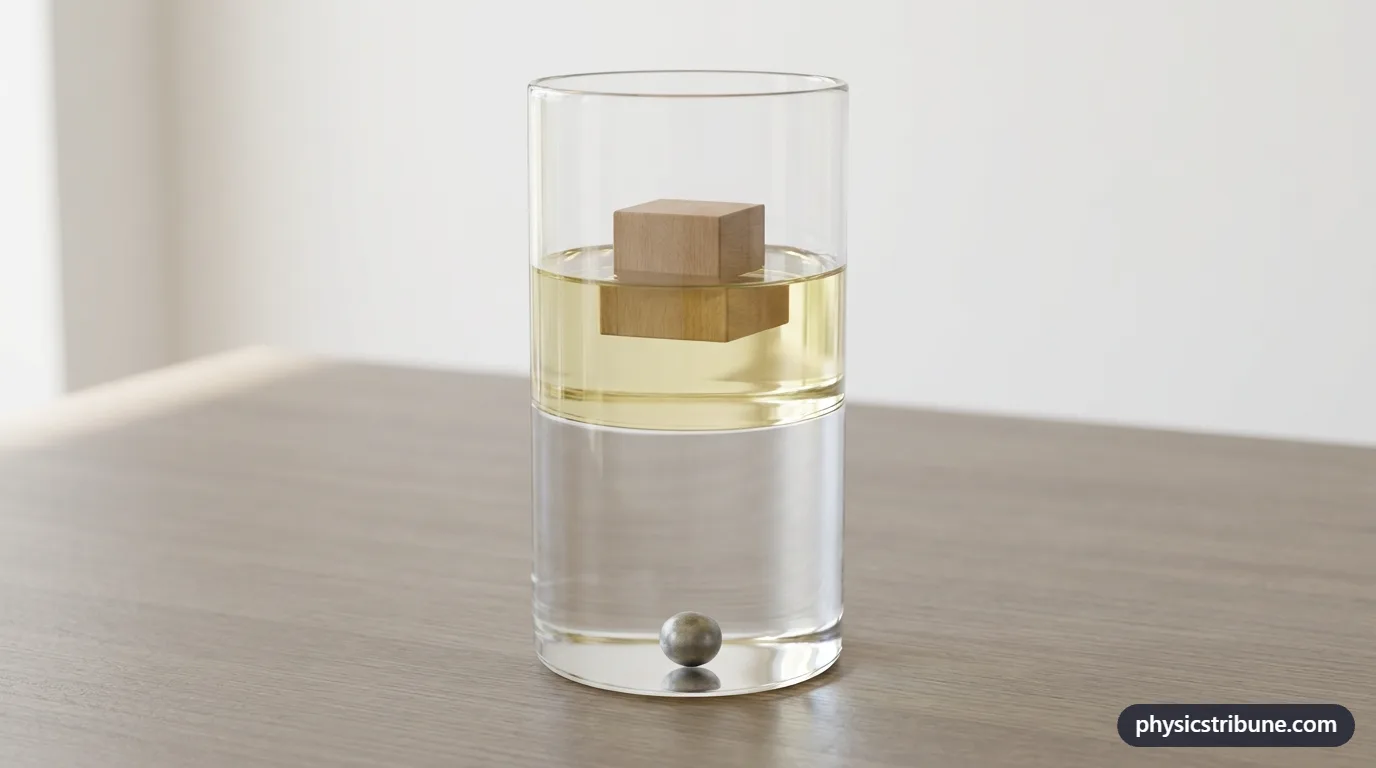
Liquids can float on each other too. Pour honey, water and oil carefully into a tall glass and they settle into layers, densest at the bottom. Small objects dropped in will stop at the layer that matches their density. Our examples of buoyancy list many more cases from nature and engineering.
How Can You Test Floating and Sinking at Home?
Fill a clear container with tap water and gather small objects: a coin, a grape, a cork, a plastic bottle cap, a crayon and a piece of fruit. Predict each result, then test it. Afterward, stir several spoonfuls of salt into the water and retest the ones that sank. A few, such as a grape or an egg, may now float.
For a more precise version, find each object's density by measuring the water it displaces, a method shown in our density of irregular objects experiment. Younger students will enjoy the simpler activities on floating and sinking for kids.
Practice Floating and Sinking Problems
Work through the printable buoyancy worksheets and density worksheets, both with answer keys. For the law behind it all, read Archimedes' principle and the story of Archimedes himself. Then test yourself with the quiz below.
Common Misconceptions
Myth: Heavy objects sink and light objects float.
Physics: Weight alone does not decide it. A cruise ship weighing many thousands of tonnes floats while a small coin sinks, because what matters is density, the mass for each unit of volume.
Myth: Big objects float and small ones sink.
Physics: Size does not decide it either. A grain of sand sinks and a large log floats, but a large boulder sinks and a tiny cork crumb floats.
Myth: Objects float because they contain air.
Physics: Air often helps by lowering the average density, but solid wood, wax and ice float with no trapped air at all.
Myth: There is no buoyant force on an object that sinks.
Physics: A sinking object still receives a buoyant force equal to the weight of the water it displaces; that force is simply smaller than its weight.
Key Facts
- An object floats if its average density is lower than the fluid's density and sinks if it is higher.
- A floating object displaces a weight of fluid equal to its own weight.
- The fraction of a floating object below the surface equals ρ_object divided by ρ_fluid.
- Ice floats with about 92 percent of its volume below the surface of fresh water.
- Ships float because the air inside the hull lowers their average density below that of seawater.
- Submarines, fish and divers control buoyancy by changing their average density.
- Adding salt raises water's density, so some objects that sink in fresh water float in salt water.
Quick Quiz: How Well Do You Know Why Things Float or Sink?
6 questions. Tap an answer to check it.
An object will float in water if its average density is:
Objects less dense than the fluid float; denser ones sink.
A block floats with 70% of its volume underwater in fresh water. What is its density?
The fraction submerged equals ρ_object / ρ_water, so 0.7 × 1,000 = 700 kg/m³.
Why does a steel ship float?
The large volume of air in the hull makes the ship's average density lower than seawater.
What happens to an egg that sinks in fresh water when you dissolve plenty of salt in the water?
Salt raises the water's density, which increases the buoyant force on the egg.
A 30 N block receives a 20 N buoyant force when fully submerged. What happens?
Weight exceeds the maximum buoyant force by 10 N, so the block sinks.
How do submarines dive?
Taking in water makes the submarine denser than seawater, so it sinks.
Frequently Asked Questions
Why do some things float and others sink?
It comes down to density, which is how much mass is packed into each bit of volume. Water pushes up on any object with a force equal to the weight of the water the object pushes aside. If the object is less dense than water, that push can match its weight before it is fully underwater, so it floats. If it is denser, it sinks.
What makes an object float?
An object floats when the buoyant force from the fluid equals its weight while part of it remains above the surface. That happens whenever its average density, counting any air or hollow space inside, is lower than the fluid's density. The object settles at the depth where it has displaced exactly its own weight of fluid and then stays there.
Does the shape of an object affect whether it floats?
Shape matters only because it can change the average density. A lump of modeling clay sinks, but the same clay shaped into a wide, thin-walled boat encloses air and displaces much more water, so it floats. Shape also affects how stable a floating object is, which is why boats have wide, low hulls rather than tall narrow ones.
Why does an object float better in salt water?
Salt water is denser than fresh water, about 1,025 kg/m³ for typical seawater compared with 1,000 kg/m³. A denser fluid gives a larger buoyant force for the same displaced volume, so floating objects sit a little higher and some objects that sink in fresh water can float in very salty water.
Why do steel ships float when steel sinks?
A ship is not solid steel. Its hull is a shell surrounding a huge volume of air, cargo space and cabins, so the average density of the whole ship is lower than seawater. The ship sinks into the water until it has pushed aside its own weight of seawater. If the hull fills with water, the average density rises and the ship goes down.
What is neutral buoyancy?
Neutral buoyancy means an object has the same average density as the fluid around it, so the buoyant force exactly equals its weight even when fully submerged. It neither rises nor sinks and can hover at any depth. Scuba divers, submarines and many fish adjust their density to reach this state so they can stay at a chosen depth without effort.
Do heavier objects sink faster?
For objects of the same size and shape, a denser one generally sinks faster because the difference between its weight and the buoyant force is larger, and water resistance grows with speed until the forces balance. However, a heavy object that is less dense than water does not sink at all, so weight alone cannot predict sinking.
Why does a person float more easily after taking a deep breath?
Filling your lungs with air increases your body's volume without adding noticeable mass, so your average density drops. Most people have an average density close to that of water, so this small change is enough to tip the balance. Breathing out raises your density again, which is why you may slowly sink after exhaling in a pool.