
At a Glance
Static friction keeps a resting object from sliding and can grow up to f_s,max = μs N. Kinetic friction acts on an object that is already sliding and equals f_k = μk N. Because μk is usually smaller than μs, it takes more force to start a heavy object moving than to keep it moving.
- Static friction
- Surfaces at rest relative to each other, 0 ≤ f_s ≤ μs N
- Kinetic friction
- Surfaces sliding, f_k = μk N
- Which is larger?
- Maximum static friction, for most material pairs
- Shared SI unit
- newton (N); μs and μk have no unit
- Direction
- Both act along the surface, opposing slipping
On this page
- What Is the Difference Between Static and Kinetic Friction?
- How Are Static and Kinetic Friction Defined?
- What Are the Formulas for Static and Kinetic Friction?
- Why Is Static Friction Greater Than Kinetic Friction?
- What Happens When You Push Harder and Harder?
- What Are Examples of Static and Kinetic Friction?
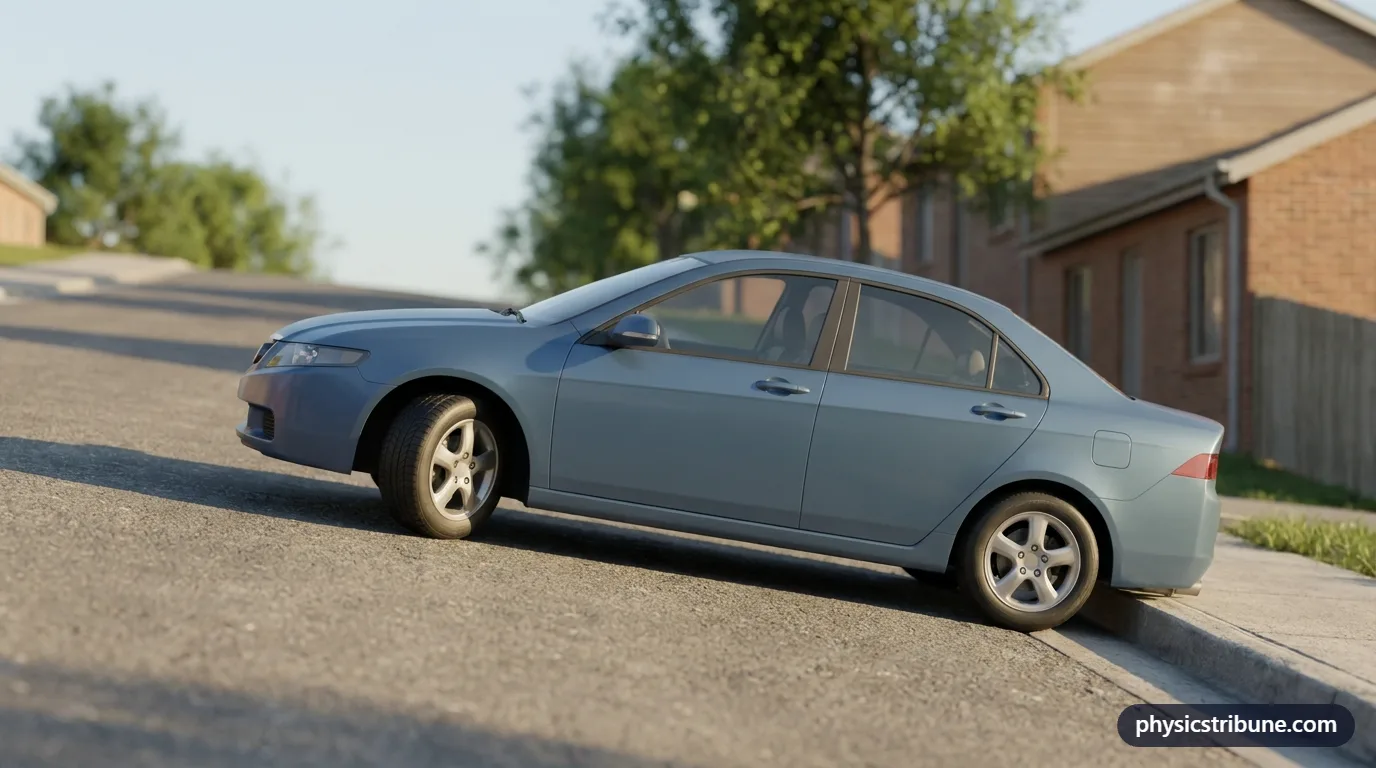
- Why Does It Matter for Braking and Slopes?
- Who Studied Static and Kinetic Friction?
- Common Misconceptions
- Key Facts
- Quiz
- FAQ
What Is the Difference Between Static and Kinetic Friction?
Both kinds of friction are contact forces that act along the surface where two objects touch, and both oppose slipping. The difference is the state of the contact. Static friction works while the surfaces are locked together, with no sliding between them. Kinetic friction, sometimes called sliding or dynamic friction, takes over the moment one surface starts to slide across the other.
The two forces also behave differently. Static friction is flexible: it grows to match whatever sideways push you apply, from zero up to a ceiling. Kinetic friction is close to a fixed value for a given pair of surfaces and a given normal force, whether the object slides slowly or quickly.
The table below compares them feature by feature. For the bigger picture of friction, including rolling and fluid friction, start at our friction guide.
| Feature | Static friction | Kinetic friction |
|---|---|---|
| When it acts | Surfaces in contact, not sliding | Surfaces sliding over each other |
| Formula | f_s ≤ μs N, maximum f_s,max = μs N | f_k = μk N |
| Size | Variable, from zero up to the maximum | Roughly constant for given surfaces and N |
| Coefficient | μs (static) | μk (kinetic) |
| Usually larger? | Yes, its maximum is larger for most pairs | No, usually smaller than μs N |
| Direction | Opposes the motion that would happen without it | Opposite to the direction of sliding |
| Depends on speed? | No speed involved | Only weakly at ordinary speeds |
| Depends on contact area? | Very little, for dry rigid surfaces | Very little, for dry rigid surfaces |
| Energy effect | No energy turned into heat at the contact | Turns kinetic energy into heat |
| Can it speed objects up? | Yes, it drives walking and car tires | It can drag a slower object along with a faster one |
| On a free-body diagram | f_s, any size up to its limit | f_k, a fixed size |
| Everyday example | A parked car holding still on a hill | A sled skidding to a stop |
| Source: Definitions as used in standard SI mechanics; formulas from our formula data set (data/formulas.json) · Retrieved October 2026 | ||
How Are Static and Kinetic Friction Defined?
Static friction is the force that prevents two surfaces in contact from starting to slide past each other. A coffee mug on a tilted tray, a ladder leaning on a wall and your shoe planted on a sidewalk all rely on it. Its size is whatever is needed to cancel the other sideways forces, so a mug on a level tray feels no static friction at all.
Kinetic friction is the force that resists the motion of two surfaces already sliding against each other. A hockey puck slowing on the ice, a sled skidding to a stop and a book shoved across a desk all experience it. It always points opposite to the direction of sliding, and it turns some of the motion's energy into heat.
Notice that "static" describes the contact, not the object. A box riding on the bed of a moving truck is traveling at highway speed, yet the friction holding it in place is static, because the box and the truck bed are not slipping relative to each other.
What Are the Formulas for Static and Kinetic Friction?
Static friction is described by an inequality,
In both formulas
The two worked examples below use the same crate, so you can see the gap between starting and sliding. To solve either formula for any variable, use our friction calculator.
Here is the maximum static friction formula with each variable and its SI unit; the kinetic version has the same shape with μk in place of μs.
| Symbol | Quantity | SI unit |
|---|---|---|
| maximum static friction force | newton (N) | |
| coefficient of static friction | dimensionless (1) | |
| normal force | newton (N) |
Rearranged to find another variable:
Valid for: static friction can take any value 0 ≤ f_s ≤ μs N; this is the threshold just before sliding.
Example 1 How hard to push a resting crate
A 40 kg wooden crate sits on a warehouse floor, which pushes up on it with a normal force of 392.4 N. The coefficient of static friction between crate and floor is 0.6. What is the largest friction force the floor can supply before the crate starts to slide?
- Given:
- coefficient of static friction:
- normal force:
- coefficient of static friction:
- Formula:
- Substitute:
- Answer:
Any push smaller than this value is matched exactly by static friction, so the crate does not budge.
Example 2 Keeping the same crate moving
Once the crate from the first example is sliding, the coefficient of kinetic friction is 0.4 and the normal force is still 392.4 N. What kinetic friction force acts on the sliding crate?
- Given:
- coefficient of kinetic friction:
- normal force:
- coefficient of kinetic friction:
- Formula:
- Substitute:
- Answer:
A steady push of this size keeps the crate gliding at constant velocity, which is why the job feels easier once the crate breaks loose.
Why Is Static Friction Greater Than Kinetic Friction?
Even polished surfaces are rough at the microscopic scale. When two surfaces rest together, only the tips of their tiny bumps actually touch, and at those contact points the materials press so hard that they partly bond. Given a little time at rest, the contact spots settle and grow, so the bond gets stronger.
To start sliding, you must shear all of those settled contacts at once. Once the surfaces are moving, the bumps skip from one contact to the next without time to settle in, so the average grip is weaker. That is the main reason the coefficient of static friction is usually larger than the coefficient of kinetic friction for the same pair of materials.
The size of the gap varies a lot. For rubber on dry pavement the two values are fairly close, while for some metals in clean contact the static value can be noticeably larger. A few material pairs, such as some lubricated or very slippery plastics, show almost no gap at all.
What Happens When You Push Harder and Harder?
Imagine pushing the 40 kg crate from the worked examples with a slowly growing force. At 50 N, static friction answers with 50 N and the crate stays put. At 150 N, it answers with 150 N. The friction force rises in step with your push, so the net force stays zero.
At about 235 N (computed from
On a graph of friction force against applied force, this appears as a straight rising line, a peak at the breakaway point, then a sudden drop to a flat line. The free-body diagram below shows the sliding stage, with the push larger than kinetic friction.

What Are Examples of Static and Kinetic Friction?
Static friction is at work whenever something grips without slipping:
- Car tires rolling normally on a road, because the patch of tire touching the road is momentarily at rest on it.
- Your feet pushing backward on the ground as you walk.
- A parked bike staying put on a gently sloping driveway.
- A knot holding in a rope, and a nail holding in a board.
Kinetic friction is at work whenever surfaces rub as they slide:
- A skidding car with locked wheels.
- A curling stone gliding across the ice and slowly losing speed.
- Sandpaper rubbing across a wooden shelf.
- A child sliding down a playground slide.
More everyday cases, sorted by type, are collected on our friction examples page.
Why Does It Matter for Braking and Slopes?
Anti-lock brakes exist because of the gap between the two coefficients. A tire that keeps rolling grips the road with static friction, which can be larger than the kinetic friction of a skidding tire. With a typical dry-road static coefficient of about 0.9, the best possible deceleration is roughly 8.8 m/s², but a skid with a kinetic coefficient near 0.7 gives only about 6.9 m/s² (both computed as
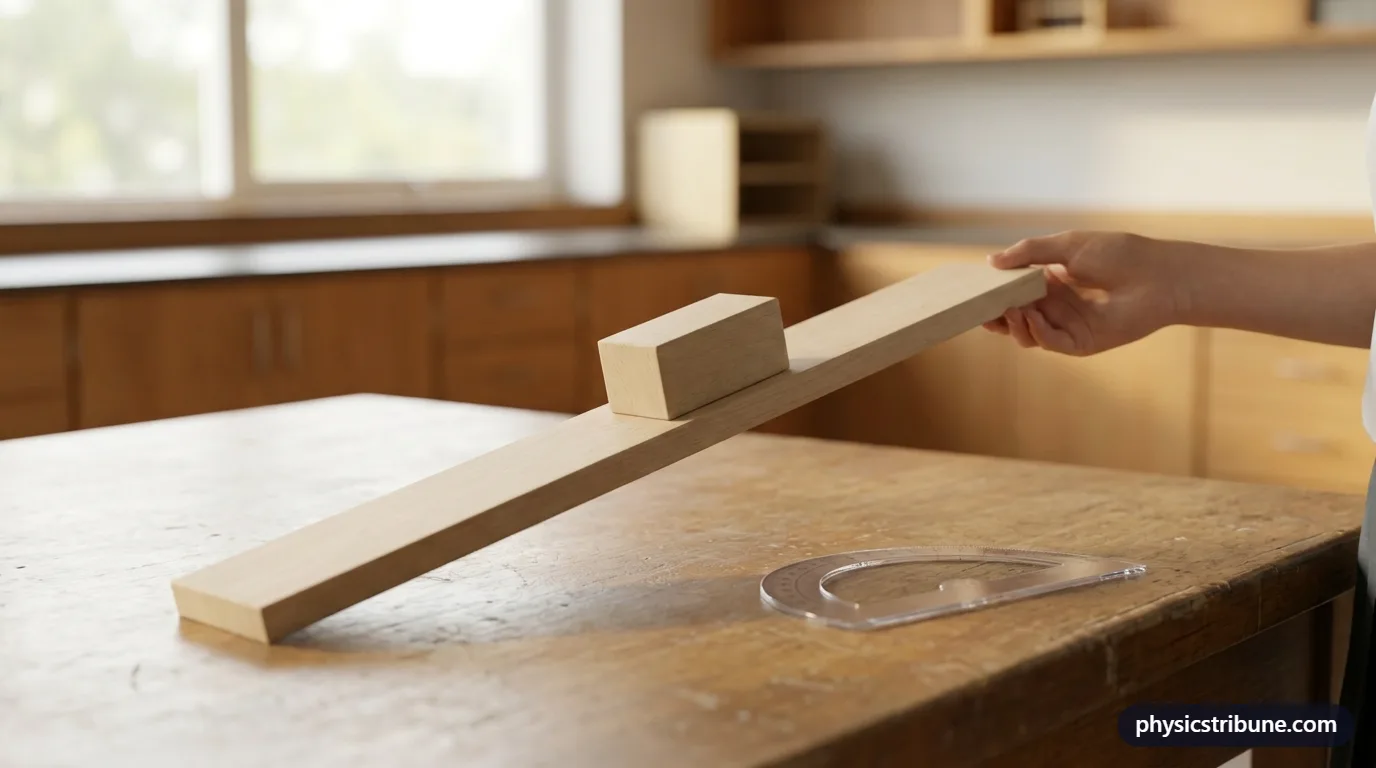
Slopes show the same split. An object rests on a ramp as long as the downhill part of its weight is smaller than the maximum static friction. The steepest angle it can rest at satisfies

Who Studied Static and Kinetic Friction?
The basic rules of dry friction, that it is proportional to the normal force and largely independent of the contact area, were worked out by experimenters in the 1600s and 1700s. The French engineer Charles-Augustin de Coulomb, better known for his law of electric force, ran careful tests on wood and metal in the late 1700s. He noted that friction at rest builds up over time and that sliding friction depends only weakly on speed, which is why dry friction is still sometimes called Coulomb friction.
To practice telling the two forces apart, try our friction worksheets, which include free-body diagrams and answer keys, then check yourself with the quiz below.
Common Misconceptions
Myth: Static friction always equals μs N.
Physics: μs N is only the maximum. Static friction takes whatever value is needed to stop slipping, and a resting object with no sideways push feels no static friction at all.
Myth: Static friction only acts on objects that are not moving.
Physics: It acts on any contact that is not slipping. A rolling tire and a box riding in a moving truck both rely on static friction while traveling fast.
Myth: Kinetic friction gets much bigger the faster an object slides.
Physics: For dry surfaces at everyday speeds, kinetic friction is nearly independent of speed. Speed-dependent drag comes from air or liquids, which is fluid friction.
Myth: A wider surface always means more friction.
Physics: For dry, rigid surfaces friction depends on the normal force and the materials, and only very slightly on the apparent contact area. Tires are wide mainly for heat, wear and grip on soft or wet roads.
Key Facts
- Static friction acts between surfaces that are not sliding; kinetic friction acts between surfaces that are sliding.
- Static friction adjusts to the applied force, from zero up to a maximum of μs N.
- Kinetic friction has a nearly constant value, f_k = μk N, for a given pair of surfaces.
- For most materials μs is larger than μk, so starting an object moving takes more force than keeping it moving.
- Both friction forces are measured in newtons, and both coefficients are unitless numbers.
- Rolling tires and walking feet rely on static friction, not kinetic friction.
- The steepest slope an object can rest on without sliding satisfies tan θ = μs.
Quick Quiz: How Well Do You Know Static vs Kinetic Friction?
6 questions. Tap an answer to check it.
A bookcase sits on the floor and nobody is pushing it sideways. How much static friction acts on it?
With no sideways push there is nothing to oppose, so static friction is zero.
Which statement is usually true for the same pair of surfaces?
Resting contacts grip more strongly, so the static coefficient is usually larger.
A car accelerates without its tires slipping. Which friction pushes it forward?
The tire contact is not sliding on the road, so the forward force is static friction.
A sliding box has a normal force of 200 N and μk = 0.25. What is the kinetic friction force?
f_k = μk N = 0.25 × 200 N = 50 N.
A crate needs 300 N to start moving but only 220 N to keep moving at constant velocity. Why?
The 300 N push beats the static maximum, then only the smaller kinetic friction must be matched.
Which type of friction turns kinetic energy into heat at the contact?
Only sliding surfaces rub and heat up; static contacts do not slip.
Frequently Asked Questions
What is the difference between static and kinetic friction?
Static friction acts between two surfaces that are touching but not sliding, and it can take any value up to a maximum of μs N. Kinetic friction acts once the surfaces slide past each other, and it has a nearly fixed value of μk N. Static friction prevents motion from starting, while kinetic friction resists motion that is already happening.
Is static friction always greater than kinetic friction?
The maximum static friction is greater than kinetic friction for almost every common pair of materials, because resting contacts have time to settle and bond more strongly. Static friction at any given moment can be smaller, though, since it only matches the applied force. A box nudged with 5 N feels just 5 N of static friction, which may be far less than the kinetic value.
Why is it harder to start pushing something than to keep it moving?
To start an object moving, your push must exceed the maximum static friction, μs N. Once it slides, only kinetic friction, μk N, opposes it, and μk is usually smaller. So the force needed drops as soon as the object breaks loose. You can feel this when shoving furniture: the first heave is the hardest, then a steadier push keeps it going.
Which type of friction acts on a rolling wheel?
A wheel rolling without skidding uses static friction, because the part of the tire touching the road is momentarily at rest relative to the road. The wheel also feels a small rolling resistance from the tire flexing. If the wheel locks and skids, the contact switches to kinetic friction, which is usually weaker and makes steering impossible.
What is the coefficient of static and kinetic friction?
A coefficient of friction is a unitless number that tells how strongly two particular materials grip each other. The static coefficient, μs, sets the maximum friction before sliding starts, and the kinetic coefficient, μk, sets the friction during sliding. They are measured by experiment for each pair of surfaces, and typical values run from a few hundredths for ice up to about one for rubber on dry pavement.
Can kinetic friction be greater than static friction?
For ordinary dry surfaces it is very rare for kinetic friction to exceed the maximum static friction. Some lubricated contacts and a few special materials show nearly equal values, and in unusual conditions the sliding value can creep slightly higher. In school and introductory college physics you can safely assume μk is smaller than or equal to μs.
Does static friction do work?
Static friction does no work at the contact point, because the surfaces do not slide relative to each other there, so no energy is lost as heat. It can still help transfer energy within a system. When a car accelerates, static friction from the road acts on the tires, while the energy actually comes from the engine through the drive shaft.
How do you know whether to use static or kinetic friction in a problem?
Ask whether the surfaces are sliding against each other. If the problem says an object is at rest, about to move or rolling without slipping, use static friction and remember it is at most μs N. If the object is sliding, skidding or moving at constant velocity across a surface, use kinetic friction, f_k = μk N, as a fixed value.
Keep Exploring







Sources
Constants come from NIST CODATA 2022 (public domain) and unit definitions from the BIPM SI Brochure (CC BY 4.0). Text, diagrams and illustrations are original work by Physics Tribune.