At a Glance
Static friction is the force that stops two touching surfaces from starting to slide. It adjusts to match the applied force, from zero up to a ceiling of f_s,max = μs N, with μs set by the two materials and N the force pressing them together. Once the push exceeds that limit, the object starts to slide.
- Symbol
- fs (maximum fs,max)
- SI unit
- newton (N)
- Formula
- fs ≤ μsN, so fs,max = μsN
- Scalar or vector
- Vector, along the surface, opposing the tendency to slide
- Depends on
- The two materials (μs) and the normal force, not the contact area
- Compared with kinetic
- Usually larger: μs > μk for most surface pairs
On this page
- What Is Static Friction?
- Static Friction Explained Simply
- What Is the Formula for Static Friction?
- How Does Static Friction Change as You Push Harder?
- What Causes Static Friction?
- Which Way Does Static Friction Point?
- What Are Examples of Static Friction in Everyday Life?
- Why Is Static Friction Important for Cars?
- How Is Static Friction Different From Kinetic Friction?
- Practice Static Friction Problems
- Common Misconceptions
- Key Facts
- Quiz
- FAQ
What Is Static Friction?
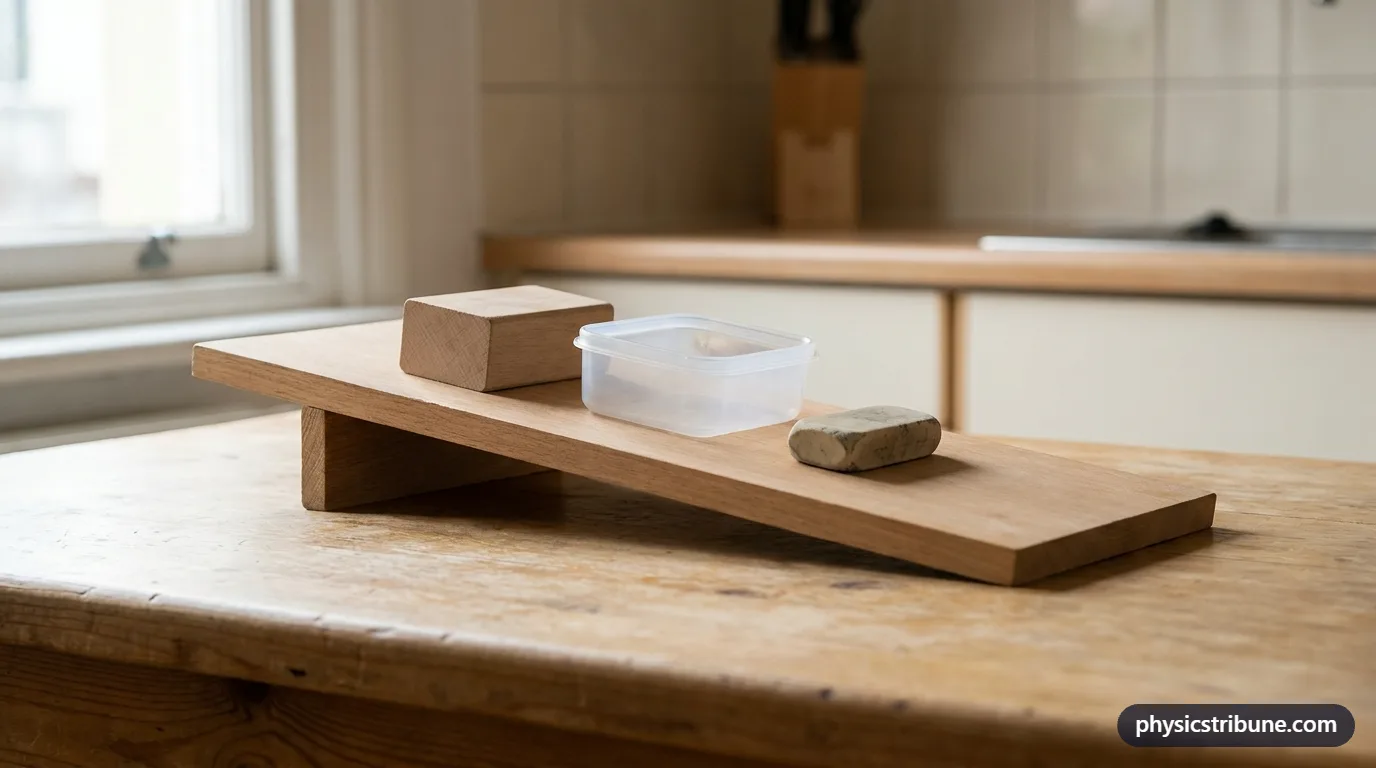
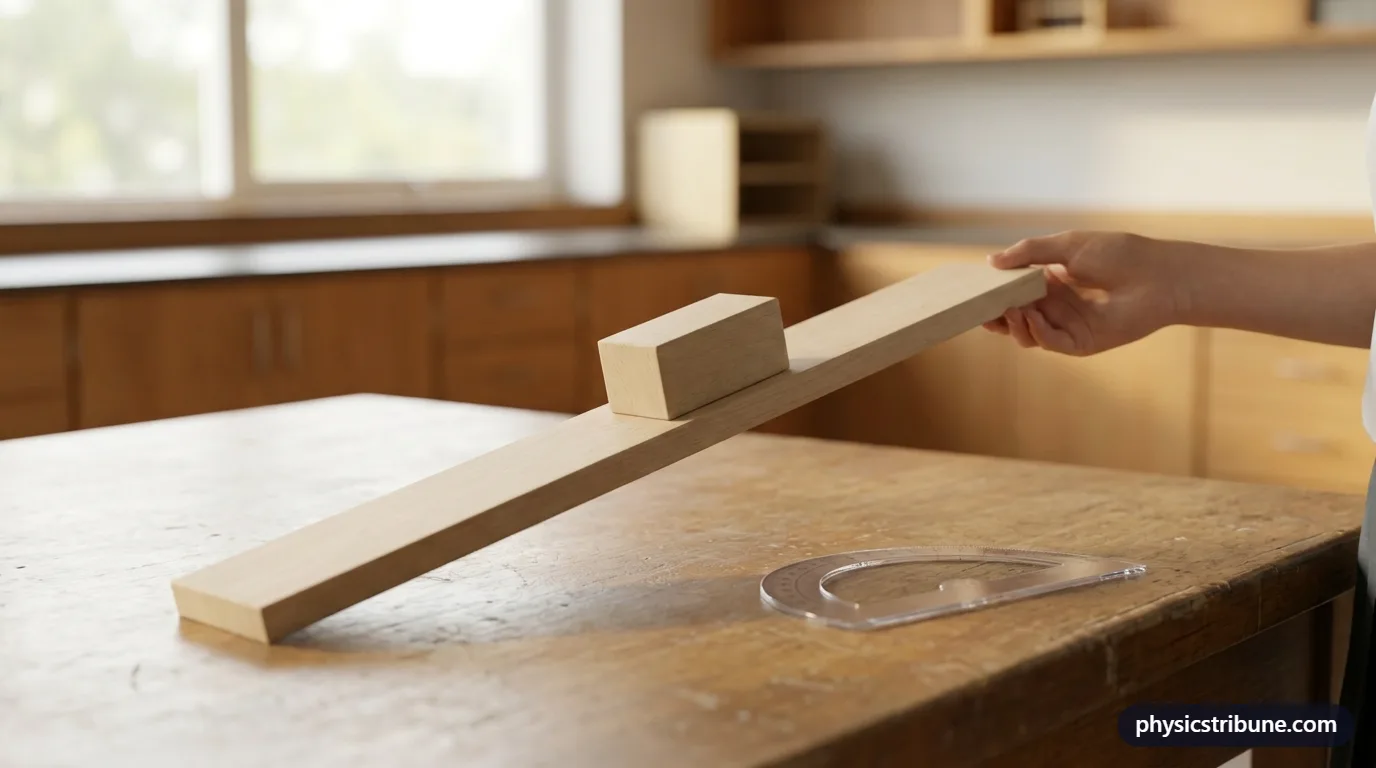
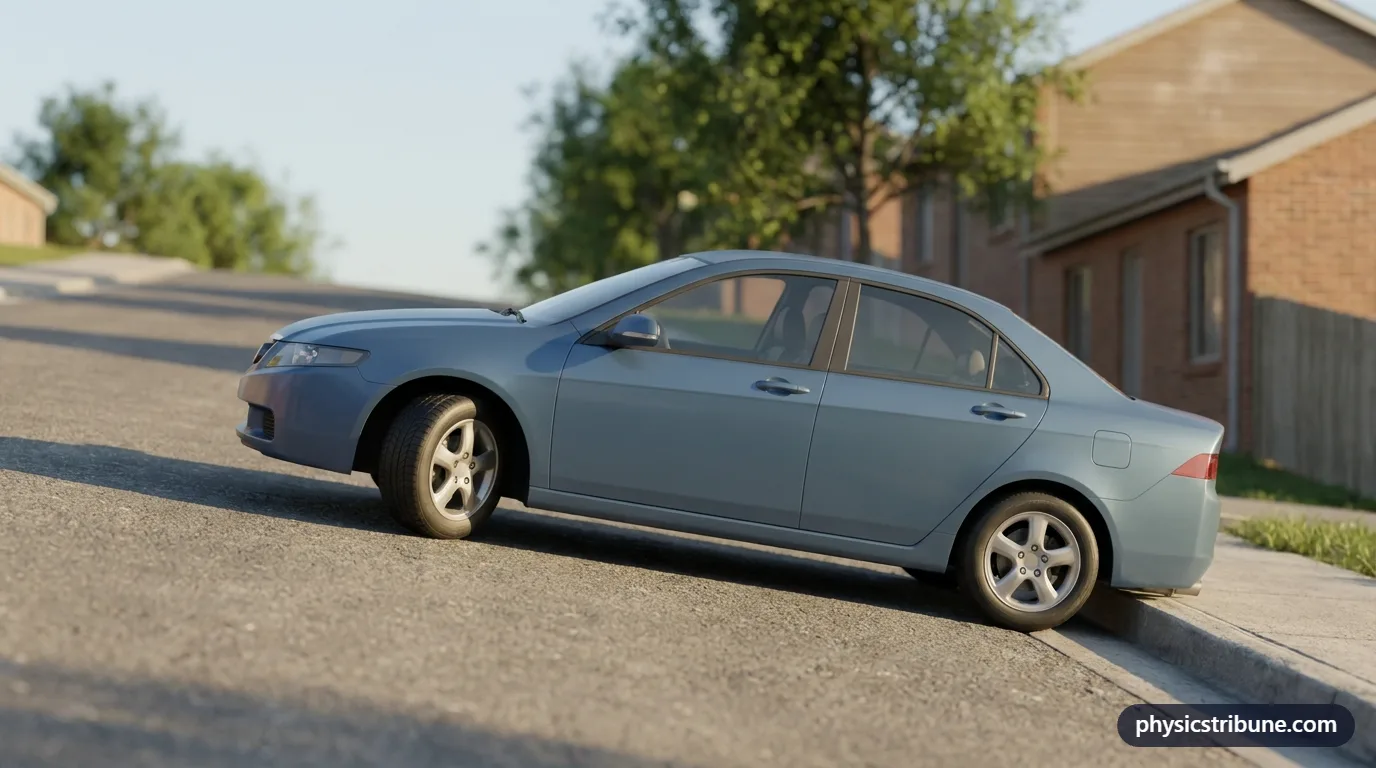
Static friction is the grip between two surfaces that are touching but not slipping past each other. A parked car on a hill, a mug resting on a tilted tray and your shoe planted on a sidewalk are all held in place by it. Without static friction, any tiny sideways push would set objects sliding.
Like all friction, static friction acts along the surface where the two objects touch. It points opposite to the direction the object would slide if friction suddenly vanished. It is one type of the broader force of friction, and it is a contact force measured in newtons.
What makes static friction special is that it has no single fixed value. It is a responsive force that grows and shrinks to cancel whatever is trying to start the motion, but only up to a ceiling. That ceiling is what the static friction formula calculates.
Static Friction Explained Simply
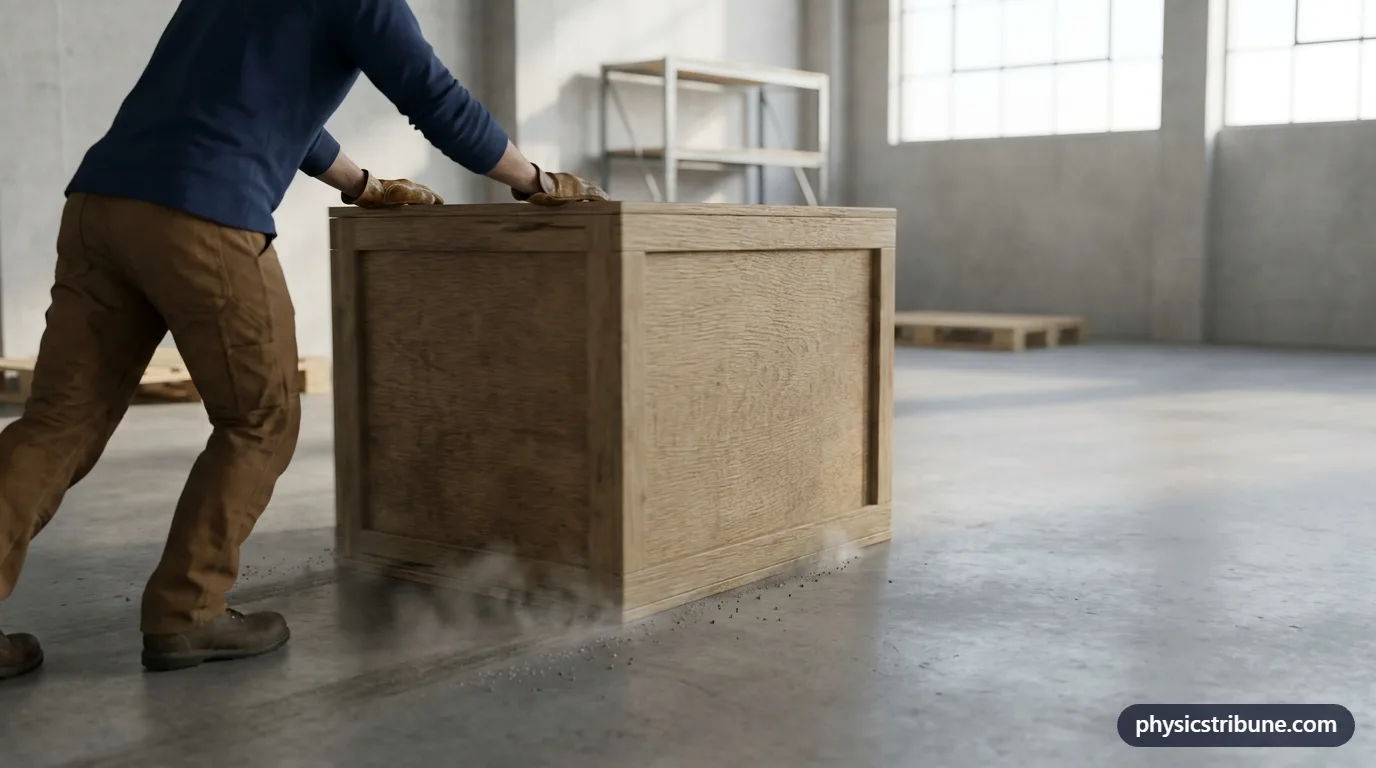
Imagine pushing a heavy toy box across a carpet. You push gently, and nothing happens. You push a bit harder, and still nothing. The carpet is pushing back on the box exactly as hard as you push, so the box stays still. That invisible push-back is static friction.
Keep leaning harder and eventually the box lurches forward. You have found the most grip the carpet can give. Once the box is sliding, it usually feels easier to keep it moving, because sliding friction is a little weaker than the grip that held it still.
So static friction is like a helper that matches your effort, but it has a limit. Heavier boxes and grippier floors raise that limit.
What Is the Formula for Static Friction?
Static friction obeys an inequality rather than a plain equation:
The right-hand side gives the largest value static friction can reach,
Here is the formula for the largest static friction force, with each symbol and its SI unit, plus the rearranged forms for μs and N.
| Symbol | Quantity | SI unit |
|---|---|---|
| maximum static friction force | newton (N) | |
| coefficient of static friction | dimensionless (1) | |
| normal force | newton (N) |
Rearranged to find another variable:
Valid for: static friction can take any value 0 ≤ f_s ≤ μs N; this is the threshold just before sliding.
Example 1 How hard can you push before the crate moves?
A 40 kg crate sits on a level concrete floor, so the normal force on it equals its weight, 392.4 N. The coefficient of static friction between the crate and the floor is 0.55. What is the largest static friction force the floor can supply?
- Given:
- coefficient of static friction:
- normal force:
- coefficient of static friction:
- Formula:
- Substitute:
- Answer:
Any push smaller than this leaves the crate in place, with friction matching the push exactly.
How Does Static Friction Change as You Push Harder?
Static friction rises in step with the push. A 10 N shove meets 10 N of static friction; a 100 N shove meets 100 N. As long as the push is below
At the threshold, the surfaces begin to slip. Friction then drops to the kinetic value,
The pattern also explains the squeaks and judders of a chalk on a board or a door hinge. The surfaces stick, build up force, slip, then stick again, many times a second. Engineers call this stick-slip motion.
Example 2 Measuring grip with a heavy bookshelf
Two movers lean on an 85 kg bookshelf standing on a wooden floor. The normal force is 833.85 N. The shelf does not budge until their combined horizontal push reaches 510 N. What is the coefficient of static friction?
- Given:
- maximum static friction force:
- normal force:
- maximum static friction force:
- Formula:
- Substitute:
- Answer:
The push at the instant the shelf starts to move equals the maximum static friction, which is what makes this measurement possible.
| Horizontal push (N) | Friction force (N) | Type of friction | Does the crate move? |
|---|---|---|---|
| 0 | 0 | None needed | No |
| 50 | 50 | Static | No |
| 100 | 100 | Static | No |
| 150 | 150 | Static | No |
| 200 | 200 | Static | No |
| 215.8 | 215.8 | Static, at its maximum | On the verge of sliding |
| 250 | 157.0 | Kinetic | Yes, and it accelerates |
| Source: Computed with f_s,max = μs N and f_k = μk N; coefficients are typical values for wood on concrete · Retrieved October 2026 | |||

What Causes Static Friction?
Even polished surfaces are rough on a microscopic scale. When two of them touch, they meet only at the tips of tiny bumps, and at those points the atoms of the two materials bond weakly to each other. The bumps also lock together like the teeth of two very fine combs.
To start sliding, you have to break those bonds and lift or shear the bumps past each other all at once. Once sliding begins, the contacts have less time to form and settle, so the grip is weaker. That is the basic reason why static friction usually exceeds kinetic friction.
A heavier load presses the bumps together harder, so more of them touch and the true contact area grows. This is why friction scales with the normal force and not with the outline area you see. A brick on its wide face and on its narrow end has about the same maximum static friction.
Which Way Does Static Friction Point?
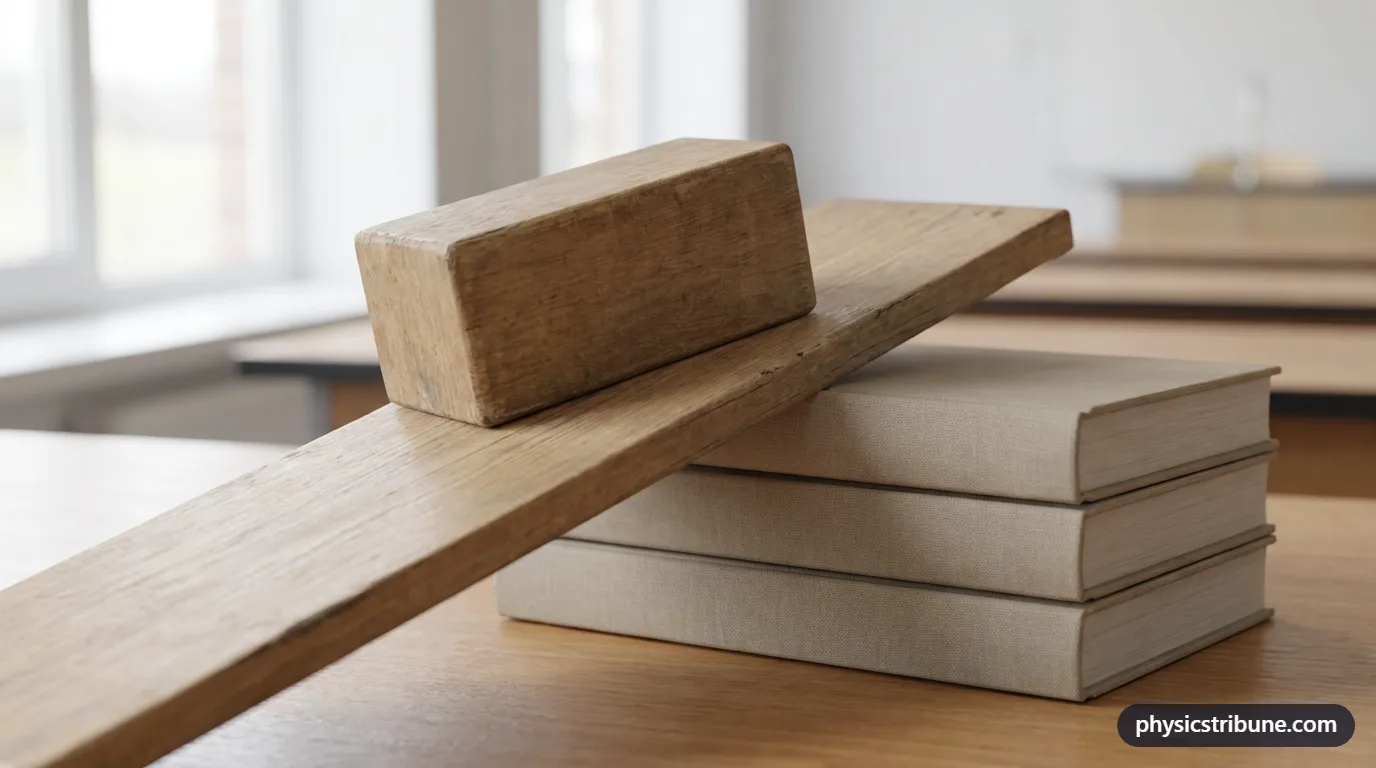
Static friction points along the surface, opposite to the direction the object would slip on its own. On a flat floor with a sideways push, that means backward against the push. On a slope, an object at rest tends to slide downhill, so static friction points up the slope.
On a vertical wall, gravity tries to drag a pressed object downward, so static friction points straight up. In that case the normal force comes from your push into the wall, not from the object's weight, and friction must carry the full weight on its own. On a ramp at rest, friction must balance the downhill part of gravity,
Example 3 Holding a book against a wall
You press a 1.5 kg book flat against a wall so it does not slide down. The book's weight is 14.715 N, and the coefficient of static friction between your hand, the book and the wall is effectively 0.4. What is the smallest normal force (your push into the wall) that keeps the book from slipping?
- Given:
- maximum static friction force:
- coefficient of static friction:
- maximum static friction force:
- Formula:
- Substitute:
- Answer:
Here friction acts upward and must hold up the full weight, so the needed normal force is more than twice the weight.

What Are Examples of Static Friction in Everyday Life?
Static friction is quietly at work in almost every motion you make:
- Walking and running. Your foot pushes backward on the ground without slipping, and static friction pushes you forward. On ice, that grip almost disappears.
- Rolling tires. The patch of a rolling tire touching the road is momentarily at rest on it, so static friction drives, steers and brakes the car.
- Holding objects. Your fingers squeeze a glass, and static friction stops it from sliding out of your hand.
- Knots and nails. A knot holds because rope fibers grip each other, and a nail stays in wood because of friction along its shank.
- Parked cars and resting books. Anything at rest on a slope is held there by static friction.
For a longer sorted list, see our examples of friction.

Why Is Static Friction Important for Cars?
A car can only accelerate, brake or turn as hard as static friction between tires and road allows. On level ground, the largest acceleration without skidding is about
Once a tire locks and skids, the grip falls to the smaller kinetic value and steering stops working. Anti-lock brakes pulse the brakes many times a second to keep the tires just short of slipping, so the car uses static friction for as long as possible. Rain and ice lower
How Is Static Friction Different From Kinetic Friction?
Static friction acts when surfaces are at rest relative to each other, and its size can be anything up to
A third type, rolling friction, is the small resistance of a wheel or ball rolling without slipping, and it is usually much smaller than either. Our side-by-side static vs kinetic friction comparison lists the differences in one table.
Practice Static Friction Problems
Static friction problems reward a clear routine: draw a free-body diagram, find the normal force, compute
Common Misconceptions
Myth: Static friction always equals μs N.
Physics: μs N is only the maximum. The actual static friction equals whatever is needed to prevent sliding, which is often much less than the maximum.
Myth: Friction always works against motion, so it cannot make anything move forward.
Physics: Static friction opposes slipping between surfaces, not motion itself. When you walk, it pushes you forward, and it is what accelerates a car.
Myth: A wider contact area gives more static friction.
Physics: For ordinary rigid objects, the maximum static friction depends on the normal force and the materials, not on the visible contact area.
Myth: If an object is not moving, there is no friction on it.
Physics: A resting object on a slope, or one being pushed without moving, has static friction acting on it. Only an object on a level surface with no sideways force feels zero friction.
Key Facts
- Static friction acts between surfaces in contact that are not sliding relative to each other.
- Static friction adjusts to match the applied force, from zero up to a maximum of μs N.
- The coefficient of static friction μs has no units and is usually larger than the kinetic coefficient μk.
- Static friction depends on the normal force and the materials, but hardly at all on the apparent contact area.
- Static friction points opposite to the direction an object would slide without it.
- Walking, driving and gripping objects all rely on static friction.
- When the applied force exceeds μs N, the surfaces slip and kinetic friction takes over.
Quick Quiz: How Well Do You Know Static Friction?
6 questions. Tap an answer to check it.
A 200 N box sits on a level floor with μs = 0.5. You push it sideways with 40 N and it stays still. What is the static friction force?
Static friction only needs to match the push to keep the box at rest, so it is 40 N, below its 100 N maximum.
What does μs N tell you?
μs N is the ceiling for static friction; beyond it, the surfaces start to slip.
When you walk forward, which way does static friction from the ground act on your foot?
Your foot pushes backward on the ground, so the ground's static friction pushes you forward.
A block rests on a ramp without sliding. Which way does static friction act on it?
The block would slide downhill without friction, so static friction points up the slope.
Doubling the normal force on a resting object does what to its maximum static friction?
f_s,max = μs N is proportional to N, so twice the normal force gives twice the maximum.
Why does a heavy object often lurch forward when it finally starts to slide?
Once sliding starts, friction drops to the smaller kinetic value while the push stays the same, so there is a sudden net force.
Frequently Asked Questions
What is static friction in simple words?
Static friction is the grip that stops something from starting to slide. When you push a heavy box and it does not move, the floor is pushing back with static friction equal to your push. If you push harder than the most grip the floor can give, the box finally starts to slide, and a weaker kind of friction takes over.
What is the formula for static friction?
Static friction follows f_s ≤ μs N. The largest possible static friction is f_s,max = μs N: multiply the static coefficient for the two materials by the normal force in newtons. The actual friction can be any value from zero up to this maximum, depending on how hard something is trying to make the surfaces slide.
Is static friction greater than kinetic friction?
For almost all pairs of materials, yes. The maximum static friction is larger than the kinetic friction between the same surfaces, because microscopic contacts bond more firmly when they have time to settle. That is why it takes a bigger push to start a heavy object moving than to keep it sliding. A few special surface pairs have nearly equal coefficients.
Can static friction cause motion?
Yes. Static friction opposes slipping between two surfaces, and that can push an object forward. When you walk, your foot pushes backward on the ground, and static friction from the ground pushes you forward. A car's driven wheels work the same way. Without that grip, as on smooth ice, your feet and tires would just spin or slide.
Does static friction depend on surface area?
Not for ordinary rigid objects. The maximum static friction depends on the normal force and the two materials, not on how much area you see touching. A bigger contact area spreads the load, so each microscopic contact is pressed less, and the two effects cancel. Soft materials such as wide racing tires are a partial exception.
What is an example of static friction?
A car parked on a hill is a classic example. Gravity pulls it downhill, but static friction between the tires and the road holds it still. Other examples include a book resting on a tilted desk, a ladder leaning against a wall without slipping, a pencil held between your fingers and the soles of your shoes gripping the floor as you walk.
What is the direction of static friction?
Static friction acts along the contact surface, opposite to the direction the object would slide if there were no friction. On a slope, it points uphill. When you push a box to the right, it points to the left. When a car speeds up, friction on the driven tires points forward, because the tires would otherwise spin backward against the road.
What is the unit of static friction?
Static friction is a force, so its SI unit is the newton (N). The coefficient of static friction, μs, has no unit, because it is the ratio of the maximum friction force to the normal force, and the newtons cancel out. Multiply the coefficient by a normal force in newtons and you get the maximum static friction in newtons.