
At a Glance
Normal force is the perpendicular push a surface gives an object resting on or pressing against it. On a level surface with no other vertical forces it equals the weight, N = m g, and on a ramp tilted at angle θ it is N = m g cos θ. It is measured in newtons (N).
- Symbol
- N (also FN or n)
- SI unit
- newton (N), equal to 1 kg·m/s²
- Formula
- N = mg on a level surface, N = mg cos θ on a ramp
- Scalar or vector
- Vector, always perpendicular to the surface
- Type of force
- Contact force (electromagnetic in origin)
- Depends on
- Weight, surface angle, other pushes or pulls, acceleration
On this page
- What Is Normal Force?
- Normal Force Explained Simply
- How Do You Calculate Normal Force?
- What Is the Normal Force on an Inclined Plane?
- When Is Normal Force Not Equal to Weight?
- How Do You Draw Normal Force on a Free-Body Diagram?
- What Are Some Examples of Normal Force?
- Is Normal Force a Reaction to Weight?
- Going Deeper: Where Does Normal Force Come From?
- Practice Normal Force Problems
- Common Misconceptions
- Key Facts
- Quiz
- FAQ
What Is Normal Force?
Normal force is the support a surface provides when something presses on it. Set a backpack on a bench and the bench pushes up on the backpack. Lean on a wall and the wall pushes back on your hand. In both cases the push points straight out of the surface, and that perpendicular direction is what the word normal means in geometry.
Normal force is a contact force. It exists only while two objects touch, and it disappears the moment they separate. A ball sitting on the floor feels it; the same ball in midair does not.
Like every force, it is a vector, so it has both a size and a direction. Its SI unit is the newton. In diagrams it is usually labeled N or FN, and it is drawn starting at the contact surface and pointing away from it.
Normal Force Explained Simply
Think of a surface as a very stiff mattress. When you put something on it, the surface squashes by a tiny amount, far too small to see, and it springs back just hard enough to hold the object up. Put a heavier object on it and it squashes a bit more and pushes back a bit harder.
That is the key idea: the floor does not have a fixed push. It gives exactly as much as needed to stop the object from sinking in, up to the point where the surface breaks. A thin sheet of ice can supply enough normal force for a cat but not for a car.
So when someone asks how strong the normal force is, the honest answer is "it depends on what else is happening." You find it by looking at all the other forces and asking what the surface must do to keep the object from moving into it.
How Do You Calculate Normal Force?
There is no single formula that covers every case, because normal force is a response force. You find it with Newton's second law applied in the direction perpendicular to the surface. If the object does not accelerate in that direction, the forces perpendicular to the surface must cancel.
For an object resting on a level floor with nothing else pushing or pulling vertically, only gravity and the floor act up and down. The two must balance, so the normal force equals the weight:
On a slope, gravity is split into two parts. One part pulls along the slope and the other presses into it. Only the second part is balanced by the surface, which gives the formula below.
On a slope the normal force balances only the part of gravity that points into the surface. Here is the formula with each symbol and its SI unit.
| Symbol | Quantity | SI unit |
|---|---|---|
| normal force | newton (N) | |
| mass of object | kilogram (kg) | |
| acceleration due to gravity (9.80 m/s² (standard 9.80665 m/s²)) | meter per second squared (m/s²) | |
| incline angle above horizontal | radian (rad) |
Rearranged to find another variable:
Valid for: no other forces perpendicular to the incline surface; incline not accelerating.
Example 1 A stack of books on a level desk
A stack of textbooks with a mass of 7.5 kg sits still on a level desk. Nothing else pushes or pulls on it vertically. How large is its weight, which the desk must match with its normal force? Use g = 9.8 m/s².
- Given:
- mass:
- acceleration due to gravity:
- mass:
- Formula:
- Substitute:
- Answer:
Because the stack is at rest and only gravity and the desk act on it vertically, the normal force has this same size and points straight up.
What Is the Normal Force on an Inclined Plane?
Tilt a surface by an angle θ and the normal force becomes
The table shows how quickly this happens for a 10 kg crate. Notice that a gentle 10° slope barely changes the support, while a 60° slope cuts it in half. This matters a great deal for friction, because the friction force a surface can provide grows with the normal force.
The diagram shows the three forces on a block on a slope: weight straight down, the normal force at right angles to the ramp, and friction along it. For full slope problems, including acceleration and friction, see forces on an inclined plane or use the inclined plane calculator.
Example 2 A toolbox resting on a loading ramp
A 12 kg toolbox rests on a ramp tilted 20° above the horizontal (0.3491 rad). What normal force does the ramp exert on it? Use g = 9.8 m/s².
- Given:
- mass of object:
- acceleration due to gravity:
- incline angle above horizontal:
- mass of object:
- Formula:
- Substitute:
- Answer:
The ramp pushes back with a little less than the full weight, since part of gravity now pulls the toolbox along the slope instead of into it.
| Slope angle | cos θ | Normal force (N) | Share of full weight |
|---|---|---|---|
| 0° | 1.000 | 98.0 | 100% |
| 10° | 0.985 | 96.5 | 98.5% |
| 20° | 0.940 | 92.1 | 94.0% |
| 30° | 0.866 | 84.9 | 86.6% |
| 45° | 0.707 | 69.3 | 70.7% |
| 60° | 0.500 | 49.0 | 50.0% |
| 75° | 0.259 | 25.4 | 25.9% |
| 90° | 0.000 | 0.0 | 0% |
| Source: Computed with N = mg cos θ, m = 10 kg, g = 9.8 m/s² · Retrieved October 2026 | |||

When Is Normal Force Not Equal to Weight?
Students often memorize N = mg and use it everywhere, but it holds only in one special situation. The normal force differs from the weight in several common cases:
- Extra push down. Press down on a box with your hand and the floor must push up with the weight plus your push.
- Pull upward. Lift on a suitcase handle without raising it off the floor, and the floor supports less, because your hand is carrying part of the load.
- Angled pull. Drag a sled with a rope tilted upward and the vertical part of the rope's pull reduces the normal force on the snow.
- Slopes. On a ramp only the perpendicular part of gravity counts, so N = mg cos θ.
- Vertical acceleration. In an elevator that speeds up going up, the floor must push harder than your weight. When it speeds up going down, it pushes less.
The last case is the basis of apparent weight. A bathroom scale does not measure your weight directly; it measures the normal force it has to supply.
If the words weight and mass still blur together, our mass vs weight comparison sorts them out.
Example 3 Standing on a scale in a rising elevator
A 70 kg student stands on a bathroom scale in an elevator that speeds up while moving upward at 1.5 m/s². What normal force does the scale exert on the student? Use g = 9.8 m/s².
- Given:
- mass:
- acceleration due to gravity:
- elevator acceleration (positive upward):
- mass:
- Formula:
- Substitute:
- Answer:
The scale shows this larger number, which is why you feel heavier for a moment when an elevator starts upward.
How Do You Draw Normal Force on a Free-Body Diagram?
On a free-body diagram, draw the object as a simple box or dot and add one arrow for each force. The normal force arrow starts at the contact surface and points away from it, at a right angle to that surface. On a flat floor it points straight up; on a ramp it tilts back with the ramp; against a wall it points sideways, away from the wall.
A useful habit is to list every surface your object touches. Each one contributes its own normal force, so a book squeezed between two hands has two, one from each palm. The diagram below shows a box on a floor while someone presses down on its top: the floor's push has to cover both the weight and the extra push.

What Are Some Examples of Normal Force?
Normal force is so constant in daily life that it is easy to overlook. A few places to spot it:
- A chair holding you up while you read.
- A car's tires pressing on the road, with the road pushing back on each one.
- A climber leaning back against a rock face, where the rock pushes horizontally on the climber's feet.
- A coin resting on a tilted book, held by a slightly reduced normal force plus friction.
- A rider at the bottom of a roller coaster dip, pressed into the seat by a normal force much larger than their weight.
Friction depends on all of these. The friction a surface can supply is roughly proportional to the normal force, which is why loaded trucks grip better on dry roads and why pushing down on a stuck drawer makes it harder to slide. Our friction guide explains that link.

Is Normal Force a Reaction to Weight?
No, and this is one of the most common mix-ups in mechanics. Weight is the pull of Earth on the object. Its partner under Newton's third law, first published by Isaac Newton in 1687 is the equal pull of the object on Earth. The normal force on the object is paired with the push the object exerts on the surface.
Weight and normal force often have the same size, but that is a result of balance, not of the third law. They act on the same object and are different types of force, so they cannot be an action-reaction pair. Remove the table and the normal force vanishes instantly, yet the weight stays exactly the same.
Going Deeper: Where Does Normal Force Come From?
At the atomic level, normal force is electromagnetic. When two surfaces get very close, the electron clouds of their outer atoms repel one another, and the quantum rules that stop electrons from crowding into the same state add to that resistance. The atoms in the surface shift slightly, like countless tiny springs being compressed.
Because this squeeze is so small, we treat ordinary surfaces as rigid. Engineers cannot always do that. A bridge deck, a mattress or a trampoline bends visibly, and the normal force then depends on how far it bends, much like a spring obeying Hooke's law.
Practice Normal Force Problems
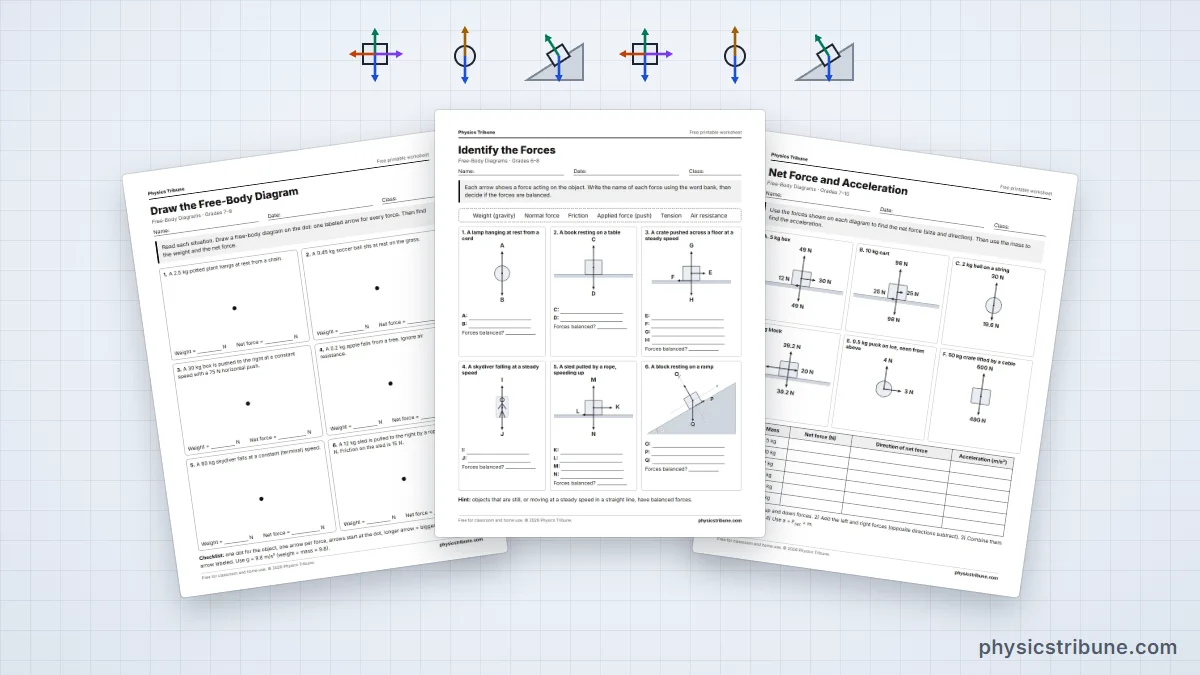
Normal force shows up in almost every mechanics problem, so it pays to practice spotting it. Our free-body diagram worksheets include printable sets with answer keys, and the force formulas sheet collects the related equations in one place. For slope problems, check your answers with the inclined plane calculator, then try the quiz below.
Common Misconceptions
Myth: The normal force always equals mg.
Physics: It equals mg only on a level surface with no other vertical forces and no vertical acceleration. Slopes, extra pushes and elevators all change it.
Myth: Normal force is the reaction force to weight.
Physics: Weight's partner is the object's pull on Earth. Normal force and weight act on the same object, so they cannot be a third-law pair.
Myth: Normal force always points straight up.
Physics: It points perpendicular to the surface. On a ramp it tilts, and against a wall it points sideways.
Myth: Only soft surfaces push back; hard floors just block things.
Physics: Every surface deforms a tiny amount and pushes back. Hard floors simply do it with an extremely small squeeze.
Key Facts
- Normal force is the push a surface exerts on an object in contact with it, always perpendicular to the surface.
- Its SI unit is the newton, and it is a vector quantity.
- On a level surface with no other vertical forces, the normal force equals the weight, N = mg.
- On a ramp tilted at angle θ, the normal force is N = mg cos θ, so it shrinks as the slope gets steeper.
- Extra pushes, upward pulls and vertical acceleration all change the normal force.
- Weight and normal force are not an action-reaction pair, even when they are equal in size.
- A bathroom scale reads the normal force it supplies, not your true weight.
Quick Quiz: How Well Do You Know Normal Force?
6 questions. Tap an answer to check it.
In which direction does the normal force on an object always point?
Normal means perpendicular, so the force points straight out of the surface.
A 4 kg box rests on a level floor with no other vertical forces. About how large is the normal force?
N = mg = 4 × 9.8, which is about 39 N.
What happens to the normal force on a block as the ramp under it gets steeper?
N = mg cos θ, and cos θ gets smaller as θ grows.
You press down on a book lying on a table. What happens to the normal force from the table?
The table must now support the book's weight plus your push.
What is the third-law partner of the table's normal force on a book?
Third-law pairs act on different objects: the table pushes the book and the book pushes the table.
What does a bathroom scale actually measure?
The scale reads how hard it must push up on you, which changes in an accelerating elevator.
Frequently Asked Questions
What is normal force in simple terms?
Normal force is the push a surface gives to anything resting on it or pressing against it. The floor pushes up on your feet, a table pushes up on a plate, and a wall pushes back on your hand. The push always points straight out of the surface, and it grows or shrinks to match whatever is pressing on it.
Is normal force equal to weight?
Only in a special case. If an object rests on a level surface, nothing else pushes or pulls it vertically, and it is not accelerating up or down, then the normal force equals its weight. On a slope, with an extra push, with an upward pull, or in an accelerating elevator, the two values are different.
How do you find normal force on an incline?
Multiply the weight by the cosine of the slope angle: N = mg cos θ. This works when nothing else pushes into or pulls away from the ramp. For a 5 kg box on a 30° slope, the normal force is about 42 N instead of the full 49 N weight, because part of gravity pulls the box along the slope.
What is the unit of normal force?
Normal force is measured in newtons, written N. One newton is the force that gives a 1 kg mass an acceleration of 1 m/s². In American engineering you may also see pounds-force, where one pound-force is about 4.45 N. Do not confuse the symbol N for the force itself with the unit N for newtons.
Can normal force be zero?
Yes. It is zero whenever two objects stop touching, such as a ball in the air. It also becomes zero at the top of a hump in the road if a car goes fast enough to just lift off, and for passengers in a freely falling elevator. Astronauts in orbit feel weightless for the same reason: nothing is pushing on them.
Can normal force be greater than weight?
Yes. If you push down on a box, the floor must support the weight plus your push. An elevator that speeds up going upward needs a larger floor force to accelerate you. A car at the bottom of a dip also feels a bigger normal force, because the road must both hold it up and bend its path upward.
Why is it called normal force?
In geometry, normal means perpendicular. A line that meets a surface at a right angle is called the normal to that surface. Since this contact force always acts at right angles to the surface, physicists named it the normal force. The name has nothing to do with the force being ordinary or typical.
What is the difference between normal force and friction?
Both come from surfaces touching, but they point in different directions. Normal force acts perpendicular to the surface and keeps objects from passing through it. Friction acts parallel to the surface and resists sliding. The two are linked: the maximum friction a surface can supply is roughly the coefficient of friction times the normal force.
Keep Exploring







Sources
Constants come from NIST CODATA 2022 (public domain) and unit definitions from the BIPM SI Brochure (CC BY 4.0). Text, diagrams and illustrations are original work by Physics Tribune.