
At a Glance
On a slope at angle θ, the weight mg splits into a component along the incline, F∥ = mg sin θ, and a component into the incline, mg cos θ, which the normal force N = mg cos θ balances. Without friction, the object slides down with acceleration a = g sin θ.
- Along the slope
- F∥ = mg sin θ (down the incline)
- Into the slope
- F⊥ = mg cos θ, balanced by N = mg cos θ
- Frictionless acceleration
- a = g sin θ, independent of mass
- With kinetic friction
- a = g(sin θ − μk cos θ)
- SI units
- forces in newtons (N), angle in degrees or radians
On this page
- What Forces Act on an Object on an Inclined Plane?
- Inclined Plane Forces Explained Simply
- Why Do You Tilt the Axes on a Slope?
- How Do You Find the Components of Weight on a Slope?
- Why Is the Normal Force Smaller on a Slope?
- How Fast Does an Object Accelerate Down a Frictionless Slope?
- How Does Friction Change the Motion on a Slope?
- At What Angle Does an Object Start to Slide?
- What Force Do You Need to Push an Object Up a Slope?
- How Do You Solve an Inclined Plane Problem Step by Step?
- Where Do Inclined Plane Forces Matter in Real Life?
- Practice Inclined Plane Problems
- Common Misconceptions
- Key Facts
- Quiz
- FAQ
What Forces Act on an Object on an Inclined Plane?
Put a block on a tilted board and three forces can act on it. Its weight, mg, always points straight down toward Earth's center. The normal force from the board always points out of the surface at a right angle to it. And friction, if the surfaces grip at all, acts along the surface, opposing sliding or the tendency to slide.
On level ground, weight and normal force line up and cancel. On a slope they no longer point in opposite directions, so they cannot fully cancel. Whatever is left over points down the slope, and that leftover is what makes objects slide.
If someone pushes or pulls on the object, or a rope holds it, you add those forces too. A good free-body diagram showing every force is always the first step.
Inclined Plane Forces Explained Simply
Gravity pulls a box on a slope straight down, but the box can only move along the slope. So only part of gravity's pull actually drags the box downhill. The rest of the pull just presses the box against the ramp.
On a gentle slope, almost all of gravity presses into the ramp and only a little pulls the box downhill. On a steep slope it is the other way around. Tilt the ramp all the way to vertical and the whole pull of gravity points along the surface, so the box simply falls.
That is why sledding hills feel faster as they get steeper, and why a parked car on a gentle driveway stays put while the same car on a very steep street needs a good parking brake.
Why Do You Tilt the Axes on a Slope?
In most problems you set x horizontal and y vertical. On a slope it is smarter to rotate the axes: x along the incline and y perpendicular to it. The object moves only along the incline, so its acceleration has an x part and no y part, which makes the equations far simpler.
With tilted axes, the normal force and friction already line up with the axes. Only the weight points at an awkward angle, so it is the only force you need to split into components. One small piece of geometry gives the key fact: the angle between the weight and the y axis equals the slope angle θ.
How Do You Find the Components of Weight on a Slope?
Split the weight mg into a part along the slope and a part into the slope. Using the right triangle formed by the weight and its components, the part along the slope is
The sine and cosine behave just as you would expect from experience. At 0° the slope is flat, sin θ is zero and nothing pulls the object sideways. At 90° the surface is a wall, cos θ is zero and the object no longer presses against it. In between, the two parts trade off smoothly, as the table below shows for a 10 kg block.
A common slip is swapping sine and cosine. A quick sanity check: the downhill part should grow as the slope gets steeper, and only sine does that.
The component of weight that pulls an object down a slope depends on its mass, the gravitational field strength and the sine of the slope angle.
| Symbol | Quantity | SI unit |
|---|---|---|
| component of weight parallel to the incline (down the slope) | newton (N) | |
| mass of object | kilogram (kg) | |
| acceleration due to gravity (9.80 m/s² (standard 9.80665 m/s²)) | meter per second squared (m/s²) | |
| incline angle above horizontal | radian (rad) |
Rearranged to find another variable:
Valid for: frictionless: acceleration down the slope is a = g sin θ.
Example 1 A crate on a loading ramp
A 40 kg crate rests on a loading ramp tilted at 22°. Taking g = 9.81 m/s², how large is the component of its weight pulling it down along the ramp?
- Given:
- mass of object:
- acceleration due to gravity:
- incline angle above horizontal:
- mass of object:
- Formula:
- Substitute:
- Answer:
That is a bit more than a third of the crate's full weight, which is why a ramp makes loading easier than lifting.
| Slope angle θ | sin θ | cos θ | Along slope mg sin θ (N) | Normal force mg cos θ (N) | Frictionless a = g sin θ (m/s²) |
|---|---|---|---|---|---|
| 5° | 0.087 | 0.996 | 8.5 | 97.7 | 0.85 |
| 10° | 0.174 | 0.985 | 17.0 | 96.6 | 1.70 |
| 15° | 0.259 | 0.966 | 25.4 | 94.8 | 2.54 |
| 20° | 0.342 | 0.940 | 33.6 | 92.2 | 3.36 |
| 30° | 0.500 | 0.866 | 49.1 | 85.0 | 4.90 |
| 45° | 0.707 | 0.707 | 69.4 | 69.4 | 6.94 |
| 60° | 0.866 | 0.500 | 85.0 | 49.1 | 8.50 |
| Source: Computed with F∥ = mg sin θ, N = mg cos θ and a = g sin θ, m = 10 kg, g = 9.81 m/s² · Retrieved October 2026 | |||||

Why Is the Normal Force Smaller on a Slope?
The normal force only has to balance the part of the weight that presses into the surface. If nothing else pushes or pulls perpendicular to the slope, the object does not accelerate in that direction, so
This matters for friction, because friction depends on the normal force. A steeper slope means a smaller normal force, which means less friction available to hold the object in place, at the same moment that the downhill pull is growing. Both effects push toward sliding as the angle rises.
If you press down on the object or pull it upward with a rope at an angle, the normal force changes. Always find N from the perpendicular balance rather than assuming it equals mg cos θ.
How Fast Does an Object Accelerate Down a Frictionless Slope?
With no friction, the only unbalanced force is
So on a frictionless slope, a marble and a bowling ball speed up at the same rate. The slope simply dilutes gravity: at 30° the acceleration is exactly half of g, about 4.9 m/s². Galileo used gentle ramps for exactly this reason, because they slowed falling motion enough to time it with the simple clocks of his day.
Example 2 A sled on a smooth icy hill
A sled slides down an icy hill tilted at 18°. Treating the ice as frictionless and taking g = 9.81 m/s², what is the sled's acceleration along the slope?
- Given:
- g:
- θ:
- g:
- Formula:
- Substitute:
- Answer:
The sled's mass never appears: a light sled and a loaded one speed up at the same rate on a frictionless slope.

How Does Friction Change the Motion on a Slope?
Friction acts along the slope, opposite to the direction the object moves or would move. While the object is still, static friction adjusts itself to match the downhill pull, up to a limit of
For an object sliding downhill, the net force along the slope is
The diagram shows a block sliding on a 30° slope with a small kinetic friction coefficient. Friction points up the slope, and the net force down the slope is the difference between the two dashed and solid arrows along the surface.
Example 3 A box sliding down a waxed board
A box slides down a board tilted at 30°. The coefficient of kinetic friction between the box and the waxed board is 0.12. Taking g = 9.81 m/s², what is the box's acceleration down the board?
- Given:
- g:
- θ:
- μk:
- g:
- Formula:
- Substitute:
- Answer:
Friction removes part of the downhill pull, so the box speeds up more slowly than the 4.9 m/s² it would reach on a frictionless board.

At What Angle Does an Object Start to Slide?
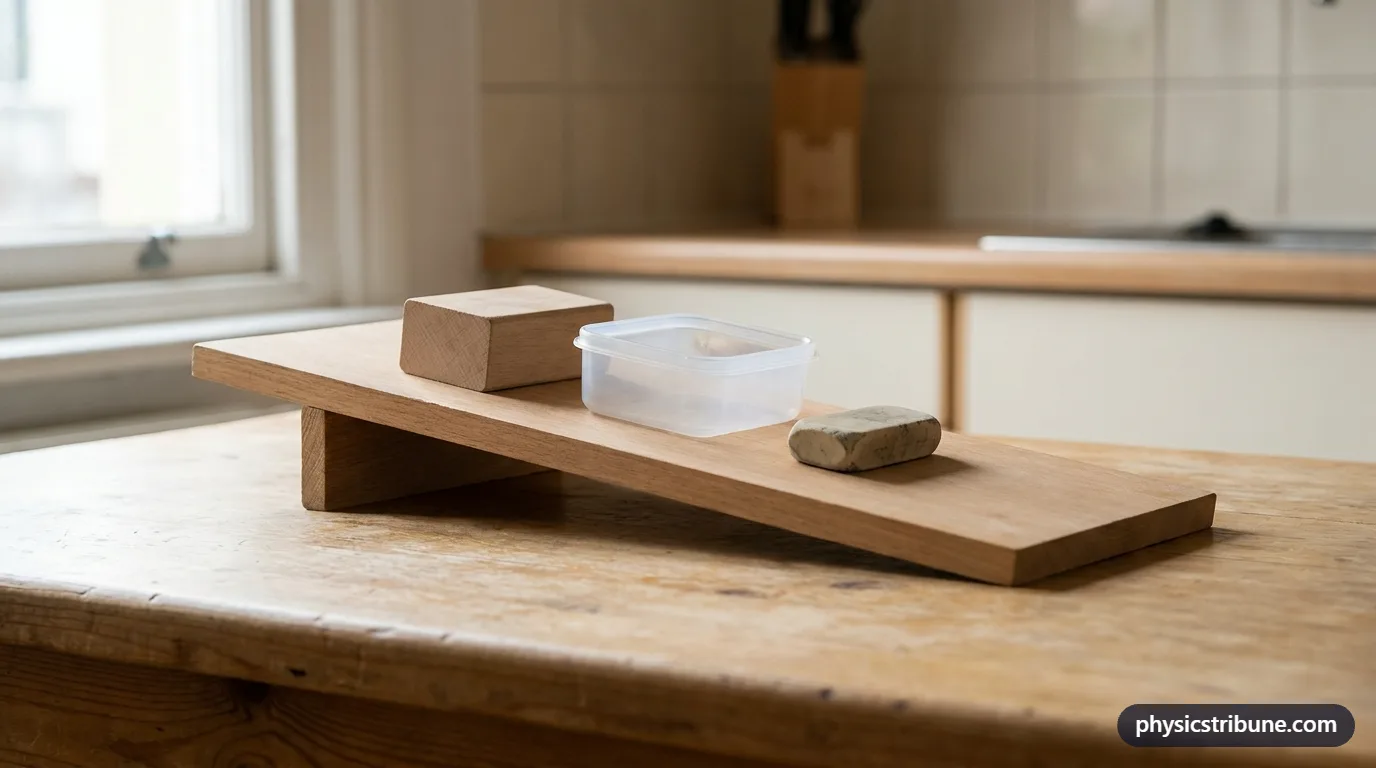
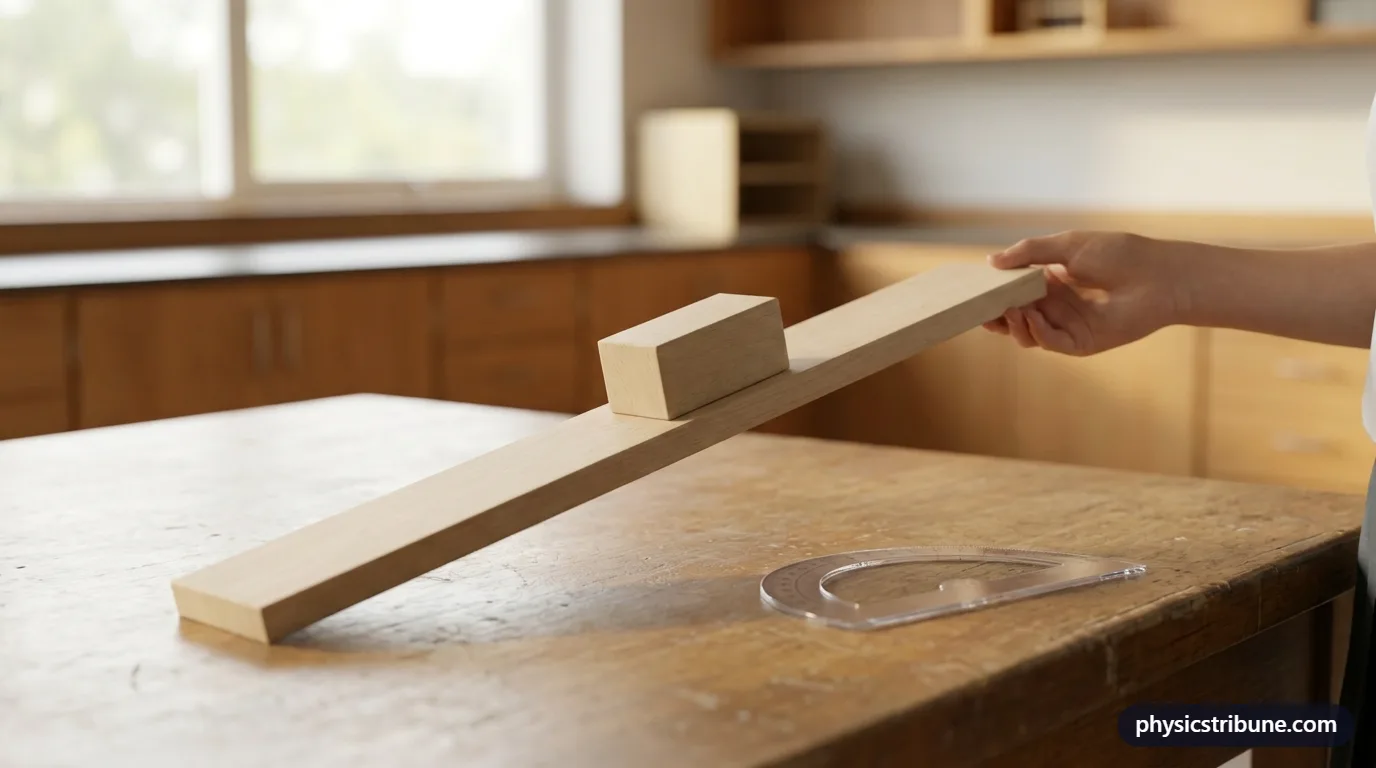
Slowly tilt a board with a book on it. At first static friction holds the book. Sliding begins when the downhill pull just exceeds the largest friction available:
This angle is sometimes called the angle of repose or the critical angle. It gives a simple way to measure the static coefficient of friction: tilt, watch for the first slip and take the tangent of the angle. A surface pair with μs = 0.5 starts to slip at about 26.6°. Our friction ramp experiment turns this into a hands-on lab.
What Force Do You Need to Push an Object Up a Slope?
To slide an object up a slope at steady speed, your push along the slope must balance everything pulling it back. Without friction that is just
For example, a 50 kg cart pushed up a 15° ramp with μk = 0.3 needs a steady push of about 269 N along the ramp. That is more than half its weight of roughly 491 N, because friction adds to the downhill pull instead of helping.
If you push horizontally instead of along the slope, part of your push presses the object into the ramp. That raises the normal force and the friction, so a horizontal push is less efficient than one directed along the surface.
How Do You Solve an Inclined Plane Problem Step by Step?
- Draw the free-body diagram: weight straight down, normal force out of the surface, friction along the surface, plus any pushes or tensions.
- Tilt the axes: x along the slope (usually pointing downhill), y perpendicular to it.
- Split the weight: mg sin θ along x and mg cos θ into the surface along y.
- Balance the y direction: the sum of forces perpendicular to the slope is zero, which gives N.
- Apply Fnet = ma along x: include friction with the right sign, then solve for the unknown.
- Check the answer: the acceleration should never exceed g, and it should shrink to zero on a flat surface.
Where Do Inclined Plane Forces Matter in Real Life?
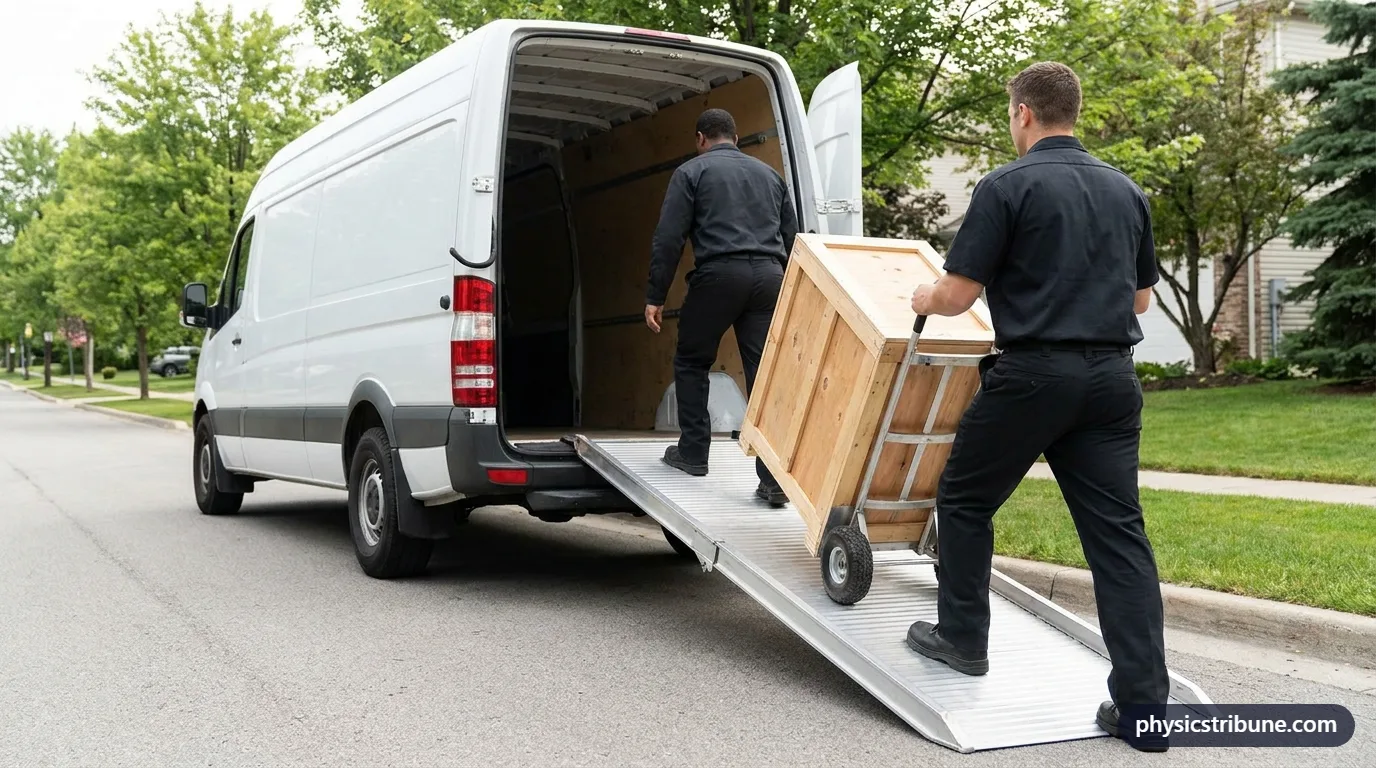
Road engineers limit how steep streets and highways can be so that trucks can climb and brake safely. Long mountain descents often have runaway truck ramps: steep uphill lanes of loose gravel where the downhill component of weight and deep friction work together to stop a vehicle whose brakes have failed.
Accessible ramps for wheelchairs are commonly built with a rise of 1 unit for every 12 units of length, an angle of about 4.8°. At that slope the downhill pull is only a small fraction of the total weight, so a person can roll up under their own power. Skiers, snowboarders and sledders feel the same physics in reverse, picking steeper runs when they want more speed. For the ramp as a tool for lifting loads, see our page on the inclined plane simple machine.
Practice Inclined Plane Problems
Slopes are a favorite exam topic because they combine vectors, friction and Newton's laws in one setup. Work through our inclined plane worksheets, which come with answer keys, and check any setup with the inclined plane calculator. To see how ramps helped start modern physics, read about Galileo Galilei and his rolling-ball experiments.
Common Misconceptions
Myth: The normal force on a slope always equals the object's weight.
Physics: On a simple incline the normal force is mg cos θ, which is smaller than mg. It equals the full weight only on level ground.
Myth: Heavier objects slide down a frictionless slope faster.
Physics: The downhill force grows with mass, but so does inertia. They cancel, so every object has a = g sin θ on a frictionless slope.
Myth: The weight of an object on a slope points perpendicular to the slope.
Physics: Weight always points straight down toward Earth's center. Only its component mg cos θ points into the slope.
Myth: Friction on a slope always points up the hill.
Physics: Friction opposes sliding or the tendency to slide. When you push an object up the slope, friction points down the slope.
Key Facts
- On a slope at angle θ, weight splits into mg sin θ along the slope and mg cos θ into the slope.
- The normal force on a simple incline is N = mg cos θ, always less than the full weight.
- Without friction, an object slides down a slope with acceleration a = g sin θ, whatever its mass.
- With kinetic friction, the downhill acceleration becomes a = g(sin θ − μk cos θ).
- An object at rest starts to slide when tan θ exceeds the coefficient of static friction.
- Tilting the axes so x runs along the slope means only the weight needs to be split into components.
- Pushing an object up a slope at steady speed takes mg sin θ plus the kinetic friction force.
Quick Quiz: How Well Do You Know Forces on an Inclined Plane?
6 questions. Tap an answer to check it.
Which expression gives the component of weight along a slope of angle θ?
The part of weight along the slope is mg sin θ, which grows as the slope steepens.
On a frictionless 30° slope, what is the acceleration of a sliding block?
a = g sin 30° = 0.5g, about 4.9 m/s².
How does the normal force on a simple incline compare with the object's weight?
N = mg cos θ, and cos θ is less than 1 for any tilt.
A block just begins to slip when a board is tilted to 35°. What is μs?
μs = tan 35°, which is about 0.70.
Which way does friction point when you push a box up a ramp?
Friction opposes the motion, and the box is moving up the ramp.
Why do we tilt the axes when solving incline problems?
With x along the slope, the acceleration has only one component, simplifying the equations.
Frequently Asked Questions
What are the forces on an inclined plane?
An object on an inclined plane usually feels three forces. Its weight points straight down. The normal force points out of the surface, at a right angle to it. Friction acts along the surface, opposing motion or the tendency to move. Any applied push, pull or rope tension is added to these. A free-body diagram with tilted axes keeps them organized.
What is the formula for force on an inclined plane?
The force pulling an object down a slope is the parallel component of its weight, F = mg sin θ, where m is mass, g is the gravitational field strength and θ is the slope angle. The component pressing into the slope is mg cos θ, which the normal force balances. Friction, if present, equals μN along the surface.
How do you find the normal force on an incline?
Balance the forces perpendicular to the slope. If nothing else pushes or pulls in that direction, the normal force equals the perpendicular part of the weight, N = mg cos θ. For a 10 kg block on a 30 degree slope with g = 9.81 m/s², that gives about 85 N, compared with a full weight of 98.1 N.
Why do we use sin for the parallel component and cos for the perpendicular one?
The angle between the weight vector and the line perpendicular to the slope equals the slope angle θ. In that right triangle, the weight is the hypotenuse, the side next to θ points into the slope and the side opposite θ points along it. Adjacent goes with cosine and opposite goes with sine, giving mg cos θ and mg sin θ.
What is the acceleration of an object down an inclined plane?
Without friction, the acceleration is a = g sin θ along the slope, regardless of mass. On a 30 degree slope that is half of g, about 4.9 m/s². With kinetic friction, the acceleration drops to a = g(sin θ − μk cos θ). A rolling ball accelerates a little slower than a sliding block because part of its energy goes into spinning.
Does mass affect how fast an object slides down a slope?
Not in the simple model. The downhill force mg sin θ and the friction force μk mg cos θ both scale with mass, and so does the object's inertia. Mass cancels out of the acceleration. In real life, air resistance can make very light objects, like a sheet of foam, slide a little slower than dense ones of the same shape.
At what angle will an object slide down a ramp?
An object at rest begins to slide when the slope angle makes tan θ greater than the coefficient of static friction between the surfaces. For μs = 0.5, that critical angle is about 26.6 degrees. Smoother pairs, such as ice on steel, slip at much gentler angles, while rubber on rough wood can hold on slopes steeper than 45 degrees.
What happens to the forces as the slope gets steeper?
As the angle grows, the downhill component mg sin θ increases and the perpendicular component mg cos θ decreases. A smaller perpendicular component means a smaller normal force and therefore less maximum friction. So steeper slopes pull harder downhill and grip less at the same time, which is why objects that sit still on gentle ramps slide on steep ones.
Keep Exploring




Sources
Constants come from NIST CODATA 2022 (public domain) and unit definitions from the BIPM SI Brochure (CC BY 4.0). Text, diagrams and illustrations are original work by Physics Tribune.