At a Glance
Charles-Augustin de Coulomb (born June 14, 1736, died August 23, 1806) was a French physicist and engineer best known for Coulomb's law, published in 1785. It says the force between two point charges is F = k |q1 q2| / r^2, so doubling the distance cuts the force to one quarter.
- Born
- June 14, 1736, Angoulême, France
- Died
- August 23, 1806, Paris, France, age 70
- Nationality
- French
- Known for
- Coulomb's law, the torsion balance and the laws of friction
- Key work
- Seven memoirs on electricity and magnetism (1785 to 1791)
- Key equation
- F = k |q1 q2| / r^2 (Coulomb's law)
On this page
- Who Was Charles-Augustin de Coulomb?
- What Was Coulomb's Early Life and Engineering Career?
- What Is Coulomb's Torsion Balance?
- How Did Coulomb Discover the Inverse-Square Law?
- What Are Coulomb's Laws of Friction?
- What Else Did Coulomb Find About Electricity and Magnetism?
- Coulomb's Key Equation
- Why Is Coulomb Important Today?
- Key Facts
- Quiz
- FAQ
Who Was Charles-Augustin de Coulomb?
Charles-Augustin de Coulomb was the scientist who turned electricity into a precise, measurable science. Before him, people knew that like charges repel and unlike charges attract, but no one had measured exactly how the push or pull changes with distance. Using an instrument of his own design, he showed that the force falls off with the square of the distance, the rule we call Coulomb's law.
He spent most of his career as an officer in the French army's engineering corps, building forts and studying the strength of materials. That practical background made him a careful measurer. His work on friction, soil pressure and beams is still part of engineering, and his electrical measurements laid the ground for the mathematical theory of electricity that followed.
What Was Coulomb's Early Life and Engineering Career?
Coulomb was born in 1736 in Angoulême, in southwest France, and grew up mainly in Paris, where he studied mathematics and science. In 1760 he entered the royal military engineering school at Mézières, one of the best technical schools in Europe, and graduated as a lieutenant in the engineers in 1761.
In 1764 he was sent to the French Caribbean island of Martinique to oversee the construction of a large stone fort. The work lasted about eight years in a hot, disease-ridden climate, and he fell seriously ill several times. The experience taught him how real structures carry loads, how soil pushes against walls and how ropes and timbers rub and wear.
Back in France he turned those lessons into theory. His 1773 paper to the Academy of Sciences dealt with the bending of beams, the collapse of masonry and the pressure of earth on retaining walls. Engineers still use his approach to soil pressure today.
| Year | Event |
|---|---|
| 1736 | Born on June 14 in Angoulême, France |
| 1760 | Enters the royal military engineering school at Mézières |
| 1761 | Graduates as a lieutenant in the engineering corps |
| 1764 | Sent to Martinique to build a fort; stays about eight years |
| 1773 | Presents his paper on beams, masonry and soil pressure to the Academy of Sciences |
| 1777 | Shares an Academy prize for work on compass needles, using torsion suspension |
| 1781 | Wins the Academy prize for his study of friction; elected to the Academy |
| 1785 | Publishes his first memoir: the inverse-square law of electric repulsion |
| 1791 | Completes his series of seven memoirs on electricity and magnetism |
| 1793 | Leaves Paris when the Academy is closed during the Revolution |
| 1802 | Appointed an inspector general of public education |
| 1806 | Dies in Paris on August 23, aged 70 |
| Source: Birth and death dates from our physicists data file (Wikidata, CC0); other years are standard biographical dates · Retrieved October 2026 | |
What Is Coulomb's Torsion Balance?
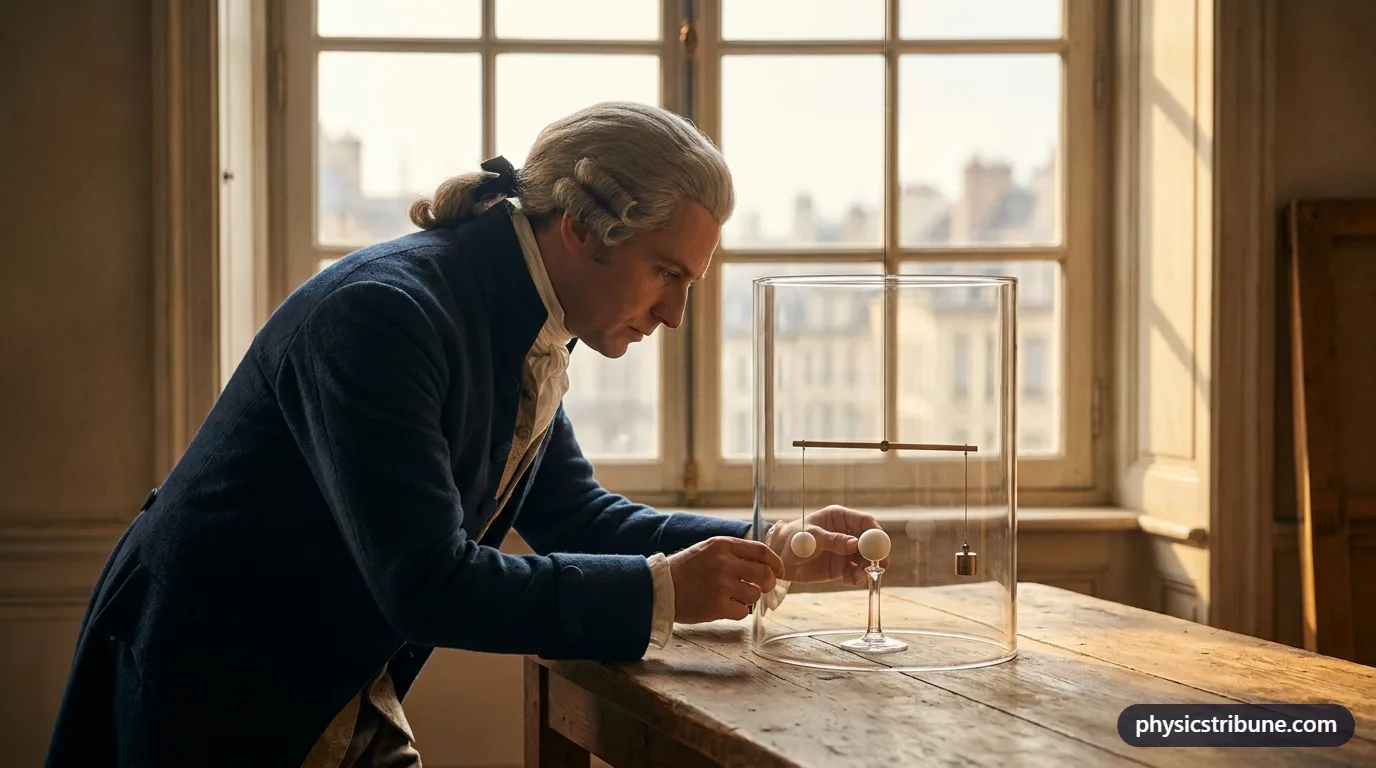
Coulomb's great instrument was the torsion balance. A light horizontal rod hangs from a very thin wire inside a glass case. A small force at the end of the rod twists the wire, and the wire resists with a turning effect that grows in proportion to the angle of twist. By reading the angle on a scale, he could measure forces far smaller than anything a spring scale could detect.
He developed the idea while working on compass needles for a 1777 prize competition of the Academy of Sciences, which he shared. For his electrical work he put a small charged ball on one end of the rod and brought another charged ball near it. The British scientist Henry Cavendish later used a much larger torsion balance to measure gravity between lead spheres, in the Cavendish experiment.
How Did Coulomb Discover the Inverse-Square Law?
In his first electrical memoir of 1785, Coulomb charged two small balls with the same kind of electricity and let them repel. He twisted the top of the wire to push the balls closer and recorded how much twist was needed at each separation. Halving the distance needed about four times the twist, so the force grew four times larger. The force between charges follows an inverse-square law, the same mathematical pattern as Newton's gravity.
Attraction was harder to measure because the balls tend to snap together. In later memoirs he timed the swings of a charged needle near a charged sphere and showed that attraction obeys the same rule. He also showed that the force is proportional to the product of the two charges, completing the law.
Others, including Cavendish and the Scottish scientist John Robison, had reached the inverse-square idea earlier but did not publish full measurements. Coulomb's clear, public data convinced the scientific world.

What Are Coulomb's Laws of Friction?
In 1781 Coulomb won the Academy's prize with a long study of friction in machines, and he was elected to the Academy that year. Through many trials with sliding timbers and loaded sledges, he confirmed that friction is roughly proportional to the force pressing two surfaces together and nearly independent of the contact area.
He also separated the force needed to start an object moving from the force needed to keep it sliding, the difference we now describe as static friction versus kinetic friction. Physics books still call the simple model of dry sliding friction Coulomb friction, and you can explore it on our friction pages.
What Else Did Coulomb Find About Electricity and Magnetism?
In his seven memoirs from 1785 to 1791, Coulomb showed that the electric charge on a conductor spreads out over its outer surface rather than its interior, a result now explained by Gauss's law. He measured how charged objects slowly lose charge to the surrounding air and through their supports. He also used his balance to show that the force between magnetic poles follows an inverse-square law.
When the French Revolution closed the Academy in 1793, he left Paris and retired to a small estate near Blois. He returned when the new National Institute was founded and served as an inspector of public education from 1802. He died in Paris in 1806.
Coulomb's Key Equation
Coulomb's law says the electric force between two point charges is proportional to the product of the charges and inversely proportional to the square of the distance between them. The constant k is about 8.988 × 10⁹ N·m²/C², the Coulomb constant. Like charges repel and opposite charges attract. Use our Coulomb's law calculator to try your own numbers.
Here is Coulomb's law as it is written today, with each symbol and its SI unit, plus the rearranged versions.
| Symbol | Quantity | SI unit |
|---|---|---|
| magnitude of the electrostatic force | newton (N) | |
| Coulomb constant (8.988 × 10⁹ N·m²/C² (= 1/(4πε₀))) | newton meter squared per coulomb squared (N·m²/C²) | |
| charge 1 | coulomb (C) | |
| charge 2 | coulomb (C) | |
| distance between the charges | meter (m) |
Rearranged to find another variable:
Valid for: point charges in vacuum (air ≈ vacuum); like charges repel, unlike attract.
Example 1 Two charged beads
Two small beads carry charges of +3 µC and -2 µC and sit 5 cm apart. Using k = 8.988 × 10⁹ N·m²/C², how strong is the attractive force between them?
- Given:
- Coulomb constant:
- charge 1:
- charge 2:
- distance between the charges:
- Coulomb constant:
- Formula:
- Substitute:
- Answer:
Opposite signs mean the beads attract; the law's absolute value gives the size of the force, and the signs tell you its direction.
Example 2 Finding the separation from the force
Two identical spheres each carry +4 nC. A torsion balance shows they repel each other with a force of 1.6 × 10⁻⁵ N. How far apart are their centers?
- Given:
- Coulomb constant:
- charge 1:
- charge 2:
- magnitude of the electrostatic force:
- Coulomb constant:
- Formula:
- Substitute:
- Answer:
Forces this small, about the weight of a grain of sand, are exactly what Coulomb's torsion balance was built to measure.
Why Is Coulomb Important Today?
Coulomb's law is the foundation of electrostatics. It explains why atoms hold together, how a balloon clings to a wall and how the electric field around a charge is shaped. Combined with the later laws of Ampère and Faraday, it became part of Maxwell's complete theory of electromagnetism.
The SI unit of electric charge, the coulomb, is named after him. One coulomb is a large amount: it equals the charge of about 6.24 × 10¹⁸ electrons. His name is also one of the 72 names engraved on the Eiffel Tower in honor of French scientists and engineers.
Key Facts
- Charles-Augustin de Coulomb was born on June 14, 1736, and died on August 23, 1806.
- He was a French army engineer who spent about eight years building a fort in Martinique.
- He built a sensitive torsion balance that measured tiny forces from the twist of a thin wire.
- In 1785 he showed that the force between charges falls off with the square of the distance.
- He described the basic laws of dry sliding friction in a prize-winning study of 1781.
- He showed that charge on a conductor sits on its outer surface.
- The SI unit of electric charge, the coulomb, is named after him.
Quick Quiz: How Well Do You Know Charles-Augustin de Coulomb?
6 questions. Tap an answer to check it.
What instrument did Coulomb use to measure electric force?
The twist of a thin wire let him measure very small forces between charged balls.
According to Coulomb's law, what happens to the force if the distance between two charges doubles?
The force follows an inverse-square law, so twice the distance gives one quarter the force.
In which year did Coulomb publish his first memoir on the electric force?
His first electrical memoir, with the inverse-square law for repulsion, appeared in 1785.
What was Coulomb's main profession?
He served for decades as an officer in the French army's engineering corps.
Which SI unit is named after Coulomb?
The coulomb, symbol C, is the SI unit of electric charge.
Where did Coulomb find that charge sits on a conductor?
He showed that the charge on a conductor spreads over its outer surface.
Frequently Asked Questions
What is Charles-Augustin de Coulomb known for?
Coulomb is known for Coulomb's law, which gives the force between two electric charges, and for the torsion balance he used to measure it. He also studied friction, the strength of beams and soil pressure as a military engineer. The SI unit of electric charge, the coulomb, is named in his honor.
What is Coulomb's law in simple terms?
Two charged objects push or pull on each other with a force that depends on how much charge each has and how far apart they are. More charge means a bigger force. Doubling the distance makes the force four times weaker. Like charges push apart, and opposite charges pull together.
How did Coulomb measure electric force?
He used a torsion balance: a light rod hanging from a thin wire, with a small charged ball on one end. When another charged ball came near, the force twisted the wire. He measured the angle of twist needed to hold the balls at each distance and turned those angles into forces.
When did Coulomb discover his law?
Coulomb published the inverse-square law for electric repulsion in 1785, in the first of seven memoirs he presented to the French Academy of Sciences. Over the next few years he extended it to attraction and to magnetic poles. Others had suspected the inverse-square rule, but his were the first published precise measurements.
What is a coulomb?
The coulomb, symbol C, is the SI unit of electric charge. It is the charge carried by a current of one ampere in one second. Since 2019 it has been defined through the exact value of the elementary charge, so one coulomb equals the charge of about 6.24 × 10¹⁸ protons.
What did Coulomb discover about friction?
Coulomb found that sliding friction is roughly proportional to the force pressing the surfaces together, nearly independent of contact area, and only weakly dependent on speed. He distinguished the force to start sliding from the force to keep sliding. This simple model is still called Coulomb friction in physics and engineering.
Why is the unit of charge named after Coulomb?
Coulomb made the first precise, published measurements of the force between charges, which turned electricity into a quantitative science. When scientists agreed on international electrical units in the late 1800s, they honored the pioneers of the field, so charge got the coulomb, current the ampere and potential difference the volt.
How are Coulomb's law and Newton's law of gravity similar?
Both forces weaken with the square of the distance and are proportional to the product of two quantities: charges for Coulomb, masses for Newton. The big differences are that electric forces can repel as well as attract, and that they are vastly stronger. Between two protons, the electric push outweighs the gravitational pull enormously.


