
At a Glance
An electromagnet is a coil of wire, usually around a soft iron core, that is magnetic only while current flows; its field inside a long coil is B = μ0 n I, so it can be turned up, down, off or reversed. A permanent magnet is made of a hard magnetic material whose aligned domains keep a fixed field without any power supply.
- Electromagnet
- Field from current in a coil
- Permanent magnet
- Field from aligned atomic domains
- Needs power?
- Electromagnet: yes · Permanent: no
- Strength control
- Electromagnet: adjustable · Permanent: fixed
- Coil field formula
- B = μ0 n I
On this page
- What Is the Difference Between an Electromagnet and a Permanent Magnet?
- How Does Each Type of Magnet Work?
- How Is the Strength of Each Magnet Calculated?
- Why Can You Control an Electromagnet but Not a Permanent Magnet?
- What Materials Are Used in Each?
- Where Are Electromagnets and Permanent Magnets Used?
- Who Discovered the Link Between Electricity and Magnetism?
- Common Misconceptions
- Key Facts
- Quiz
- FAQ
What Is the Difference Between an Electromagnet and a Permanent Magnet?
Both kinds of magnet make the same sort of field, with a north pole, a south pole and field lines looping from one to the other. What differs is the source of that field and how much control you have over it.
An electromagnet is a coil of wire, usually wrapped around an iron core. When current flows, the moving charges create a magnetic field; when the current stops, the field collapses. A permanent magnet is a solid piece of material, such as ferrite or neodymium alloy, whose atoms stay lined up on their own, so the field is always there.
That one difference leads to all the others in the table below: whether power is needed, whether strength can change, whether poles can swap and which jobs each magnet suits.
| Feature | Electromagnet | Permanent magnet |
|---|---|---|
| Source of the field | Electric current in a coil | Aligned electron spins in magnetic domains |
| Needs a power supply? | Yes, while it is on | No |
| Can be switched off? | Yes, by stopping the current | No |
| Strength | Adjustable with current, turns and core | Fixed when the magnet is made |
| Can poles be reversed? | Yes, by reversing the current | No, not in normal use |
| Typical core or material | Soft iron or silicon steel | Ferrite, alnico, neodymium or samarium-cobalt |
| Magnetic character of material | Soft: easy to magnetize and demagnetize | Hard: resists demagnetization |
| Energy use | Uses power and heats the coil | Uses no power |
| Maximum field | Very high with large or superconducting coils | Limited by the material |
| Simple formula | B = μ0 n I inside a long coil | No simple formula, measured or modeled |
| What weakens it | Lower current, coil damage, core saturation | Heat, impact, strong opposing fields |
| Typical uses | Cranes, relays, MRI, door locks, bells | Fridge magnets, compasses, speakers, small motors |
| Source: Standard magnetism concepts; materials and uses are typical examples · Retrieved October 2026 | ||
How Does Each Type of Magnet Work?
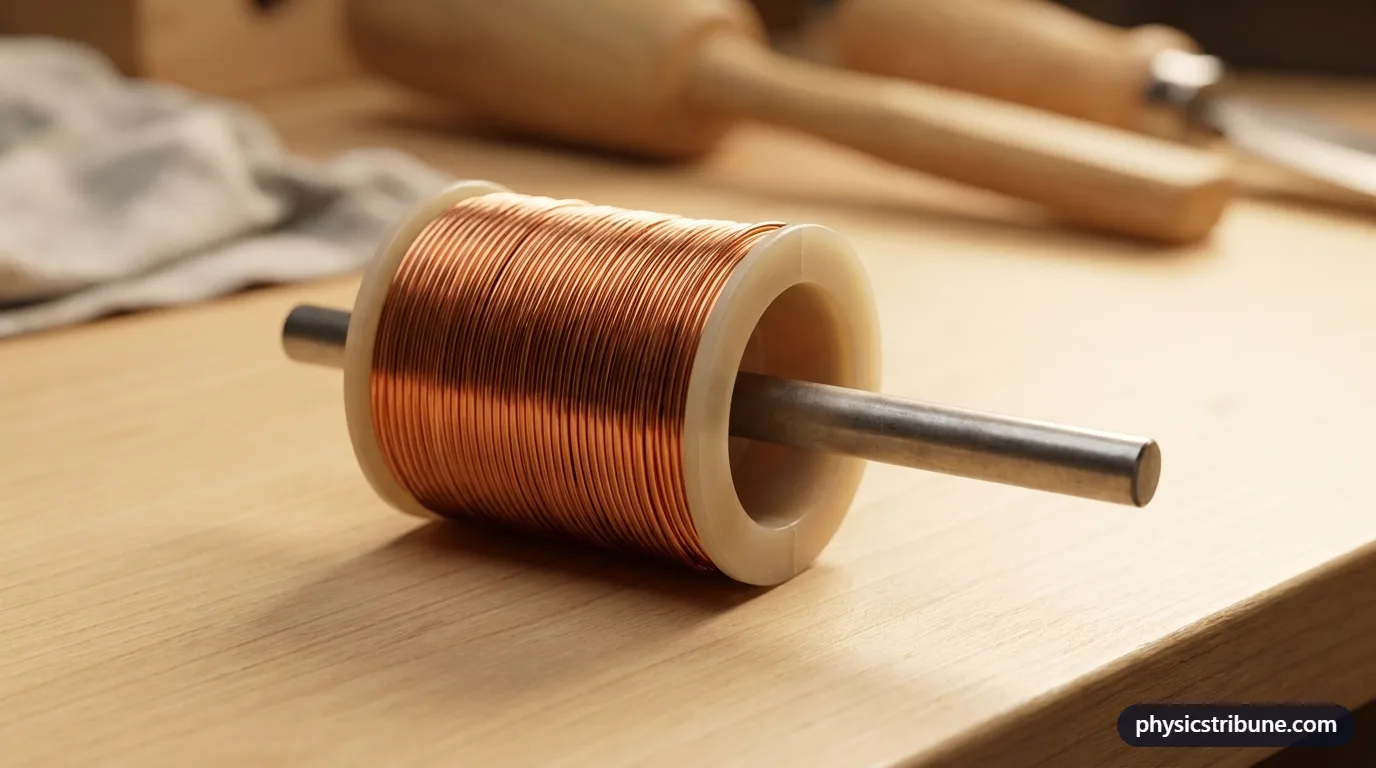
Every magnetic field comes from moving or spinning charge. In an electromagnet the motion is easy to see: electrons drift through the wire, and each loop of the coil adds its field to the others, just like the field of a solenoid. An iron core boosts the result, because the coil's field lines up the tiny magnetic regions inside the iron, which then add their own much larger field.
In a permanent magnet there is no current in a wire. Instead, electrons in each atom behave like microscopic magnets because of their spin. In ferromagnetic materials, neighboring atoms line up in regions called magnetic domains. When a magnet is made, a strong field forces most domains to point the same way, and in a hard magnetic material they stay that way after the field is removed.
So the two are closer cousins than they look. An electromagnet uses a current you control, while a permanent magnet uses billions of tiny atomic currents that you cannot switch off.

How Is the Strength of Each Magnet Calculated?
For an electromagnet, a simple formula gets you most of the way. Inside a long coil without a core, the field is
A permanent magnet has no equally simple formula. Its strength is set by the material and how it was magnetized, and makers describe it with properties such as remanence, the field the material keeps, and coercivity, its resistance to being demagnetized. Engineers usually measure the field near the surface with a sensor rather than calculate it.
For straight wires and coils you can check numbers with our magnetic field calculator.
The field inside the coil of an electromagnet (before adding an iron core) follows the solenoid formula.
| Symbol | Quantity | SI unit |
|---|---|---|
| magnetic field inside | tesla (T) | |
| permeability of free space (4π × 10⁻⁷ T·m/A (approximately; 1.2566 × 10⁻⁶ T·m/A)) | tesla meter per ampere (T·m/A) | |
| turns per unit length (N/ℓ) | per meter (1/m) | |
| current | ampere (A) | |
| total number of turns | dimensionless (1) | |
| length of the solenoid | meter (m) |
Rearranged to find another variable:
Valid for: long ideal solenoid, far from the ends; air core.
Example 1 Field inside an air-core coil
A hobby electromagnet coil is 0.25 m long with 500 turns of wire and no core yet. It carries a current of 2.0 A. What is the magnetic field inside the coil?
- Given:
- permeability of free space:
- total number of turns:
- length of the solenoid:
- current:
- permeability of free space:
- Formula:
- Substitute:
- Answer:
That is a few millitesla, similar to a small fridge magnet; sliding a soft iron core into the coil can multiply it hundreds of times.
| Source | Type | Typical field |
|---|---|---|
| Earth's field at the surface | Natural | About 25 to 65 µT |
| Flexible fridge magnet | Permanent | About 5 mT |
| Air-core hobby coil in Example 1 | Electromagnet | About 5 mT (computed) |
| Neodymium magnet, at its surface | Permanent | About 0.5 to 1.4 T |
| Hospital MRI scanner | Superconducting electromagnet | Usually 1.5 or 3 T |
| Strongest steady lab magnets | Electromagnet | Several tens of tesla |
| Source: Typical values (approximate); the coil value is computed with B = μ0 N I / ℓ using μ0 from NIST CODATA 2022 · Retrieved October 2026 | ||
Why Can You Control an Electromagnet but Not a Permanent Magnet?
An electromagnet has three knobs. More current gives a stronger field, more turns of wire give a stronger field, and a better core multiplies it. Reverse the direction of the current and the north and south poles swap ends, which you can check with the right-hand rule. Open the switch and the magnet lets go.
A permanent magnet has none of these knobs. Its strength is fixed when it is made, and its poles stay put. The only ways to change it are crude ones: heating it past a critical temperature, hitting it hard, or exposing it to a strong opposing field. All of these scramble the domains and weaken it, usually for good.
The trade-off is energy. An electromagnet needs a steady supply of electricity, and the coil warms up as current flows through its resistance. A permanent magnet holds your shopping list to the fridge for years without using any energy.
Example 2 Setting the current with the battery
The same coil is wound from wire with a total resistance of 4.0 Ω and connected to a 12 V battery. What current flows through it?
- Given:
- voltage across the resistor:
- resistance:
- voltage across the resistor:
- Formula:
- Substitute:
- Answer:
Raise the voltage or use thicker wire with less resistance and the current, and so the field, goes up. A permanent magnet has no such knob.

What Materials Are Used in Each?
Electromagnet cores use soft magnetic materials, such as pure iron or silicon steel. "Soft" here means easy to magnetize and easy to demagnetize, so the core follows the current and lets go cleanly when it stops. A core made of hard steel would stay partly magnetized after switch-off, which is a problem for a crane or a relay.
Permanent magnets use hard magnetic materials, the opposite type. Common ones are ceramic ferrite, which is cheap and used in fridge magnets and speakers, alnico, an alloy of aluminum, nickel and cobalt with iron, and the rare-earth families neodymium-iron-boron and samarium-cobalt, which are the strongest for their size. Our page on permanent and induced magnets explains why some metals keep their magnetism and others do not.
Where Are Electromagnets and Permanent Magnets Used?
Electromagnets suit jobs that need switching, adjusting or very strong fields:
- Scrapyard cranes that lift steel and drop it on command
- Relays, solenoid valves, door locks and electric bells
- MRI scanners, which use superconducting coils for a strong, steady field
- Particle accelerators and maglev trains
- The field coils of many large motors and generators
Permanent magnets suit jobs that need a steady field with no power supply:
- Fridge magnets, cabinet catches and magnetic clasps
- Compass needles, which line up with Earth's magnetic field
- Loudspeakers and headphones
- Small DC motors in toys and tools, and many electric car motors
Many devices use both. A loudspeaker pairs a fixed permanent magnet with a small electromagnet coil, and the push and pull between them moves the cone.
Who Discovered the Link Between Electricity and Magnetism?
Natural permanent magnets, lumps of the mineral magnetite called lodestones, were known in the ancient world, and magnetized needles were used for navigation for centuries before anyone connected magnetism with electricity. That link came in 1820, when Hans Christian Ørsted noticed that a current in a wire deflected a nearby compass needle. You can repeat that observation with our Ørsted compass experiment.
Within a few years, inventors were wrapping wire around iron to build the first electromagnets, and Joseph Henry showed in the early 1830s that many turns of insulated wire made them far stronger. Want to try it yourself? Our guide to building an electromagnet uses a nail, wire and a battery.
Common Misconceptions
Myth: Permanent magnets last forever without changing.
Physics: They are permanent only in normal use. High temperatures, hard knocks or strong opposing fields can partly or fully demagnetize them.
Myth: Electromagnets are always stronger than permanent magnets.
Physics: A small battery coil is usually weaker than a neodymium magnet of the same size. Electromagnets win only when they have enough current, turns and a good core.
Myth: An electromagnet makes a different kind of magnetic field.
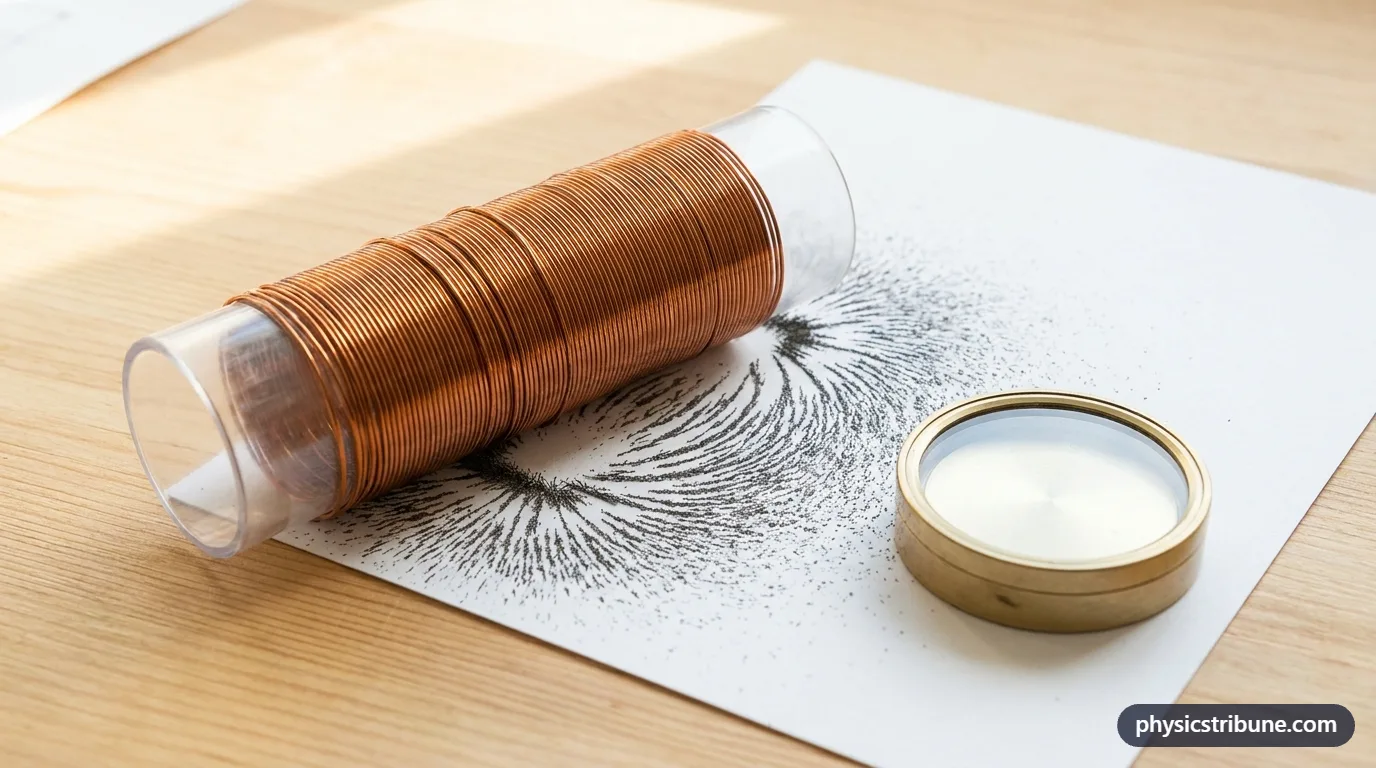
Physics: The field is the same physical thing. A current-carrying coil has the same pattern of field lines as a bar magnet, with north and south poles.
Myth: Any metal can be used as the core of an electromagnet.
Physics: Only ferromagnetic metals such as iron help. Copper or aluminum cores add almost nothing, and hard steel would stay magnetized after switch-off.
Key Facts
- An electromagnet is magnetic only while current flows through its coil; a permanent magnet stays magnetic with no power.
- The field inside a long coil is B = μ0 n I, so more turns or more current make a stronger electromagnet.
- Reversing the current in an electromagnet swaps its north and south poles.
- Electromagnet cores use soft iron, which loses its magnetism easily; permanent magnets use hard materials that keep it.
- Heat, impact and strong opposing fields can weaken a permanent magnet by scrambling its domains.
- The strongest steady magnetic fields on Earth come from electromagnets, many of them superconducting.
- Loudspeakers, motors and generators often combine a permanent magnet with an electromagnet.
Quick Quiz: How Well Do You Know Difference Between Electromagnet and Permanent Magnet?
6 questions. Tap an answer to check it.
What makes an electromagnet magnetic?
The magnetic field of an electromagnet comes from current flowing in its coil.
How can you reverse the poles of an electromagnet?
Reversing the current reverses the direction of the field, so the poles swap.
Which material is best for the core of an electromagnet?
Soft iron magnetizes strongly and loses its magnetism when the current stops.
According to B = μ0 n I, what happens to the field in a coil if the current doubles?
The field is directly proportional to the current.
Which of these can demagnetize a permanent magnet?
Heat above the Curie temperature scrambles the magnetic domains.
Which device is most likely to use an electromagnet rather than a permanent magnet?
A crane must switch its magnet off to release the load, which only an electromagnet can do.
Frequently Asked Questions
What is the main difference between an electromagnet and a permanent magnet?
An electromagnet is a coil of wire that becomes magnetic only while electric current flows through it, so it can be switched on and off and its strength can be changed. A permanent magnet is made of a material whose atoms stay aligned, so it is always magnetic and needs no power, but its strength and poles are fixed.
What is the difference between an electromagnet and a bar magnet?
A bar magnet is a type of permanent magnet: a solid bar of hard magnetic material with fixed north and south poles at its ends. An electromagnet produces the same field pattern, with the same kind of poles, but only while current flows in its coil. You can reverse an electromagnet's poles by reversing the current, which a bar magnet cannot do.
Which is stronger, an electromagnet or a permanent magnet?
It depends on the design. A small coil on a battery is usually weaker than a neodymium magnet of similar size. With many turns, high current and an iron core, electromagnets can far exceed any permanent magnet. The strongest steady magnetic fields ever made come from large electromagnets, including superconducting coils in MRI scanners and research labs.
Why do electromagnets use a soft iron core?
Soft iron is easy to magnetize, so the coil's field lines up the domains in the iron, multiplying the field many times. Soft iron is also easy to demagnetize, so when the current stops, the core quickly loses most of its magnetism and releases whatever it was holding. A hard steel core would keep some magnetism and hold on.
Can a permanent magnet lose its magnetism?
Yes. Heating a magnet above a critical temperature, called its Curie temperature, scrambles its domains and removes its magnetism. Dropping or hammering it can weaken it too, and so can placing it in a strong field that points the opposite way. Stored sensibly, though, a modern permanent magnet loses only a tiny fraction of its strength over many years.
How can you make an electromagnet stronger?
Increase the current, add more turns of wire, or use a better iron core. Each turn adds to the field, and the field grows in proportion to the current until the core saturates. Winding the turns closely together also helps, because the field depends on turns per meter. Using too much current, however, heats the wire and can melt its insulation.
Do electric motors use electromagnets or permanent magnets?
Most motors use both. A current-carrying coil, which is an electromagnet, turns inside a magnetic field that may come from permanent magnets or from more coils. Small DC motors in toys and many electric car motors use permanent magnets for the fixed field, while large industrial motors often use electromagnets for every part of the field.
Is the Earth an electromagnet or a permanent magnet?
Earth behaves more like an electromagnet. Its field is produced by electric currents in the moving, molten iron of the outer core, a process called a dynamo. A permanent magnet could not explain it, because the deep interior is far too hot for any material to stay magnetized, and because the field slowly drifts and has reversed many times.
Keep Exploring
 magnetismElectromagnets
 magnetismHow Magnets Work
 magnetismPermanent and Temporary (Induced) Magnets
 magnetismSolenoids
 magnetismFerromagnetism, Paramagnetism and Diamagnetism
 experimentsBuild an electromagnet
 calculatorsMagnetic Field Calculator (wire, solenoid)
 physicistsHans Christian Ørsted
 compareElectric Field vs Magnetic Field