
At a Glance
The right-hand rule finds directions in magnetism. Grip rule: point your right thumb along the current and your fingers curl the way the magnetic field circles the wire. Force rule: point your fingers along the velocity or current, curl them toward the field B, and your thumb shows the force F = qv × B or F = IL × B on a positive charge.
- What it finds
- The direction of a field, force or other cross-product quantity
- Grip rule
- Thumb = current, curled fingers = magnetic field
- Force rule
- Fingers = v or I, curl toward B, thumb = force
- Force on a wire
- F = ILB sin θ, perpendicular to both I and B
- Negative charges
- Use the right hand, then reverse the answer
- Based on
- The vector cross product, A × B
On this page
- What Is the Right-Hand Rule?
- The Right-Hand Rule Explained Simply
- How Do You Use the Right-Hand Grip Rule?
- How Does the Right-Hand Rule Work for Coils and Solenoids?
- How Do You Find the Direction of Magnetic Force on a Charge?
- What About Negative Charges Like Electrons?
- How Does the Right-Hand Rule Apply to a Current-Carrying Wire?
- How Are Fleming's Rules Related to the Right-Hand Rule?
- Where Else Is the Right-Hand Rule Used?
- What Are the Most Common Right-Hand Rule Mistakes?
- Key Facts
- Quiz
- FAQ
What Is the Right-Hand Rule?
The right-hand rule is a memory aid that turns your right hand into a three-dimensional pointer. Many quantities in magnetism come out at right angles to the things that cause them. A wire's field circles around the wire, and the force on a moving charge is sideways to both its motion and the field. Your hand keeps track of those directions so you do not have to picture them in your head.
There are two main forms. The grip rule (also called the curl rule) finds the direction of the magnetic field made by a current. The force rule finds the direction of the magnetic force on a moving charge or a current-carrying wire. Both come from the same mathematics, the cross product of two vectors.
The rule always uses the right hand because physicists agreed on that convention long ago. Use your left hand by mistake and every answer comes out exactly backward. Similar memory aids go back to the 1800s, including the swimmer rule of André-Marie Ampère and the corkscrew rule of James Clerk Maxwell.
The Right-Hand Rule Explained Simply
Grab a pencil with your right hand, thumb pointing along it toward the tip. Your fingers wrap around the pencil in one particular direction. Now imagine the pencil is a wire and the current flows toward the tip. The way your fingers wrap is the way the magnetic field circles the wire.
For forces, hold your right hand flat. Point your fingers in one direction, then bend them toward a second direction. Your thumb sticks out in a third direction at right angles to both. That third direction is where the push goes.
That is all there is to it. The hard part is not the gesture but remembering which finger stands for which quantity, so the table further down sums them up.
How Do You Use the Right-Hand Grip Rule?
For a straight wire, point your right thumb in the direction of the current. Your fingers curl the same way the magnetic field lines circle the wire. If the current comes straight toward you out of the page, the field circles counter-clockwise. If it goes into the page, the field circles clockwise.
The rule gives direction only. To find how strong the field is, use
Remember that "current" here means conventional current, the flow of positive charge. In a metal the electrons actually drift the other way, but the rules are written for conventional current.
Example 3 Field beside a wire found with the grip rule
A long vertical wire carries 20 A upward. What is the magnetic field strength 2.0 cm (0.020 m) from it? (The grip rule then tells you which way the field circles.) Use μ0 = 1.25663706127 × 10⁻⁶ T·m/A.
- Given:
- permeability of free space:
- current:
- perpendicular distance from the wire:
- permeability of free space:
- Formula:
- Substitute:
- Answer:
Seen from above, with the current coming toward you, the field circles counter-clockwise.


How Does the Right-Hand Rule Work for Coils and Solenoids?
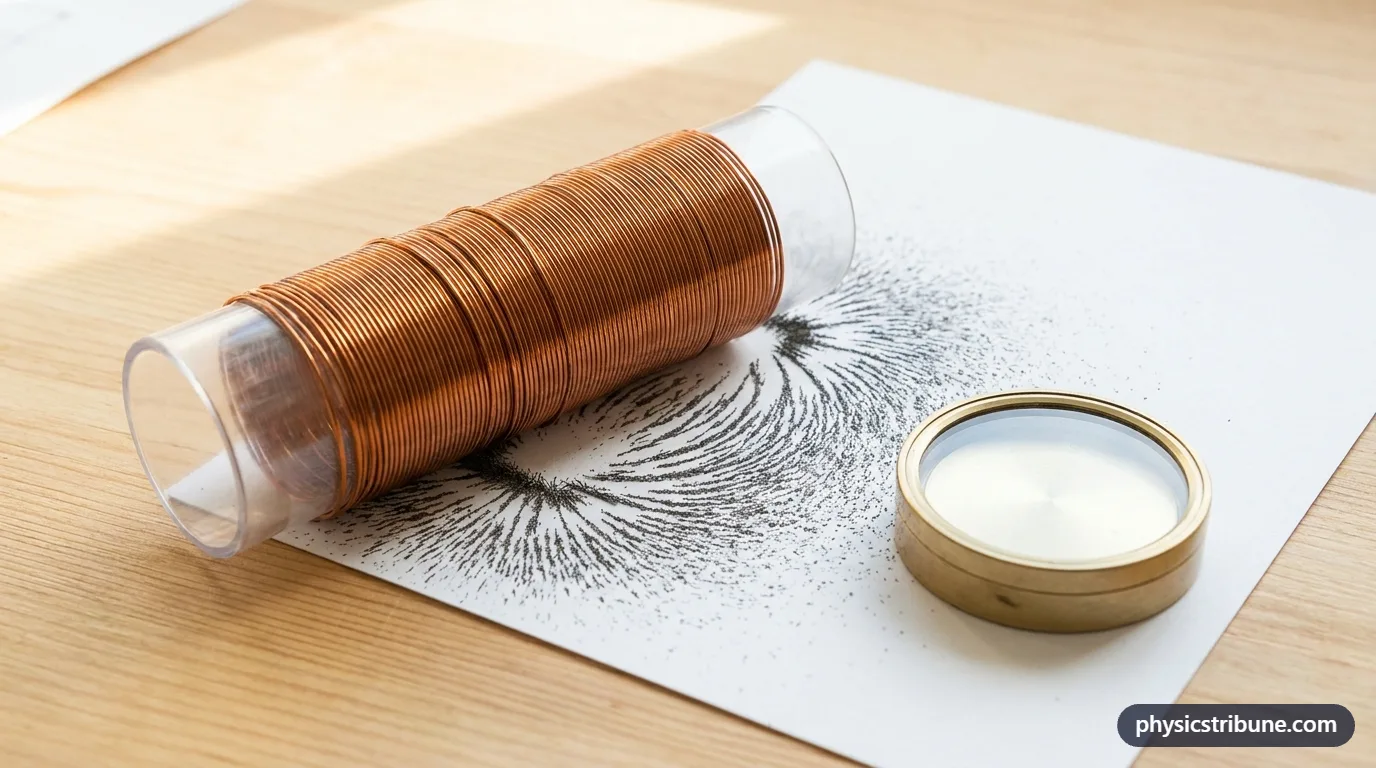
For a loop or a coil, swap the roles of thumb and fingers. Curl your right fingers in the direction the current flows around the loops. Your thumb then points along the magnetic field inside the coil, which is also the direction of the coil's north pole.
This version is handy for solenoids and electromagnets. Look at the end of a coil: if the current runs counter-clockwise as you face it, that end is a north pole. If it runs clockwise, you are looking at a south pole. Flip the battery and the poles swap.
How Do You Find the Direction of Magnetic Force on a Charge?
The magnetic force on a moving charge is
Many teachers prefer an equivalent flat-hand version. Hold your right hand flat, fingers along the field, thumb along the velocity. The force comes straight out of your palm, as if your hand were pushing something. Both versions always agree, so pick the one that feels natural and stick with it.
The size of the force is
What About Negative Charges Like Electrons?
The right-hand rule is set up for positive charges. For an electron or any other negative charge, apply the rule exactly as usual and then reverse the direction of the force. Some students use their left hand for electrons instead, which gives the same result, but mixing hands is a common source of errors.
A quick check helps. A proton and an electron fired the same way through the same field curve in opposite directions. In particle detectors this is how physicists tell positive and negative particles apart at a glance: the tracks curl opposite ways.
How Does the Right-Hand Rule Apply to a Current-Carrying Wire?
A current is a stream of moving charges, so a wire in a magnetic field feels a force too. Point your fingers along the current, curl them toward the field, and your thumb shows the force on the wire. The size is
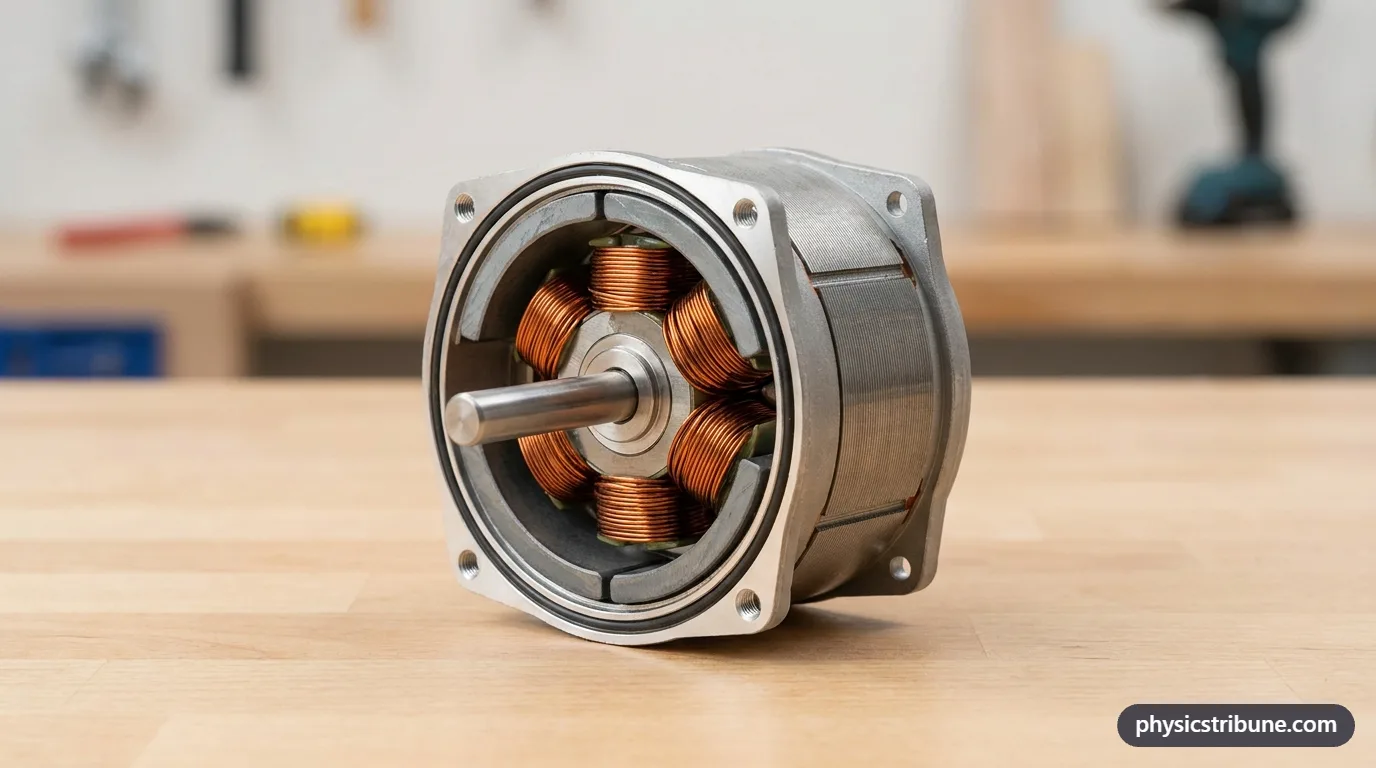
This sideways push is called the motor effect. It is the reason an electric motor spins: current flows one way along one side of a coil and the opposite way along the other, so the two sides are pushed in opposite directions and the coil turns. Details are on the force on a current-carrying wire page.
The right-hand rule gives the direction; this formula gives the size of the force on a current-carrying wire. Here it is with each symbol and its SI unit.
| Symbol | Quantity | SI unit |
|---|---|---|
| magnetic force | newton (N) | |
| current | ampere (A) | |
| length of wire in the field | meter (m) | |
| magnetic field | tesla (T) | |
| angle between wire (current direction) and B | radian (rad) |
Rearranged to find another variable:
Valid for: straight wire in a uniform field.
Example 1 Force on a wire across a magnet
A straight wire 20 cm (0.20 m) long carries 5.0 A east, at right angles to a 0.50 T magnetic field that points north. What is the size of the force on the wire? (Use the right-hand rule for its direction.)
- Given:
- current:
- length of wire in the field:
- magnetic field:
- current:
- Formula:
- Substitute:
- Answer:
With fingers pointing east and curling toward north, the thumb points straight up, so the wire is pushed upward.
Example 2 When the wire is tilted
The same 0.20 m wire carrying 5.0 A is turned so it makes a 60° angle (1.0472 rad) with the 0.50 T field. What is the size of the force now?
- Given:
- current:
- length of wire in the field:
- magnetic field:
- angle between wire (current direction) and B:
- current:
- Formula:
- Substitute:
- Answer:
The direction is still perpendicular to both the wire and the field; only the size shrinks as the wire lines up with B.

How Are Fleming's Rules Related to the Right-Hand Rule?
Fleming's rules are another way to remember the same directions, popular in British and Indian courses. They use the thumb, first finger and second finger held at right angles to each other.
- Fleming's left-hand rule is for motors: first finger along the field, second finger along the current, thumb gives the motion (force). See Fleming's left-hand rule.
- Fleming's right-hand rule is for generators: thumb along the motion of the wire, first finger along the field, second finger gives the direction of the induced current.
A common memory trick is "FBI" or "Father, Mother, Child" style labels for the three fingers. Whatever system your course uses, it must give the same answers as the cross-product rule, so you can check one against the other. The induced-current direction can also be found with Lenz's law.
| Rule | What you point | What you read off | Used for |
|---|---|---|---|
| Right-hand grip rule (wire) | Thumb along the current | Curled fingers give the field direction | Field around a straight wire |
| Right-hand grip rule (coil) | Fingers curl with the current | Thumb gives the field inside and the north pole | Solenoids, electromagnets |
| Right-hand force rule | Fingers along v or I, curl toward B | Thumb gives the force | Force on a positive charge or a wire |
| Flat-hand (palm) rule | Fingers along B, thumb along v or I | Palm pushes in the force direction | Same as the force rule |
| Fleming's left-hand rule | First finger = field, second finger = current | Thumb gives the motion | Electric motors |
| Fleming's right-hand rule | Thumb = motion, first finger = field | Second finger gives the induced current | Generators |
| Rotation rule | Fingers curl with the rotation | Thumb gives the axis vector | Torque, angular velocity |
| Source: Standard conventions of the vector cross product; summary written for this page · Retrieved October 2026 | |||
Where Else Is the Right-Hand Rule Used?
Any quantity defined by a cross product uses the right-hand rule. In mechanics, the direction of torque comes from
Mathematicians use it to set up 3D axes, too. In a right-handed coordinate system, curling your fingers from the x-axis to the y-axis makes your thumb point along the z-axis. Almost every physics and engineering book uses that convention.
What Are the Most Common Right-Hand Rule Mistakes?
- Using the left hand while writing with the right. Put the pencil down first.
- Forgetting to flip for electrons. The rule is for positive charge and conventional current.
- Mixing up the grip rule and the force rule. The grip rule finds a field from a current; the force rule finds a force from a field.
- Swapping fingers in the coil version. For a coil, fingers follow the current and the thumb gives the field.
- Reading into and out of the page backward. A dot (⊙) means toward you, like the tip of an arrow; a cross (⊗) means away, like its tail feathers.
Practice beats memorizing. Our magnetism worksheets include right-hand rule drills with answer keys, and the magnetism formula sheet lists every related equation.
Myth: The right-hand rule tells you how strong a field or force is.
Physics: It gives direction only. The size comes from formulas such as B = μ0I/(2πr) or F = ILB sin θ.
Myth: The rule works the same for electrons as for protons.
Physics: The rule is defined for positive charge. For a negative charge, reverse the direction it gives.
Myth: The grip rule and the force rule are the same thing.
Physics: The grip rule finds the field a current makes. The force rule finds the push a field exerts on a current or moving charge.
Myth: In the rules, current means the direction electrons flow.
Physics: The rules use conventional current, the direction positive charge would move, which is opposite to the electron drift in a metal wire.
Key Facts
- The right-hand rule gives the direction of quantities that are perpendicular to two others, such as magnetic fields and forces.
- Grip rule: thumb along the current, curled fingers show the magnetic field around the wire.
- For a coil, fingers follow the current and the thumb points to the north pole.
- Force rule: fingers along the velocity, curl toward the field, thumb gives the force on a positive charge.
- For electrons and other negative charges, the force points the opposite way.
- The size of the force on a wire is F = ILB sin θ; the right-hand rule supplies only its direction.
- Torque, angular velocity and 3D coordinate axes use the same right-hand convention.
Quick Quiz: How Well Do You Know Right-Hand Rule?
6 questions. Tap an answer to check it.
In the right-hand grip rule for a straight wire, what does the thumb point along?
The thumb follows the current and the curled fingers show the field.
A current comes straight out of the page toward you. Which way does its magnetic field circle?
With the thumb pointing at you, the right-hand fingers curl counter-clockwise.
For a negative charge, how does the force compare with what the right-hand rule shows?
The rule is for positive charge, so the answer is reversed for a negative charge.
For a coil carrying current, what does the thumb show in the right-hand rule?
Curl the fingers with the current and the thumb points along the field toward the north pole.
A wire carries current east in a field pointing north. Which way is the force on the wire?
Fingers east, curled toward north, leave the thumb pointing up.
What does the right-hand rule NOT tell you?
The rule gives direction only; the size comes from a formula.
Frequently Asked Questions
What is the right-hand rule in simple terms?
It is a way of using your right hand to find a direction in three dimensions. Point your thumb along a current and your curled fingers show how its magnetic field circles. Or point your fingers along a moving charge, curl them toward the magnetic field, and your thumb shows which way the charge is pushed. It turns an abstract vector rule into a gesture.
What is the right-hand grip rule?
The grip rule finds the direction of the magnetic field around a current. Wrap your right hand around a wire with your thumb pointing along the conventional current. Your fingers curl in the direction the field lines circle. For a coil, curl your fingers with the current around the loops, and your thumb points along the field inside, toward the north pole.
How do you use the right-hand rule for magnetic force?
Point the fingers of your right hand in the direction of the velocity of a positive charge, or along the current in a wire. Bend your fingers toward the direction of the magnetic field. Your outstretched thumb then points in the direction of the force. For an electron, reverse that direction. The force is always at right angles to both the motion and the field.
Why do we use the right hand and not the left?
It is simply an agreed convention that defines the direction of the cross product and of the magnetic field vector. Once scientists picked the right hand, every formula and diagram was written to match. Nature does not care which hand you use, but the magnetic field arrows in your answers depend on the convention, so you must stay consistent.
What is the difference between the right-hand rule and Fleming's left-hand rule?
They describe the same physics with a different finger code. The right-hand force rule uses curled fingers from velocity toward field with the thumb giving the force. Fleming's left-hand rule holds thumb, first finger and second finger at right angles: field along the first finger, current along the second, and the thumb gives the motion. Both give identical directions for a motor.
Does the right-hand rule work for electrons?
Only if you reverse the result. The rule is defined for positive charges and conventional current. An electron has negative charge, so the force on it points opposite to what your thumb shows. Some students use the left hand for electrons as a shortcut, which gives the reversed answer directly, but it is easy to forget which hand you are using.
What do dots and crosses mean in right-hand rule diagrams?
They show directions perpendicular to the page. A dot means the current or field points out of the page, toward you, like seeing the tip of an arrow. A cross means it points into the page, away from you, like seeing the feathered tail of an arrow. Many right-hand rule problems use these symbols for the field direction.
How is the right-hand rule used in torque?
Torque is the cross product of the lever arm vector and the force. Curl the fingers of your right hand in the direction the force tends to rotate the object, and your thumb points along the torque vector. A wrench turning a bolt counter-clockwise, seen from above, gives a torque pointing up, which matches the way a standard bolt moves when loosened.
Keep Exploring
 magnetismMagnetic Field
 magnetismMagnetic Force on a Moving Charge (Lorentz Force)
 magnetismFleming's Left-Hand Rule
 magnetismMagnetic Force on a Current-Carrying Wire
 motionCross Product (Vector Product) in Physics
 magnetismHow Electric Motors Work
 calculatorsMagnetic Field Calculator (wire, solenoid)
 worksheetsMagnetism Worksheets
 physicistsAndré-Marie Ampère