
At a Glance
Momentum is a property of a moving object, p = m v, measured in kg·m/s. Impulse is what a force delivers during a collision or push, J = F Δt, measured in N·s. The impulse-momentum theorem links them: the impulse on an object equals its change in momentum, J = Δp.
- Momentum
- p = m v, what an object has
- Impulse
- J = F Δt, what a force gives
- Units
- kg·m/s for p, N·s for J (the same unit)
- Type
- Both are vectors
- Link
- Impulse = change in momentum, J = Δp
On this page
- What Is the Difference Between Momentum and Impulse?
- How Are Momentum and Impulse Defined?
- What Are the Formulas for Momentum and Impulse?
- How Does the Impulse-Momentum Theorem Connect Them?
- Why Does Stretching the Impact Time Reduce the Force?
- What Are Examples of Momentum and Impulse?
- Why Do Signs and Directions Matter for Both?
- Where Can You Practice Momentum and Impulse Problems?
- Common Misconceptions
- Key Facts
- Quiz
- FAQ
What Is the Difference Between Momentum and Impulse?
Momentum and impulse are close relatives, and students often treat them as the same thing because they share a unit. They answer different questions. Momentum asks how much motion an object carries right now. Impulse asks how much a force changed that motion while it acted.
Think of a bank account. Momentum is the balance at a given moment. Impulse is a deposit or a withdrawal. A balance belongs to the account; a deposit is an event that happens to it over a stretch of time. In the same way, a rolling bowling ball has momentum, while the bat that hits a baseball delivers impulse.
The table below compares the two point by point. The rest of the page explains the formulas, the theorem that connects them and why the distinction matters for safety design.
| Feature | Momentum | Impulse |
|---|---|---|
| Question it answers | How much motion does the object have? | How much did a force change that motion? |
| Formula | p = m v | J = F Δt |
| Symbol | p | J (sometimes I) |
| SI unit | kg·m/s | N·s (equal to kg·m/s) |
| Scalar or vector | Vector, along the velocity | Vector, along the force |
| Describes | A state at one instant | An event over a time interval |
| Needs a time interval? | No | Yes |
| Belongs to | The moving object | The interaction between two objects |
| Can be zero while moving? | No, a moving object always has momentum | Yes, if no net force acts |
| On a graph | Mass times the value on a v-t graph | Area under a force-time graph |
| Relationship | Changes by the impulse received | Equals the change in momentum, Δp |
| Everyday example | A rolling bowling ball | A bat striking a baseball |
| Source: Definitions as used in standard SI mechanics; examples are illustrative · Retrieved October 2026 | ||
How Are Momentum and Impulse Defined?
Momentum is the product of an object's mass and its velocity,
Impulse is the product of the average force on an object and the time that force acts,
One quick test helps. If you can describe the quantity with a photograph of a moving object, it is momentum. If you need a short video of a force acting, it is impulse.
Example 1 A soccer ball in flight
A 0.43 kg soccer ball flies toward the goal at 18 m/s. What is its momentum?
- Given:
- mass:
- velocity:
- mass:
- Formula:
- Substitute:
- Answer:
This number describes the ball at one instant. It says nothing about how the ball got that motion.
What Are the Formulas for Momentum and Impulse?
Momentum is
When the force changes during a collision, as it nearly always does, impulse is the area under the force-time graph. Using the average force simply replaces that curved area with a rectangle of the same size. The full set of related equations is collected on our momentum formulas page, and the momentum calculator solves p = mv for any missing value.
Here is the impulse formula with each variable and its SI unit, plus the rearranged forms for force and contact time.
| Symbol | Quantity | SI unit |
|---|---|---|
| impulse | newton second (N·s) | |
| average force | newton (N) | |
| duration of the force | second (s) |
Rearranged to find another variable:
Valid for: F is the average (or constant) force over Δt.
Example 2 A hammer driving a nail
A hammer head presses on a nail with an average force of 2,400 N during a contact that lasts 0.0015 s. What impulse does the nail receive?
- Given:
- average force:
- duration of the force:
- average force:
- Formula:
- Substitute:
- Answer:
A large force acting for a very short time can still deliver only a modest impulse.
How Does the Impulse-Momentum Theorem Connect Them?
The impulse on an object equals its change in momentum:
The theorem is the bridge between the two quantities. Momentum is a before-and-after snapshot, and impulse is the cause of the difference between the snapshots. If no impulse acts, momentum stays the same, which leads straight to the conservation of momentum in collisions.
The velocity-time graph below shows a 2 kg cart at rest, then pushed with a steady 12 N force for 0.5 s, then coasting. The push delivers 6 N·s of impulse, so the cart's momentum rises from 0 to 6 kg·m/s and its velocity from 0 to 3 m/s. After the push ends, the momentum stays constant.
Example 3 A tennis ball reversing direction
A 0.057 kg tennis ball arrives at a racket moving at 25 m/s and leaves in the opposite direction at 35 m/s. The strings touch the ball for 0.005 s. Taking the outgoing direction as positive, what average force does the racket exert?
- Given:
- time interval:
- mass:
- final velocity:
- initial velocity:
- time interval:
- Formula:
- Substitute:
- Answer:
The impulse here is 0.057 × 60 = 3.42 N·s (computed). Reversing the ball needs more impulse than stopping it, because its momentum changes sign.

Why Does Stretching the Impact Time Reduce the Force?
Stopping a moving object always takes the same impulse, because its change in momentum is fixed by its mass and speed. What you can choose is how that impulse is split between force and time. A longer stop means a smaller average force.
Picture a 0.06 kg egg falling at 4 m/s. To stop it, something must remove 0.24 kg·m/s of momentum. A tile floor does that in about 0.002 s, so the average force is about 120 N and the shell cracks. A soft pillow stretches the stop to about 0.05 s, cutting the force to about 4.8 N (all values computed), and the egg survives.
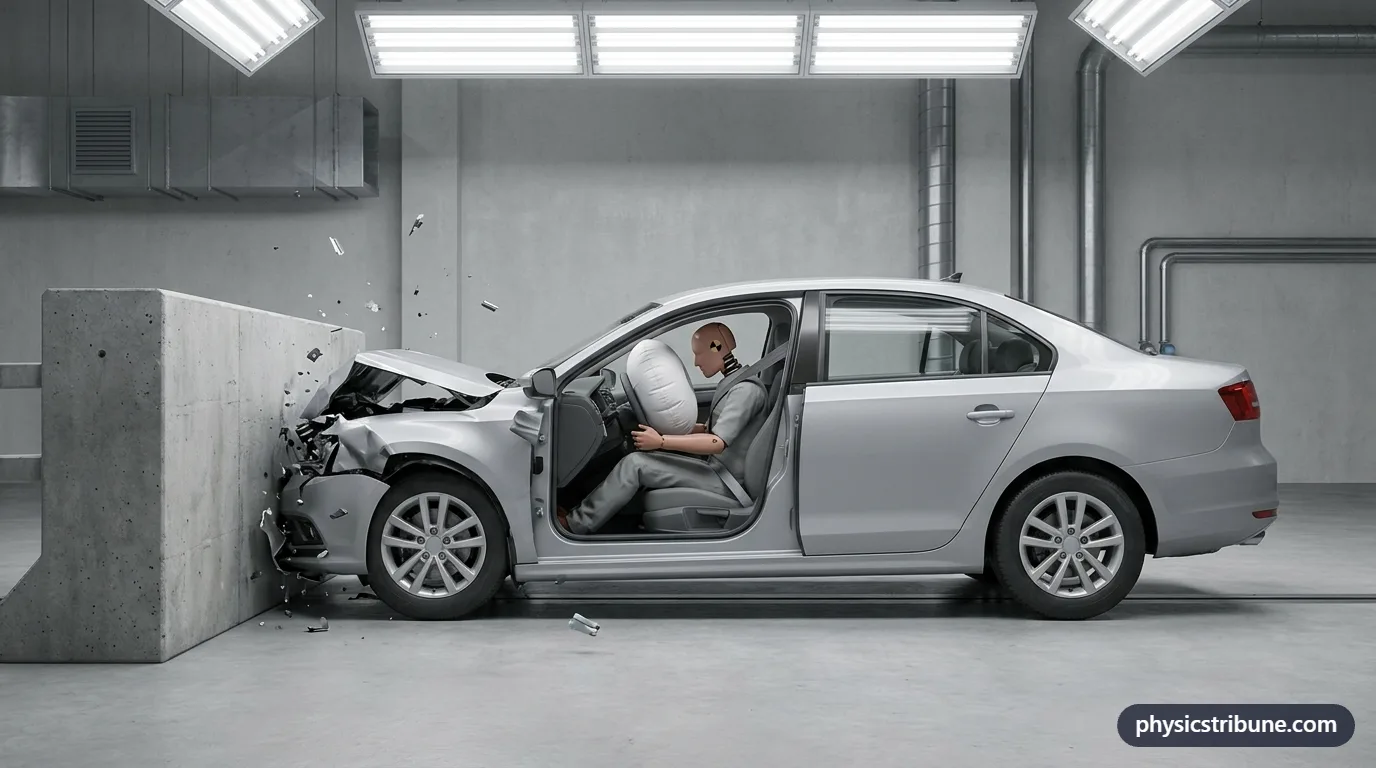
The same idea drives airbags, crumple zones, bike helmets and the way a catcher pulls the glove back. Each one lengthens the contact time so the impulse arrives as a gentle push rather than a sharp blow. Our page on car safety features follows this through in detail.
What Are Examples of Momentum and Impulse?
Statements about momentum describe something in motion:
- A freight train rolling at walking pace has enormous momentum because of its mass.
- A hockey puck sliding across the ice keeps nearly constant momentum because friction is small.
- A bowling ball of 6 kg moving at 7 m/s carries 42 kg·m/s of momentum (computed).
Statements about impulse describe a force acting for a time:
- A golfer's club strikes the ball for well under a thousandth of a second.
- A rocket engine firing for a minute delivers impulse to the spacecraft the whole time.
- Follow-through in tennis or baseball keeps the force on the ball a little longer, adding impulse.
A useful habit is to ask whether the sentence needs a time interval. Impulse always does; momentum never does.
Why Do Signs and Directions Matter for Both?
Both quantities are vectors, so direction is part of the answer. When a ball bounces off a wall, its momentum flips from positive to negative. The change in momentum is then larger than the momentum itself, because you must first cancel the incoming motion and then build up motion the other way.
That is why a ball that bounces receives more impulse than one that sticks. It is also why the tennis example above uses a negative incoming velocity. Forgetting the sign is the most common mistake in impulse problems, and it usually makes the answer far too small.
Where Can You Practice Momentum and Impulse Problems?
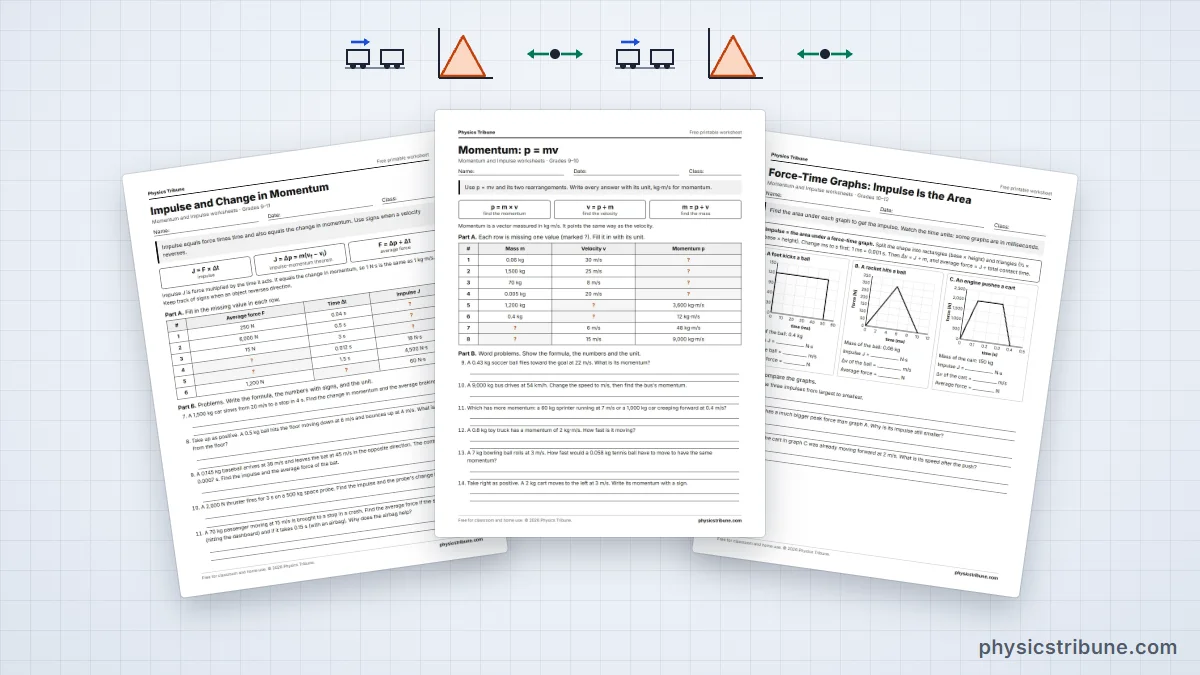
Mixed problems that ask for momentum before, momentum after and the impulse in between are the fastest way to lock in the difference. Our momentum and impulse worksheets include printable answer keys. For a broader overview of the topic, start from the momentum and impulse hub, and compare a related pair on momentum vs kinetic energy.
Common Misconceptions
Myth: Momentum and impulse are the same thing because they have the same unit.
Physics: Sharing a unit does not make them equal. Momentum is what an object has; impulse is the change a force produces. Impulse equals the change in momentum, not the momentum itself.
Myth: A bigger force always means a bigger impulse.
Physics: Impulse depends on force and time together. A small force acting for a long time can deliver more impulse than a large force acting for an instant.
Myth: Airbags reduce the impulse on a passenger.
Physics: The impulse is the same, because the passenger's momentum must still go to zero. The airbag spreads it over a longer time, which lowers the average force.
Myth: A ball that bounces back gets the same impulse as one that stops dead.
Physics: A bounce reverses the momentum, so the change is larger. The surface must deliver more impulse to send the ball back than to stop it.
Key Facts
- Momentum is mass times velocity and describes the motion an object has at one moment.
- Impulse is average force times contact time and describes how a force changes that motion.
- The impulse on an object always equals its change in momentum.
- Momentum and impulse share the same SI unit, because 1 N·s equals 1 kg·m/s.
- Both are vectors, so a bounce changes momentum more than a stop does.
- For a fixed change in momentum, a longer contact time means a smaller average force.
- Impulse is the area under a force-time graph.
Quick Quiz: How Well Do You Know Momentum vs Impulse?
6 questions. Tap an answer to check it.
Which formula gives impulse?
Impulse is average force multiplied by the time the force acts.
A 3 kg cart moves at 4 m/s. What is its momentum?
Momentum is mass times velocity: 3 kg × 4 m/s = 12 kg·m/s.
What does the impulse on an object equal?
The impulse-momentum theorem says J = Δp.
An airbag protects a driver mainly by
The same impulse spread over a longer time means a smaller average force.
Which unit is equivalent to N·s?
1 N = 1 kg·m/s², so 1 N·s = 1 kg·m/s.
A ball bounces straight back from a wall at the same speed. Compared with a ball that sticks, the bouncing ball receives
Reversing the momentum doubles the change compared with stopping it.
Frequently Asked Questions
What is the main difference between momentum and impulse?
Momentum is the quantity of motion an object has at one instant, found by multiplying its mass by its velocity. Impulse is the effect of a force acting over a period of time, found by multiplying the average force by the time it acts. Momentum describes a state, while impulse describes an event that changes that state.
Is impulse equal to momentum?
Impulse is equal to the change in momentum, not to momentum itself. This is the impulse-momentum theorem, J = Δp. The two are only numerically equal in the special case where an object starts from rest, because then its final momentum and its change in momentum are the same number.
Do momentum and impulse have the same units?
Yes. Momentum is measured in kilogram meters per second, and impulse is measured in newton seconds. Since a newton is a kilogram meter per second squared, multiplying by seconds gives kilogram meters per second. Physicists use kg·m/s for momentum and N·s for impulse mostly to signal which idea they mean.
Can an object have momentum but no impulse?
Yes. A puck gliding across smooth ice has momentum but receives almost no impulse, because almost no net force acts on it. Its momentum therefore stays nearly constant. Impulse only appears when a net force acts for some time, and whenever it does, the momentum changes by exactly that impulse.
Why does following through increase impulse?
Following through keeps the bat, racket or club in contact with the ball a little longer. Since impulse is force multiplied by contact time, the extra time adds impulse even if the force stays the same. More impulse means a larger change in the ball's momentum, so it leaves faster.
Is impulse a vector or a scalar?
Impulse is a vector. It points in the same direction as the average force that produced it. Momentum is also a vector, pointing along the velocity. Because both have direction, you need to choose a positive direction and keep track of signs, especially for bounces where the momentum reverses.
How do you find impulse from a force-time graph?
Impulse is the area under the force-time graph. For a constant force the area is a rectangle, force times time. For a changing force you can split the area into simple shapes, count grid squares, or use the average force multiplied by the total time. The result equals the change in momentum.
Which matters more in a car crash, momentum or impulse?
Both matter. The car's momentum before the crash sets how much impulse is needed to stop it. Safety features cannot change that amount, but they can stretch out the time over which the impulse is delivered. That keeps the average force on the people inside much lower.
Keep Exploring
 momentumImpulse and the Impulse-Momentum Theorem
 momentumLinear Momentum (p = mv)
 momentumMomentum & Impulse
 momentumLaw of Conservation of Momentum
 compareMomentum vs Kinetic Energy
 momentumCar Safety Physics: Crumple Zones, Airbags and Seat Belts
 calculatorsMomentum Calculator
 worksheetsMomentum and Impulse Worksheets
 formulasMomentum and Impulse Formulas