Momentum Calculator
- Convert to SI: m = 1,500 kg, v = 20 m/s
- p = m × v = 1,500 × 20 = 30,000 kg·m/s

At a Glance
Momentum is calculated with p = m v, using mass in kilograms and velocity in meters per second to get kg·m/s. Impulse is J = F Δt, and the impulse-momentum theorem says F Δt = m (v_f - v_i), so the average force that changes an object's motion equals its change in momentum divided by the time taken.
- Formulas
- p = mv · J = FΔt = Δp
- Solves for
- Momentum, mass, velocity, impulse, force, time
- Mass units
- kg, g, lb, metric ton
- Speed units
- m/s, km/h, mph, ft/s
- Momentum units
- kg·m/s, N·s, lb·ft/s, lbf·s
- Vector?
- Yes: the sign gives the direction
On this page
- Momentum and impulse calculator: solve p = mv, J = FΔt or FΔt = mΔv
- How to Use the Momentum Calculator
- What Is the Momentum Formula?
- How Do You Calculate Momentum Step by Step?
- How Do You Calculate Impulse?
- How Is Impulse Related to the Change in Momentum?
- How Much Momentum Do Everyday Objects Have?
- How Do You Calculate Momentum After a Collision?
- Related Calculators and Practice
- Key Facts
- FAQ
How to Use the Momentum Calculator
Start by picking a method. Choose Momentum p = mv when you know two of mass, velocity and momentum, Impulse J = FΔt when a force acts for a known time, or Impulse-momentum FΔt = mΔv when a force changes an object's speed. Then press the variable you want to find, type the other values and set each unit from its dropdown.
The answer updates as you type and appears in the unit you chose for it, followed by a numbered list of steps: the conversion to SI units, the formula, the substitution and the result. Velocity, force, momentum and impulse may be negative, because the sign tells you the direction along a line. Mass and time must always be positive.
What Is the Momentum Formula?
The momentum formula in physics is
This page focuses on calculating momentum. For what momentum means and why it matters, see our linear momentum page, and the momentum formulas sheet collects the related equations for collisions and conservation in one place.
The first method of the calculator uses this formula and its two rearranged forms, after converting every input to SI units.
| Symbol | Quantity | SI unit |
|---|---|---|
| momentum | kilogram meter per second (kg·m/s) | |
| mass | kilogram (kg) | |
| velocity | meter per second (m/s) |
Rearranged to find another variable:
Valid for: vector (same direction as v); non-relativistic.
How Do You Calculate Momentum Step by Step?
Working out momentum by hand takes three steps:
- Convert to SI units. Mass goes in kilograms and velocity in meters per second. Divide km/h by 3.6, multiply mph by 0.44704, and multiply pounds by 0.45359237.
- Choose a positive direction. Give velocities that point the other way a minus sign.
- Multiply mass by velocity. The product is the momentum in kg·m/s, carrying the same sign as the velocity.
For a 0.43 kg soccer ball kicked at 25 m/s, the momentum is 0.43 times 25, or 10.75 kg·m/s. If the ball bounces back off a wall at 20 m/s, its new momentum is 0.43 times minus 20, or minus 8.6 kg·m/s.
Example 1 A delivery van on a city street
A 2,400 kg delivery van drives at 15 m/s (54 km/h). What is its momentum?
- Given:
- mass:
- velocity:
- mass:
- Formula:
- Substitute:
- Answer:
The unit kg·m/s is the same as N·s, so this is also the impulse the brakes must supply to stop the van.
How Do You Calculate Impulse?
Impulse measures how strongly and for how long a force acts. Multiply the average force by the time it lasts:
The unit N·s equals kg·m/s, which is a hint that impulse and momentum are closely linked. When you need the force instead, the calculator divides the impulse by the time, and when you need the time, it divides the impulse by the force. Both must point the same way for the time to come out positive.
Example 2 A golf club striking a ball
A golf club pushes on a ball with an average force of 4,600 N for 0.0005 s. What impulse does the ball receive?
- Given:
- average force:
- duration of the force:
- average force:
- Formula:
- Substitute:
- Answer:
Since the ball started at rest, this impulse is also its momentum as it leaves the tee.
How Is Impulse Related to the Change in Momentum?
The impulse-momentum theorem states that the impulse on an object equals its change in momentum:
The theorem explains many safety designs. Stretching the stopping time lowers the average force for the same change in momentum, which is why airbags, crumple zones and soft landing mats work. The car safety features page shows this in vehicles, and impulse vs momentum sets the two quantities side by side.
Example 3 Average force on a stopping skateboarder
A 55 kg skateboarder rolling at 6 m/s drags a foot and comes to rest in 2.5 s. What average force acts on the rider?
- Given:
- time interval:
- mass:
- final velocity:
- initial velocity:
- time interval:
- Formula:
- Substitute:
- Answer:
The minus sign shows that the force points backward, against the direction of travel.
How Much Momentum Do Everyday Objects Have?
The table lists typical momenta from a falling raindrop to a moving freight train. Unlike kinetic energy, momentum grows only in proportion to speed, so mass plays a larger part. A walking adult carries more momentum than a fast baseball, because 70 kg is about 480 times the mass of the ball while the ball is only about 29 times faster.
Heavy vehicles stand out. A loaded semi truck at highway speed has about 24 times the momentum of a family car at the same speed, which is why trucks need much longer distances to stop. The diagram shows the braking force that slowly removes a car's momentum.
| Object | Mass (kg) | Speed (m/s) | Momentum (kg·m/s) | Momentum (lb·ft/s) |
|---|---|---|---|---|
| Raindrop, 2 mm across | 0.0000042 | 6.5 | 2.73 × 10⁻⁵ | 1.97 × 10⁻⁴ |
| Tennis serve | 0.057 | 55 | 3.14 | 22.7 |
| Pitched baseball | 0.145 | 40 | 5.8 | 42 |
| Hockey puck, slap shot | 0.17 | 40 | 6.8 | 49.2 |
| Kicked soccer ball | 0.43 | 25 | 10.8 | 77.8 |
| Walking adult | 70 | 1.4 | 98 | 709 |
| Cyclist with bike | 85 | 7 | 595 | 4,300 |
| Sprinter at top speed | 80 | 11 | 880 | 6,370 |
| Compact car at 50 km/h | 1,200 | 13.9 | 16,700 | 121,000 |
| Family car at 100 km/h | 1,500 | 27.8 | 41,700 | 301,000 |
| Loaded semi truck at 100 km/h | 36,000 | 27.8 | 1.00 × 10⁶ | 7.23 × 10⁶ |
| Freight train at 60 km/h | 5,000,000 | 16.7 | 8.33 × 10⁷ | 6.03 × 10⁸ |
| Source: Computed with p = mv; masses and speeds are typical values · Retrieved October 2026 | ||||

How Do You Calculate Momentum After a Collision?
In a collision between two objects with no outside push, the total momentum before equals the total momentum after. Find each object's momentum with p = mv, add them with their signs, and set that total equal to the sum after impact. This is the law of conservation of momentum.
For a pair of carts, a 2 kg cart at 3 m/s hitting a resting 1 kg cart gives a total of 6 kg·m/s before and after. If they stick together, 6 divided by 3 kg gives a shared speed of 2 m/s. For full before-and-after solutions, including bouncy and sticky impacts, use our collision calculator.
Key Facts
- Momentum is calculated with p = mv, using kilograms and meters per second to get kg·m/s.
- Momentum is a vector: its sign or direction matches the direction of the velocity.
- Impulse is J = FΔt, and its unit N·s is identical to kg·m/s.
- The impulse-momentum theorem says FΔt = mv_f − mv_i, the change in momentum.
- Doubling the time of an impact halves the average force for the same change in momentum.
- In a collision with no outside force, the total momentum before equals the total momentum after.
Frequently Asked Questions
How do you calculate momentum?
Multiply the mass in kilograms by the velocity in meters per second. The result is momentum in kg·m/s. For example, a 60 kg runner at 5 m/s has 60 times 5, or 300 kg·m/s. If the velocity points in the negative direction, the momentum is negative too. The calculator above converts other units such as pounds or miles per hour and shows each step.
What is the formula for momentum?
The formula is p = mv, where p is momentum, m is mass and v is velocity. Rearranged, velocity is v = p/m and mass is m = p/v. Momentum is a vector, so it points the same way as the velocity. The formula holds for everyday speeds; near the speed of light, a relativistic version with an extra factor is needed.
What is the unit of momentum?
The SI unit of momentum is the kilogram meter per second, written kg·m/s. It is exactly the same as the newton second, N·s, which is the unit usually used for impulse. In US customary units, momentum can be expressed in pound feet per second or pound-force seconds. The calculator converts between all of these with exact factors.
How do you calculate impulse from force and time?
Multiply the average force in newtons by the time it acts in seconds. The product is impulse in N·s. A 200 N push lasting 0.3 s delivers 60 N·s. If the force changes during the contact, use its average value over that time. Impulse also equals the change in momentum, so you can find it from mass and the two velocities instead.
How do you find velocity from momentum and mass?
Divide the momentum by the mass: v = p/m. With momentum in kg·m/s and mass in kilograms, the answer is in meters per second. A 0.06 kg ball with 1.8 kg·m/s of momentum moves at 30 m/s. Choose Momentum p = mv in the calculator, press Velocity and enter the two known values to see the steps.
Can momentum be negative?
Yes. Momentum has a direction, and on a straight line we show that with a sign. If you call motion to the right positive, an object moving left has negative momentum. The size of the momentum is still mass times speed. Signs matter in collisions, where you add the momenta of objects moving in opposite directions.
Why do airbags reduce the force in a crash?
In a crash, a passenger's momentum must drop to zero, and the change in momentum is fixed by their mass and speed. By the impulse-momentum theorem, force equals that change divided by the stopping time. An airbag stretches the stopping time from a few thousandths of a second to a few hundredths, so the average force on the body drops several times.
Keep Exploring
 momentumLinear Momentum (p = mv)
 momentumImpulse and the Impulse-Momentum Theorem
 momentumLaw of Conservation of Momentum
 calculatorsElastic & Inelastic Collision Calculator
 calculatorsKinetic Energy Calculator
 calculatorsForce Calculator (F = ma)
 compareMomentum vs Impulse
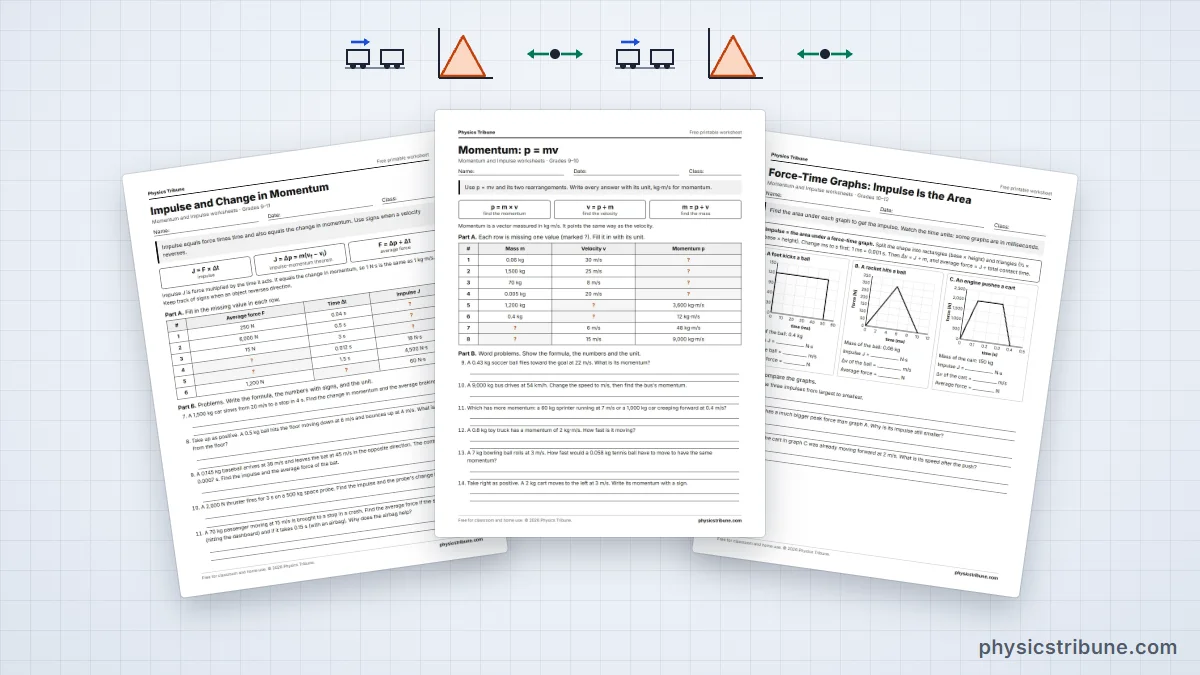 worksheetsMomentum and Impulse Worksheets
 formulasMomentum and Impulse Formulas