At a Glance
A concave mirror is a converging mirror with a positive focal length, and it forms real, inverted images or magnified upright ones. A convex mirror is a diverging mirror with a negative focal length, and it always forms smaller, upright, virtual images. Both follow 1/f = 1/d_o + 1/d_i with f = R/2.
- Concave mirror
- Curves inward, converges light
- Convex mirror
- Bulges outward, diverges light
- Focal length sign
- Concave: positive · Convex: negative
- Shared formulas
- 1/f = 1/d_o + 1/d_i and f = R/2
- Signature use
- Concave: makeup mirror · Convex: car side mirror
On this page
- What Is the Difference Between a Concave and Convex Mirror?
- How Are Concave and Convex Mirrors Defined?
- What Images Do Concave and Convex Mirrors Form?
- What Formulas Apply to Both Mirrors?
- What Are Concave and Convex Mirrors Used For?
- Why Do Objects Look Closer or Farther in Each Mirror?
- How Do Mirrors Compare With Lenses of the Same Name?
- Common Misconceptions
- Key Facts
- Quiz
- FAQ
What Is the Difference Between a Concave and Convex Mirror?
Pick up a shiny metal spoon. The bowl side is a concave mirror, and the back is a convex mirror. Look into each and you will see two very different faces: upside down in the bowl when you hold it at arm's length, upright and tiny on the back.
Both are curved mirrors, usually cut from the surface of a sphere, and both obey the ordinary law of reflection at every point. The difference is how the curve aims the reflected rays. A concave surface tips them toward each other, so the mirror is converging. A convex surface tips them away from each other, so it is diverging.
The side-by-side table below sums up the practical results, from focal length signs to everyday uses.
| Feature | Concave mirror | Convex mirror |
|---|---|---|
| Shape of reflecting side | Curves inward, like a spoon's bowl | Bulges outward, like a spoon's back |
| Other name | Converging mirror | Diverging mirror |
| Effect on parallel rays | Reflects them to a focus | Reflects them apart |
| Principal focus | Real, in front of the mirror | Virtual, behind the mirror |
| Sign of focal length | Positive | Negative |
| Focal length from radius | f = R/2 | f = R/2 (with R negative) |
| Image of a distant object | Real, inverted, smaller | Virtual, upright, smaller |
| Image of a close object | Virtual, upright, magnified | Virtual, upright, smaller |
| Can project onto a screen? | Yes, for objects beyond f | No |
| Field of view | Narrow | Wide |
| Magnification range | Any size, depends on distance | Always less than 1 |
| Typical uses | Makeup mirrors, headlights, telescopes | Car side mirrors, store and road safety mirrors |
| Source: Standard spherical-mirror optics with the real-is-positive sign convention; uses are typical examples · Retrieved October 2026 | ||
How Are Concave and Convex Mirrors Defined?
A concave mirror has its reflecting surface on the inside of the curve. Light arriving parallel to the central axis bounces back and passes through a single point in front of the mirror, the principal focus. Because light really meets there, the focus is real and the focal length is positive.
A convex mirror has its reflecting surface on the outside of the curve. Parallel light bounces off and spreads out as if it came from a point behind the mirror. That focus is virtual, so the focal length is negative.
For both, the focal length is half the radius of curvature,
What Images Do Concave and Convex Mirrors Form?
A convex mirror behaves the same way every time. For any real object it forms an image that is virtual, upright and smaller, located behind the mirror between the surface and the focal point. The farther the object moves away, the smaller and closer to the focal point its image gets.
A concave mirror depends on where the object stands:
- Beyond the center of curvature: real, inverted and smaller.
- At the center of curvature: real, inverted and the same size.
- Between the center of curvature and the focus: real, inverted and larger.
- At the focus: the reflected rays leave parallel, so no clear image forms.
- Inside the focus: virtual, upright and magnified.
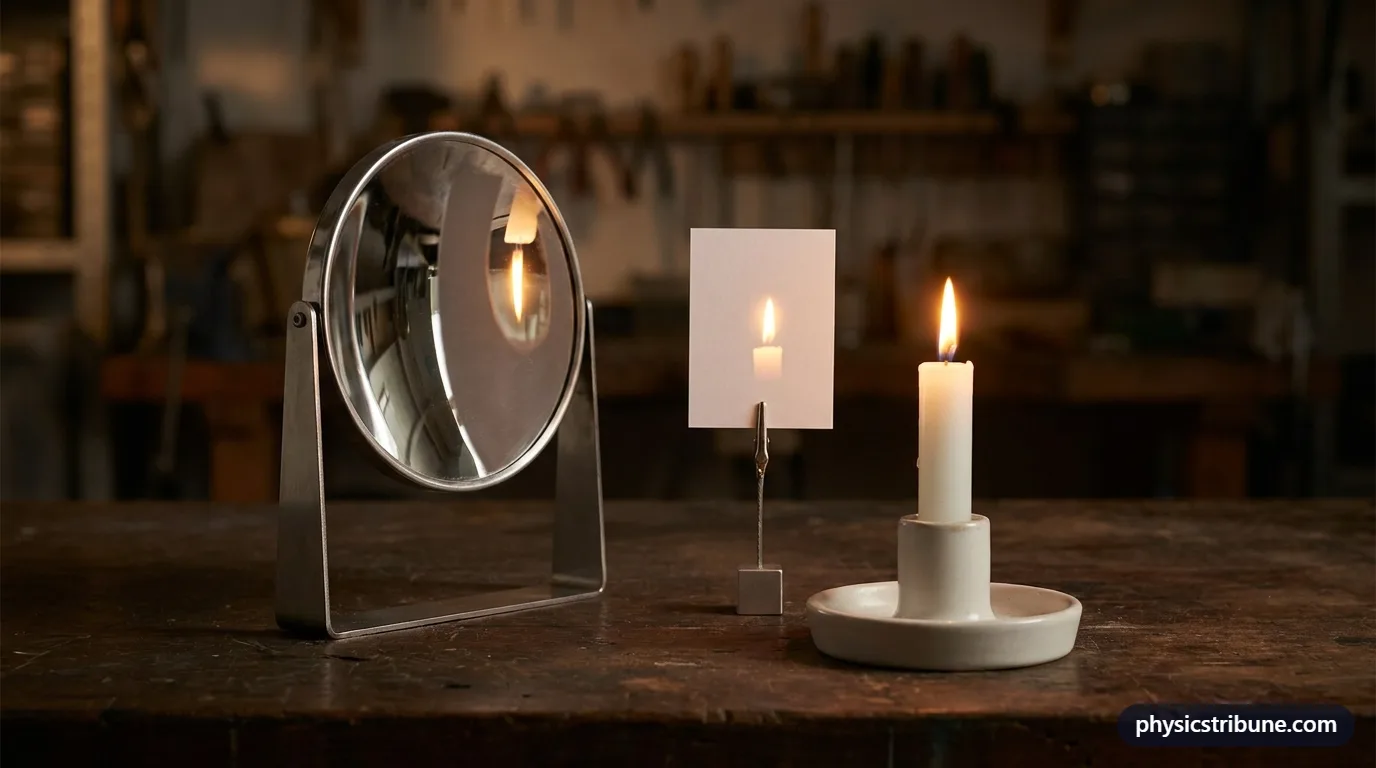
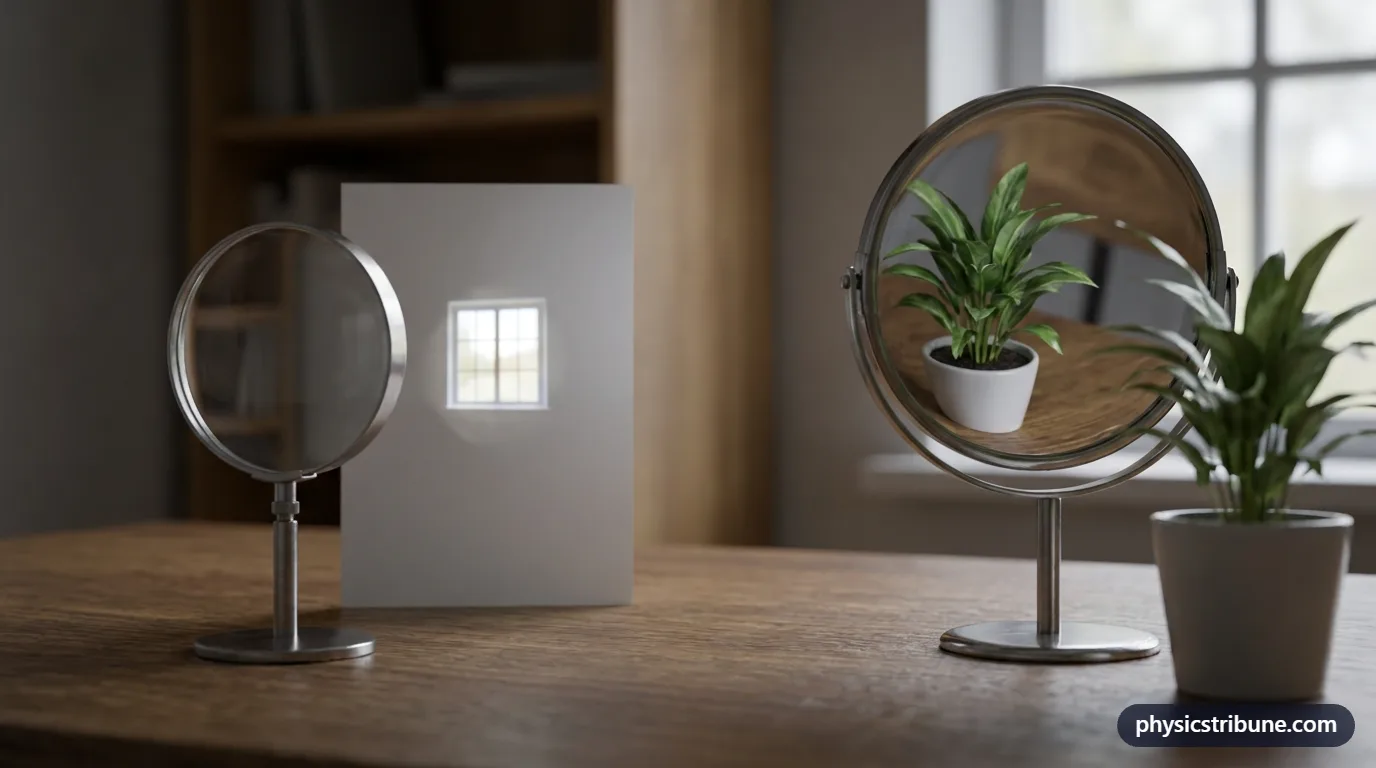
The last case is why a makeup mirror enlarges your face when you lean in close. The two ray diagrams below compare a concave mirror with the object outside the focus and a convex mirror with the object at a similar distance.


What Formulas Apply to Both Mirrors?
Both mirrors use the mirror equation,
Image size comes from the magnification formula,
You can solve any of these cases with the mirror equation calculator, which handles the signs for you.
Concave and convex mirrors share the mirror equation; the sign of the focal length tells them apart.
| Symbol | Quantity | SI unit |
|---|---|---|
| focal length (= R/2) | meter (m) | |
| object distance | meter (m) | |
| image distance | meter (m) |
Rearranged to find another variable:
Valid for: spherical mirror, paraxial rays; f > 0 concave, f < 0 convex; d_i > 0 real image (in front of the mirror).
Example 1 A concave mirror imaging a toy figure
A concave mirror has a focal length of 0.20 m. A small toy figure stands 0.50 m in front of it. Where does the image form?
- Given:
- focal length (= R/2):
- object distance:
- focal length (= R/2):
- Formula:
- Substitute:
- Answer:
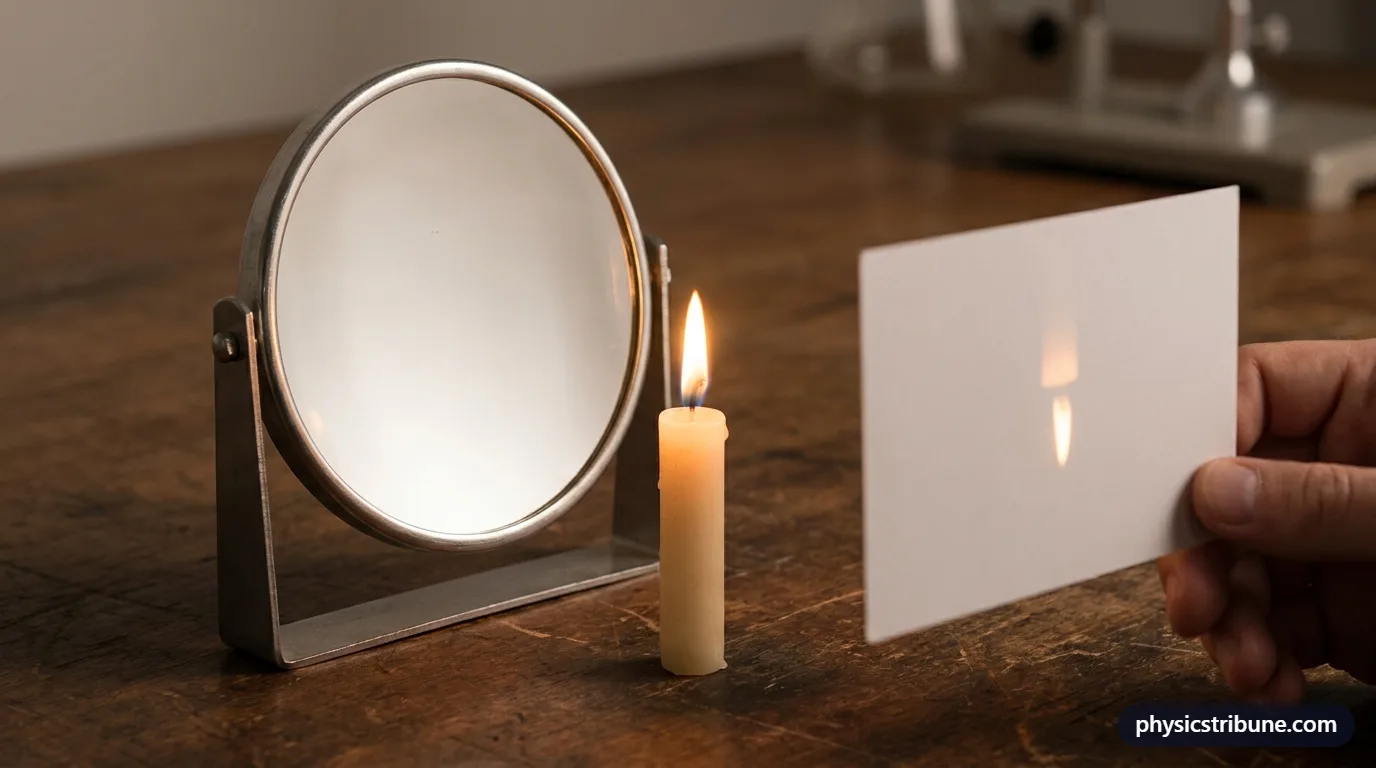
A positive image distance means a real image in front of the mirror, upside down, which you could catch on a small card.
Example 2 A convex mirror at a parking garage corner
A convex safety mirror has a focal length of -0.25 m. A car is 1.0 m in front of it. Where does the image of the car appear?
- Given:
- focal length (= R/2):
- object distance:
- focal length (= R/2):
- Formula:
- Substitute:
- Answer:
The negative sign places a virtual image behind the glass, much closer to the mirror than the real car.
Example 3 A shopper in a store security mirror
A shopper stands 2.0 m in front of a convex security mirror, and her image forms 0.30 m behind the glass, so d_i = -0.30 m. What is the magnification?
- Given:
- image distance:
- object distance:
- image distance:
- Formula:
- Substitute:
- Answer:
A positive magnification well below 1 means the image is upright and much smaller, which is how one mirror can show a whole aisle.
What Are Concave and Convex Mirrors Used For?
Concave mirrors collect and focus light, or magnify a nearby object:
- Shaving and makeup mirrors, which magnify a face held inside the focal length
- Flashlight and car headlight reflectors, where a bulb at the focus sends out a nearly parallel beam
- Reflecting telescopes, which gather faint starlight with a large curved mirror
- Solar cookers and solar furnaces that concentrate sunlight
- Dentists' mirrors, which give an enlarged view of a tooth
Convex mirrors trade size for a wider view:
- Passenger-side mirrors on cars
- Security mirrors in stores and warehouses
- Traffic mirrors at blind corners, driveways and parking garages
- Mirrors on buses and delivery trucks that need to see along the whole vehicle
Why Do Objects Look Closer or Farther in Each Mirror?
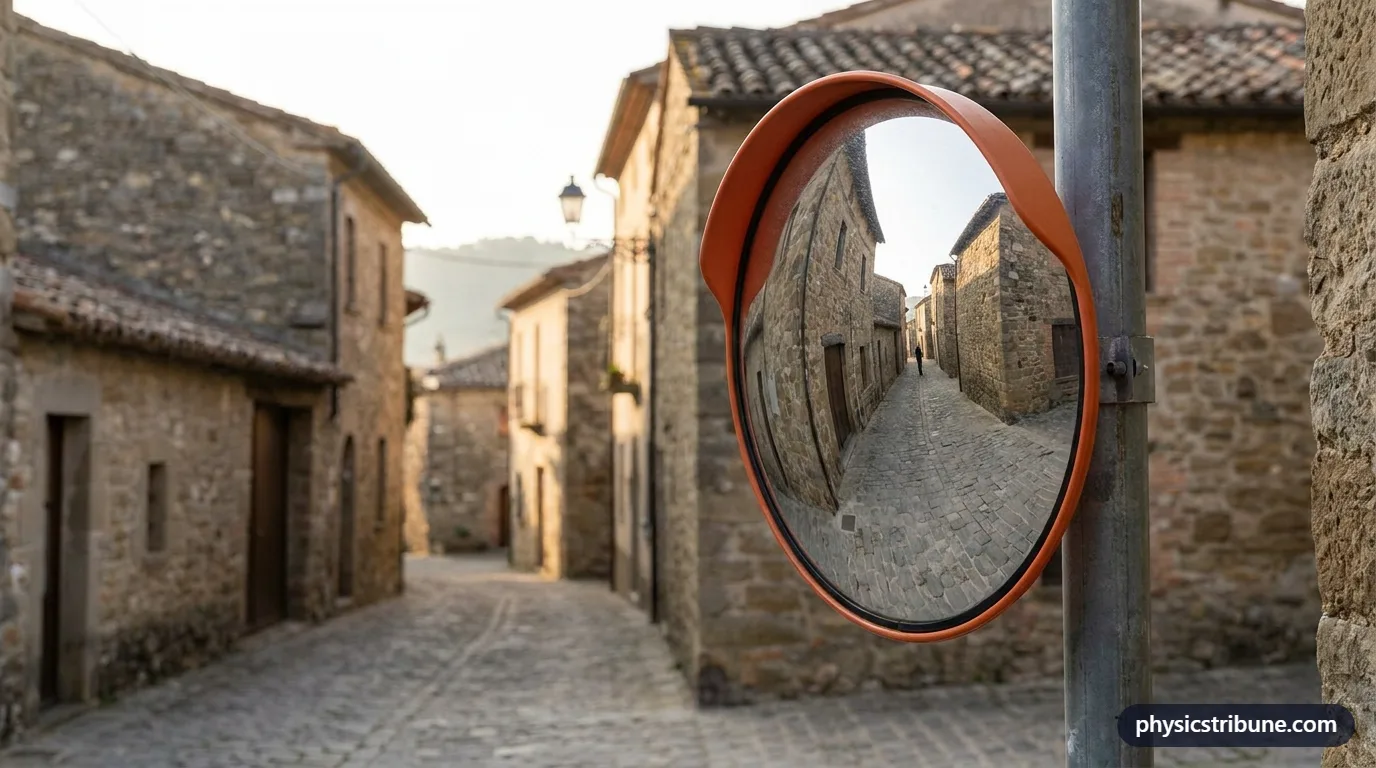
A convex mirror squeezes a wide scene into a small image. Because each car or person appears smaller than it would in a flat mirror, your brain judges it to be farther away than it really is. That is the reason passenger-side car mirrors in many countries carry a printed safety warning about distance.
A concave mirror held close does the opposite. It shows a small region enlarged, so details look nearer and bigger, which is helpful for a dentist or for putting in contact lenses but useless for watching traffic. The choice between the two always comes down to this trade: a wide view with small images, or a narrow view with large ones.
How Do Mirrors Compare With Lenses of the Same Name?
The names can be confusing. A concave mirror converges light, but a concave lens diverges it. A convex mirror diverges light, but a convex lens converges it. The reason is that mirrors reflect light back while lenses let it pass through and bend it by refraction.
A simple memory aid: think about what each one does, not what it is called. Converging devices have positive focal lengths and can form real images; diverging devices have negative focal lengths and only form virtual images of real objects. Our concave vs convex lens page covers the lens side in detail.
Common Misconceptions
Myth: A concave mirror always makes things look bigger.
Physics: Only when the object is inside the focal length. Farther away, a concave mirror forms a real, inverted image that may be smaller than the object.
Myth: The image in a convex mirror is on the surface of the mirror.
Physics: The image is virtual and located behind the surface, between the mirror and its focal point, which is why it seems to have depth.
Myth: Concave mirrors and concave lenses both spread light out.
Physics: A concave mirror converges light by reflection, while a concave lens diverges light by refraction. The shapes match but the effects are opposite.
Myth: Convex mirrors are used on cars because they make other cars look closer.
Physics: They make other cars look smaller and therefore farther away. Drivers accept that error in exchange for a much wider view of the road.
Key Facts
- A concave mirror curves inward and converges light; a convex mirror bulges outward and diverges it.
- The focal length of a spherical mirror is half its radius of curvature, f = R/2.
- Concave mirrors have positive focal lengths and convex mirrors have negative ones.
- A convex mirror always forms a virtual, upright and smaller image of a real object.
- A concave mirror forms real, inverted images for objects beyond its focus and magnified virtual images inside it.
- Convex mirrors give a wide field of view, so they are used for car side mirrors and safety mirrors.
- A concave mirror converges light but a concave lens diverges it, because one reflects and the other refracts.
Quick Quiz: How Well Do You Know Concave vs Convex Mirror?
6 questions. Tap an answer to check it.
Which mirror is a converging mirror?
A concave mirror reflects parallel rays together to a focus.
What kind of image does a convex mirror always form of a real object?
Convex mirrors diverge light, so the image is always virtual, upright and reduced.
A spherical mirror has a radius of curvature of 0.80 m. What is its focal length?
Focal length is half the radius: 0.80 m divided by 2 is 0.40 m.
Where should an object be placed to get a magnified upright image in a concave mirror?
Inside the focal length, a concave mirror forms a virtual, upright, magnified image.
Why are convex mirrors used at blind corners in parking garages?
The outward curve shows a much wider area, even though images are smaller.
In the mirror equation, a convex mirror has a focal length that is…
Its focus is virtual, behind the mirror, so f is negative.
Frequently Asked Questions
What is the main difference between concave and convex mirrors?
A concave mirror curves inward and reflects light so the rays come together, which makes it a converging mirror. A convex mirror curves outward and reflects light so the rays spread apart, which makes it a diverging mirror. Concave mirrors can form real or enlarged images, while convex mirrors only form small, upright, virtual images with a wide view.
Which mirror is used in car side mirrors?
Passenger-side car mirrors are convex. The outward curve squeezes a wide stretch of road into a small image, so the driver can see vehicles in the next lane that a flat mirror would miss. The trade-off is that cars look smaller and seem farther away than they are, which is why drivers are warned to judge distance carefully.
Which mirror is used in a makeup or shaving mirror?
Makeup and shaving mirrors are concave. When your face is closer to the mirror than its focal length, the mirror forms a virtual, upright and magnified image, so small details are easy to see. If you back away past the focal point, the image blurs and then turns upside down, which shows the mirror is curved inward.
Why is the focal length of a convex mirror negative?
In the standard sign convention, real focal points in front of a mirror count as positive. A convex mirror's reflected rays spread out and only appear to come from a point behind the glass, so its focus is virtual. A negative focal length lets the same mirror equation work for both mirror types without separate rules.
Can a convex mirror form a real image?
Not for an ordinary real object in front of it. A convex mirror always sends reflected rays outward, so they never meet in front of the mirror, and the image is always virtual, upright and smaller. Only light that is already converging toward a point behind the mirror, which happens in some telescope designs, can produce a real image.
How do you tell whether a mirror is concave or convex?
Bring your face close and then move back. If your reflection grows larger up close and eventually flips upside down as you back away, the mirror is concave. If your reflection is always upright and smaller than in a flat mirror, and you can see a wide area behind you, the mirror is convex.
What is the relationship between focal length and radius of curvature?
For a spherical mirror, the focal length is half the radius of curvature, f = R/2. The center of curvature is therefore twice as far from the mirror as the focal point. This holds for rays close to the central axis; rays striking near the rim of a deeply curved mirror focus slightly closer, an effect called spherical aberration.
Why do headlights use concave mirrors?
A headlight places its bulb at or near the focus of a concave reflector. Light leaving the bulb hits the curved surface and reflects out as a nearly parallel beam, which travels far down the road without spreading much. It is the mirror equation run backward: light from the focus comes out parallel.