At a Glance
Work is force times distance, W = F·d, measured in joules (J). Power is work divided by time, P = W / t, measured in watts (W), where 1 W = 1 J/s. Doing the same work in half the time requires twice the power.
- Work
- Energy transferred by a force, W = F·d
- Power
- Rate of doing work, P = W / t
- SI units
- Work: joule (J) · Power: watt (W = J/s)
- Depends on time?
- Work: no · Power: yes
- Type of quantity
- Both are scalars
On this page
- What Is the Difference Between Work and Power?
- How Are Work and Power Defined?
- What Are the Formulas for Work and Power?
- What Are the Units of Work and Power?
- Can You Do the Same Work With Different Power?
- What Are Everyday Examples of Work and Power?
- How Is Work Related to Energy and Power?
- Common Misconceptions
- Key Facts
- Quiz
- FAQ
What Is the Difference Between Work and Power?
In physics, work is done whenever a force pushes or pulls something through a distance in the direction of the force. It measures how much energy has been transferred. Power measures how quickly that transfer happens. One is a total; the other is a rate.
Think of filling a bathtub. The amount of water in the tub is like work, and how far the faucet is open is like power. A trickle and a full blast can both fill the tub to the same level; the full blast just gets there sooner.
That is why a small electric screwdriver and a large drill can drive the same screw. Each does about the same work on the screw, but the drill, with more power, finishes in a fraction of the time. The table below lines up the two quantities point by point.
| Feature | Work | Power |
|---|---|---|
| Question it answers | How much energy was transferred? | How fast was it transferred? |
| Symbol | W | P |
| Basic formula | W = F·d | P = W / t |
| Other forms | W = F·d·cos θ | P = F·v |
| SI unit | joule (J) | watt (W) |
| Unit in base terms | kg·m²/s² | kg·m²/s³ |
| Other common units | kilojoule, calorie, kilowatt-hour | kilowatt, horsepower |
| Depends on time taken? | No | Yes |
| Scalar or vector | Scalar | Scalar |
| Can be negative? | Yes, if the force opposes motion | Yes, when energy is being removed |
| Unit named after | James Prescott Joule | James Watt |
| Example | Lifting a 250 N box 1.2 m takes 300 J | Doing that lift in 2 s takes 150 W |
| Source: Definitions as used in standard SI mechanics; example values computed with W = F·d and P = W / t · Retrieved October 2026 | ||
How Are Work and Power Defined?
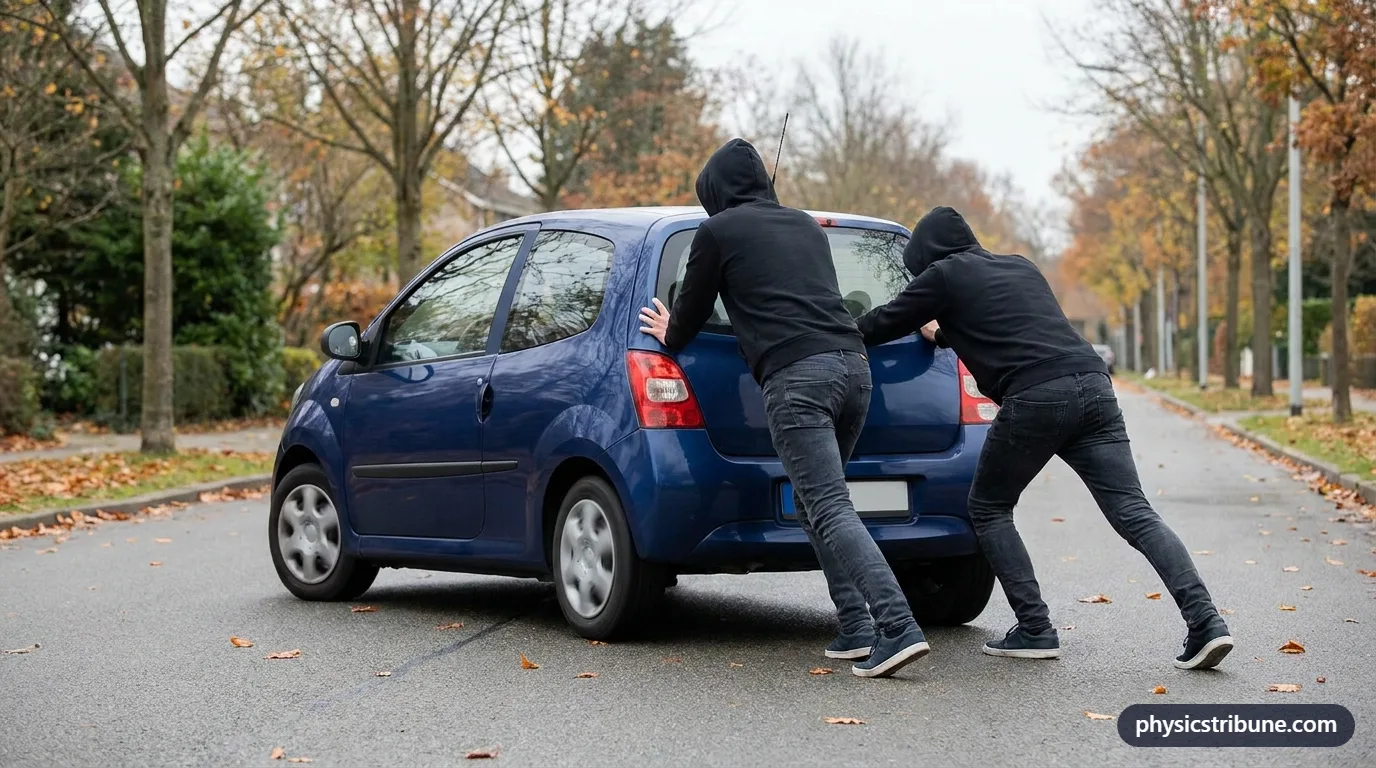
Work is the product of a force and the distance the object moves along the direction of that force. If you push a stalled car 10 m along a street, you do work on it. If you push on a brick wall that does not move, you may get tired, but in the physics sense you do no work on the wall, because it travels no distance.
Power is the work done, or energy transferred, per unit of time. A motor rated at 500 W can transfer 500 joules of energy every second. Light bulbs, car engines, athletes and power stations are all compared by their power, because the rate is what usually matters in practice.
Both quantities are scalars. Work can be positive or negative, depending on whether the force helps or opposes the motion, and power carries the same sign as the work it describes.
What Are the Formulas for Work and Power?
For a constant force along the motion, work is
Average power is
Notice that time appears only in the power formula. That single difference is the heart of the comparison. To solve either formula with the steps shown, use our work calculator or our power calculator.
Here is the power formula with each variable and its SI unit, plus the forms rearranged for work and for time.
| Symbol | Quantity | SI unit |
|---|---|---|
| average power | watt (W) | |
| work done or energy transferred | joule (J) | |
| time | second (s) |
Rearranged to find another variable:
Example 1 Lifting a box onto a truck
A mover lifts a box of books straight up onto a truck bed 1.2 m high, pulling upward with a steady force of 250 N. How much work does the mover do on the box?
- Given:
- force (component along the displacement):
- displacement:
- force (component along the displacement):
- Formula:
- Substitute:
- Answer:
This is the energy given to the box, and it does not depend on how quickly the lift happens.
What Are the Units of Work and Power?
Work is measured in joules. One joule is the work done when a force of one newton moves an object one meter, so 1 J = 1 N·m. Lifting a medium apple about one meter takes roughly one joule.
Power is measured in watts, where one watt is one joule per second. Larger machines are rated in kilowatts, and engines are often described in horsepower, where 1 hp is about 746 W. The watt is named after the Scottish engineer James Watt, who improved the steam engine and popularized the horsepower as a way to sell it.
Electricity bills mix the two in a way that confuses many people. A kilowatt-hour is a unit of energy, not power: it is the work done by 1 kW running for one hour, exactly 3.6 million joules.
Can You Do the Same Work With Different Power?
Yes, and the pulley diagram below shows a typical case. A mover lifts a box with a single fixed pulley, pulling with a force equal to the box's weight. Whether the rope is hauled up in two seconds or six, the box gains the same height, so the same work is done on it.
What changes is the power. Divide the same work by a shorter time and the power goes up; stretch the job over a longer time and it goes down. The two worked examples that follow put numbers on this.
Stairs offer a test you can feel. Walking up a flight and running up the same flight both raise your body through the same height, so the work against gravity is identical. Running leaves you out of breath because your muscles had to deliver that energy at a much higher rate.
Example 2 A quick lift
The mover in the first example completes the same 300 J lift in 2 s. What average power does the mover deliver?
- Given:
- work done or energy transferred:
- time:
- work done or energy transferred:
- Formula:
- Substitute:
- Answer:
Compare this with the slow lift in the next example: the work is identical, only the time changes.
Example 3 A slow lift
A second mover raises an identical box onto the same truck, doing the same 300 J of work, but takes 6 s. What average power does this mover deliver?
- Given:
- work done or energy transferred:
- time:
- work done or energy transferred:
- Formula:
- Substitute:
- Answer:
Three times the time means one third of the power for exactly the same work.
| Pace | Time | Work against gravity | Average power |
|---|---|---|---|
| Running | 4 s | 1,765 J | 441 W |
| Brisk walk | 8 s | 1,765 J | 221 W |
| Slow walk | 12 s | 1,765 J | 147 W |
| Source: Computed with W = mgh (g = 9.80665 m/s²) and P = W / t; values rounded to the nearest whole number · Retrieved October 2026 | |||

What Are Everyday Examples of Work and Power?
Statements about work describe a total amount of energy transferred:
- A crane does work raising a steel beam to the tenth floor.
- A cyclist does work against friction and air drag over a 20 km ride.
- Your arm does work when you lift a backpack onto a hook.
Statements about power describe a rate:
- A microwave oven is rated at 1,000 W.
- A trained cyclist can hold about 250 W for an hour.
- A small car engine might produce about 70 kW at full throttle.
A useful habit: if a sentence includes "per second", "how fast" or a rating on a label, it is about power. If it describes a finished task, such as lifting, pushing or dragging something somewhere, it is about work.
How Is Work Related to Energy and Power?
Work is the way energy gets moved from one object or form to another. When you do 300 J of work lifting a box, the box gains 300 J of gravitational potential energy. The work-energy theorem makes this precise for motion: the net work on an object equals its change in kinetic energy.
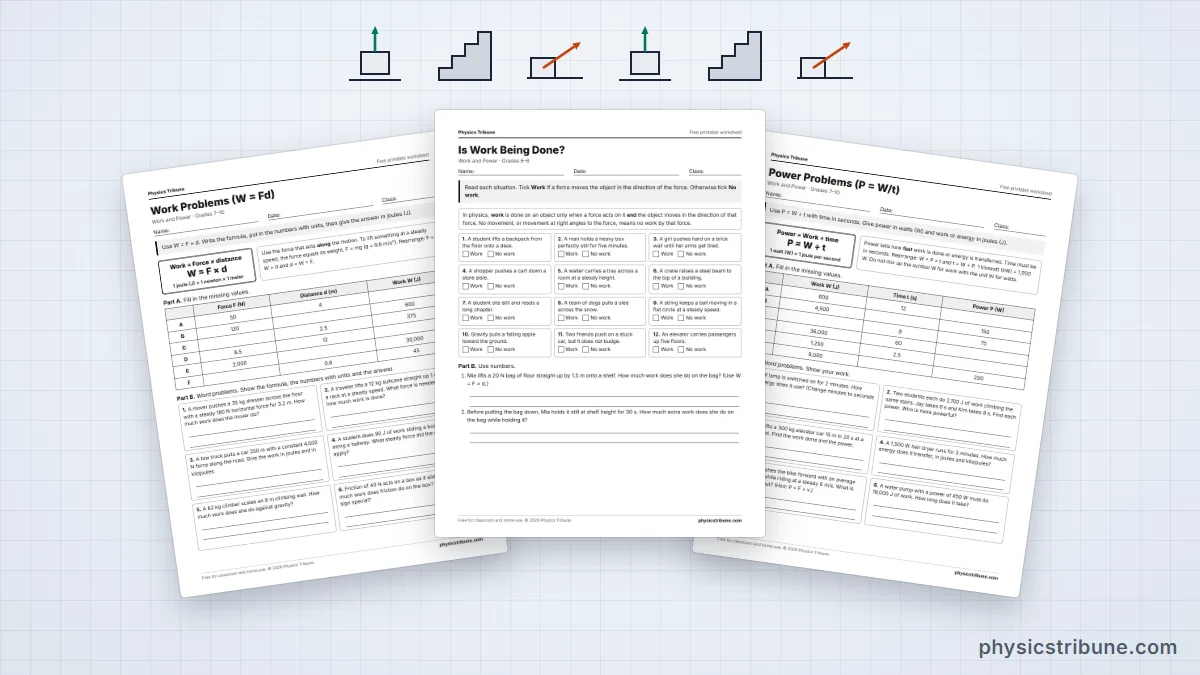
Power then tells you how fast that energy moves. That is why the sibling comparison energy vs power follows the same pattern as this page. For a branch overview see work and power, and for printable practice with answer keys try our work and power worksheets.
Common Misconceptions
Myth: Work and power mean the same thing.
Physics: Work is a total amount of energy transferred, while power is how fast that energy is transferred. The same job can need very different amounts of power.
Myth: If you feel tired, you must have done work.
Physics: In physics, work needs movement along the direction of the force. Holding a heavy bag still tires your muscles, but you do no work on the bag.
Myth: A more powerful machine always does more work.
Physics: A powerful machine does work faster. Given enough time, a weaker machine can do exactly the same total work.
Myth: A kilowatt-hour is a unit of power.
Physics: It is a unit of energy: power multiplied by time. Your electricity bill charges for energy used, not for power.
Key Facts
- Work is the energy transferred when a force moves an object through a distance.
- Power is the rate of doing work, or work divided by time.
- Work is measured in joules and power in watts, where 1 W equals 1 J/s.
- The same amount of work can be done with high power over a short time or low power over a long time.
- Pushing on an object that does not move does no work on it, however tiring it feels.
- A kilowatt-hour is a unit of energy equal to 3.6 million joules, not a unit of power.
- One horsepower is about 746 watts.
Quick Quiz: How Well Do You Know Work vs Power?
6 questions. Tap an answer to check it.
What is the SI unit of power?
Power is measured in watts, and one watt is one joule per second.
Two students carry identical boxes up the same stairs. One takes 10 s and the other takes 20 s. Which statement is true?
The work depends on weight and height, not time; power is larger for the shorter time.
A motor does 600 J of work in 3 s. What is its average power?
P = W / t = 600 J ÷ 3 s = 200 W.
A person pushes hard on a wall that does not move. How much work is done on the wall?
Work requires movement along the direction of the force.
Which of these is a unit of energy, not power?
A kilowatt-hour is power times time, which is energy.
If the same work is done in half the time, the power:
Power is work divided by time, so halving the time doubles the power.
Frequently Asked Questions
What is the main difference between work and power?
Work is the amount of energy transferred when a force moves something, and power is how quickly that transfer happens. Work is measured in joules and does not depend on time. Power is measured in watts and is found by dividing work by time. Lifting a box slowly or quickly takes the same work but different power.
What is the difference between work and energy?
Energy is the ability to cause change, a quantity an object or system has. Work is one way of transferring energy, by a force acting through a distance. When you do 50 J of work lifting a bag, you give the bag 50 J of potential energy. Both use the joule, but energy is something stored, while work is energy on the move.
Is power the same as work done?
No. Power is work done divided by the time taken. Two people can do exactly the same work, but the one who finishes in less time has delivered more power. A 1,000 W kettle and a 2,000 W kettle supply the same energy to boil a liter of water; the 2,000 W kettle simply does it in about half the time.
Can you do work without power?
Any work done in a finite time involves some power, but the power can be very small if the work is spread over a long time. A tiny solar-powered motor can lift a load as high as a large crane can, as long as you are willing to wait. Zero power over a time interval means zero work in that interval.
What unit is used for work and what unit for power?
Work uses the joule, which equals one newton meter. Power uses the watt, which equals one joule per second. Larger amounts use kilojoules and kilowatts. Older or engineering units include the calorie and the foot-pound for work and the horsepower for power, where one horsepower is about 746 watts.
Why is power more important than work for machines?
Most machines are judged by how fast they get a job done, so their labels list power. A car engine, a blender and an elevator motor could all eventually do the same work, but the power rating tells you how quickly. Power also sets how much energy per second the machine draws from fuel or electricity.
How do you calculate power from work and time?
Divide the work by the time: P = W / t. If a motor does 4,800 J of work in 12 seconds, its average power is 400 W. Make sure work is in joules and time is in seconds so that the answer comes out in watts. To find work from power, multiply instead: W = P × t.
Is work a vector or scalar?
Work is a scalar, even though it comes from two vectors, force and displacement. It is the dot product of the two, so it has a size and a sign but no direction. Power is also a scalar. A positive value means energy is being given to the object, and a negative value means energy is being taken away.