At a Glance
James Watt (born January 19, 1736, died August 25, 1819) was a Scottish engineer whose separate condenser, patented in 1769, cut the fuel a steam engine needed to a fraction of earlier designs. The unit of power named after him measures energy per second, P = W / t, and one watt equals one joule per second.
- Born
- January 19, 1736, Greenock, Scotland
- Died
- August 25, 1819, near Birmingham, England, age 83
- Nationality
- Scotland (Great Britain)
- Known for
- Separate condenser, rotary steam engine, horsepower
- Unit named after him
- watt (W), the SI unit of power
- Key equation
- P = W / t (power is work done per unit time)
On this page
Who Was James Watt?
James Watt was the engineer who made steam power practical. Steam engines existed before him, but they wasted most of their fuel and could only pump water. Watt's improvements cut the coal bill so sharply that engines became worth building almost anywhere, and his later designs could turn wheels to drive mills and factories.
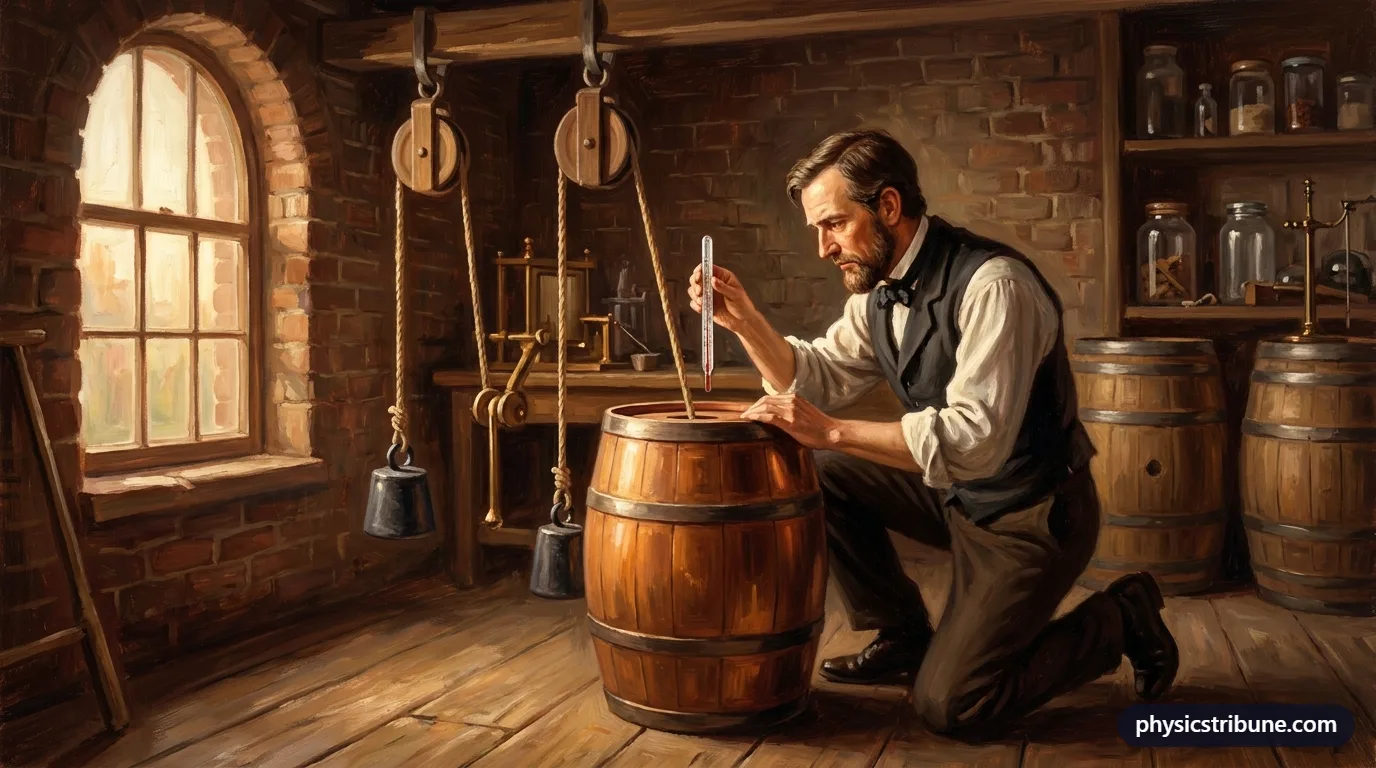
He was not a trained scientist in the modern sense. He started as a maker of scientific instruments, and he approached the steam engine like a measuring problem: where does the heat go, and how much is lost? That careful, numbers-first approach is a big part of why his name is attached to a physical unit.
Watt worked for many years in partnership with the Birmingham manufacturer Matthew Boulton. Their firm, Boulton and Watt, built engines across Britain and became one of the engines of the Industrial Revolution. You can read how such machines work on our page about the heat engine.
Early Life and Training
Watt was born in Greenock, a port on the River Clyde west of Glasgow. His father was a shipwright and merchant, and young James spent hours in the family workshop making models. He was often unwell as a child and was partly taught at home, where he showed a strong talent for mathematics.
At about 19 he went to London to learn the trade of mathematical instrument maker, crowding several years of training into one. Back in Scotland, he found work at the University of Glasgow, where he repaired and built instruments for the professors and opened a small shop on the campus.
The university gave him something more valuable than a job: contact with scientists such as Joseph Black, who was studying heat. Black's idea that melting and boiling absorb hidden, or latent, heat helped Watt understand why steam engines used so much fuel.
| Year | Event |
|---|---|
| 1736 | Born in Greenock, Scotland, on January 19 |
| 1750s | Trains as an instrument maker in London, then works at the University of Glasgow |
| 1763 to 1764 | Repairs the university's model Newcomen engine |
| 1765 | Conceives the separate condenser |
| 1769 | Patents the separate condenser |
| 1775 | Patent extended to 1800; partnership with Matthew Boulton |
| 1776 | First full-size Boulton and Watt engines start work |
| 1780s | Develops rotary motion, double action and parallel motion |
| 1785 | Elected a Fellow of the Royal Society |
| 1800 | Patent expires; Watt retires from the business |
| 1819 | Dies near Birmingham on August 25, aged 83 |
| Source: Birth and death dates from our physicists data file (Wikidata, CC0); other years are standard biographical dates · Retrieved October 2026 | |
How Did Watt Improve the Steam Engine?
In 1763 or 1764 the university asked Watt to repair a small working model of a Newcomen engine, the common mine pump of the day. In that design, steam filled a cylinder and was then cooled with a spray of cold water, so it condensed and the air outside pushed the piston down. The problem was that the same cylinder had to be heated again for the next stroke, which wasted a huge amount of steam.
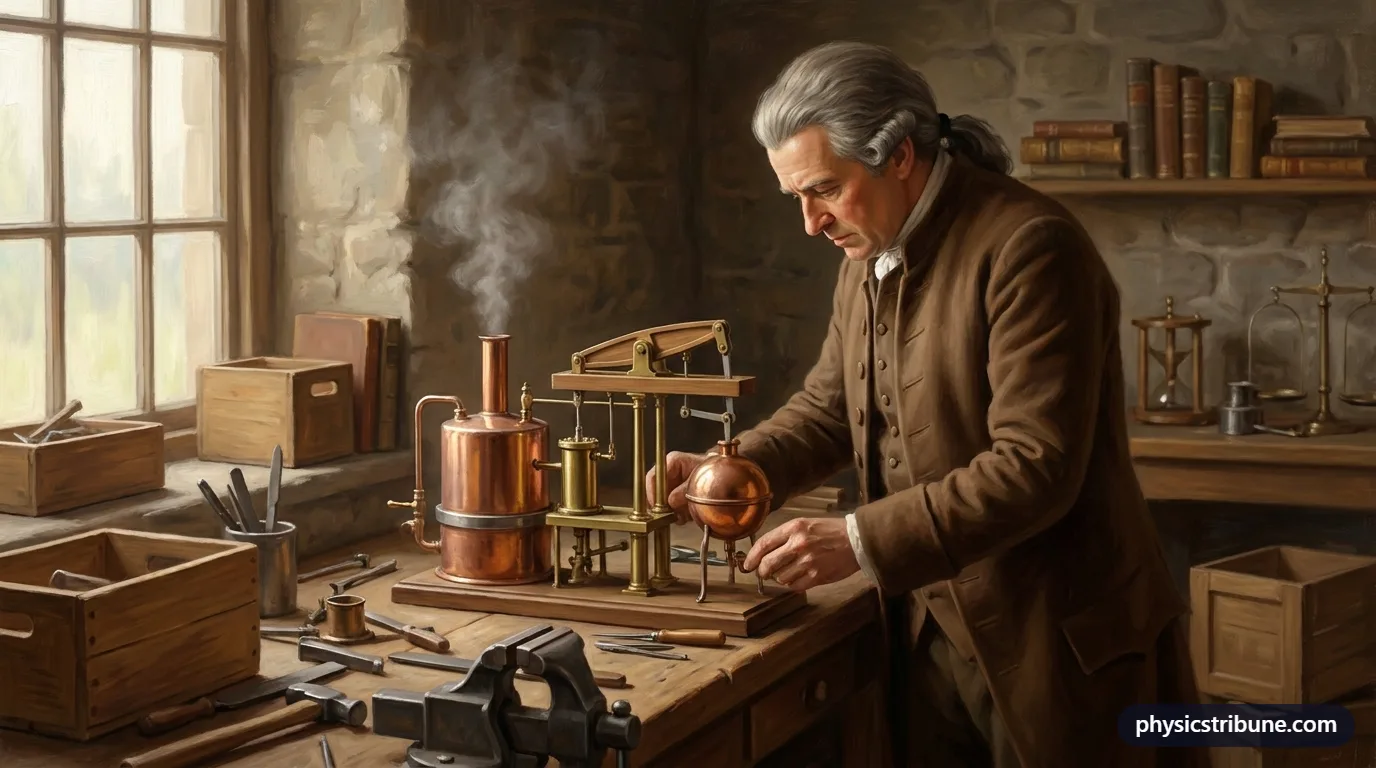
Watt's answer, which came to him in 1765, was to condense the steam in a separate vessel connected to the cylinder. The cylinder could stay hot all the time while the condenser stayed cold. He also wrapped the cylinder in a steam jacket and used the steam itself, rather than outside air, to push the piston. He patented the idea in 1769.
Turning a model into a working engine took years. Accurate cylinders were hard to make until the ironmaster John Wilkinson developed a better way to bore them. The first full-size Boulton and Watt engines started work in 1776 and used roughly a quarter of the coal of a Newcomen engine doing the same job. See how energy losses are compared on our energy efficiency page.
Example 2 Pumping water out of a mine
A pumping engine lifts 400 kg of water up a 15 m shaft every minute. Taking g = 9.81 m/s², what useful power does it deliver?
- Given:
- m:
- g:
- h:
- time:
- m:
- Formula:
- Substitute:
- Answer:
The work done on the water is its gain in potential energy, m g h, and dividing by the time gives the power.
What Else Did James Watt Invent?
Pumping water was only the start. Factories needed engines that could turn shafts, so in the early 1780s Watt developed ways to change the up-and-down motion of the piston into rotation. One was the sun-and-planet gear, a pair of linked gearwheels that turned the beam's motion into steady turning. He also made the engine double-acting, so steam pushed the piston on both the up and down strokes.
In 1784 he devised a clever linkage, called parallel motion, that let the end of the rocking beam guide the piston rod in a nearly straight line. He was especially proud of it. Later in the decade the firm fitted engines with a centrifugal governor, a pair of spinning weights that rose with speed and closed the steam valve, an early example of automatic feedback control.
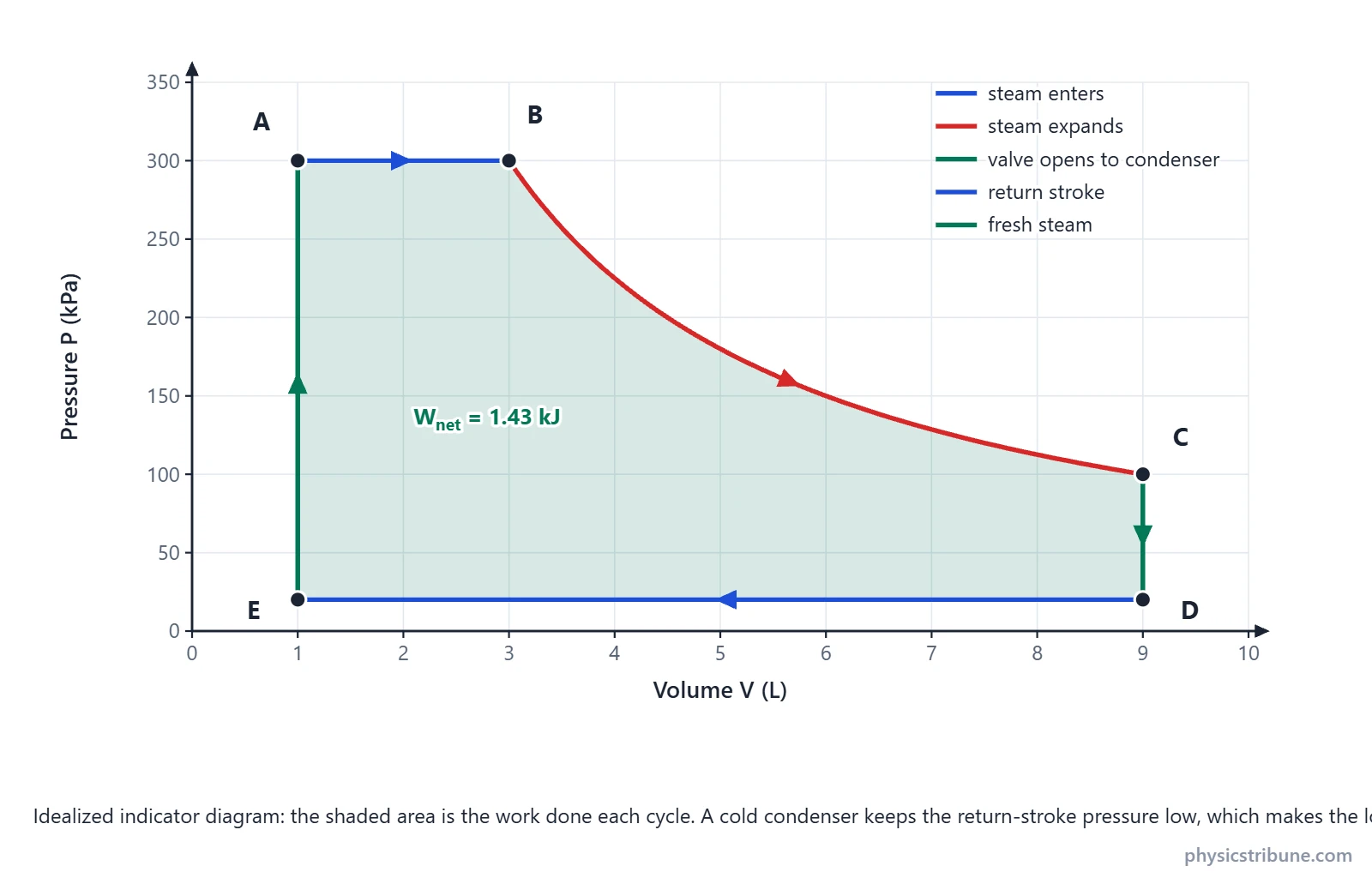
Outside engines, Watt patented a copying press for letters in 1780, which saved clerks from copying documents by hand. In the 1790s his assistant John Southern developed the steam indicator, which drew a pressure and volume record of each stroke so engineers could see how well an engine was running.
Why Did Watt Invent Horsepower?
Boulton and Watt sold engines to mine owners and millers who were used to working with horses. To show what an engine could do, Watt needed a unit customers already understood. He studied horses turning mills and settled on a figure of 33,000 foot-pounds of work per minute for one horsepower.
His figure was generous, since an average horse cannot keep up that rate all day. That may have been deliberate: if an engine was rated at 10 horsepower, buyers would never be disappointed when it replaced ten horses. Converted to SI units, one mechanical horsepower comes to about 745.7 watts.
Horsepower is still used for car engines and motors in some countries, while science uses the watt. Compare the two on our horsepower page.
Example 3 A horse turning a mill
A horse walks around a mill track pulling with a steady force of 800 N at 1.2 m/s. At what rate is it doing work?
- Given:
- force along the direction of motion:
- speed:
- force along the direction of motion:
- Formula:
- Substitute:
- Answer:
This works out to about 1.3 horsepower; a strong horse can beat Watt's rating for a while, but not all day.
| Source | Power (W) | Power (hp) |
|---|---|---|
| Person climbing stairs briskly | about 300 | about 0.4 |
| Working horse over a full day | about 500 | about 0.7 |
| One horsepower (Watt's rating) | about 745.7 | 1 |
| Mill engine in worked example 1 | 15,000 | about 20 |
| Small modern car engine | about 75,000 | about 100 |
| Source: Horsepower conversion computed from 33,000 ft·lbf/min with 1 ft = 0.3048 m and 1 lbf = 4.448 N; other values are typical figures, hp computed as W / 745.7 · Retrieved October 2026 | ||
Watt's Key Equation
Watt did not write this equation in modern form, but power is the quantity his work was all about. Power tells you how fast work is done or energy is transferred. Two engines can do the same total work, but the one that finishes sooner has the higher power.
In SI units, power is measured in watts, and one watt is one joule of work per second. A unit for power named after Watt was proposed in Britain in 1882, and the watt later became part of the International System of Units. Learn more on our watt page and our main page about power, or check your own numbers with the power calculator.
Here is the definition of power in its modern form, with each symbol and its SI unit, plus the rearranged versions.
| Symbol | Quantity | SI unit |
|---|---|---|
| average power | watt (W) | |
| work done or energy transferred | joule (J) | |
| time | second (s) |
Rearranged to find another variable:
Example 1 A factory engine at work
A mill engine does 1.8 × 10⁶ J of useful work in 2 minutes (120 s). What is its average power output?
- Given:
- work done or energy transferred:
- time:
- work done or energy transferred:
- Formula:
- Substitute:
- Answer:
That is about 20 horsepower, a typical size for a mill engine of the late 1700s.
Later Life and Legacy
Watt's main patent ran until 1800, after Parliament extended it in 1775. That gave Boulton and Watt a long head start, though it also slowed rivals who wanted to try high-pressure steam. When the patent ended, Watt retired from the business and handed it to his son and Boulton's son.
He spent his last years at his home near Birmingham, still tinkering in a garret workshop, where he worked on a machine for copying sculptures. He was a member of the Lunar Society, a group of Midlands thinkers that met around the full moon, and was elected a Fellow of the Royal Society in 1785.
Watt's engines did not create the Industrial Revolution alone, but they gave it a reliable source of power that was not tied to rivers or horses. For a clear look at how work and power differ, see work vs power, and for practice problems try our work and power worksheets.
Common Misconceptions
Myth: James Watt invented the steam engine.
Physics: Steam engines had been pumping water from mines for decades. Watt made them far more efficient and able to drive rotating machinery.
Myth: One horsepower is what an average horse can do all day.
Physics: Watt's figure was generous. A typical horse working a full day delivers less, though it can exceed one horsepower in short bursts.
Myth: Power and energy are the same thing.
Physics: Energy is the total amount of work done; power is how fast it is done. A watt is one joule per second.
Key Facts
- James Watt was born on January 19, 1736, in Greenock, Scotland, and died on August 25, 1819, near Birmingham.
- He conceived the separate condenser in 1765 and patented it in 1769.
- His engines used roughly a quarter of the coal of the older Newcomen design.
- With Matthew Boulton he built engines that drove mines, mills and factories.
- He defined one horsepower as 33,000 foot-pounds of work per minute, about 745.7 watts.
- He developed rotary motion, double-acting cylinders and parallel motion in the 1780s.
- The watt, the SI unit of power equal to one joule per second, is named after him.
Quick Quiz: How Well Do You Know James Watt?
6 questions. Tap an answer to check it.
What was Watt's key improvement to the steam engine?
Condensing the steam in a separate, cold vessel kept the cylinder hot and saved fuel.
What older engine was Watt repairing when he had his idea?
He was fixing the University of Glasgow's model of a Newcomen engine.
One watt is equal to which of these?
Power is work per unit time, so 1 W = 1 J/s.
About how many watts is one mechanical horsepower?
33,000 ft·lbf per minute converts to about 745.7 W.
Who was Watt's long-term business partner?
Watt and Matthew Boulton ran the firm Boulton and Watt.
An engine does 6,000 J of work in 3 s. What is its power?
P = W / t = 6,000 J / 3 s = 2,000 W.
Frequently Asked Questions
What is James Watt best known for?
Watt is best known for the separate condenser, which made the steam engine several times more fuel efficient, and for engines that could turn wheels and drive factories. He also introduced the horsepower as a unit for selling engines. The SI unit of power, the watt, is named in his honor.
Did James Watt invent the steam engine?
No. Thomas Savery and Thomas Newcomen built working steam pumps decades before Watt. Watt's contribution was to fix their biggest flaw: the cylinder was cooled and reheated on every stroke. By condensing the steam in a separate vessel, he kept the cylinder hot and cut the fuel needed dramatically.
What was the separate condenser?
It was a chamber, kept cold, where used steam was turned back into water. Because the condensing happened outside the main cylinder, the cylinder could stay hot all the time. Steam was no longer wasted reheating cold metal, so the engine did the same work with much less coal.
How did Watt define horsepower?
He watched horses turning mill wheels and chose 33,000 foot-pounds of work per minute as one horsepower. In SI units that is about 745.7 watts. His figure was on the high side for an average horse working a full day, so customers who replaced horses with an engine were not left short of power.
Why is the watt named after James Watt?
His work on steam engines was all about doing work faster and with less fuel, which is exactly what power measures. In 1882 British scientists proposed naming a unit of power after him, and the watt was later adopted into the International System of Units. One watt equals one joule per second.
Who was Matthew Boulton?
Matthew Boulton was a Birmingham manufacturer who became Watt's business partner in the 1770s. He provided money, workshops and skilled workers, and he was a gifted salesman. Their firm, Boulton and Watt, built and licensed engines across Britain. Without Boulton's backing, Watt's ideas might have stayed on paper much longer.
What was the centrifugal governor?
It was a device with two heavy balls on hinged arms, spun by the engine. As the engine sped up, the balls swung outward and upward, which partly closed the steam valve and slowed the engine. When it slowed, the balls dropped and opened the valve. It kept the speed steady without a person watching it.
How efficient were Watt's steam engines?
By modern standards, not very. Even his best engines turned only a few percent of the coal's energy into useful work. But compared with the Newcomen engines they replaced, they needed roughly a quarter of the coal for the same job, a huge saving for mine owners paying to haul fuel.