
At a Glance
Water freezes at 0 °C, 32 °F and 273.15 K, and boils at sea level at 100 °C, 212 °F and 373.15 K. Convert with T_F = (9/5) T_C + 32 and T_K = T_C + 273.15. Kelvin is the SI unit and is the only one of the three that starts at absolute zero, so it never goes negative.
- Celsius (°C)
- Water freezes at 0, boils at 100
- Fahrenheit (°F)
- Water freezes at 32, boils at 212
- Kelvin (K)
- Absolute zero is 0; SI base unit
- Step sizes
- 1 K = 1 °C = 1.8 °F
- Key formulas
- T_F = (9/5) T_C + 32 · T_K = T_C + 273.15
On this page
- What Is the Difference Between Celsius, Fahrenheit and Kelvin?
- How Is Each Temperature Scale Defined?
- How Do You Convert Between Celsius, Fahrenheit and Kelvin?
- Why Do Scientists Use Kelvin Instead of Celsius?
- What Are Common Temperatures on All Three Scales?
- Where Do Celsius and Fahrenheit Meet?
- Which Countries and Fields Use Each Scale?
- How Can You Practice Temperature Conversions?
- Common Misconceptions
- Key Facts
- Quiz
- FAQ
What Is the Difference Between Celsius, Fahrenheit and Kelvin?
All three scales measure temperature, so a cup of coffee has one true hotness no matter which numbers you use. What changes is the label. Each scale picks a starting point and a step size, like measuring a hallway in feet or in meters.
Celsius anchors itself to water: 0 °C for freezing and 100 °C for boiling at sea-level pressure. Fahrenheit uses smaller steps, with water freezing at 32 °F and boiling at 212 °F, so 180 Fahrenheit degrees span the same gap as 100 Celsius degrees. Kelvin uses the Celsius step size but moves zero down to absolute zero, the coldest possible temperature.
The table below lines up the three scales feature by feature. For a deeper look at how scales are built, see temperature scales.
| Feature | Celsius | Fahrenheit | Kelvin |
|---|---|---|---|
| Symbol | °C | °F | K (no degree sign) |
| Type of scale | Relative | Relative | Absolute |
| Water freezes | 0 °C | 32 °F | 273.15 K |
| Water boils (1 atm) | 100 °C | 212 °F | 373.15 K |
| Absolute zero | −273.15 °C | −459.67 °F | 0 K |
| Degrees from freezing to boiling | 100 | 180 | 100 |
| Size of one degree | 1 K | 5/9 K | 1 K |
| Can be negative? | Yes | Yes | No |
| SI status | Derived unit | Not SI | SI base unit |
| Used in formulas like PV = nRT? | No | No | Yes |
| Main everyday users | Most countries | United States | Scientists |
| Named after | Anders Celsius | Daniel Gabriel Fahrenheit | Lord Kelvin |
| Source: Fixed points from the SI definitions (BIPM); absolute-zero values computed with T_K = T_C + 273.15 and T_F = (9/5) T_C + 32 · Retrieved October 2026 | |||
How Is Each Temperature Scale Defined?
The degree Celsius was built around water because water is everywhere and easy to purify. Today it is formally defined from the kelvin: a Celsius temperature equals the kelvin temperature minus exactly 273.15. In practice, ice water still reads very close to 0 °C.
The degree Fahrenheit dates from the early 1700s, when Daniel Gabriel Fahrenheit made reliable mercury thermometers and chose reference points that gave convenient numbers for weather and the human body. Its degree is 5/9 the size of a Celsius degree, which lets everyday air temperatures be written without decimals or minus signs most of the year.
The kelvin is the SI base unit of temperature. Since 2019 it has been fixed by giving the Boltzmann constant an exact value, 1.380649 × 10⁻²³ J/K, which ties temperature directly to the energy of particles. A kelvin is written without a degree sign: room temperature is about 293 K, not 293 °K.
How Do You Convert Between Celsius, Fahrenheit and Kelvin?
There are two core formulas. From Celsius to Fahrenheit, multiply by 9/5 and add 32:
To go from Fahrenheit to kelvin, first convert to Celsius with
The worked examples below cover the most common directions. To convert any value instantly, use our temperature converter.
This is the conversion between Celsius and Fahrenheit, with the rearranged form for going back from Fahrenheit to Celsius.
| Symbol | Quantity | SI unit |
|---|---|---|
| temperature in degrees Fahrenheit | degree Fahrenheit (°F) | |
| temperature in degrees Celsius | degree Celsius (°C) |
Rearranged to find another variable:
Valid for: temperature values, not temperature differences (ΔT_F = 9/5 ΔT_C).
Example 1 A warm spring afternoon
A weather app shows an afternoon temperature of 25 °C. What is that temperature in degrees Fahrenheit?
- Given:
- temperature in degrees Celsius:
- temperature in degrees Celsius:
- Formula:
- Substitute:
- Answer:
A quick mental check: double the Celsius value and add 30 to get a rough Fahrenheit value, here 80 °F.
Example 2 Reading an American recipe
A bread recipe from the United States says to bake at 425 °F. What oven setting is that in degrees Celsius?
- Given:
- temperature in degrees Fahrenheit:
- temperature in degrees Fahrenheit:
- Formula:
- Substitute:
- Answer:
Most ovens with a Celsius dial step in 10 or 5 degree increments, so a cook would round to the nearest mark.
Why Do Scientists Use Kelvin Instead of Celsius?
Kelvin is an absolute scale: 0 K is absolute zero, where particles have the least possible thermal energy. Because nothing can be colder, kelvin temperatures are never negative, and doubling a kelvin value really does mean doubling the average energy of the particles.
That makes kelvin the natural choice for physics formulas. The ideal gas law, the radiation laws and the speed of sound in a gas all use absolute temperature. Plug in Celsius and the math breaks: 20 °C is not twice as hot as 10 °C, but 586.30 K is twice 293.15 K.
For temperature differences, Celsius and kelvin give the same number. A rise from 20 °C to 30 °C is a rise of 10 K. That is why lab reports often mix the two, using °C for readings and K for changes and formulas. The scale is named after the physicist Lord Kelvin, who argued for an absolute scale in the mid-1800s.
Example 3 Dry ice in kelvin
Dry ice (solid carbon dioxide) turns directly into gas at about −78.5 °C at normal air pressure. What is that temperature in kelvin?
- Given:
- temperature in degrees Celsius:
- temperature in degrees Celsius:
- Formula:
- Substitute:
- Answer:
Even something this cold is still well above absolute zero, which is why its kelvin value stays positive.
What Are Common Temperatures on All Three Scales?
A handful of reference points make the scales feel familiar. Room temperature is about 20 °C, 68 °F or 293 K. A healthy human body is close to 37 °C, 98.6 °F or 310 K. A home freezer runs near −18 °C, which is almost exactly 0 °F.
The reference table after this section lists values from absolute zero up to the surface of the Sun, each converted with the formulas above. Notice how the Fahrenheit numbers spread out faster than the others; that is the 1.8 ratio between degree sizes at work.
| Situation | Celsius | Fahrenheit | Kelvin |
|---|---|---|---|
| Absolute zero | −273.15 | −459.67 | 0 |
| Liquid nitrogen boils (about) | −196 | −320.8 | 77.15 |
| Dry ice turns to gas (about) | −78.5 | −109.3 | 194.65 |
| Celsius and Fahrenheit match | −40 | −40 | 233.15 |
| Home freezer (typical) | −18 | −0.4 | 255.15 |
| Water freezes | 0 | 32 | 273.15 |
| Comfortable room (typical) | 20 | 68 | 293.15 |
| Human body (typical) | 37 | 98.6 | 310.15 |
| Water boils at sea level | 100 | 212 | 373.15 |
| Iron melts (about) | 1,538 | 2,800.4 | 1,811.15 |
| Sun's visible surface (about) | 5,505 | 9,941 | 5,778.15 |
| Source: Celsius values are typical published values; Fahrenheit and kelvin computed with T_F = (9/5) T_C + 32 and T_K = T_C + 273.15 · Retrieved October 2026 | |||
Where Do Celsius and Fahrenheit Meet?
The Celsius and Fahrenheit scales cross at exactly −40. Setting
Kelvin never meets either scale in a useful way. It sits 273.15 above Celsius at every temperature, and at −40 °C the kelvin reading is still a positive 233.15 K. The diagram below shows a heating oven read on all three scales at once.

Which Countries and Fields Use Each Scale?
Each scale has a home where it feels natural:
- Celsius: weather reports, cooking and medicine in most of the world, plus many lab thermometers.
- Fahrenheit: everyday weather, ovens and body temperature in the United States and a few other places.
- Kelvin: physics and chemistry formulas, astronomy, cryogenics and the color temperature ratings printed on light bulb boxes.
A useful habit is to think in the scale that matches the job. Use Fahrenheit or Celsius to decide on a jacket, and switch to kelvin the moment a temperature goes into an equation. If you are unsure how temperature differs from the energy it measures, see heat vs temperature.
How Can You Practice Temperature Conversions?
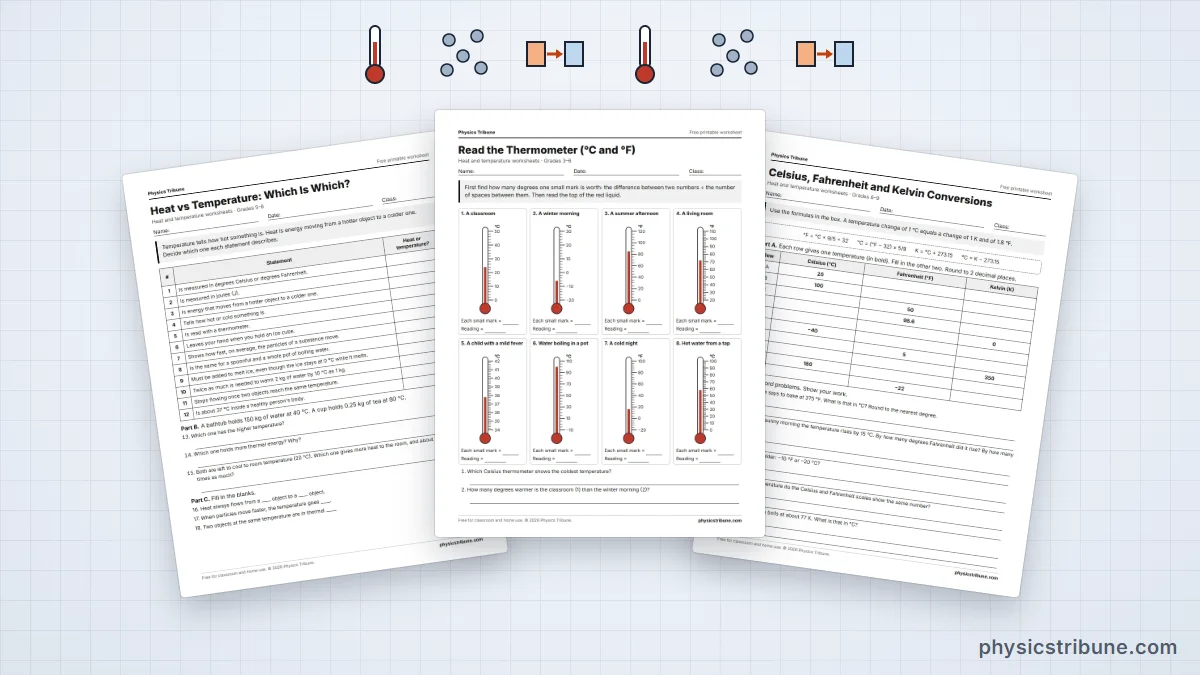
Conversions stick best with repetition across all three scales. Our heat and temperature worksheets include printable conversion drills with answer keys, and the quiz below checks the main ideas on this page.
Common Misconceptions
Myth: Kelvin is written as degrees, like 300 °K.
Physics: Kelvin is an absolute unit and is written without a degree sign, so the correct form is 300 K.
Myth: To convert Fahrenheit to Celsius, divide by 1.8 and then subtract 32.
Physics: The 32 is an offset in Fahrenheit, so you subtract 32 first and then multiply by 5/9 (or divide by 1.8).
Myth: 40 °C is twice as hot as 20 °C.
Physics: Celsius has an arbitrary zero, so ratios mean nothing. In kelvin, 40 °C is 313.15 K and 20 °C is 293.15 K, only about 7% higher.
Myth: A change of 10 °C is the same as a change of 10 °F.
Physics: A Celsius degree is 1.8 times larger, so a rise of 10 °C equals a rise of 18 °F. It also equals a rise of 10 K.
Key Facts
- Celsius, Fahrenheit and Kelvin all measure temperature but use different zero points and step sizes.
- Water freezes at 0 °C, 32 °F and 273.15 K.
- One kelvin equals one Celsius degree, and both equal 1.8 Fahrenheit degrees.
- Kelvin is the SI base unit and starts at absolute zero, so it is never negative.
- To convert Celsius to Fahrenheit, multiply by 9/5 and add 32.
- To convert Celsius to kelvin, add 273.15.
- The Celsius and Fahrenheit scales give the same reading at −40.
Quick Quiz: How Well Do You Know Celsius vs Fahrenheit vs Kelvin?
6 questions. Tap an answer to check it.
Which temperature scale is the SI base unit?
The kelvin is one of the seven SI base units.
What is 0 °C in kelvin?
Add 273.15 to a Celsius value to get kelvin.
Water boils at sea level at what Fahrenheit temperature?
Boiling water at standard pressure is 100 °C, which is 212 °F.
At which temperature do Celsius and Fahrenheit give the same number?
Solving T = (9/5)T + 32 gives T = −40.
A room warms by 5 °C. By how many kelvin did it warm?
Celsius degrees and kelvins are the same size, so a change of 5 °C is a change of 5 K.
Which scale can never show a negative value?
Kelvin starts at absolute zero, so it has no ordinary negative temperatures.
Frequently Asked Questions
What is the difference between Celsius, Fahrenheit and Kelvin?
They are three scales for the same quantity. Celsius puts water's freezing point at 0 and boiling point at 100. Fahrenheit puts them at 32 and 212, so its degrees are smaller. Kelvin uses Celsius-sized steps but starts at absolute zero, the coldest possible temperature, which makes it the scale used in physics formulas.
How do you convert Celsius to Fahrenheit?
Multiply the Celsius temperature by 9/5, which is 1.8, and then add 32. For example, 30 °C times 1.8 is 54, and adding 32 gives 86 °F. A fast mental shortcut is to double the Celsius value and add 30. It is close for everyday weather but drifts off at very high or very low temperatures.
How do you convert Fahrenheit to Kelvin?
Do it in two steps. First subtract 32 from the Fahrenheit value and multiply by 5/9 to get Celsius. Then add 273.15 to get kelvin. For example, 50 °F minus 32 is 18, times 5/9 is 10 °C, and 10 plus 273.15 gives 283.15 K. Never add 273.15 directly to a Fahrenheit value.
Why is there no degree symbol for kelvin?
Kelvin is an absolute unit that counts up from a true zero, like meters or kilograms, rather than a position on an arbitrary scale. International measurement bodies dropped the degree sign for kelvin in the late 1960s. So room temperature is written as about 293 K, and the unit is spoken simply as kelvin.
At what temperature are Celsius and Fahrenheit equal?
They are equal at −40. If you set the Fahrenheit and Celsius values to the same number in the conversion formula and solve, the only answer is −40. So −40 °C and −40 °F are the same temperature. In kelvin, that is 233.15 K.
Can temperature in kelvin be negative?
No. The kelvin scale starts at absolute zero, the point at which a system has the least possible thermal energy, so ordinary temperatures in kelvin are always positive. Physicists do use a special idea called negative absolute temperature for some unusual quantum systems, but it describes an odd energy distribution, not something colder than absolute zero.
Why does the United States still use Fahrenheit?
Fahrenheit was widely used in the British Empire and its former colonies before the metric system spread. Most countries switched to Celsius during the twentieth century, while everyday life in the United States kept Fahrenheit out of habit and the cost of change. American scientists, doctors in research and engineers still use Celsius and kelvin in their work.
Which temperature scale is the most accurate?
No scale is more accurate than another; accuracy depends on the thermometer, not the numbers printed on it. Fahrenheit has smaller degrees, so whole-number readings are slightly finer. Kelvin is the most fundamental because it is the SI base unit and is tied to the exact value of the Boltzmann constant.
Keep Exploring
 thermodynamicsTemperature Scales (Celsius, Fahrenheit, Kelvin)
 unitsKelvin (K): SI Unit of Thermodynamic Temperature
 unitsDegree Celsius (°C): SI Unit of Celsius Temperature
 thermodynamicsAbsolute Zero
 calculatorsTemperature Converter (°C, °F, K)
 compareHeat vs Temperature
 physicistsLord Kelvin
 thermodynamicsHow Thermometers Work
 worksheetsHeat and Temperature Worksheets