
At a Glance
Temperature measures how hot or cold something is, which depends on the average kinetic energy of its particles. For an ideal gas, the average kinetic energy per molecule is KE = 3/2 k_B T, with T in kelvin and k_B = 1.380649 × 10⁻²³ J/K. The SI unit of temperature is the kelvin.
- Symbol
- T
- SI unit
- kelvin (K); also °C and °F
- Key formula
- KEavg = 3/2 kBT (ideal gas)
- Scalar or vector
- Scalar
- Type of quantity
- Intensive: it does not depend on how much material there is
- Lowest possible
- Absolute zero, 0 K = −273.15 °C
On this page
- What Is Temperature in Physics?
- Temperature Explained Simply
- How Is Temperature Related to Kinetic Energy?
- What Is the SI Unit of Temperature?
- How Is Temperature Measured?
- What Is the Difference Between Temperature and Heat?
- What Are Some Real-Life Examples of Temperature?
- Why Do Hot Objects Cool Down to Room Temperature?
- Is There a Lowest Possible Temperature?
- Where Can You Practice Temperature Problems?
- Common Misconceptions
- Key Facts
- Quiz
- FAQ
What Is Temperature in Physics?
In everyday language temperature means how hot or cold something feels. Physics gives it a sharper meaning. All matter is made of atoms and molecules that are always moving: jiggling in a solid, sliding past each other in a liquid, flying around in a gas. Temperature measures the average energy of that random motion.
Temperature also has a practical job. It tells you which way heat will flow. Put a warm object against a cooler one and energy moves from the higher temperature to the lower one until they match. Two objects at the same temperature exchange no net heat, a state called thermal equilibrium.
That second idea is the basis of the zeroth law of thermodynamics. It is what makes a thermometer work: the thermometer comes to the same temperature as whatever it touches and then reports its own reading.
Temperature Explained Simply
Imagine a crowded dance floor. When slow music plays, people sway gently; when the music speeds up, everyone moves faster and bumps into each other harder. The dancers are like molecules, and the overall energy of the crowd is like temperature. A hotter object is one whose particles are dancing faster on average.
Notice the word average. In any glass of water some molecules move fast and some move slowly at the same moment. Temperature does not describe one molecule; it describes the typical motion of the whole crowd.
Temperature also does not depend on how much stuff you have. A spoonful of soup and the whole pot can both be at 70 °C. The pot holds far more thermal energy, but each particle in it is moving with the same average energy as in the spoon.
How Is Temperature Related to Kinetic Energy?
For an ideal gas the link is exact: the average translational kinetic energy of one molecule is
The formula explains why kelvin is the natural scale. At 0 K the average kinetic energy would be zero, so the scale's zero matches the physics. On the Celsius scale, 0 °C is just the freezing point of water, and the molecules there still carry plenty of energy.
The formula does not depend on the type of gas. A helium atom and a much heavier nitrogen molecule in the same room have the same average kinetic energy, so the lighter helium atoms move faster. Our page on the kinetic theory of gases develops this idea further.
For an ideal gas, temperature is tied directly to the average kinetic energy of one molecule by this formula.
| Symbol | Quantity | SI unit |
|---|---|---|
| average translational kinetic energy per molecule | joule (J) | |
| Boltzmann constant (1.381 × 10⁻²³ J/K (exact: 1.380649 × 10⁻²³)) | joule per kelvin (J/K) | |
| absolute temperature | kelvin (K) |
Rearranged to find another variable:
Valid for: ideal gas; translational motion only.
Example 1 Energy of an air molecule in a classroom
Air in a classroom is at 20 °C, which is 293.15 K. What is the average translational kinetic energy of one gas molecule in the air? Use k_B = 1.380649 × 10⁻²³ J/K.
- Given:
- Boltzmann constant:
- absolute temperature:
- Boltzmann constant:
- Formula:
- Substitute:
- Answer:
This is a tiny energy for one molecule, but a single breath contains around 10²² molecules, so the total adds up.
Example 2 How hot is a gas with a given molecular energy?
In a lab sample of helium, the average kinetic energy per atom is 1.0 × 10⁻²⁰ J. What is the temperature of the gas in kelvin?
- Given:
- average translational kinetic energy per molecule:
- Boltzmann constant:
- average translational kinetic energy per molecule:
- Formula:
- Substitute:
- Answer:
Convert to Celsius by subtracting 273.15 to see whether this would feel like a hot oven or a cool room.
What Is the SI Unit of Temperature?
The SI unit of temperature is the kelvin, symbol K, written without a degree sign. Since 2019 it has been defined by fixing the value of the Boltzmann constant, which ties each kelvin to a definite amount of particle energy.
The Celsius scale uses the same step size as the kelvin but a different zero, so
Example 3 A kitchen freezer in kelvin
A home freezer is set to −18 °C. What is this temperature on the kelvin scale?
- Given:
- temperature in degrees Celsius:
- temperature in degrees Celsius:
- Formula:
- Substitute:
- Answer:
Use the kelvin value whenever temperature goes into a formula as a ratio or product, such as the gas laws.
How Is Temperature Measured?
Every thermometer relies on some property that changes with temperature in a predictable way. The most common types are:
- Liquid-in-glass thermometers, where alcohol expands up a narrow tube as it warms.
- Bimetallic strips, two bonded metals that expand by different amounts and bend, used in oven dials and older thermostats.
- Thermistors and resistance thermometers, whose electrical resistance changes with temperature; these sit inside digital thermometers.
- Thermocouples, junctions of two different metals that produce a small voltage, used in furnaces and engines.
- Infrared thermometers, which read the thermal radiation an object gives off without touching it.
Contact thermometers need time to reach equilibrium with the object, which is why a fever thermometer must stay in place for a moment. Infrared types respond almost instantly, as the diagram below shows.


What Is the Difference Between Temperature and Heat?
Temperature and heat are related but not the same. Temperature is a property of an object at one moment, measured in kelvin. Heat is energy in transit, moving from a hotter object to a colder one, measured in joules. An object has a temperature; it does not have heat stored in it.
A sparkler shows the difference well. Its sparks are well over 1,000 °C, yet they barely sting when they land on your hand, because each spark has so little mass that it carries very little energy. A bathtub of 40 °C water has a much lower temperature but could transfer far more heat. Our heat vs temperature comparison goes through more examples.
How much a temperature changes when heat flows depends on the material, which is described by its specific heat capacity.
What Are Some Real-Life Examples of Temperature?
Temperatures in nature range over an enormous span. The table below runs from the faint glow left over from the Big Bang to the core of the Sun, with each value given on three scales and as the average kinetic energy per particle.
Everyday life sits in a very narrow slice of that range, roughly 250 K to 320 K. Small shifts inside it still matter a great deal: a body temperature only a few degrees above normal is a serious fever, and food spoils far faster at room temperature than in a refrigerator.
| Example | Kelvin (K) | Celsius (°C) | Fahrenheit (°F) | Average KE per particle (J) |
|---|---|---|---|---|
| Cosmic microwave background (about) | 2.7 | −270.45 | −454.8 | 5.59 × 10⁻²³ |
| Liquid helium boils (about) | 4.2 | −268.95 | −452.1 | 8.70 × 10⁻²³ |
| Liquid nitrogen boils (about) | 77 | −196.15 | −321.1 | 1.60 × 10⁻²¹ |
| Coldest air measured on Earth (about) | 184 | −89.15 | −128.5 | 3.81 × 10⁻²¹ |
| Water freezes | 273.15 | 0 | 32 | 5.66 × 10⁻²¹ |
| Room temperature | 293.15 | 20 | 68 | 6.07 × 10⁻²¹ |
| Human body (typical) | 310.15 | 37 | 98.6 | 6.42 × 10⁻²¹ |
| Water boils at sea level | 373.15 | 100 | 212 | 7.73 × 10⁻²¹ |
| Flowing lava (about) | 1,473 | 1,200 | 2,192 | 3.05 × 10⁻²⁰ |
| Surface of the Sun (about) | 5,772 | 5,499 | 9,930 | 1.20 × 10⁻¹⁹ |
| Core of the Sun (about) | 15,000,000 | about 15,000,000 | about 27,000,000 | 3.11 × 10⁻¹⁶ |
| Source: Computed with T_C = T_K − 273.15, T_F = 9/5 T_C + 32 and KE = 3/2 k_B T (k_B from NIST CODATA 2022); natural temperatures are typical values · Retrieved October 2026 | ||||
Why Do Hot Objects Cool Down to Room Temperature?
A hot drink left on a desk loses heat to the cooler air around it, and its temperature drops. The drop is fast at first, while the temperature gap is large, and slows as the drink approaches room temperature. Eventually the drink and the room are in equilibrium and the temperature stops changing.
The graph below shows a mug of coffee cooling from 85 °C toward a room at 21 °C. The shape, steep at first and flattening later, is described by Newton's law of cooling. The same curve, run in reverse, describes a cold soda warming up on a picnic table.

Is There a Lowest Possible Temperature?
Yes. Absolute zero, 0 K or −273.15 °C, is the lowest temperature possible. At that point a system would have the least energy it could ever have. Particles do not freeze perfectly still, because quantum physics leaves a small leftover motion, but no more energy can be removed.
Absolute zero can be approached but never reached, as the third law of thermodynamics states. Laboratories have cooled clouds of atoms to within a billionth of a kelvin of it. There is no matching upper limit: the cores of stars reach millions of kelvin, and particle colliders briefly create matter at trillions.
Where Can You Practice Temperature Problems?
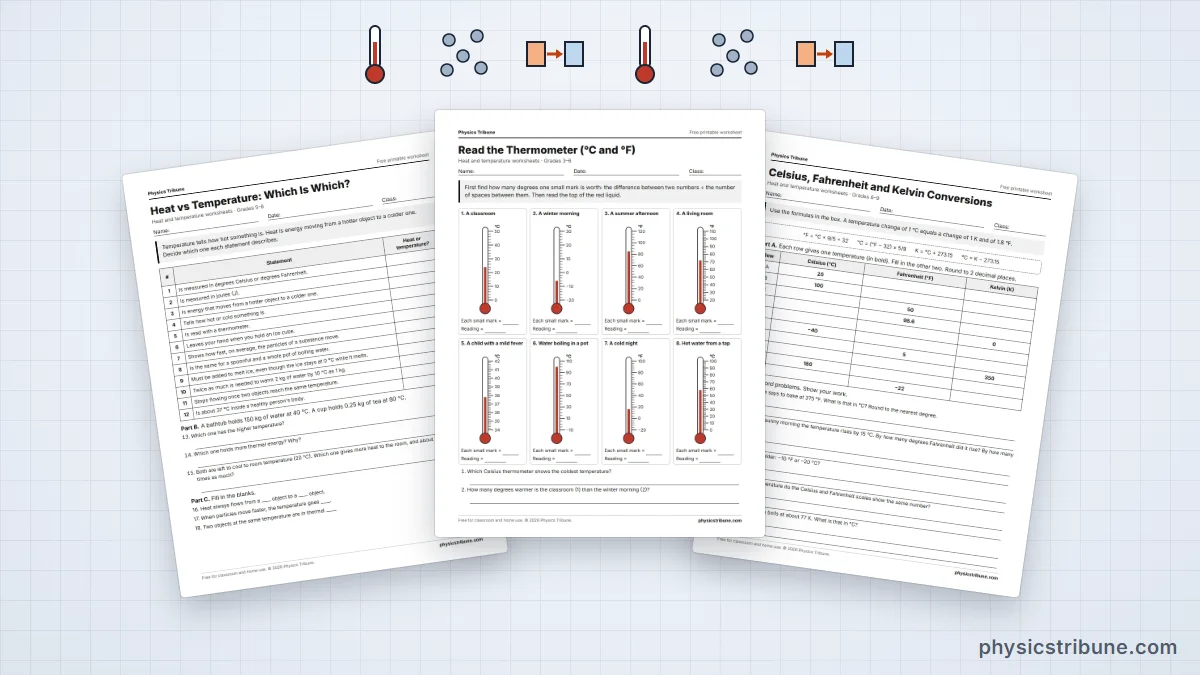
Printable practice sets with answer keys are on our heat and temperature worksheets page. To see how the absolute temperature scale was born, read about Lord Kelvin, and for the whole topic area, start from temperature and heat.
Common Misconceptions
Myth: Temperature and heat are the same thing.
Physics: Temperature describes the average energy of particles at one moment. Heat is energy that moves between objects because of a temperature difference.
Myth: Metal is colder than wood in the same room because it is at a lower temperature.
Physics: Both are at room temperature. Metal feels colder because it conducts heat away from your hand much faster.
Myth: At absolute zero all motion stops completely.
Physics: Quantum physics leaves a small zero-point motion even at the lowest energy state. Absolute zero is the point where no more energy can be removed.
Myth: A bigger object at the same temperature is hotter.
Physics: A larger object holds more thermal energy, but its temperature, the average energy per particle, can be exactly the same as a smaller one.
Key Facts
- Temperature tracks the typical energy of random motion carried by each atom or molecule.
- The SI unit of temperature is the kelvin (K), and T_K = T_C + 273.15.
- For an ideal gas, the average kinetic energy per molecule is 3/2 k_B T.
- Heat flows on its own from a higher temperature to a lower one until both are equal.
- Temperature is a scalar and an intensive property: a spoonful and a pot of soup can share one temperature.
- Absolute zero, 0 K or −273.15 °C, is the lowest possible temperature and cannot be reached.
- Thermometers work by reaching thermal equilibrium with the object they measure.
Quick Quiz: How Well Do You Know Temperature?
6 questions. Tap an answer to check it.
What does temperature measure?
Temperature tracks the average energy of random particle motion, not the total.
What is 25 °C in kelvin?
T_K = 25 + 273.15 = 298.15 K.
Two objects are in thermal equilibrium. What is true?
Thermal equilibrium means equal temperatures, so no net heat flows between them.
If the kelvin temperature of an ideal gas doubles, the average kinetic energy of its molecules…
KE_avg = 3/2 k_B T, so it is directly proportional to T in kelvin.
Which statement about absolute zero is correct?
Absolute zero is 0 K, or −273.15 °C, and can only be approached, never reached.
Why does a metal spoon feel colder than a wooden spoon in the same drawer?
Both spoons are at room temperature; metal simply draws heat from your skin more quickly.
Frequently Asked Questions
What is temperature in simple words?
Temperature is a number that tells you how hot or cold something is. Physically, it measures how fast, on average, the tiny particles inside the object are moving. Faster jiggling means a higher temperature. It also tells you the direction of heat flow: energy always moves on its own from the hotter object to the colder one.
What is the SI unit of temperature?
The SI unit of temperature is the kelvin, symbol K. It is one of the seven SI base units. A change of one kelvin is the same size as a change of one degree Celsius, but the kelvin scale starts at absolute zero. To convert Celsius to kelvin, add 273.15, so 25 °C equals 298.15 K.
Is temperature a scalar or a vector?
Temperature is a scalar. It has a size but no direction: a cup of tea is simply at 70 °C, not 70 °C pointing north. What can have direction is the temperature gradient, the rate at which temperature changes from place to place, which points the way heat would flow backward. The temperature itself is just a number with a unit.
How is temperature related to kinetic energy?
Temperature is proportional to the average kinetic energy of particles. For an ideal gas, the average kinetic energy of one molecule equals 3/2 times the Boltzmann constant times the absolute temperature in kelvin. So if you double the kelvin temperature of a gas, you double the average energy of its molecules, and their typical speed increases by about 41 percent.
What is the difference between temperature and thermal energy?
Temperature is the average kinetic energy per particle, while thermal energy is the total energy of random motion of all the particles together. A large iceberg has a low temperature but holds far more thermal energy than a cup of hot coffee, simply because it contains vastly more molecules. Thermal energy depends on the amount of material; temperature does not.
What instrument is used to measure temperature?
Temperature is measured with a thermometer. Common types include liquid-in-glass thermometers, digital thermometers that use a thermistor, thermocouples for high temperatures, bimetallic strip dials and infrared thermometers that read thermal radiation without contact. All of them rely on a physical property, such as expansion, resistance or voltage, that changes in a known way with temperature.
Why do scientists use kelvin instead of Celsius?
Kelvin starts at absolute zero, so its values are directly proportional to the average energy of particles. That makes formulas like the ideal gas law and the Carnot efficiency work correctly. Using Celsius in those formulas would give nonsense, such as dividing by zero at the freezing point of water. For temperature differences, Celsius and kelvin give the same number.
Can temperature be negative?
On the Celsius and Fahrenheit scales, yes: winter days are often below 0 °C or 0 °F. On the kelvin scale, ordinary matter cannot go below 0 K, because that is the lowest possible energy state. Physicists do talk about negative kelvin temperatures in a few special laboratory systems, but those behave as hotter than any positive temperature, not colder.
What is the highest temperature possible?
There is no known upper limit to temperature in the way absolute zero is a lower limit. The core of the Sun is about 15 million kelvin, and particle colliders create tiny fireballs of matter at trillions of kelvin for a split second. Some theories suggest physics as we know it breaks down at extreme temperatures, but no practical ceiling has been found.
Keep Exploring
 thermodynamicsTemperature Scales (Celsius, Fahrenheit, Kelvin)
 thermodynamicsHeat (Thermal Energy Transfer)
 thermodynamicsThermal Energy
 compareHeat vs Temperature
 calculatorsTemperature Converter (°C, °F, K)
 worksheetsHeat and Temperature Worksheets
 thermodynamicsAbsolute Zero
 thermodynamicsHow Thermometers Work
 physicistsLord Kelvin
Sources
Constants come from NIST CODATA 2022 (public domain) and unit definitions from the BIPM SI Brochure (CC BY 4.0). Text, diagrams and illustrations are original work by Physics Tribune.