
At a Glance
There are four laws of thermodynamics. The zeroth law says objects in thermal equilibrium with a third object share one temperature; the first law says ΔU = Q − W, so energy is conserved; the second law says the entropy of an isolated system never decreases (ΔS ≥ 0); the third law says entropy approaches a minimum as temperature approaches absolute zero, which cannot be reached.
- How many laws
- Four: zeroth, first, second, third
- Zeroth law
- Thermal equilibrium defines temperature
- First law
- ΔU = Q − W (energy is conserved)
- Second law
- ΔS ≥ 0 for an isolated system
- Third law
- S approaches a minimum as T approaches 0 K
- Key units
- joule (J), kelvin (K), J/K for entropy
On this page
- What Are the Laws of Thermodynamics?
- The Laws of Thermodynamics Explained Simply
- What Does the Zeroth Law Say?
- What Does the First Law of Thermodynamics Say?
- What Is the Second Law of Thermodynamics?
- What Is the Third Law of Thermodynamics?
- Who Discovered the Laws of Thermodynamics?
- In What Order Should You Study the Laws of Thermodynamics?
- All pages in this guide
- Key Facts
- FAQ
What Are the Laws of Thermodynamics?
Thermodynamics is the part of physics that tracks heat, work and the energy stored inside matter. Its four laws are not derived from anything simpler. They are summaries of countless measurements on engines, gases, ice, stars and living cells, and no confirmed experiment has ever broken one of them.
Each law answers a different question. The zeroth law tells us what temperature is. The first law tells us how much energy we have. The second law tells us which way energy will flow and how much of it we can turn into useful work. The third law tells us what happens at the coldest limit nature allows.
All four laws talk about a thermodynamic system, which is simply the part of the world you choose to study, such as the gas inside a cylinder. Everything outside it is the surroundings, and the laws describe what crosses the boundary between them.
| Law | Plain statement | Equation | Key idea |
|---|---|---|---|
| Zeroth law | Two objects each in equilibrium with a third share one temperature | If T_A = T_C and T_B = T_C, then T_A = T_B | Temperature |
| First law | Energy is conserved when heat and work cross a boundary | ΔU = Q − W | Internal energy |
| Second law | Heat flows on its own from hot to cold; isolated entropy never falls | ΔS_isolated ≥ 0 | Entropy |
| Third law | Entropy approaches a minimum as temperature nears absolute zero | S → S_0 as T → 0 K | Absolute zero |
| Source: Statements and equations from our laws data set (data/laws.json) · Retrieved October 2026 | |||
The Laws of Thermodynamics Explained Simply
A popular way to remember the laws treats energy like a game you cannot quit. The zeroth law says everyone at the table agrees on the rules. The first law says you cannot win, because you never get out more energy than you put in. The second law says you cannot break even, because some energy always ends up as waste heat. The third law says you cannot leave the game, because you can never reach absolute zero.
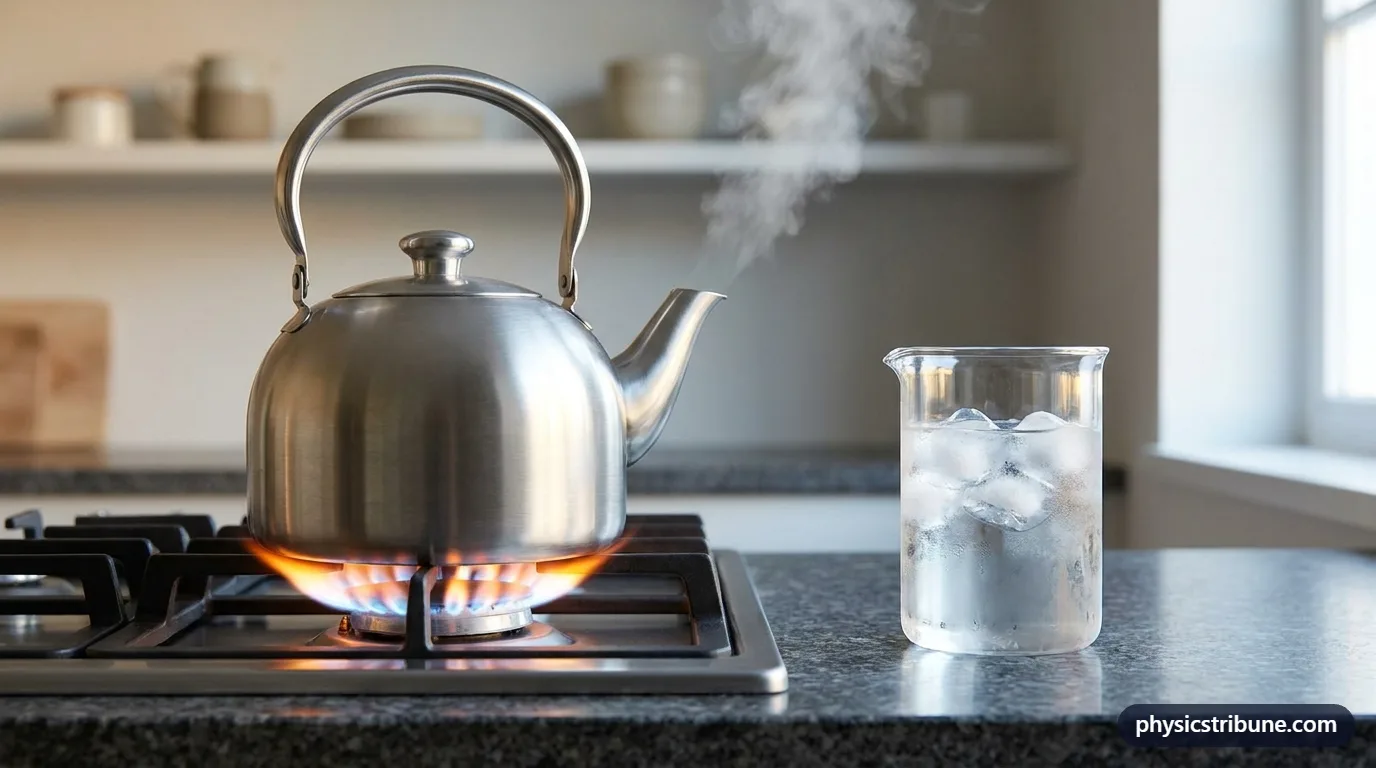
Picture a glass of iced tea on a summer porch. Heat flows from the warm air into the cold drink until both reach the same temperature, and the ice melts. The energy lost by the air equals the energy gained by the tea, and the process never runs backward on its own: the tea will not freeze again while the porch warms up.
What Does the Zeroth Law Say?
The zeroth law of thermodynamics states that if two objects are each in thermal equilibrium with a third object, they are in equilibrium with each other. Thermal equilibrium means no net heat flows when they touch.
This sounds obvious, but it is the reason a thermometer works. The thermometer is the third object: if it reads the same in your bath water and in your sink, those two waters would exchange no net heat. The law was named last, after the first three were already numbered, which is why it got the odd label "zeroth."
What Does the First Law of Thermodynamics Say?
The first law of thermodynamics is conservation of energy written for heat. In equation form,
A bicycle pump shows the law in action. When you push the handle down quickly, you do work on the trapped air, so its internal energy rises and the barrel feels warm. A car engine runs the trade the other way, taking in heat from burning fuel and giving some of it out as work on the pistons. Some textbooks write the law as
What Is the Second Law of Thermodynamics?
The second law of thermodynamics says heat flows on its own only from hotter to colder objects, and the total entropy of an isolated system never decreases. Entropy is a measure of how many ways the particles of a system can share its energy, and it is often described loosely as disorder.
The law has a practical sting: no heat engine can turn all the heat it takes in into work. Some heat must always be dumped to a colder place. The best possible engine, described by the Carnot cycle, has an efficiency of
The second law also explains why many processes only go one way. A dropped egg does not reassemble, and perfume spreading through a room does not gather back into the bottle. These are irreversible processes, and every real process is irreversible to some degree.
| Quantity | Formula | SI unit |
|---|---|---|
| First law | ΔU = Q − W | joule (J) |
| Internal energy of a monatomic ideal gas | U = (3/2) n R T | joule (J) |
| Entropy change at constant temperature | ΔS = Q / T | joule per kelvin (J/K) |
| Boltzmann entropy | S = k_B ln W | joule per kelvin (J/K) |
| Heat engine efficiency | e = W / Q_h = 1 − Q_c / Q_h | no unit |
| Carnot (maximum) efficiency | e_C = 1 − T_c / T_h | no unit |
| Heat pump coefficient of performance | COP = Q_h / W | no unit |
| Source: Formulas from our formula data set (data/formulas.json) · Retrieved October 2026 | ||

What Is the Third Law of Thermodynamics?
The third law of thermodynamics says that as a system approaches absolute zero, its entropy approaches a constant minimum value. Walther Nernst developed it between 1906 and 1912, and a common form states that absolute zero cannot be reached in any finite number of steps.
Each cooling step removes a smaller share of the remaining heat, so the temperature creeps toward 0 K without ever arriving. Laboratories have cooled atoms to within a tiny fraction of a kelvin, yet the last step always remains. The law also gives entropy a natural zero point, which chemists use to tabulate entropy values for substances.
Who Discovered the Laws of Thermodynamics?
No single person discovered them. Sadi Carnot analyzed steam engines in 1824 and laid the groundwork for the second law. In the 1840s James Prescott Joule measured how much work produces a given amount of heat, which led to the first law.
Rudolf Clausius gave a clear statement of the first law in 1850 and later introduced entropy, while Lord Kelvin stated the second law in 1851 and proposed the absolute temperature scale. Ludwig Boltzmann then linked entropy to the motion of atoms. Our answer to who discovered thermodynamics tells the full story.
In What Order Should You Study the Laws of Thermodynamics?
The laws build on one another, so we suggest this order:
- Thermodynamic systems: open, closed and isolated, plus the idea of surroundings.
- The zeroth law, together with temperature and thermal equilibrium.
- The first law, with heat, work and internal energy.
- The second law and entropy.
- Reversible and irreversible processes, which show why real machines lose energy.
- The third law and absolute zero.
After that, apply the laws to thermodynamic processes and heat engines and refrigerators. Every equation from this section is collected on our thermodynamics formulas sheet.
All Laws of Thermodynamics (7)


Key Facts
- There are four laws of thermodynamics, numbered zeroth, first, second and third.
- The zeroth law makes temperature measurable by defining thermal equilibrium.
- The first law, ΔU = Q − W, is conservation of energy applied to heat and work.
- The second law says heat flows on its own only from hot to cold and isolated entropy never decreases.
- No heat engine can be 100 percent efficient; the Carnot limit is 1 − T_c/T_h.
- The third law says absolute zero cannot be reached in a finite number of steps.
- Entropy is measured in joules per kelvin and counts the ways a system can share its energy.
Frequently Asked Questions
What are the 4 laws of thermodynamics in simple terms?
The zeroth law says things touching long enough reach the same temperature, so thermometers work. The first law says energy is never created or destroyed, only moved as heat or work. The second law says heat spreads from hot to cold on its own and no engine is perfectly efficient. The third law says you can approach absolute zero but never actually reach it.
What is the most important law of thermodynamics?
Many physicists single out the second law, because it alone gives processes a direction in time and sets hard limits on engines, refrigerators and power plants. The first law is just as fundamental, since it is conservation of energy. In practice you need both: the first tells you how much energy is available, and the second tells you how much of it you can actually use.
Why is it called the zeroth law of thermodynamics?
The first, second and third laws were already established and numbered when physicists realized that the idea of thermal equilibrium, which makes temperature meaningful, was even more basic. Rather than renumber the famous laws, they called the new one the zeroth law so it would sit logically before the others. The name is credited to the British physicist Ralph Fowler in the 1930s.
Does the second law of thermodynamics mean disorder always increases?
It means the total entropy of an isolated system never decreases. Local order can still grow, as when water freezes in a freezer or a plant builds sugar from sunlight, but the freezer or the Sun releases enough heat to raise the entropy of the surroundings by more. Counting system and surroundings together, the total always goes up or, in an ideal reversible process, stays the same.
Can the laws of thermodynamics be broken?
No confirmed experiment has ever broken them, which is why perpetual motion machines are rejected without testing. At very small scales and very short times, a few molecules can briefly move against the usual direction of heat flow, but these fluctuations average out rapidly. For any system large enough to see or use, the four laws hold every time.
How do the laws of thermodynamics apply to everyday life?
They explain why a hot drink cools to room temperature, why your car engine needs a radiator, why a refrigerator needs electricity to pump heat out of its cold interior, and why your body gives off heat while it uses food energy. They also explain why power plants waste a large share of their fuel energy as heat, no matter how well they are built.
Keep Exploring
 thermodynamicsFirst Law of Thermodynamics
 thermodynamicsSecond Law of Thermodynamics
 thermodynamicsEntropy
 thermodynamicsZeroth Law of Thermodynamics
 thermodynamicsThird Law of Thermodynamics
 thermodynamicsCarnot Cycle and Carnot Efficiency
 formulasHeat and Thermodynamics Formulas
 physicistsRudolf Clausius
 questionsWho discovered thermodynamics?