
At a Glance
Newton's law of cooling says the cooling rate is proportional to the temperature difference between an object and its surroundings: dT/dt = -k(T - T_env). Solved, it gives T(t) = T_env + (T0 - T_env) e^(-kt), so the temperature gap shrinks by the same fraction in every equal time interval.
- Discovered by
- Isaac Newton
- Published
- 1701, anonymously
- Rate form
- dT/dt = −k(T − Tenv)
- Solution
- T(t) = Tenv + (T0 − Tenv)e−kt
- Cooling constant k
- Unit 1/s (often quoted per minute); larger k means faster cooling
- Applies to
- Modest temperature differences, mainly convective cooling, steady surroundings
On this page
- What Is Newton's Law of Cooling?
- Newton's Law of Cooling Explained Simply
- What Is the Formula for Newton's Law of Cooling?
- What Does a Newton's Law of Cooling Graph Look Like?
- What Determines the Cooling Constant k?
- Where Do You See Newton's Law of Cooling in Everyday Life?
- Who Discovered Newton's Law of Cooling?
- When Does Newton's Law of Cooling Not Work Well?
- Practice Newton's Law of Cooling Problems
- Common Misconceptions
- Key Facts
- Quiz
- FAQ
What Is Newton's Law of Cooling?
Newton's law of cooling describes how quickly a warm object loses heat to cooler surroundings. Its central claim is simple: the cooling rate is proportional to the temperature gap. An object 60 degrees hotter than the room cools about three times as fast as the same object only 20 degrees hotter.
Because the gap shrinks as the object cools, the cooling rate shrinks too. That is why a cup of tea drops many degrees in its first few minutes and then lingers at lukewarm for a long time. The temperature approaches room temperature smoothly, getting closer every minute without ever technically arriving.
The same rule works in reverse for warming. A cold drink taken out of the refrigerator warms up fastest right away, then more and more slowly as it approaches the room's temperature. In both directions, the object is heading toward thermal equilibrium with its surroundings.
Newton's Law of Cooling Explained Simply
Picture heat as water flowing downhill. The steeper the hill, the faster the water runs. For heat, the steepness is the temperature difference between the hot object and the air around it. A big difference means a steep hill and fast heat flow.
As the object cools, the hill gets flatter, so the flow slows down. Near the bottom the hill is almost level and the heat barely trickles out. This is the whole idea behind the law: the bigger the temperature gap, the faster the cooling.
A handy way to remember it is that the gap shrinks by the same fraction in equal stretches of time. If a drink loses half its extra warmth in 15 minutes, it loses half of what is left in the next 15 minutes, and half again after that.
What Is the Formula for Newton's Law of Cooling?
In its rate form, the law reads
Solving this equation gives the form you use for calculations:
The units of
Here is the solved form of Newton's law of cooling with every variable and its unit, plus the rearranged forms for finding the time or the cooling constant.
| Symbol | Quantity | SI unit |
|---|---|---|
| object temperature at time t | kelvin (K) | |
| surrounding (ambient) temperature | kelvin (K) | |
| initial object temperature | kelvin (K) | |
| cooling constant | per second (1/s) | |
| time | second (s) |
Rearranged to find another variable:
Valid for: empirical; small temperature differences, mainly convective cooling, constant ambient temperature. Any consistent temperature unit (°C or K).
Example 1 A forgotten mug of coffee
A mug of coffee at 88 °C is left on a desk in a 21 °C office. Its cooling constant is 0.035 per minute. What is the coffee's temperature after 15 minutes?
- Given:
- initial object temperature:
- surrounding (ambient) temperature:
- cooling constant:
- time:
- initial object temperature:
- Formula:
- Substitute:
- Answer:
The coffee has lost a little over 27 degrees in a quarter of an hour, but the next 15 minutes will remove noticeably less because the gap to room temperature is now smaller.
What Does a Newton's Law of Cooling Graph Look Like?
A graph of temperature against time for a cooling object is an exponential decay curve that levels off at room temperature. It starts steep, bends gradually and flattens into a horizontal line. That flat line is the room temperature, which the curve approaches but never crosses.
The table below follows a cup of hot water that starts at 90 °C in a 20 °C room. With an open cup the gap halves roughly every 17 minutes (computed from ln 2 ÷ 0.04). With a lid and an insulating sleeve the cooling constant drops to a quarter, and the drink stays hot far longer.
If you plot the logarithm of the temperature gap,
| Time (min) | Open cup, k = 0.04/min (°C) | Lidded insulated cup, k = 0.01/min (°C) |
|---|---|---|
| 0 | 90.0 | 90.0 |
| 5 | 77.3 | 86.6 |
| 10 | 66.9 | 83.3 |
| 15 | 58.4 | 80.2 |
| 20 | 51.5 | 77.3 |
| 30 | 41.1 | 71.9 |
| 45 | 31.6 | 64.6 |
| 60 | 26.4 | 58.4 |
| 90 | 21.9 | 48.5 |
| Source: Computed with T(t) = T_env + (T0 − T_env)e^(−kt); cooling constants are illustrative values · Retrieved October 2026 | ||

What Determines the Cooling Constant k?
The cooling constant gathers every property of the object and its surroundings into one number. It grows with the surface area exposed to air and with how easily heat crosses that surface, and it shrinks as the object's mass and specific heat capacity grow. In short,
This explains several everyday observations. A wide, shallow bowl of soup cools faster than a tall mug holding the same amount, because more surface touches the air. Blowing on food raises
Because so many factors feed into it,
Example 3 Measuring the cooling constant of soup
A bowl of soup at 75 °C is set on a table in a 20 °C room. Twelve minutes later a kitchen thermometer reads 50 °C. What is the soup's cooling constant?
- Given:
- object temperature at time t:
- initial object temperature:
- surrounding (ambient) temperature:
- time:
- object temperature at time t:
- Formula:
- Substitute:
- Answer:
Once k is known from one reading, the same equation predicts the soup's temperature at any later time in the same room.

Where Do You See Newton's Law of Cooling in Everyday Life?
Newton's law of cooling quietly shapes many daily routines:
- Hot drinks. Coffee and tea cool rapidly in the first minutes, which is why a drink that is too hot to sip becomes pleasant fairly soon but then stays warm for a while.
- Cooking and baking. Recipes that say "let cool for 10 minutes" rely on the fast early drop; waiting longer gives much smaller gains.
- Food safety. Leftovers are split into shallow containers so they cool through the warm range quickly, since a larger surface raises the cooling constant.
- Engines and electronics. Engineers size radiators and heat sinks so the gap between the part and the air stays small enough while heat is carried away.
- Weather and buildings. A house loses heat faster on a frigid night than on a mild one, which is why heating bills climb as outdoor temperatures fall.
Crime-scene investigators have also used the idea to estimate how long ago a body began to cool, although real estimates need corrections because a body is far from a simple uniform object.
Example 2 When can the cake be frosted?
A cake comes out of the oven with its center at 165 °C and is set on a rack in a 22 °C kitchen. The baker wants the center at 40 °C before adding frosting, and the cake's cooling constant is 0.05 per minute. How long must the baker wait?
- Given:
- object temperature at time t:
- initial object temperature:
- surrounding (ambient) temperature:
- cooling constant:
- object temperature at time t:
- Formula:
- Substitute:
- Answer:
Real cakes cool from the outside in, so the center lags behind this simple estimate a little; a wire rack helps by letting air reach the bottom.

Who Discovered Newton's Law of Cooling?
Isaac Newton described the cooling rule in a short paper published anonymously in 1701. He was trying to build a temperature scale for heat far beyond what thermometers of his day could handle, so he heated an iron block until it glowed and timed how it cooled in a steady breeze.
Newton did not write the law as a modern equation. He stated in words that the heat lost in equal times was in proportion to how much hotter the iron was than the air. The exponential formula used today came later, once calculus-based methods for such rate problems became standard.
Later experimenters in the 1800s showed that the law is only approximate at large temperature differences, where radiation grows much faster than the simple rule predicts. Even so, it remains one of the most widely used models in heat transfer because it is easy to apply and accurate enough for many practical jobs.
When Does Newton's Law of Cooling Not Work Well?
The law is an empirical approximation, not an exact law of nature. It works best when the temperature difference is modest, when heat leaves mainly by convection to moving air, and when the surroundings stay at a steady temperature.
It breaks down in several situations. For very hot objects, thermal radiation takes over, and radiated power depends on the fourth power of absolute temperature, so cooling at high temperatures is faster than Newton's rule predicts. In still air, natural convection itself speeds up as the gap grows, which bends the curve slightly. A change of state, such as steam condensing or water freezing, also pauses the temperature completely until the phase change ends.
The law also assumes the object has one temperature throughout. A thick roast or a large block of stone can have a hot core and a cool surface at the same time, so its interior cools more slowly than a single exponential curve suggests.
Practice Newton's Law of Cooling Problems
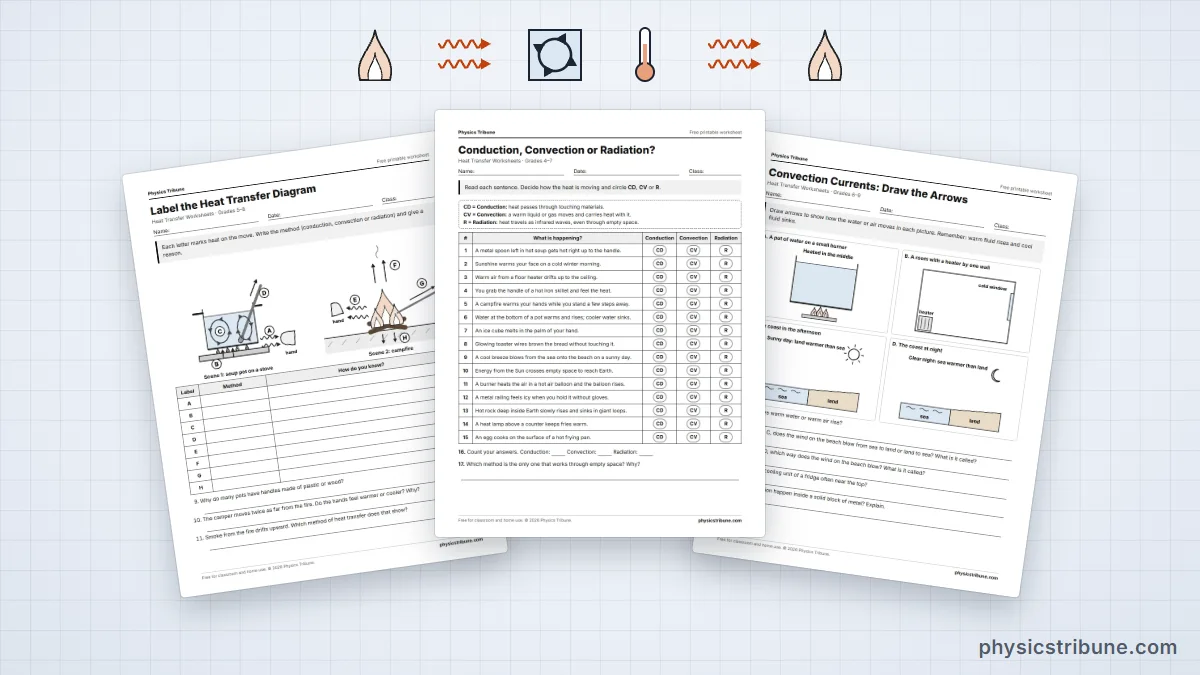
To build confidence, try predicting a temperature, finding a waiting time and measuring a cooling constant with your own numbers. Our heat transfer worksheets include printable problems with answer keys, and the thermodynamics formula sheet collects this equation alongside the other heat laws. For the wider picture of how heat moves, compare the three mechanisms in conduction vs convection vs radiation.
Common Misconceptions
Myth: A hot object cools at a steady number of degrees per minute.
Physics: The cooling rate depends on the temperature gap, so it is fastest at the start and keeps slowing as the object approaches room temperature.
Myth: Given enough time, the object's temperature drops below room temperature.
Physics: Cooling by contact with the air stops at room temperature. The curve approaches that value from above and never crosses it.
Myth: The law needs temperatures in kelvin, like the gas laws do.
Physics: Only differences between temperatures appear in Newton's law of cooling, and a difference is the same in Celsius and kelvin, so either scale works.
Myth: The cooling constant is a fixed property of a substance, like density.
Physics: k depends on the whole situation, including shape, container, airflow and amount of material. The same coffee has a different k in a mug and in a flask.
Key Facts
- Newton's law of cooling says the cooling rate is proportional to the temperature difference between an object and its surroundings.
- The solved form is T(t) = T_env + (T0 − T_env)e^(−kt), an exponential approach to room temperature.
- Equal time intervals shrink the temperature gap by the same fraction, so cooling slows as the object nears room temperature.
- The cooling constant k depends on surface area, airflow, mass and specific heat capacity.
- Celsius or kelvin both work in the formula, because only temperature differences appear.
- Isaac Newton published the rule anonymously in 1701 after timing a red-hot iron block cooling in a breeze.
- The law is approximate: it fails for very hot objects dominated by radiation and during phase changes.
Quick Quiz: How Well Do You Know Newton's Law of Cooling?
6 questions. Tap an answer to check it.
According to Newton's law of cooling, when does an object cool fastest?
The cooling rate is proportional to the temperature difference, which is largest at the start.
What are the units of the cooling constant k?
k multiplies time inside the exponent, so it must have units of one over time.
A drink loses half its temperature gap with the room in 10 minutes. What fraction of the original gap remains after 30 minutes?
The gap halves in every 10-minute stretch: one half, then one quarter, then one eighth.
Which change would increase the cooling constant of a bowl of soup?
A wider bowl exposes more surface to the air, so heat escapes faster and k grows.
Why does Newton's law of cooling work with Celsius temperatures?
A difference of one degree Celsius equals a difference of one kelvin, so either scale gives the same result.
In which situation is Newton's law of cooling least accurate?
At very high temperatures radiation dominates and grows much faster than the simple linear rule predicts.
Frequently Asked Questions
What is Newton's law of cooling in simple terms?
It says that a hot object cools faster when it is much hotter than its surroundings and more slowly as it gets closer to their temperature. The cooling speed is proportional to the temperature gap. That is why a hot drink loses heat quickly at first and then stays warm for a long time before it reaches room temperature.
What is the formula for Newton's law of cooling?
The rate form is dT/dt = −k(T − T_env), where T_env is the surrounding temperature and k is the cooling constant. Solved over time, it becomes T(t) = T_env + (T0 − T_env)e^(−kt), where T0 is the starting temperature. You can rearrange it to find the time needed to reach a temperature or to measure k from two readings.
What is k in Newton's law of cooling?
k is the cooling constant. It has units of inverse time, such as 1/s or 1/min, and it measures how quickly the temperature gap shrinks. A larger k means faster cooling. It depends on the object's surface area, the airflow around it, its mass and its specific heat capacity, so it is usually found by measurement.
Why do hot things cool faster at first?
Heat flows from hot to cold at a rate that depends on the temperature difference. At the start the gap between the object and the air is largest, so heat leaves fastest. As the object cools, the gap and therefore the heat flow both shrink. The result is a curve that is steep at first and gradually levels off.
Does Newton's law of cooling work for heating up?
Yes. The same equation describes an object warming toward a hotter environment, such as a cold soda left on a counter. The temperature rises fastest at first and then more slowly as it nears room temperature. In the formula, T0 is simply below T_env, so the exponential term is negative and the temperature climbs toward the room's value.
Can you use Celsius in Newton's law of cooling?
Yes. Every temperature in the formula appears as a difference, either T − T_env or T0 − T_env, and a temperature difference has the same size in Celsius and in kelvin. Just keep all three temperatures on the same scale. Do not mix Celsius and Fahrenheit in one calculation, because their degree sizes differ.
Is Newton's law of cooling accurate?
It is a good approximation when the temperature difference is moderate and heat leaves mainly by convection to air at a steady temperature. It becomes less accurate for very hot objects, where radiation dominates and grows with the fourth power of absolute temperature, and for large objects whose inside and outside have different temperatures. Phase changes also break the simple curve.
How do you find the time it takes something to cool?
Rearrange the solved equation to t = −(1/k) ln[(T − T_env)/(T0 − T_env)]. Put in the starting temperature, the target temperature, the room temperature and the cooling constant. Make sure the time unit matches the unit of k. If k is given per minute, the answer comes out in minutes.
Who discovered Newton's law of cooling?
Isaac Newton described the rule in an anonymous paper published in 1701, based on experiments in which he timed a hot iron block cooling in a steady wind. He stated it in words rather than as an equation. The exponential formula students learn today was written later using calculus.
Keep Exploring






Sources
Constants come from NIST CODATA 2022 (public domain) and unit definitions from the BIPM SI Brochure (CC BY 4.0). Text, diagrams and illustrations are original work by Physics Tribune.