
At a Glance
Convection is heat transfer by a moving fluid: heated liquid or gas becomes less dense, rises, and is replaced by cooler fluid that sinks, forming a circulating current. A simple model for an object cooling in moving air is Newton's law of cooling, T = T_env + (T0 - T_env) e^(-k t), where a stronger flow gives a larger k and faster cooling.
- What moves
- The fluid itself (liquid or gas) carries the heat
- Needs
- A fluid and a temperature difference; impossible in a solid or a vacuum
- Driving force
- Buoyancy (natural convection) or a fan or pump (forced convection)
- Cooling model
- T = Tenv + (T0 − Tenv)e−kt
- SI unit of heat
- joule (J); heat flow rate in watts (W)
- Other heat transfer modes
- Conduction and radiation
On this page
- What Is Convection?
- Convection Explained Simply
- How Do Convection Currents Form?
- Why Does Warm Air Rise?
- What Are the Types of Convection?
- How Do You Calculate Convective Cooling?
- Where Does Convection Happen in Nature?
- What Are Everyday Examples of Convection?
- How Do You Reduce Heat Loss by Convection?
- Practice Heat Transfer Problems
- Common Misconceptions
- Key Facts
- Quiz
- FAQ
What Is Convection?
Convection is one of the three ways heat gets from a warmer place to a cooler one. In conduction, energy passes from particle to particle while the material stays put. In convection, the warm material itself travels and takes its energy along for the ride.
That is why convection only happens in fluids. Liquids and gases can flow, so a parcel of warm water or warm air can move from the bottom of a pot to the top, or from a radiator to the far corner of a room. Solids cannot flow, so heat moves through them by conduction alone. Empty space has no fluid at all, which is why the Sun's heat reaches us by thermal radiation instead.
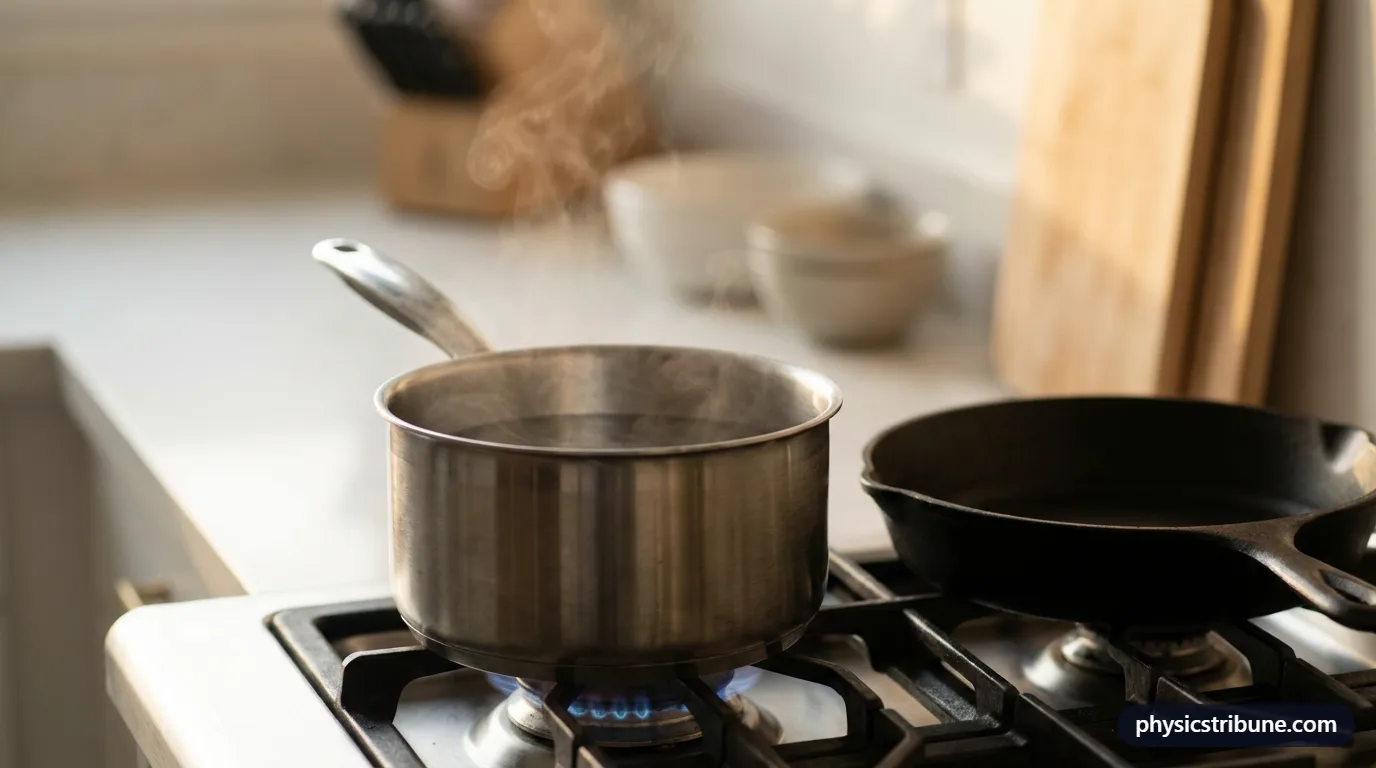
In daily life all three modes usually work together. A pan of water on a burner is heated through the metal base by conduction, then the water spreads that heat upward by convection, and the hot pan also glows faintly in the infrared. Our conduction vs convection vs radiation comparison sets them side by side.
Convection Explained Simply
Imagine a crowded elevator of air molecules. Heat them up and they jostle harder, push each other apart and take up more room. The same amount of air now fills a bigger space, so it is lighter for its size. Lighter-for-its-size fluid floats upward, just as a beach ball pops up through a swimming pool.
When the warm air rises, it leaves a gap, and cooler air slides in from the side to fill it. That cooler air then gets heated in turn and rises too. Meanwhile, the warm air at the top loses heat to the ceiling or the sky, gets heavier and drifts back down. The result is a slow, endless loop that carries heat from where it is made to where it is lost.

How Do Convection Currents Form?
A convection current forms in four repeating stages:
- Heating: fluid near the heat source warms up, usually by conduction from a hot surface.
- Rising: the warm fluid expands, its density drops, and buoyancy pushes it upward through the cooler fluid around it.
- Spreading and cooling: at the top, the fluid spreads sideways and hands its heat to cooler surroundings.
- Sinking: now cooler and denser, the fluid sinks and flows back toward the heat source to be warmed again.
The diagram below shows this loop in a pot of water over a flame. Two mirror-image cells form: water rises up the hot middle, flows out along the surface, sinks down the cooler sides and returns along the bottom. Drop a pinch of pepper or a few tea leaves into a heating pan and you can watch the flakes ride these currents.

Why Does Warm Air Rise?
Warm air rises because it is less dense than the cooler air around it, not because heat itself has any urge to go up. At the same pressure, the density of a gas falls as its absolute temperature climbs. Dry air at sea level is about 1.20 kg/m³ at 20 °C but only about 0.95 kg/m³ at 100 °C, as the table shows.
Any parcel of fluid feels an upward buoyant force equal to the weight of the surrounding fluid it pushes aside. If the parcel weighs less than that, the leftover force lifts it. A hot-air balloon is simply a giant, bagged-up parcel of warm air, and the same rule explains why smoke climbs a chimney and why a candle flame points up.
In space stations there is no effective gravity, so there is no buoyancy and no natural convection. A candle flame there becomes a dim, round ball, because hot gases are not carried away from the wick.
| Temperature (°C) | Temperature (°F) | Density (kg/m³) | Compared with 20 °C air |
|---|---|---|---|
| 0 | 32 | 1.292 | 7.3% denser |
| 10 | 50 | 1.247 | 3.5% denser |
| 20 | 68 | 1.204 | reference |
| 30 | 86 | 1.164 | 3.3% lighter |
| 40 | 104 | 1.127 | 6.4% lighter |
| 60 | 140 | 1.059 | 12.0% lighter |
| 100 | 212 | 0.946 | 21.4% lighter |
| Source: Computed with the ideal gas law, ρ = PM/(RT), using R from NIST CODATA 2022 and a molar mass of dry air of 0.02896 kg/mol · Retrieved October 2026 | |||
What Are the Types of Convection?
Physicists sort convection by what drives the flow:
- Natural (free) convection is driven only by density differences and gravity. Examples include warm air rising off a radiator, sea breezes and the slow overturning of a lake in autumn.
- Forced convection uses a fan, pump, wind or stirring spoon to push the fluid. A hair dryer, a car radiator, a computer cooling fan and blowing on hot soup are all forced convection.
- Mixed convection combines both, such as a gentle breeze moving past a sun-warmed wall that is also heating the air next to it.
Forced convection is usually much faster, because the moving fluid strips away the thin, slow layer of warm fluid that clings to a hot surface. That boundary layer acts like a blanket, and thinning it lets heat escape more quickly. Boiling is a special, very strong form of convection where bubbles of vapor stir the liquid violently.
Example 2 The same tea in front of a desk fan
The same mug starts at 90 °C in the same 20 °C room, but a desk fan blows across it and raises the cooling constant to about 0.003 per second. What is its temperature after 600 s?
- Given:
- initial object temperature:
- surrounding (ambient) temperature:
- cooling constant:
- time:
- initial object temperature:
- Formula:
- Substitute:
- Answer:
Forced convection sweeps warm air off the surface faster, so the tea ends up much closer to room temperature.

How Do You Calculate Convective Cooling?
Engineers often describe convection with a heat transfer coefficient that depends on the fluid, its speed and the shape of the surface. For classroom problems, a simpler tool is Newton's law of cooling, which says an object loses heat at a rate proportional to how much hotter it is than its surroundings.
The cooling constant k bundles together everything about the convection: still air gives a small k, a breeze gives a larger one, and moving water gives a larger one still. The graph after the examples compares the same mug of tea cooling in still air and in front of a fan, using cooling constants we chose as typical values.
This model describes how an object cools when moving air or water keeps carrying heat away from its surface.
| Symbol | Quantity | SI unit |
|---|---|---|
| object temperature at time t | kelvin (K) | |
| surrounding (ambient) temperature | kelvin (K) | |
| initial object temperature | kelvin (K) | |
| cooling constant | per second (1/s) | |
| time | second (s) |
Valid for: empirical; small temperature differences, mainly convective cooling, constant ambient temperature. Any consistent temperature unit (°C or K).
Example 1 A mug of tea on a still kitchen counter
A mug of tea starts at 90 °C in a kitchen held at 20 °C. In still air its cooling constant is about 0.0012 per second. What is the tea's temperature after 600 s (10 minutes)?
- Given:
- initial object temperature:
- surrounding (ambient) temperature:
- cooling constant:
- time:
- initial object temperature:
- Formula:
- Substitute:
- Answer:
Only natural convection is at work here, so the tea is still comfortably hot after ten minutes.
Where Does Convection Happen in Nature?
Convection shapes the planet at every scale. On a sunny afternoon, ground warmed by sunlight heats the air above it, and rising columns called thermals lift hawks and gliders without a single wing flap. When those thermals carry moist air high enough, the water vapor condenses into puffy cumulus clouds, and on hot days they can tower into thunderstorms.
Along a coast, land heats faster than water during the day. Air over the land rises, and cooler air from over the sea flows in to replace it, giving a sea breeze. At night the pattern reverses and a land breeze blows offshore.
Deep inside Earth, the rock of the mantle is hot enough to creep very slowly, at roughly the speed your fingernails grow. Convection in this rock helps drag the tectonic plates around. The Sun has convection too: its outer layer boils with bright cells of rising hot gas, each about the size of a large country.
What Are Everyday Examples of Convection?
Homes are full of convection. A baseboard heater or old-style radiator warms the air beside it, and that air rises to the ceiling and circulates across the room. Air conditioners are usually mounted high on a wall because the cold air they release is dense and sinks, sweeping the whole room on its way down.
A convection oven adds a fan to push hot air around the food, so dishes cook more evenly and a little faster than in still air. A refrigerator's freezer compartment was traditionally placed at the top for the same reason: cold air pours downward and chills the shelves below. More cases, sorted by setting, are collected in our heat transfer examples.
When you size a heater, the first step is to work out how much heat the air in a room needs, as the worked example below does with the specific heat formula. Our specific heat calculator handles the unit conversions for you.
Example 3 Warming the air in a bedroom
A bedroom holds about 60 kg of air. A convection heater must raise its temperature by 5 K. Taking the specific heat of air as 1,005 J/(kg·K), how much heat must the heater deliver to the air?
- Given:
- mass:
- specific heat capacity (water ≈ 4186 J/(kg·K)):
- temperature change:
- mass:
- Formula:
- Substitute:
- Answer:
In practice the heater supplies more than this, because walls, furniture and leaks to the outside soak up heat too.
How Do You Reduce Heat Loss by Convection?
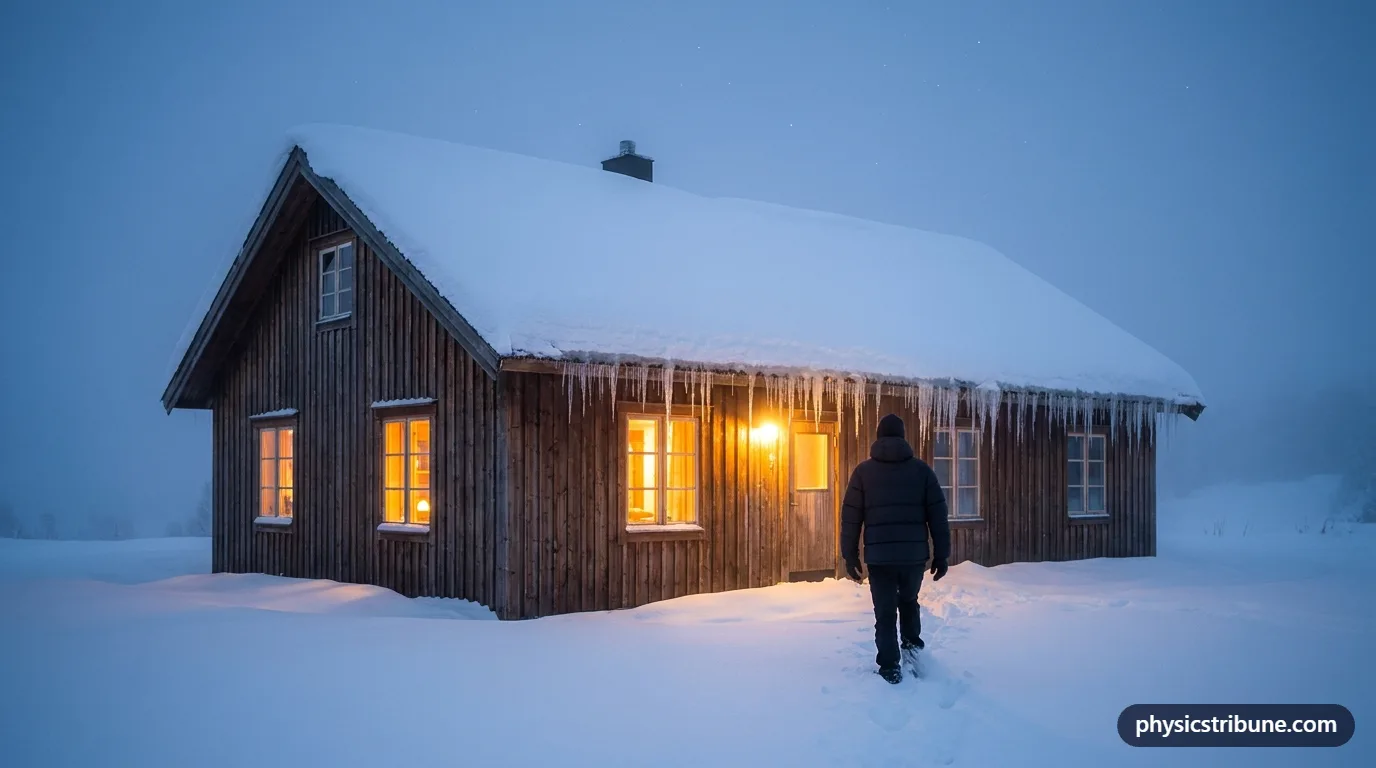
Since convection needs fluid that is free to move, the trick is to trap the fluid. Fiberglass, wool, down feathers and foam all hold air in tiny pockets where it cannot circulate, so the air acts only as a poor conductor. That is the basic idea behind most thermal insulation.
Double-pane windows narrow the gap between the glass sheets so the air inside barely moves. A vacuum flask goes further and removes the air completely, which shuts down both conduction and convection; see how a thermos works. Putting a lid on a pot of soup also helps, since it stops warm, moist air from rising away from the surface.
Practice Heat Transfer Problems
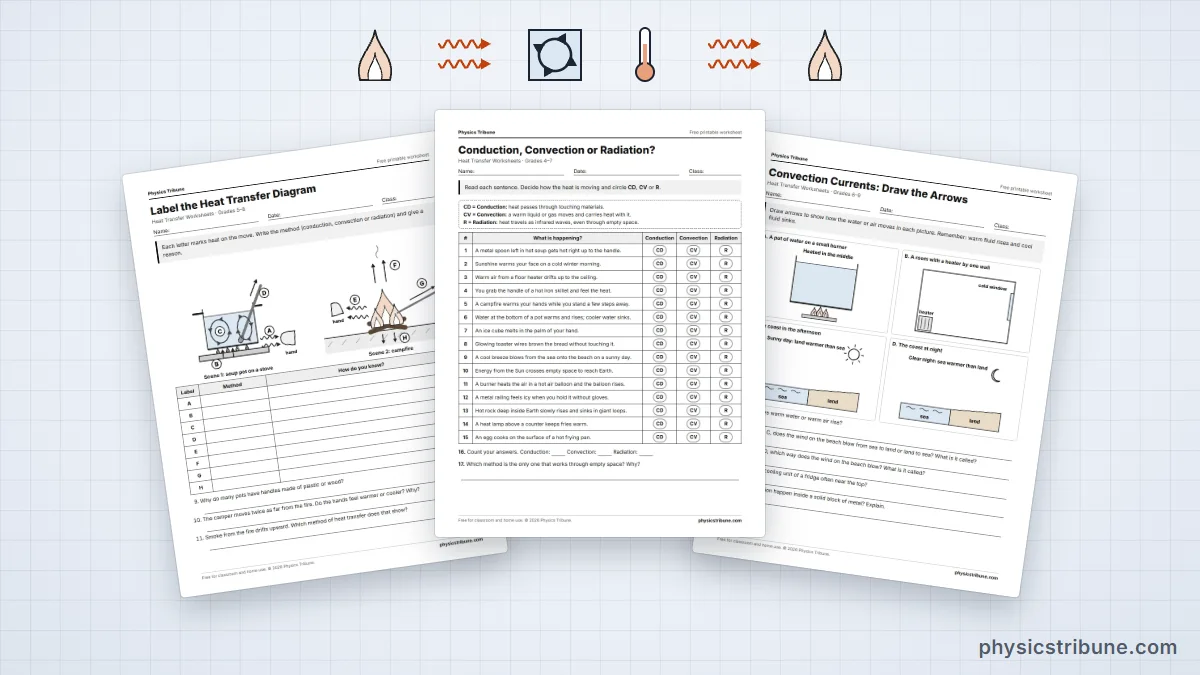
To lock in the difference between conduction, convection and radiation, try our printable heat transfer worksheets, which come with answer keys. Then take the quiz below and browse the rest of the heat transfer section.
Common Misconceptions
Myth: Heat rises.
Physics: Heat itself has no preferred direction. Warm fluid rises because it is less dense than its surroundings; in a solid, heat flows down or sideways just as easily.
Myth: Convection can happen in solids.
Physics: Convection requires the material itself to flow. Ordinary solids pass heat only by conduction, although very hot rock in Earth's mantle can creep slowly enough to convect over millions of years.
Myth: Cold flows into a room through an open window.
Physics: Cold is not a substance. Warm indoor air escapes and dense cold outdoor air sinks in to replace it, which is convection carrying heat out.
Myth: A fan cools a room by lowering the air temperature.
Physics: A fan does not cool the air; it speeds up convection and evaporation from your skin, so you lose heat faster and feel cooler.
Key Facts
- Convection is heat transfer by the bulk motion of a liquid or gas.
- Warm fluid rises because heating lowers its density, so buoyancy pushes it up through cooler fluid.
- A convection current is a loop of rising warm fluid and sinking cool fluid.
- Natural convection is driven by density differences; forced convection uses a fan, pump or wind.
- Convection cannot happen in solids or in a vacuum, because nothing is free to flow.
- Sea breezes, thunderstorm clouds, mantle motion and boiling water are all driven by convection.
- Insulation works largely by trapping air so it cannot circulate.
Quick Quiz: How Well Do You Know Convection?
6 questions. Tap an answer to check it.
Why does warm air rise above cooler air?
Heating makes air expand and lowers its density, so the surrounding denser air buoys it up.
In which of these can convection NOT occur?
Convection needs a fluid that can flow, and a vacuum has no fluid at all.
Which is an example of forced convection?
The hair dryer's fan pushes the air, which makes it forced convection.
During a sunny day at the beach, which way does a sea breeze blow?
Air over the hot land rises, and cooler air from over the sea flows in to replace it.
Why are air conditioners usually mounted high on a wall?
Dense cold air sinks, so releasing it high lets it sweep down through the whole room.
How does fiberglass insulation reduce heat loss by convection?
Trapped air cannot form convection currents, so heat can only crawl through by slow conduction.
Frequently Asked Questions
What is convection in simple terms?
Convection is heat being carried by a moving liquid or gas. When part of the fluid gets warm, it spreads out, becomes lighter for its size and rises. Cooler fluid moves in to take its place, warms up and rises too. This circulation, called a convection current, moves heat from a hot spot to cooler areas, like warm air spreading across a room from a heater.
What are 3 examples of convection?
Boiling water in a pot is a classic example: water heated at the bottom rises and cooler water sinks. A sea breeze is another, as warm air over sunny land rises and cool air from over the ocean flows in. A third is a hot-air balloon, which floats because the heated air inside is less dense than the cooler air around it.
What is the difference between conduction and convection?
In conduction, heat passes from particle to particle while the material stays in place, as when a metal spoon warms in hot soup. In convection, the warm material itself moves and carries its heat to a new place. Conduction works in solids, liquids and gases, but convection only works in fluids, because only liquids and gases can flow.
Can convection occur in a vacuum?
No. Convection needs a fluid that can move and carry energy, and a vacuum contains no fluid. That is why a vacuum flask keeps drinks hot and why sunlight crosses space as radiation. In a perfect vacuum, heat can only travel by radiation, which needs no material at all.
What is a convection current?
A convection current is the circular flow that forms when a fluid is heated in one place and cooled in another. Warm fluid rises from the heated region, spreads out, cools, becomes denser and sinks back down, then returns to be heated again. Convection currents circulate water in a pot, air in a room, the atmosphere over continents and hot rock in Earth's mantle.
What is the difference between natural and forced convection?
Natural convection is driven only by density differences and gravity: warm fluid floats up and cool fluid sinks with nothing pushing it. Forced convection uses an outside push such as a fan, pump, wind or stirring spoon. Forced convection usually moves heat much faster, which is why blowing on hot food or using a fan cools things quicker.
Why is a convection oven faster than a regular oven?
A convection oven has a fan that keeps hot air moving around the food. Still air forms a thin, cooler layer around anything inside it, and that layer slows heat transfer. The fan sweeps the layer away so fresh hot air keeps touching the food's surface. Food cooks more evenly and often a little faster, sometimes at a slightly lower temperature setting.
How does convection affect weather?
Convection drives much of the weather. Sunlight heats the ground, which warms the air above it, and that air rises, cools and can form clouds when its moisture condenses. Strong convection on hot, humid days builds tall thunderstorm clouds. Larger convection patterns between warm and cool regions also create winds such as sea breezes and the global circulation of the atmosphere.
Keep Exploring


Sources
Constants come from NIST CODATA 2022 (public domain) and unit definitions from the BIPM SI Brochure (CC BY 4.0). Text, diagrams and illustrations are original work by Physics Tribune.