At a Glance
Thermal conduction is heat moving through matter by particle-to-particle collisions, from hot to cold, without the material moving. The rate follows Fourier's law: Q/t = k A (Th − Tc) / d, so heat flows faster through good conductors, larger areas, bigger temperature differences and thinner layers.
- Type of heat transfer
- Through direct contact, particle to particle
- Rate formula
- Q/t = kA(Th − Tc)/d (Fourier's law)
- SI unit of rate
- watt (W), equal to 1 J/s
- Material property
- Thermal conductivity k, in W/(m·K)
- Direction
- Always from higher to lower temperature
- Fastest in
- Metals, thanks to free electrons
On this page
- What Is Thermal Conduction?
- Thermal Conduction Explained Simply
- How Does Conduction Work at the Particle Level?
- How Do You Calculate the Rate of Conduction?
- Why Are Metals Good Conductors of Heat?
- How Do Insulators Slow Down Conduction?
- What Are Examples of Conduction in Everyday Life?
- Why Does Metal Feel Colder Than Wood at the Same Temperature?
- Going Deeper: Steady State and Fourier's Law
- Practice Thermal Conduction Problems
- Common Misconceptions
- Key Facts
- Quiz
- FAQ
What Is Thermal Conduction?
Thermal conduction is one of the three ways heat moves, alongside convection and radiation. In conduction, energy passes from particle to particle inside a material, or across a surface where two objects touch. The particles jostle their neighbors and hand on energy, but they stay roughly where they are.
Conduction always carries heat from a warmer place to a cooler one. It continues until both regions reach the same temperature, a state called thermal equilibrium. Once there is no temperature difference, there is no net flow.
Conduction happens in solids, liquids and gases, but it is most important in solids. In fluids, heat usually spreads faster by convection, because the warm fluid itself moves. For a side-by-side look at all three, see conduction vs convection vs radiation.
Thermal Conduction Explained Simply
Picture a line of people standing shoulder to shoulder. Shove the person at one end and they bump the next, who bumps the next, and the jostle travels down the line even though nobody walks anywhere. Conduction works the same way with atoms and molecules.
When you hold one end of a metal bar in a flame, the atoms there start vibrating harder. They knock into slightly calmer neighbors, which then vibrate harder too. Energy works its way along the bar until the far end, which never touched the flame, becomes too hot to hold.
The material itself does not move, and that is what sets conduction apart. Only the energy of motion is passed along, one collision at a time.
How Does Conduction Work at the Particle Level?
Temperature measures the average energy of particle motion. In a solid, the atoms are locked in place but vibrate around fixed positions. Atoms at the hot end vibrate with more energy, and because they are connected to their neighbors by bonds, their stronger shaking pulls and pushes on the atoms next to them.
In a gas or liquid, conduction happens through direct collisions. A fast molecule strikes a slower one and on average leaves it a little faster. Gases conduct poorly because their molecules are far apart and collide less often, which is why trapped air is such a good insulator.
The diagram below shows a rod heated at one end. The particles near the flame vibrate most, and the amount of vibration falls off steadily toward the cold end, along with the temperature.

How Do You Calculate the Rate of Conduction?
The rate of heat flow by conduction is given by Fourier's law:
Each term matches common sense. A bigger area gives heat more paths. A larger temperature difference pushes heat harder. A thicker layer makes the path longer, so the rate drops. And a material with a high
The temperature difference can be written in kelvin or Celsius degrees, since a change of 1 K equals a change of 1 °C. The worked examples below cover a cooler wall, a copper rod and a home insulation problem.
Fourier's law gives the rate of heat flow through a uniform slab once the temperatures have settled. Here are the variables and the rearranged forms.
| Symbol | Quantity | SI unit |
|---|---|---|
| rate of heat flow | watt (W) | |
| thermal conductivity | watt per meter kelvin (W/(m·K)) | |
| cross-sectional area | square meter (m²) | |
| temperature difference across the slab | kelvin (K) | |
| thickness of the slab | meter (m) |
Rearranged to find another variable:
Valid for: steady state, uniform slab.
Example 1 Heat leaking into a foam cooler
One wall of a picnic cooler is made of polystyrene foam 0.03 m thick with an area of 0.6 m². The foam's thermal conductivity is about 0.033 W/(m·K). If it is 25 K warmer outside than inside, at what rate does heat conduct through that wall?
- Given:
- thermal conductivity:
- cross-sectional area:
- temperature difference across the slab:
- thickness of the slab:
- thermal conductivity:
- Formula:
- Substitute:
- Answer:
That trickle of heat is roughly what a small phone charger uses, which is why ice in a good cooler lasts a full day.
Why Are Metals Good Conductors of Heat?
Metals contain a sea of free electrons that are not tied to any single atom. These electrons move very fast and travel long distances between collisions, so they carry energy from the hot region to the cold region far more quickly than vibrating atoms alone could. That is why copper, aluminum and silver lead the table of conductors.
The same free electrons carry electric current, so good electrical conductors are usually good heat conductors too. You can read more about this link in our guide to conductors and insulators. Diamond is a rare exception: it is an electrical insulator but conducts heat superbly because its stiff, light lattice passes vibrations along very efficiently.
The table below compares typical thermal conductivities. The last column shows how much heat would flow through a 1 m² slab, 1 cm thick, with a 10 K difference across it.
Example 2 Heat flowing along a copper rod
A copper rod 0.5 m long with a cross-sectional area of 0.0001 m² has one end held at 100 °C and the other at 20 °C, a difference of 80 K. Taking k = 400 W/(m·K) for copper, what is the steady rate of heat flow along the rod?
- Given:
- thermal conductivity:
- cross-sectional area:
- temperature difference across the slab:
- thickness of the slab:
- thermal conductivity:
- Formula:
- Substitute:
- Answer:
The same rod made of glass would carry only about a hundredth of a watt, because copper conducts heat hundreds of times better.
| Material | Thermal conductivity k (W/(m·K)) | Heat flow through the slab (W) | Conductor or insulator? |
|---|---|---|---|
| Silver | 429 | 429,000 | Excellent conductor |
| Copper | 401 | 401,000 | Excellent conductor |
| Aluminum | 237 | 237,000 | Very good conductor |
| Carbon steel | 50 | 50,000 | Good conductor |
| Stainless steel | 16 | 16,000 | Moderate conductor |
| Glass | 0.9 | 900 | Poor conductor |
| Brick | 0.7 | 700 | Poor conductor |
| Water | 0.6 | 600 | Poor conductor |
| Pine wood | 0.12 | 120 | Insulator |
| Fiberglass batts | 0.04 | 40 | Good insulator |
| Polystyrene foam | 0.033 | 33 | Good insulator |
| Still air | 0.026 | 26 | Excellent insulator |
| Source: Computed with Q/t = kAΔT/d; thermal conductivities are typical room-temperature values · Retrieved October 2026 | |||
How Do Insulators Slow Down Conduction?
An insulator is a material with a low thermal conductivity. Most good insulators work by trapping tiny pockets of still air. Air conducts heat very poorly, and as long as it cannot circulate, it cannot carry heat by convection either. Foam, fiberglass, wool, down feathers and fur all use this trick.
Fourier's law shows the two ways to cut heat flow: use a material with a lower
Insulation never stops heat completely; it only slows it down. A cooler eventually warms up, and a heated house eventually cools if the furnace shuts off. The goal is to make that leak as small as is practical.
Example 3 How thick should the insulation be?
A builder wants no more than 50 W of heat to conduct through a 10 m² section of wall when it is 20 K colder outside. If the wall is filled with fiberglass of thermal conductivity 0.04 W/(m·K), how thick must the fiberglass layer be?
- Given:
- rate of heat flow:
- thermal conductivity:
- cross-sectional area:
- temperature difference across the slab:
- rate of heat flow:
- Formula:
- Substitute:
- Answer:
Doubling the thickness would halve the heat loss, which is why homes in cold climates use deeper wall and attic insulation.
What Are Examples of Conduction in Everyday Life?
Conduction is happening around you all day long:
- Cold floors. Bare feet feel colder on tile than on a wooden floor at the same temperature, because tile conducts heat away from your skin much faster.
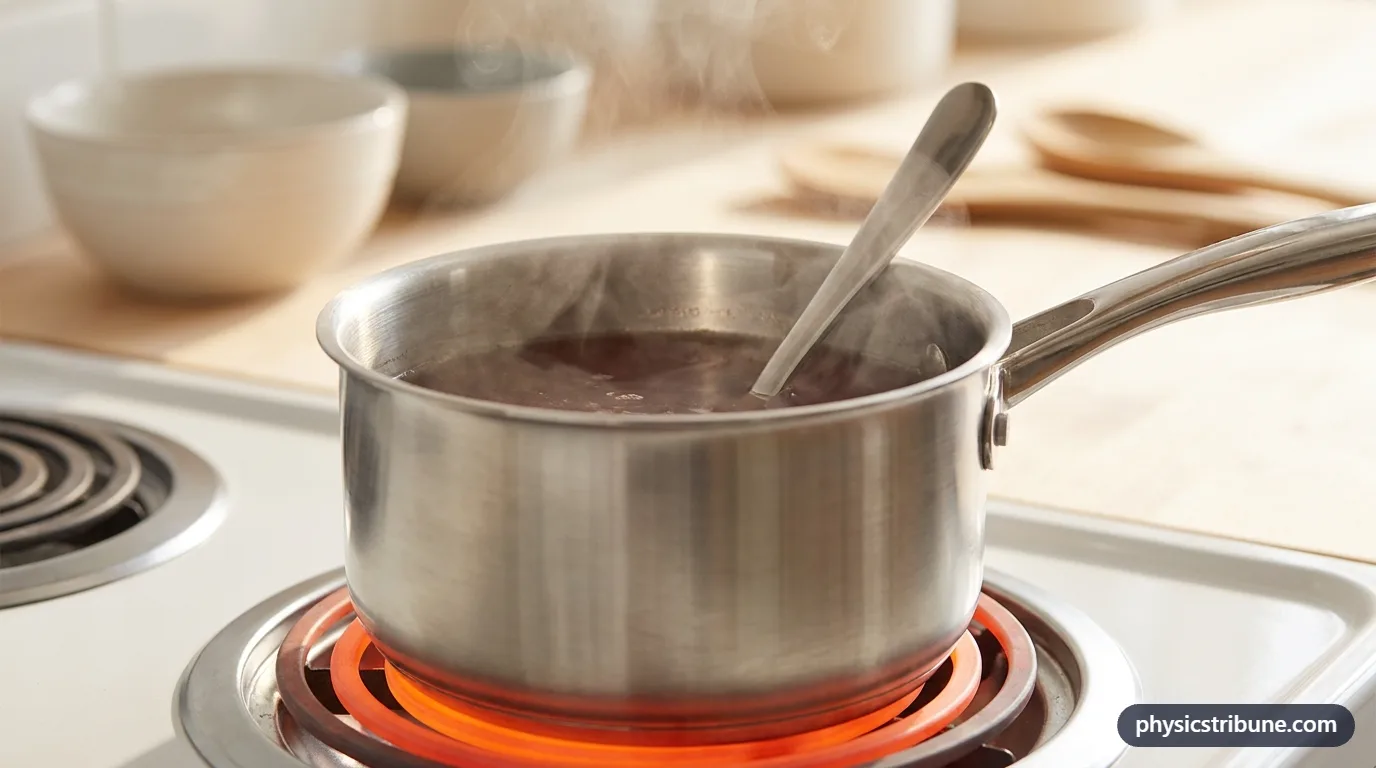
- Cooking pans. Metal pans pass heat quickly from the burner to the food, while their plastic or wooden handles conduct poorly and stay cool enough to hold.
- Ironing clothes. The hot plate of the iron heats the fabric by direct contact.
- Melting ice in your hand. Heat flows from your warm palm into the ice cube, which is why your hand feels cold.
- Heat sinks in computers. Aluminum or copper fins conduct heat away from the processor so it can be carried off by moving air.
- Winter clothing. Layers of fleece and down trap air, slowing conduction of body heat to the cold outside.
For a longer list sorted by type, see our heat transfer examples.

Why Does Metal Feel Colder Than Wood at the Same Temperature?
Leave a metal spoon and a wooden spoon in the same room overnight and they reach exactly the same temperature. Yet the metal one feels colder when you pick it up. Your skin does not sense temperature directly; it senses how fast heat is leaving your hand.
Metal has a high thermal conductivity, so it pulls heat out of your fingers quickly and spreads it through the spoon, keeping the contact spot cool. Wood conducts heat poorly, so the small patch under your fingers warms up fast and the flow almost stops. The metal feels cold because it is a better conductor, not because it is colder.
The same idea works in reverse on a hot day. A metal car door in the sun can feel painfully hot, while a plastic trim piece at the same temperature feels only warm.

Going Deeper: Steady State and Fourier's Law
Fourier's law in the form above applies once the temperatures have stopped changing, a condition called steady state. Right after you put a cold rod in a flame, each section is still warming up and absorbing some of the heat that passes through it. Only after a while does the temperature fall off in a straight line from hot end to cold end.
In its general form, the law says the heat flow per unit area is proportional to the temperature gradient, the rate at which temperature changes with distance, and points down that gradient. The French mathematician Joseph Fourier published this in 1822. To solve how temperatures change over time, he developed the method now called Fourier analysis, which is used today far outside heat transfer, in sound, images and signals.
Practice Thermal Conduction Problems
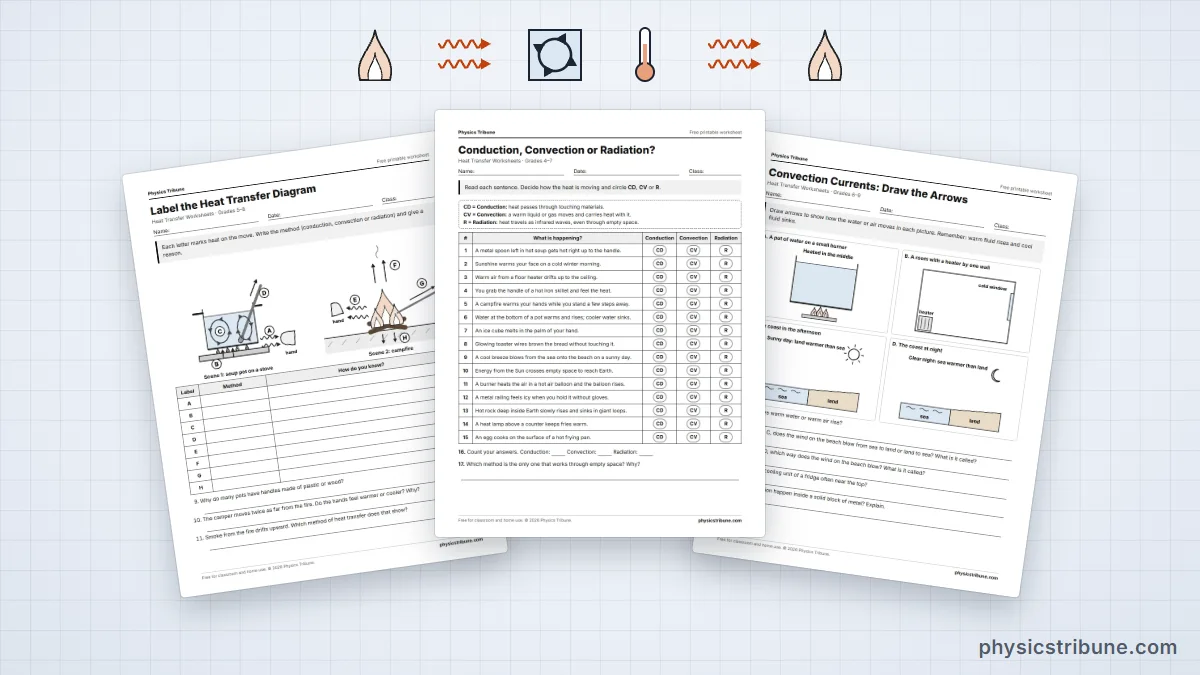
Try reworking the examples with different materials from the table, or change the thickness and see how the rate responds. Our heat transfer worksheets include printable conduction practice with answer keys, and the insulation conduction race experiment lets you compare materials at home. Then test yourself with the quiz below.
Common Misconceptions
Myth: Metal objects are colder than wooden objects in the same room.
Physics: They are at the same temperature. Metal only feels colder because it conducts heat away from your hand much faster.
Myth: Insulation keeps the cold out.
Physics: Cold is not a substance that flows. Insulation slows the flow of heat, whether that heat is leaving a warm house or entering a cool fridge.
Myth: In conduction, the hot material moves to the cold region.
Physics: The material stays in place. Only energy passes from particle to particle; moving material is convection.
Myth: Conduction only happens in solids.
Physics: Liquids and gases conduct heat too, just much more slowly. In fluids, convection usually carries more heat because the fluid can move.
Key Facts
- Thermal conduction is heat transfer through a material by collisions between neighboring particles, with no bulk movement of the material.
- Heat always conducts from a hotter region to a colder one until thermal equilibrium is reached.
- Fourier's law gives the rate of conduction as Q/t = kA(Th − Tc)/d.
- Doubling the thickness of a layer halves the rate of conduction through it.
- Metals conduct heat well because their free electrons carry energy quickly.
- Still air is one of the best insulators, so most insulating materials work by trapping air.
- Metal feels colder than wood at the same temperature because it conducts heat away from your skin faster.
Quick Quiz: How Well Do You Know Thermal Conduction?
6 questions. Tap an answer to check it.
In thermal conduction, what moves from the hot region to the cold region?
Particles stay in place and pass energy to their neighbors by collisions.
Which material is the best conductor of heat?
Copper has a thermal conductivity of about 400 W/(m·K), far above the others.
If the thickness of an insulating wall is doubled, what happens to the rate of conduction?
Thickness d is in the denominator of Fourier's law, so doubling d halves the rate.
Why does a metal bench feel colder than a wooden bench on a cold morning?
Both are at the same temperature, but metal draws heat from your skin much faster.
Why is trapped air a good insulator?
Still air conducts heat very poorly, and trapping it also stops convection.
What is the SI unit of thermal conductivity?
From Fourier's law, k = (Q/t)·d / (A·ΔT), which gives watts per meter per kelvin.
Frequently Asked Questions
What is thermal conduction in simple terms?
Thermal conduction is heat traveling through something by direct contact, from the hot part to the cold part. The particles do not move from place to place; they bump into their neighbors and pass energy along. That is how the handle of a metal spoon gets hot when the other end sits in hot soup, and how a hot pan warms an egg.
What is the formula for heat conduction?
The rate of conduction is given by Fourier's law: Q/t = k A (Th − Tc) / d. Q/t is the heat flow in watts, k is the material's thermal conductivity, A is the area, Th − Tc is the temperature difference across the material and d is its thickness. The formula applies once temperatures have stopped changing.
What are 5 examples of conduction?
Five common examples are a metal spoon heating up in a hot drink, a pan transferring heat from a stove burner to food, an ice cube melting in your hand, tile floors feeling cold under bare feet and a clothes iron pressing heat into fabric. Computer heat sinks and car engine blocks also rely on conduction to move heat away.
What is the difference between conduction and convection?
In conduction, heat passes through a material while the material stays still, by collisions between neighboring particles. In convection, the heated material itself moves, carrying its energy with it, as when warm air rises from a radiator. Conduction dominates in solids, while convection usually dominates in liquids and gases that are free to flow.
Why do metals conduct heat so well?
Metals have free electrons that are not attached to any single atom. These electrons move very quickly and carry energy across the metal much faster than vibrating atoms can by themselves. The same electrons carry electric current, so metals that conduct electricity well, such as silver, copper and aluminum, are also excellent heat conductors.
What materials are poor conductors of heat?
Poor conductors, called thermal insulators, include air, foam, fiberglass, wool, wood, cork, rubber and most plastics. Many of them work because they trap tiny pockets of still air, which conducts heat very poorly. Insulators are used in coolers, oven mitts, winter coats, building walls and the handles of cooking pots.
Does conduction happen in a vacuum?
No. Conduction needs particles to pass energy from one to another, and a vacuum has essentially none. That is why vacuum flasks keep drinks hot or cold for hours: the empty gap between the inner and outer walls blocks conduction and convection. Heat can still cross a vacuum by radiation, which is why the walls are also silvered.
What affects the rate of thermal conduction?
Four factors set the rate. A material with higher thermal conductivity passes heat faster. A larger contact area allows more heat through. A bigger temperature difference drives a faster flow. A thicker layer slows the flow down. These four factors appear directly in Fourier's law, which is why the law is so useful for designing insulation.
Keep Exploring





Sources
Constants come from NIST CODATA 2022 (public domain) and unit definitions from the BIPM SI Brochure (CC BY 4.0). Text, diagrams and illustrations are original work by Physics Tribune.