At a Glance
Conduction transfers heat through a material by particle collisions, at a rate Q/t = k A (Th − Tc) / d. Convection transfers heat by the bulk flow of a fluid, such as rising warm air. Radiation transfers heat as infrared and other electromagnetic waves, with power P = e σ A T⁴, and works even through a vacuum.
- Conduction
- Contact between particles; best in solids, especially metals
- Convection
- Moving fluid carries heat; liquids and gases only
- Radiation
- Electromagnetic waves; works through empty space
- Needs a medium?
- Conduction and convection yes, radiation no
- Key formulas
- Q/t = k A ΔT / d (conduction), P = e σ A T⁴ (radiation)
- Heat flows
- Always from hotter to colder
On this page
- What Is the Difference Between Conduction, Convection and Radiation?
- How Does Conduction Work?
- How Does Convection Work?
- How Does Radiation Transfer Heat?
- What Formulas Describe Each Type of Heat Transfer?
- What Are Examples of Conduction, Convection and Radiation?
- How Does a Vacuum Flask Stop All Three?
- How Can You Practice Heat Transfer Questions?
- Common Misconceptions
- Key Facts
- Quiz
- FAQ
What Is the Difference Between Conduction, Convection and Radiation?
Heat is energy moving from a hotter place to a colder one, and nature has three routes for that journey. They differ in what carries the energy. In conduction nothing travels except the energy itself, handed from particle to particle. In convection the warm material itself flows away and takes its energy along. In radiation the energy leaves as light, mostly infrared, and needs no material at all.
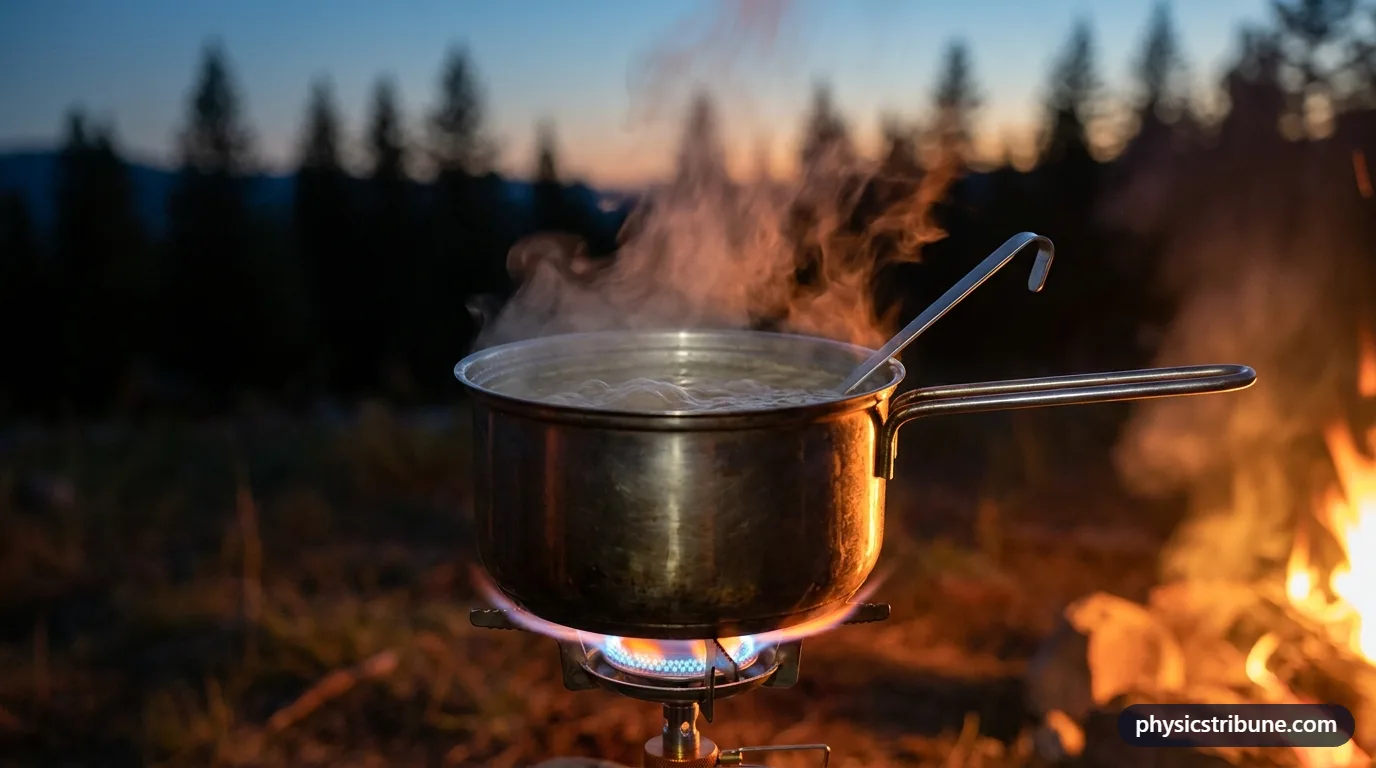
A campfire shows all three at once. The end of a metal poker in the coals gets hot along its length by conduction. Hot air and smoke rise above the flames by convection. The warmth on your face as you sit beside the fire is radiation, which is why it vanishes the moment someone steps in front of you.
The table below compares the three side by side.
| Feature | Conduction | Convection | Radiation |
|---|---|---|---|
| What carries the energy | Collisions between neighboring particles | Bulk movement of a fluid | Electromagnetic waves |
| Needs a medium? | Yes | Yes | No |
| Works in a vacuum? | No | No | Yes |
| Main states of matter | Solids (also liquids and gases) | Liquids and gases | Any, including empty space |
| Speed | Slow | Moderate | Speed of light |
| Key formula | Q/t = k A ΔT / d | No single formula (heat transfer coefficient) | P = e σ A T⁴ |
| Depends strongly on | Thermal conductivity and thickness | Fluid flow and density differences | Absolute temperature to the fourth power |
| Good transfer | Metals such as copper | Fans, pumps, boiling water | Dark, dull surfaces |
| Poor transfer | Still air, foam, wood | Trapped air with no room to circulate | Shiny, reflective surfaces |
| Everyday example | Hot pan handle | Rising warm air from a heater | Warmth of sunlight |
| How to reduce it | Insulating materials | Trap the fluid so it cannot flow | Reflective foil |
| Natural or forced? | Not applicable | Both (buoyancy or fan) | Not applicable |
| Source: Definitions as used in standard thermal physics; examples are illustrative · Retrieved October 2026 | |||
How Does Conduction Work?
Conduction is heat transfer through direct contact. Particles at the hot end vibrate faster, bump into their slower neighbors and share some of their energy. In metals, free electrons wander through the material and carry energy much faster still, which is why metals feel cold to the touch: they pull heat out of your hand quickly.
How well a material conducts is measured by its thermal conductivity. Copper and aluminum are excellent conductors, used for cookware and heat sinks. Wood, plastic, foam and especially still air are poor conductors, which makes them good insulators. The question of why metal feels colder than wood is really a question about conduction.
Conduction happens in solids, liquids and gases, but it is strongest in solids where particles are packed closely together.
| Material | Thermal conductivity, W/(m·K) | Good conductor or insulator? |
|---|---|---|
| Copper | about 400 | Excellent conductor |
| Aluminum | about 200 to 240 | Excellent conductor |
| Stainless steel | about 15 to 20 | Moderate conductor |
| Glass | about 0.8 to 1 | Poor conductor |
| Water | about 0.6 | Poor conductor |
| Wood | about 0.1 to 0.2 | Insulator |
| Foam insulation | about 0.03 to 0.04 | Good insulator |
| Still air | about 0.026 | Very good insulator |
| Source: Typical rounded values for common grades of each material; real values vary with composition and temperature · Retrieved October 2026 | ||
How Does Convection Work?
Convection is heat transfer by the movement of a fluid, meaning a liquid or a gas. When part of a fluid is heated it expands, becomes less dense and rises, while cooler, denser fluid sinks to take its place. The result is a loop called a convection current that keeps carrying heat upward.
This is natural convection, driven by density differences alone. A pot of water heated from below, warm air rising from a radiator and the sea breeze at a beach on a sunny afternoon all work this way. Forced convection uses a fan or pump to push the fluid instead, as in a convection oven, a car radiator or a hair dryer.
Convection cannot happen in a solid, because its particles cannot flow, and it cannot happen in a vacuum, because there is nothing to flow.
How Does Radiation Transfer Heat?
Thermal radiation is energy given off as electromagnetic waves by every object above absolute zero. At room temperature and body temperature these waves are mostly infrared, invisible to our eyes but felt as warmth. A stove element glowing red or the Sun shining white are simply hot enough to emit visible light as well.
Because light needs no medium, radiation is the only way heat crosses empty space. All of the Sun's energy reaches Earth by radiation through the vacuum between them. Dark, dull surfaces absorb and emit radiation well, while shiny surfaces reflect it, which is why emergency blankets are silvery.
The power radiated rises extremely fast with temperature. The Stefan-Boltzmann law, explained theoretically by Ludwig Boltzmann, says it is proportional to the fourth power of the absolute temperature, so doubling the kelvin temperature multiplies the power by 16.
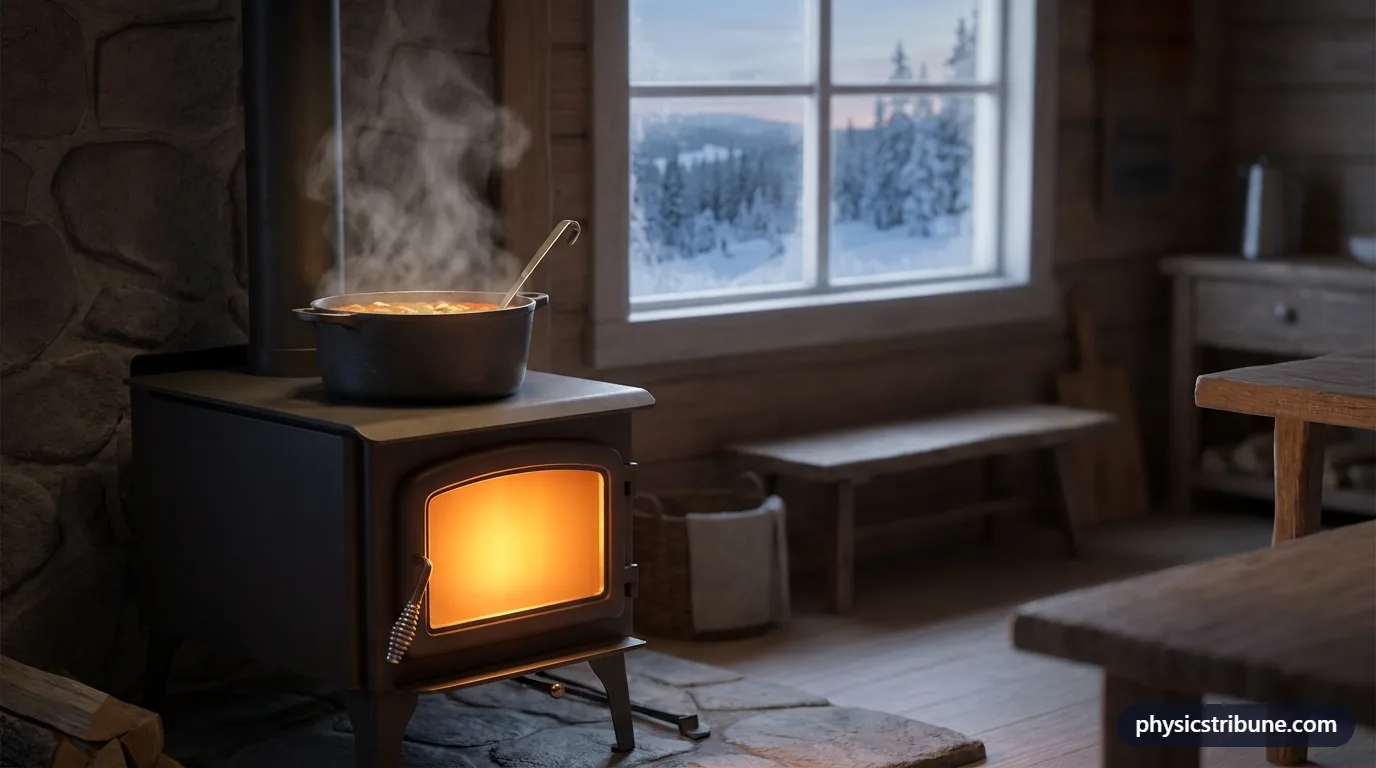
Example 2 A wood stove glowing with infrared
The dark iron surface of a wood stove has an area of 0.5 m², an emissivity of 0.9 and a surface temperature of 500 K. Using σ = 5.670374419 × 10⁻⁸ W/(m²·K⁴), how much power does the surface radiate?
- Given:
- emissivity (1 for a blackbody):
- Stefan-Boltzmann constant:
- surface area:
- absolute surface temperature:
- emissivity (1 for a blackbody):
- Formula:
- Substitute:
- Answer:
The room radiates some energy back to the stove, so the net loss is a little smaller, but this radiation is why you feel the stove's warmth from across the room.

What Formulas Describe Each Type of Heat Transfer?
Conduction through a slab follows
Radiation follows
Here is the rate of heat conduction through a slab, with each variable and its SI unit.
| Symbol | Quantity | SI unit |
|---|---|---|
| rate of heat flow | watt (W) | |
| thermal conductivity | watt per meter kelvin (W/(m·K)) | |
| cross-sectional area | square meter (m²) | |
| temperature difference across the slab | kelvin (K) | |
| thickness of the slab | meter (m) |
Rearranged to find another variable:
Valid for: steady state, uniform slab.
Example 1 Heat leaking through a single-pane window
A single-pane glass window is 1.2 m² in area and 0.005 m thick. The glass has a thermal conductivity of about 0.8 W/(m·K), and its inner surface is 15 K warmer than its outer surface. At what rate does heat conduct through the glass?
- Given:
- thermal conductivity:
- cross-sectional area:
- temperature difference across the slab:
- thickness of the slab:
- thermal conductivity:
- Formula:
- Substitute:
- Answer:
In a real room, thin layers of still air on each side of the glass slow the flow a great deal, so the actual loss is much smaller; this is why double glazing traps air or gas between panes.
What Are Examples of Conduction, Convection and Radiation?
Conduction:
- A metal spoon left in hot cocoa warms all the way to its handle.
- Bare feet feel cold on a tile floor but not on a rug at the same temperature.
- An ice cube melts faster on a metal tray than on a plastic plate.
Convection:
- Warm air from a floor heater rises and spreads across the ceiling.
- Noodles tumble in a pot of boiling water as hot water rises and cooler water sinks.
- A hot-air balloon rises because the heated air inside it is less dense, and gliding birds ride rising columns of warm air.
Radiation:
- Sunlight warms a car parked in a sunny lot.
- A toaster browns bread with glowing elements that never touch it.
- A thermal camera sees people in the dark by their infrared glow.
Many more cases are sorted on our heat transfer examples page.
How Does a Vacuum Flask Stop All Three?
A vacuum flask keeps drinks hot or cold by blocking each route in turn. Its two glass or steel walls are separated by a near vacuum, which stops conduction and convection because there are almost no particles to carry energy. The inner surfaces are silvered or polished, which reflects infrared and cuts radiation.
The only weak points are the stopper and the thin neck where the walls join, which is where most heat eventually leaks. The same thinking guides home insulation, winter clothing and spacecraft design, all covered in our heat transfer guide.
How Can You Practice Heat Transfer Questions?
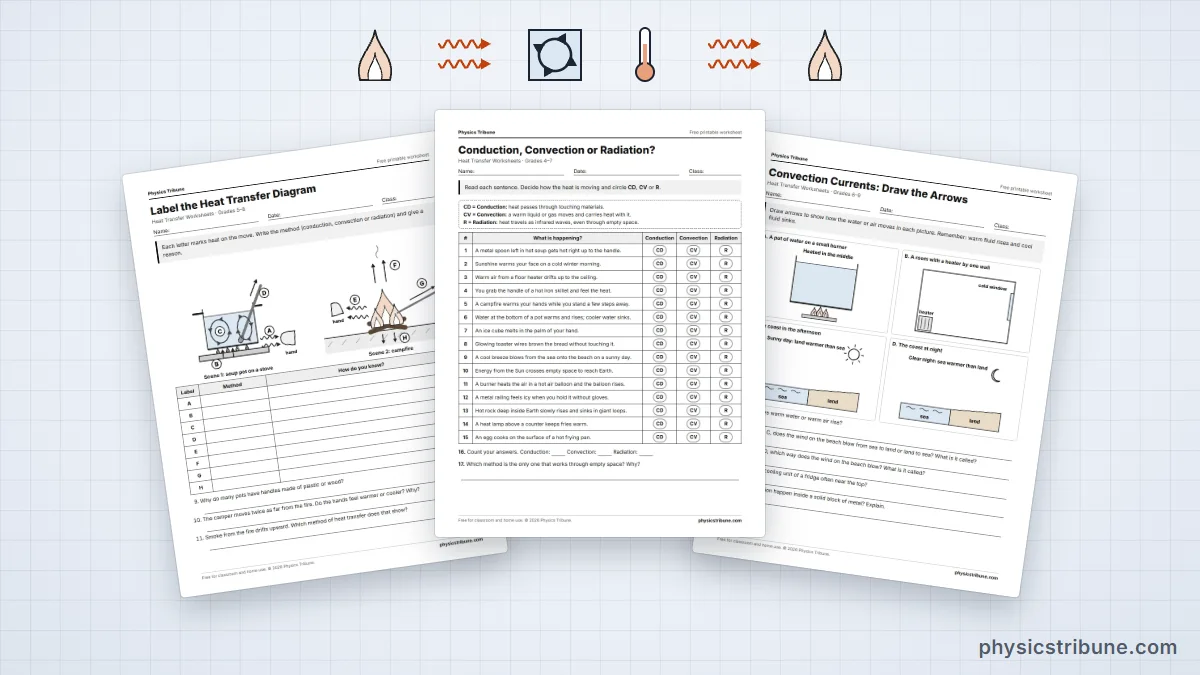
For each situation, ask what carries the energy: touching particles, a flowing fluid or light. Our heat transfer worksheets provide printable sorting activities and problems with answer keys, and the heat vs temperature comparison clears up the most common mix-up behind these questions.
Common Misconceptions
Myth: Cold flows into a warm object, the way a cold drink chills your hand.
Physics: Only heat flows, and always from hot to cold. Your hand feels cold because heat leaves it and goes into the drink.
Myth: Heat always rises.
Physics: Hot fluid rises in convection because it is less dense. Conduction and radiation carry heat in every direction, including downward.
Myth: Radiation from a heater or the Sun is the dangerous nuclear kind.
Physics: Thermal radiation is mostly infrared light, which is non-ionizing. It warms you but does not make anything radioactive.
Myth: A blanket or coat produces heat.
Physics: It only slows the loss of the heat your body makes, mainly by trapping still air that blocks conduction and convection.
Key Facts
- Heat moves by three routes: conduction, convection and radiation.
- Conduction passes energy through direct contact between particles and is strongest in metals.
- Convection carries heat with a moving liquid or gas and cannot occur in solids or a vacuum.
- Radiation transfers heat as electromagnetic waves, mostly infrared, and needs no medium.
- The Sun's energy reaches Earth only by radiation.
- Radiated power is proportional to the fourth power of absolute temperature.
- Heat always flows from a hotter object to a colder one.
Quick Quiz: How Well Do You Know Convection vs Conduction?
6 questions. Tap an answer to check it.
Which type of heat transfer can cross a vacuum?
Radiation travels as electromagnetic waves and needs no medium.
Warm air rising above a heater is an example of
The heated air itself moves upward and carries energy with it, which is convection.
Why does a metal spoon in hot tea get hot at the handle?
Energy passes along the spoon from particle to particle and through free electrons, which is conduction.
In which state of matter can convection NOT happen?
Particles in a solid cannot flow, so there can be no convection current.
If an object's absolute temperature doubles, its radiated power becomes
Radiated power depends on T to the fourth power, and 2 to the fourth is 16.
Which material is the best thermal insulator?
Still air has a very low thermal conductivity, so it slows conduction well.
Frequently Asked Questions
What is the difference between conduction, convection and radiation?
Conduction moves heat through direct contact as particles bump into their neighbors. Convection moves heat when a warm liquid or gas flows from one place to another. Radiation moves heat as electromagnetic waves, mainly infrared, which can cross empty space. All three carry energy from hotter regions to colder ones, but they use different carriers.
What is the difference between conduction and convection?
In conduction the material stays in place and only energy passes along, particle to particle. In convection the heated material itself moves, carrying its energy with it. Conduction works best in solids such as metals, while convection only happens in fluids. A hot spoon handle is conduction; the swirling of soup in a pot is convection.
What is the difference between convection and radiation?
Convection needs a fluid that can flow, so it cannot work in a vacuum. Radiation uses electromagnetic waves and needs no material, so it works through space. Hot air rising from a radiator is convection, while the warmth you feel standing in sunlight is radiation. Radiation also travels at the speed of light, far faster than any fluid.
Which type of heat transfer is fastest?
Radiation is the fastest because it travels at the speed of light, about 300,000 km per second in a vacuum. Convection is usually faster than conduction in fluids, because flowing liquid or gas carries heat in bulk. Conduction through poor conductors is very slow, which is exactly why still air and foam make good insulation.
Can heat travel through a vacuum?
Only by radiation. Conduction and convection both need particles, so they stop in a vacuum. Electromagnetic waves need no medium, which is how sunlight crosses about 150 million kilometers of empty space to warm Earth. Vacuum flasks use this fact, removing air between their walls so that only a little radiation can carry heat across.
Is boiling water conduction, convection or radiation?
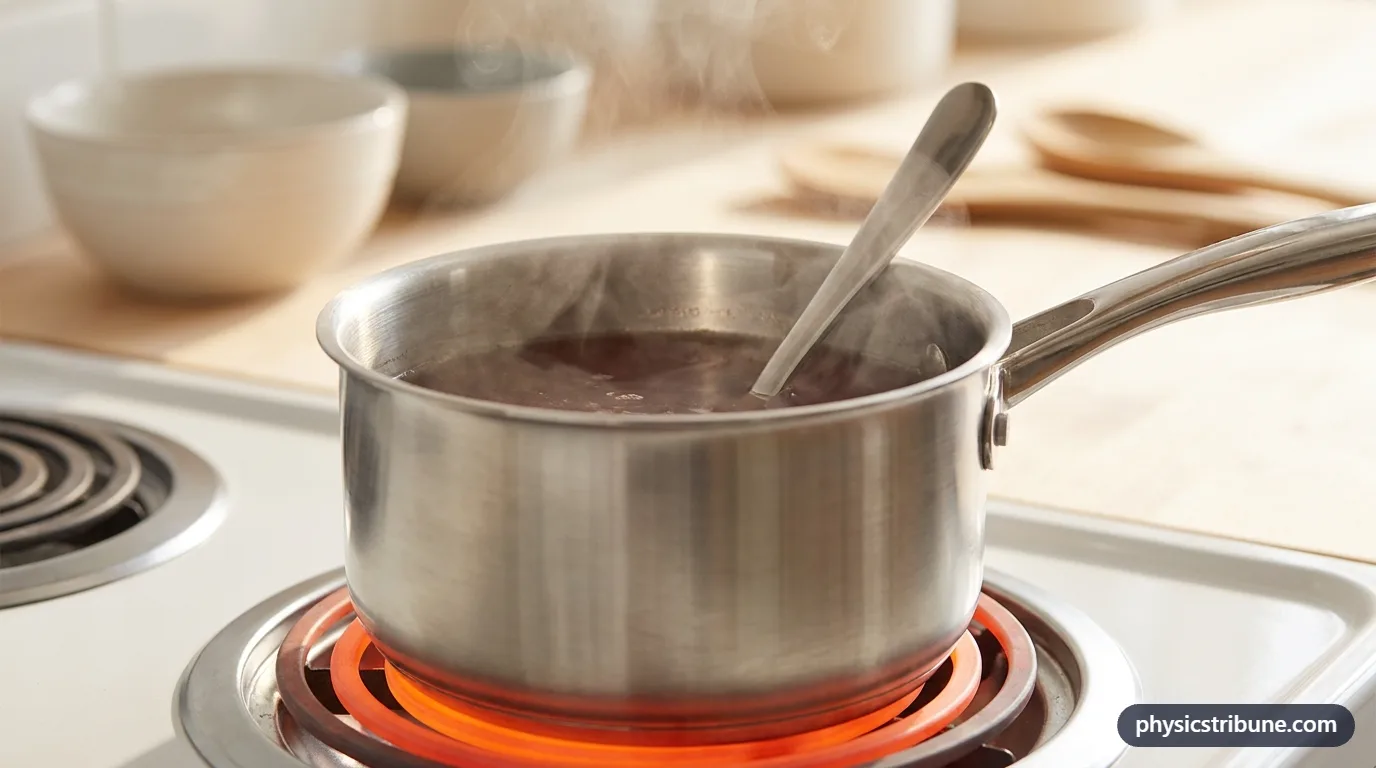
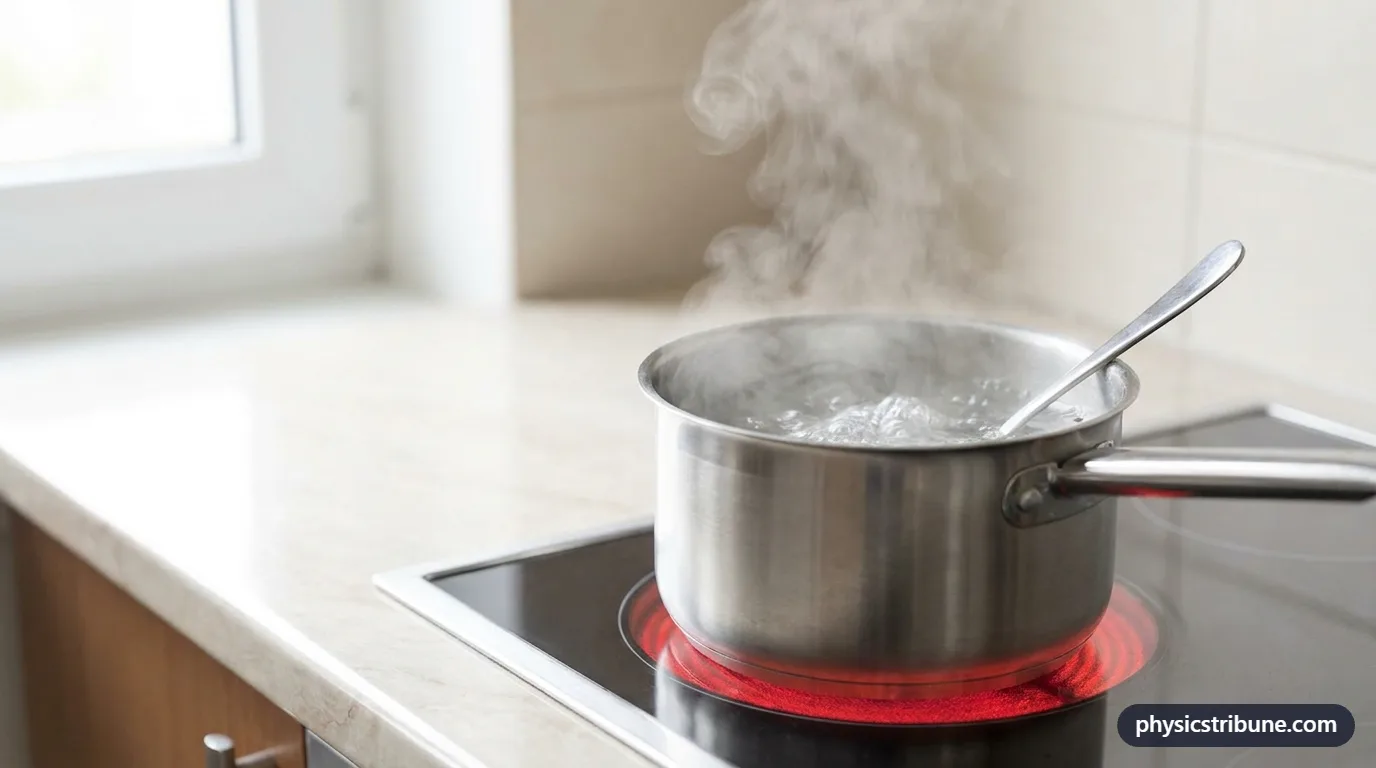
All three play a part, but convection dominates. The burner heats the pot base by conduction or radiation, and the metal conducts heat into the bottom layer of water. That water expands, rises and is replaced by cooler water sinking from above, forming convection currents that spread the heat through the whole pot.
Is the Sun heating the Earth conduction, convection or radiation?
It is radiation. Space between the Sun and Earth is almost a perfect vacuum, so neither conduction nor convection can carry energy across it. Sunlight, including visible light, infrared and ultraviolet, crosses that gap as electromagnetic waves. Once it warms the ground, conduction and convection then spread the heat through the air and oceans.
Why are pots made of metal with plastic handles?
Metals such as aluminum, copper and steel conduct heat well, so a metal pot passes heat quickly and evenly from the burner to the food. Plastic and wood are poor conductors, so a handle made of them stays cool enough to hold. One object uses both a good conductor and a good insulator for different jobs.
Keep Exploring




Sources
Constants come from NIST CODATA 2022 (public domain) and unit definitions from the BIPM SI Brochure (CC BY 4.0). Text, diagrams and illustrations are original work by Physics Tribune.